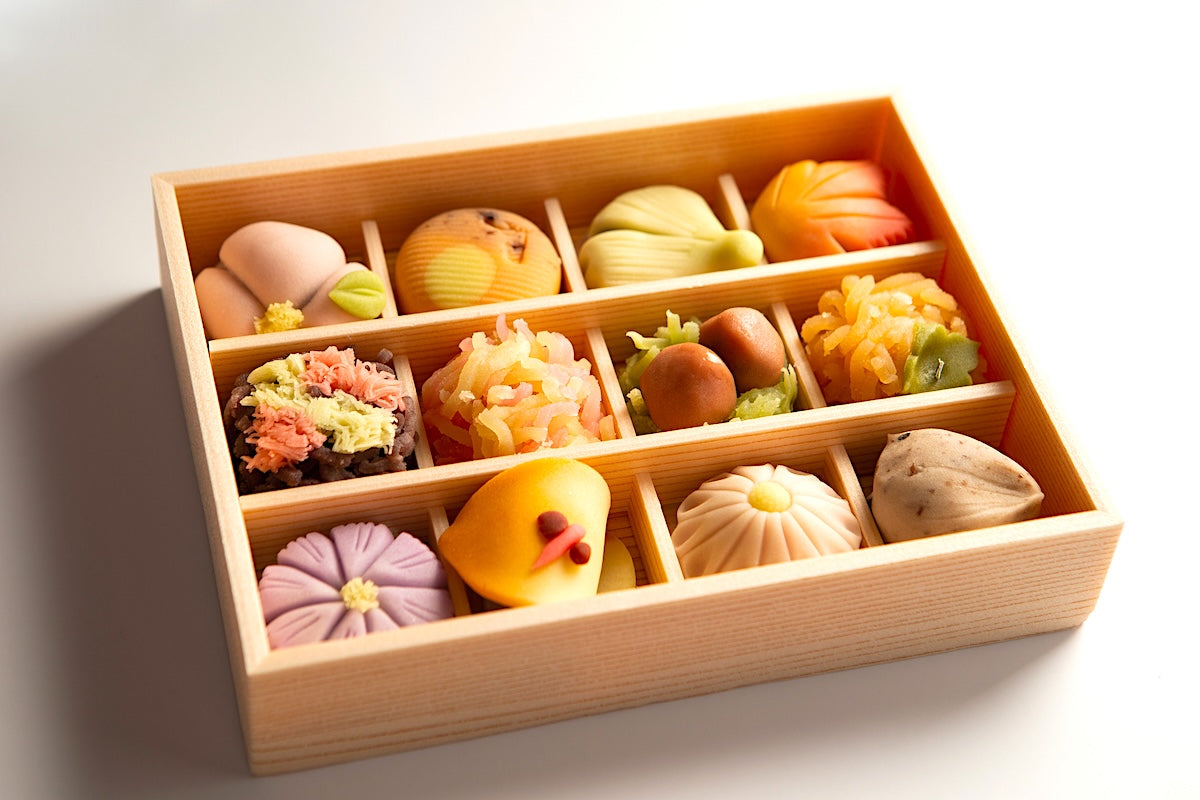
A cake in Paris tells you something about butter and technique. A wagashi in Kyoto tells you what month it is.
That contrast captures something essential about Japan’s most refined confectionery tradition.
Where Western sweets lean toward richness - eggs, butter and cream - traditional Japanese sweets are made from plant-based ingredients: glutinous rice, rice flour, azuki beans and agar. The result is confectionery that's lighter in texture - and molded to draw your attention to what's blooming or fading outside the shop window.
The term wagashi brings together 'wa' (和) - the character for anything Japanese - and kashi (菓子), which originally referred to fruit but now mostly means confectionery.
What it describes, however, is less a category than a sensibility: the idea that a traditional Japanese sweet should reflect the natural world, honor the season and offer itself to the eye and ear before it reaches the palate.
A Short History of Wagashi
The roots of wagashi can be traced back to the Nara period (710-794), when dried fruit, chestnuts and rice-based confections served as early offerings to the gods and provisions for travelers.
The Heian period (794-1185) brought Chinese influences: new ingredients, new techniques and a court culture refined enough to develop its own aesthetic language in food as well as poetry and calligraphy. Japan began drawing its confectionery tradition inward, away from its continental models and toward something uniquely Japanese.
It was during the Edo period (1603-1868), however, that wagashi truly flourished. Peace along with expanding urban culture and a thriving merchant class created demand for sophisticated sweets and as chado - the Japanese Way of Tea - matured, confectionery evolved alongside it.
Wagashi became an essential part of tea culture, a vehicle for seasonal expression as well as a craft refined by artisans who established shops still in operation today.
Types of Wagashi: Classification by Moisture Content
The wagashi world classifies its many confections by moisture content - a system that sounds technical until you realize it maps almost perfectly onto occasion and shelf life.
With a moisture content of 30% or more, namagashi, or fresh sweets, are the most perishable of the three types. They are best consumed on the same day that they are made.
The namagashi category includes confectionery made from glutinous rice flour: mochi, dango dumplings and daifuku - mochi wrapped around sweet bean paste. Strawberry daifuku, a modern variant enormously popular in spring, also belongs in this group.
Alongside these sit steamed sweets like manju, baked confections such as dorayaki - a pancake sandwich filled with sweet bean paste - and kneaded sweets.
Of these, nerikiri is probably the most well-known because of its ability to be shaped. Made by combining white bean paste with rice flour and imo yam, the dough is shaped entirely by hand into forms that might evoke a chrysanthemum, a crane or, in recent times, Santa Claus.
Han-namagashi, or semi-fresh sweets, have a moisture content that falls within the 10-30% range. They keep longer, travel better and include souvenir favorites such as monaka - crisp wafer shells filled with sweet bean paste - fresh yatsuhashi and firmer versions of yokan, the dense confection made from azuki bean paste and agar.
This is the category that makes wagashi practical as gifts, since many of these confections can survive for several days and even weeks without losing their character.

Higashi, or dry sweets, contain less than 10% moisture and are the most shelf-stable of the three. They include rakugan - rice flour and sugar pressed into molds to form flowers and other seasonal motifs - and konpeito, tiny star-shaped sugar candy introduced to Japan by the Portuguese.
Sweets for the Way of Tea
A central component in chado, or the Way of Tea, wagashi are organized for tea ceremony gatherings not by recipe but by the role they play.
Omogashi - main sweets - are served before koicha, the thick, concentrated form of powdered green tea prepared with roughly double the matcha used in thin tea.
Because koicha was, and still is, highly prized, it is usually paired with confections of comparable quality. Known as jo-namagashi - high-grade fresh sweets - these seasonal sweets might depict the plum blossoms of February or the turning maple leaves of October.

Nerikiri and kinton (above) - made by pushing a bean paste dough through a sieve to form soft strands - are the most characteristic examples, their colors and forms shifting as the year turns.
Two makers working with a maple leaf motif may produce entirely different sweets - one abstract and evocative, one anatomically precise down to the veins - and both would be considered appropriate.
Wagashi served at traditional tea gatherings carry a kamei, or gomei: a poetic name that may reference a classical poem, a seasonal phenomenon or, more unusually, a Buddhist concept.
The host’s choice of kamei is itself a form of communication, a clue to the theme of the gathering.
Higashi, the dried sweets served with usucha, or thin tea, provide a sweeter counterpoint to the tea’s astringency. These dried sweets include rakugan and aruheito candy as well as semi-fresh sweets such as suhama, a nutty confection made by kneading roasted soybean flour with sugar and syrup.
Typically, two types of higashi are served together, their artful arrangement part of the tearoom aesthetics.
Essence of Wagashi: Japan's Four Seasons
The reverence for nature found in Japanese culture runs through the country's art, literature, crafts and food, with wagashi playing a key role in expressing this essence of Japanese aesthetics.
There are two kinds of seasonal wagashi. The first are sweets made only at certain times of year. Kashiwa mochi, for instance, arrives for Children’s Day in early summer. The sweet is wrapped with oak leaves because old leaves on oak trees do not fall until the buds of new ones appear, making the tree and its leaves a symbol of unbroken family lines.
On a more practical note, the leaves are also sturdy and come with antibacterial properties, making them excellent food wrappers.
The second kind reflects the changing seasons through form, color and name. A kinton made for early spring may be composed of pale green and white strands that suggest life pushing up through the last of the snow. A sweet like this may be called Mebuki: Buds Sprouting.
Reworked in yellow and russet in November, dusted with white sugar and named Hatsushimo - First Frost - it becomes something entirely different. The texture and flavor of the wagashi barely change; these confections symbolize the season rather than contain it.
Wagashi Across the Regions
Every region of Japan has developed its own sweets, shaped by local ingredients, history and climate. Some confections have become so identified with their place of origin that they function as edible landmarks.

Kyoto’s most recognized wagashi export is yatsuhashi. The original is a hard-baked cracker made from rice flour, sugar and cinnamon. Shaped like the curved bridge of a koto, it was first created around 1689 near Shogoin temple to honor koto master Yatsuhashi Kengyo.
In the 1960s, an unbaked version - thin sheets of fragrant rice dough folded around sweet bean paste - appeared and quickly overtook the baked original in popularity. Nama yatsuhashi is now the defining Kyoto souvenir and is sold in matcha, black sesame and other flavors at train stations and tourist areas throughout the city.
Ironically, yatsuhashi is not often found at the gatherings held by Kyoto’s tea practitioners, who turn instead to jo-namagashi and other kinds of seasonal sweets.
In Tokyo, the signature traditional sweet is ningyo-yaki - small baked confections shaped like dolls and the Seven Lucky Gods.

Created during the 1900s in the Ningyocho district of Nihonbashi - an area historically tied to doll-making and puppet theater - ningyo-yaki is simple in composition: just castella-style batter filled with sweet red bean paste.
But each small cake is flavored with the city’s layered past. Today, ningyo-yaki are sold along the approach to Senso-ji, Tokyo's oldest temple, and have become one of the most recognizable tastes of Tokyo’s old downtown.
Elsewhere, Kanazawa in Ishikawa prefecture stakes its claim to wagashi fame with choseiden, widely considered one of Japan’s top three traditional confections. Over to the west in Shimane prefecture, Matsue, a city with deep ties to tea culture, produces yamakawa, a type of rakugan balancing sweetness with a hint of saltiness.
In the Ise region of Mie prefecture, akafuku mochi - soft rice cakes covered with sweet azuki paste - has been an iconic confection for centuries, a must-try even for pilgrims today.
Historic Wagashi Shops
Japan’s oldest wagashi establishments are living archives as much as they are shops. Their histories stretch back not decades but centuries - in one case, by more than a millennium.
一文字屋和輔 Ichimonjiya Wasuke (also known as Ichiwa), founded in the year 1000 near Imamiya Shrine in Kyoto, is often cited as the country’s oldest continuously operating wagashi shop. Its specialty is aburi mochi: bite-sized rice cakes skewered, brushed with sweet white miso sauce and grilled over charcoal.
塩瀬総本家 Shiose Sohonke (founded 1349, now headquartered in Tokyo) is credited with introducing manju buns to Japan.
亀屋陸奥 Kameya Mutsu (1421), located in front of Nishi Hongan-ji in Kyoto, is known for matsukaze, a baked sweet with a restrained, sesame-inflected flavor.
とらや Toraya, established during the early 16th century, has supplied yokan and other confections to imperial households for centuries.
Other historically significant houses include Kawabata Doki (川端道喜, 1503) and Kameya Kiyonaga (亀屋清永, 1617) in Kyoto, Kanbukuro (かん袋, 1329) in Osaka and Gurenya Shingetsuan (紅蓮屋心月庵, 1327) in the northeastern prefecture of Miyagi.
Beyond Traditional Japanese Confectionery: Contemporary Wagashi Artists
The new generation of wagashi creators stands on traditional foundations while pushing the craft into territory that would surprise - and probably delight - the makers of tea sweets in centuries past.
坂本紫穂 Sakamoto Shiho works under the philosophy of transforming impressions into wagashi. A former IT professional who turned to confectionery as a creative practice, she produces sweets with luminous, transparent color gradations and sculptural forms that place her work closer to contemporary art than to the conventional sweet shop.
杉山早阳子 Sugiyama Sayoko leads the experimental atelier Okashimaru, where the focus is on natural forms, unusual flavor pairings and structural experimentation. Her practice questions the conventions of wagashi culture without discarding the centuries of refinement behind them.
永田哲也 Nagata Tetsuya uses old wagashi molds to produce not sweets but sculptural paper works using high-grade washi. By reinterpreting historical confectionery imagery to create layered installations, he bridges the gap between craftsmanship and exhibition space.
Art for the 5 Senses
For centuries, wagashi craftsmen have been doing something extraordinary: placing the changing world inside something small enough to sit on your palm.
They do this by engaging the five senses: sight in the form, touch in the texture, smell in the fragrance, hearing in the poetic name spoken aloud, and taste when the season in your hand finally dissolves on the tongue.
And because the seasons and the ways to express them are always changing, wagashi, no matter how much or little moisture it holds, always feels fresh.
By Janice Tay