Modern life has made writing almost invisible. A thumb dances over a screen. A hidden bell pings. Messages fly back and forth like birds that never need to land.
Japanese calligraphy, on the other hand, asks you to slow down until writing becomes physical again: the drag of a brush on paper, the subtle give of the paper, the moment ink touches fiber and blooms - or blotches.
The name itself - shodo (書道) - points to this. More than a skill, writing becomes a do (道), a Way, like other Japanese arts that turn technique into a path you can walk for years.
Shodo is also a cultural bridge. Japanese calligraphy has its roots in Chinese characters, which began to be used in earnest in Japan towards the end of the 4th century and spread rapidly in the 6th century along with the introduction of Buddhism.
Brush and ink were closely tied to copying Buddhist texts, a practice in which writing was regarded as an act of devotion and discipline.
Then the style of calligraphy became distinctly Japanese. The Heian period (794-1185) stands as a turning point in the country's culture: as the courtly world refined its tastes, literature and writing styles, it went beyond echoing imported models and developed a unique aesthetic. This included Japanese-style calligraphy.
Tools of Shodo: The 4 Treasures of the Study

Before you can do Zen calligraphy or even learn the different styles of Japanese calligraphy, you need to meet the essential tools.
In East Asia, brush, ink, paper and inkstone are honored as the Four Treasures of the Study, known in Japanese as bunbo shiho (文房四宝).
These tools of shodo are simple enough to list in one breath and complex enough to occupy a lifetime.
Brush: The Tool that Reveals Your Mind
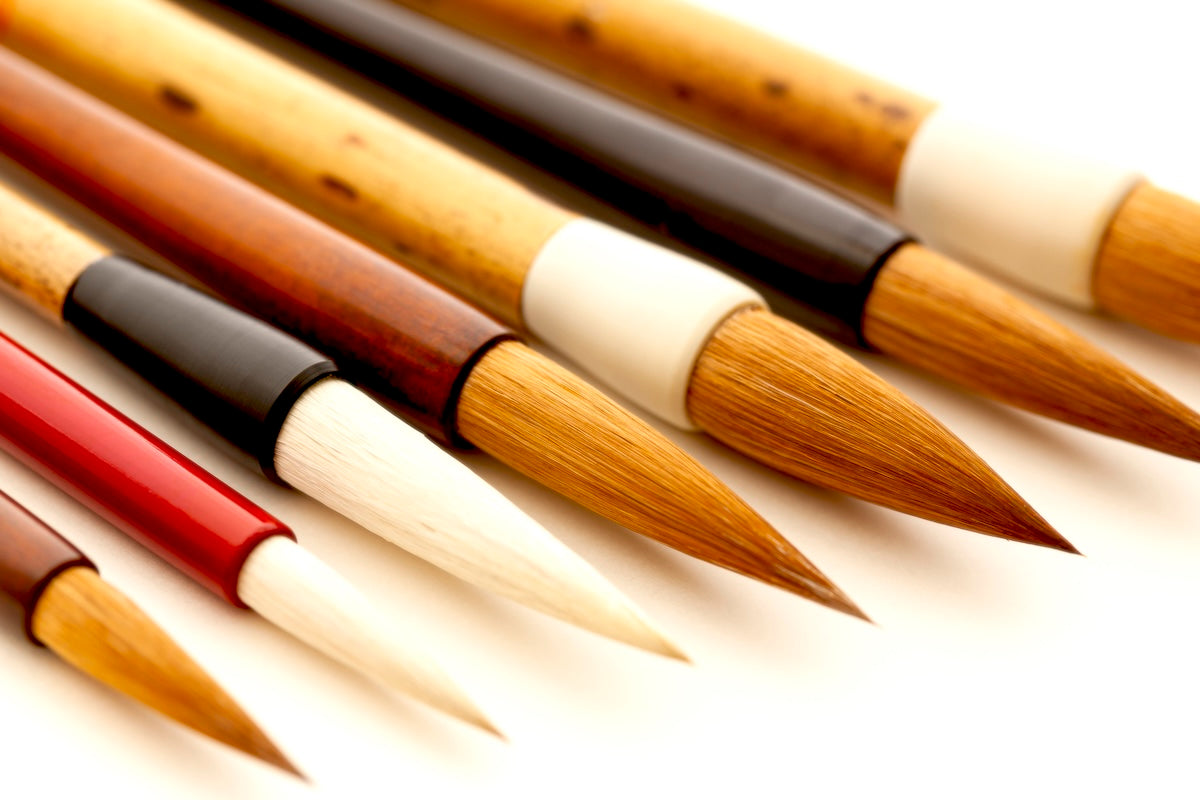
The brush, or fude, is the most iconic of Japanese calligraphy tools. Traditional brushes use animal hair and a bamboo handle, and small differences in hair, length and firmness change everything about the stroke.
Japanese calligraphers select brushes according to their expressive intention. A soft brush yields fluid, rounded strokes while a brush with firmer hair allows sharper articulation.
Because the brush flexes, it's supple enough to respond to your mind. If your attention wavers and your hand falters, the brush reports it faithfully to the paper through the ink.
Ink: From Soot to Stick
The traditional ink for shodo - sumi - is soot and animal glue formed into a solid stick. You add water to the inkstone and grind the stick in it until the black becomes liquid ink.
That process gives calligraphers control over the intensity of the ink but it's about more than preparation. Through the simple, repetitive motions, the mind calms down to the point where it can focus on practice.
Bottled ink exists and no one will judge a beginner for using it. But advanced students are encouraged to prepare their own sumi. When you make the ink, the ink makes you ready.
Inkstone: The Stone Where Ink is Made

The inkstone, or suzuri, is both a basin for water and a work surface where ink sticks are ground into ink.
Inkstones vary by material and finish. Fine ones, especially those made of stone from renowned quarries, can command high prices as collector's items.
Suzuri endure - because they last longer than brushes and paper, they can feel like an heirloom in the study.
Paper: Where Japanese Culture Meets Fiber
The traditional choice of paper for Japanese calligraphy is made from plant fibers such as mitsumata, hemp blends and kozo, or paper mulberry.
Absorbency and surface texture decide whether a line stays crisp or blooms outward.
Japanese Calligraphy Styles
Japanese calligraphy originated in five major writing styles from China: tensho (seal script), reisho (clerical script), kaisho (regular or block script), gyosho (semi-cursive) and sosho (cursive), with each one a solution to a different need.
篆書 Tensho: Ancient Seal Script
The oldest of the five scripts, tensho was commonly used in China throughout the Zhou dynasty (1046-256 BC) and the Qin dynasty (221-206 BC).
The script was eventually replaced by reisho but was still used for inscriptions and the titles of published works because of its clear, bold strokes.
As it was already a specialized style by the time it reached Japan, it is associated with titles, seals and formal inscriptions rather than everyday writing.
隷書 Reisho: Clerical Script

Developing from tensho as a simpler, more practical form of the seal script, reisho (above, bottom left) - clerical or scribe script - has a commanding look, with strokes exaggerated at the beginning and end. It is still used for large-text platforms such as signboards or plaques.
楷書 Kaisho: Regular Script
Kaisho (top right character in the above image) is the standard script, the most structured and readable of the five. Japanese kaisho developed out of, but differs slightly from, the version found in Chinese calligraphy and incorporates a bit of the gyosho style.
If you want to learn Japanese calligraphy in a way that leads somewhere stable, kaisho is your base because it teaches proportion, spacing and brush control. Without it, later cursive work becomes unstable.
行書 Gyosho: Semi-Cursive
Gyosho (bottom right character in the above image) is semi-cursive, meaning it softens kaisho without abandoning legibility. Strokes may connect. Forms may abbreviate. Rhythm begins to show up.
Gyosho became widely popular in Japan because it meshes well with kanji characters as well as with the flowing lines of hiragana, a native syllabary script.
草書 Sosho: Cursive
This cursive script (top left in above image) can be traced back to the Han dynasty (206 BC - 220AD), when it developed as a form of reisho used by scribes to take notes.
In this style, the forms are simplified and strokes merge, which is why it's often described as expressive and difficult for beginners to read.
But the calligrapher is not hiding meaning so much as trying to reveal a deeper clarity: the feeling of a moment.
Practicing Japanese Calligraphy: A Path for Students
If you're trying to learn Japanese calligraphy, you can save yourself a lot of frustration by treating it like martial arts training: basics first, repetition without drama and refinement through small corrections.
Start with the Body
A stable posture makes your breath - and strokes - steady. A steady breath leads to a steady tempo. If it becomes choppy, your lines also break up.
Treat the first stage as learning brush strokes rather than writing characters. Learn how to place the brush tip cleanly, how to press and lift, how to stop without blotting and how to finish without a limp tail of ink.
Use Kaisho as Your Engine Room

Students of Japanese calligraphy are usually guided to first learn kaiso, followed by gyosho and sosho.
These three sit close enough that skills transfer naturally. Tensho and reisho are also worth studying but they are not the shortest path from basics to fluent calligraphy practice.
Kaisho is the script where you learn spacing and proportion and build control. In kaisho, discipline precedes freedom to give you a strong foundation.
Once kaisho is stable, gyosho feels like the brush is allowed to breathe. Some connections appear, the writing speeds up slightly and the line begins to show personality while remaining legible. This is an important threshold because it teaches continuity: the key to cursive.
Sosho asks you to simplify characters without losing their inner logic. This is why the path matters: if you skip kaisho, your cursive becomes guesswork.
Copy Models: Learning from the Classics
Calligraphy traditions rely on copying models and classical works, not as imitation for its own sake but as a way to absorb rhythm and structure.
You copy until the form stops being foreign and the brush movement begins to feel inevitable.
After absorbing structure and classical models, the practitioner moves toward creative work.
This can include breaking or reshaping forms, changing ink density, playing with negative - or white - space and expressing emotion through the energy of the line.
Zen Calligraphy: Why Shodo Feels Like Meditation

Zen and Japanese calligraphy are connected strongly enough that people speak of 'Zen calligraphy' as if it were a separate category. Part of that connection is practical as well as historical: Buddhist monks copied sutras and used brush and ink daily.
Another part is philosophical. Zen emphasizes the present moment and the impossibility of correcting reality after it has occurred. Calligraphy shares that logic. A stroke cannot be revised. The line records you.
筆禅道 Hitsuzendo: The Path of the Zen Brush
The term 'hitsuzendo' can be often translated as the Zen Way of the Brush. The basic idea is that the act of writing becomes a meditative discipline where posture, breath and attention align.
The brushwork of Zen practitioners is not meant to be an art form. Instead, the works are considered embodiments of awakened awareness - lines made of the here and now.
Enso: One Circle, One Breath
Zen can sound abstract until you hold a brush. Then it becomes embarrassingly concrete. If you are distracted, your line is distracted. If you are tense, your line is tense. If you are present, the stroke looks present.
The enso, the brushed circle associated with Zen, is famous partly because it is so simple and so revealing.
Drawn in a single breath, it shows whether your mind was scattered or unified. It carries an aesthetic that can hold imperfection without apology.
How to Create a Calligraphy Practice Space at Home

The fastest way to stop practicing Japanese calligraphy is to make it hard to begin. The goal of a home setup is not grandeur but simply readiness.
A Practice Corner Where You Can Start in 1 Minute
Choose a flat, stable table with good light. Protect the table with a shitajiki mat and newspaper or a water-resistant sheet under it if you fear ink stains. When the fear goes away, the hand relaxes.
Keep your calligraphy tools - brush, ink, inkstone, water container, bunchin paperweight - in one box or tray. The more scattered the tools, the easier it is to postpone practice.
Caring for the 4 Treasures
After writing, rinse the brush so ink does not dry in the hair. Shape the tip gently and let it dry thoroughly.
Store your brushes by hanging them from a brush stand or wrapping them in a brush roll so the bristles do not bend and deform.
Inksticks should be kept in a dry, stable environment. Excess humidity can cause swelling; dryness lead to shrinkage and cracking over time.
Store your paper somewhere flat, dry and well-ventilated. Avoid trapping it tightly in plastic if moisture is a risk. Clean, breathable storage keeps paper usable and beautiful longer.
Rinse the inkstone after practice and let it dry fully before storing. Inkstones can last for generations but if not shut away while damp.
Short Sessions Often
Five to 10 minutes of practice a day can be enough because shodo rewards continuity more than intensity.
Practice kaisho drills. Copy a calligraphy model. Write a single phrase. Draw a single enso. Stop while you still want more.
Then pin one sheet to a wall. Let your home record your effort. A calligrapher becomes a calligrapher not by declaring it but by showing up often enough that the brush begins to move like an extension of breath.
The Traditional Art of Paying Attention
Japanese calligraphy is sometimes introduced as a way of writing beautifully but it's closer to a lived practice than a means of decoration.
The Way of the Brush turns Japanese writing into training for the hand, attention and state of mind. There is no backspace key, no 'undo', no fixing the wobble in a line after the fact. The stroke records what happened and what happened includes your technique, your breath and your attention.
In an age where you can write without touching pen or paper, shodo pulls you back into matter - and asks you to look at your mind.
By Janice Tay