- Manju and Mochi: What's The Difference?
- From Mantou to Manju
- The History of Manju: Temple Beginnings
- Meat - And Then Sweet Treat
- Refining a Japanese Steamed Cake Over 700 Years
- Variations of Manju: Dough, Filling and Method
- Manju and the Way of Tea
- Manju as Souvenir: Regional Identity in a Bun
- Flavors and Fillings: Beyond Red Bean Anko
- A Sweet of Journeys
Manju exist because someone, somewhere, chose to innovate, adapt - and improve.
One legend places manju’s distant ancestor on the banks of a river in ancient China, where human sacrifice was once believed necessary to appease raging waters. In a pivotal act of substitution, buns were offered in place of severed heads - a workaround that transformed ritual violence into culinary invention.
Centuries later, the buns were reinvented again. Filled with sweet bean paste rather than meat, they became suitable for monks following a path of non-violence.
Manju continued to evolve, becoming one of the most popular sweets in the lexicon of traditional Japanese confectionery.
Today, manju appear at refined tea gatherings, celebrations and holiday destinations, where they wait in boxes as souvenirs - a treat that has traveled far, adapted often and settled deep into Japanese life.
Manju and Mochi: What's The Difference?
Before tracing manju’s journey, it may help to clear up a point of frequent confusion: the difference between manju and mochi.
Both are Japanese sweets that are closely tied to customs, seasonality and daily life. But they are fundamentally different in composition.
Traditionally, mochi is made by steaming glutinous rice and pounding it until it becomes sticky and elastic, or by steaming a dough made from glutinous rice flour.
That process gives mochi its signature chewiness - a texture that shapes how it’s eaten, whether paired with sweet red bean paste, toasted and glazed with soy sauce or miso or, at New Year, served as the centerpiece of the soup known as ozoni.

Mochi's identity is inseparable from rice agriculture and the rice cakes have long played a role in ritual offerings. But mochi is also entrenched in everyday life, with daifuku - mochi with a sweet filling - being a particularly popular snack.
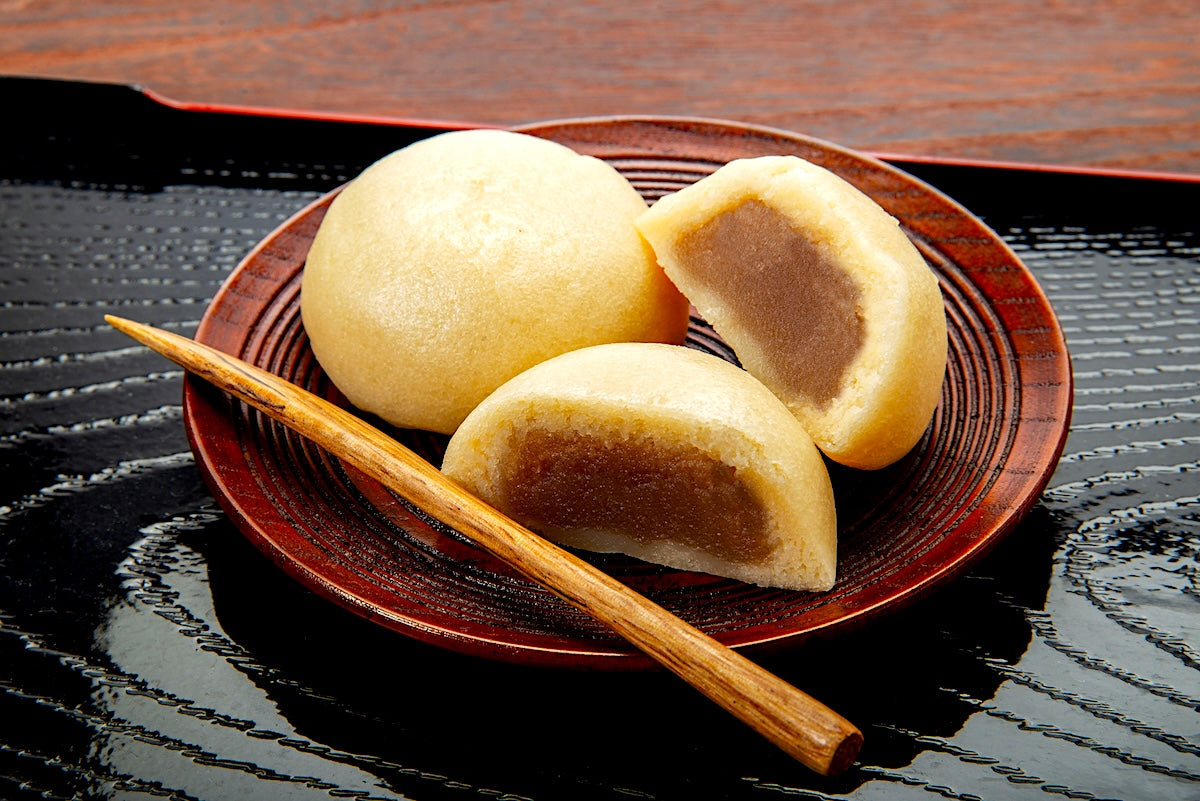
Like daifuku, manju are filled with a sweet paste, most commonly red bean. The main difference lies in the dough, which is made, not from glutinous rice flour, but from wheat or rice flour or even buckwheat. The dough is then steamed or baked, the final product soft rather than chewy.
From Mantou to Manju
The word manju (饅頭) is the Japanese reading of the Chinese word, mantou. In China, this originally referred to steamed buns that could be plain or filled with meat or vegetables. These stuffed buns later came to be known as baozi or, more simply, bao.
One origin story centers on third-century strategist Zhuge Liang of Three Kingdoms fame. According to Chinese legend, the episode unfolded during his campaign against the Nanman, who lived in a region roughly corresponding to present-day Yunnan and northern Myanmar.
After subduing Nanman leader Meng Huo, Zhuge Liang’s army attempted to cross a fast-flowing river. Local belief held that the river had been agitated by the spirits of slain enemies, and that safe passage required appeasement. The customary offering was grim: 50 men executed, their heads thrown into the water as offerings.
Zhuge Liang refused to sacrifice more lives. Instead, he ordered wheat dough to be kneaded, filled with meat from the army’s livestock and shaped to resemble human heads - round with a flattened base. When these substitutes were cast into the river, the waters calmed, allowing the army to cross safely.
The buns were initially called mantou (蠻頭), literally 'barbarian’s head', but the characters eventually shifted from 蠻頭 to 饅頭, preserving the sound while emptying it of violence. What remained was the idea of substitution: dough and meat standing in for human lives.
Over time, the buns were offered on altars rather than cast into rivers and, once their ceremonial role was complete, they were consumed. The mantou also shrank in scale, moving away from the size of a human head toward the small, rounded form that would become familiar as manju.
The History of Manju: Temple Beginnings
Mantou buns were introduced to Japan alongside Buddhism and Zen practice, though debate continues over how and when this happened.
One theory places their arrival in the 13th century, when the monk Enni Benen founded a Zen temple in Hakata after returning from Song dynasty China. He is said to have taught manju-making to a local teahouse owner who showed him kindness when he went begging for alms.
This Hakata version relied on amazake as a fermented starter, which produced what came to be known as sake manju.
The second and more detailed account revolves around a Chinese craftsman who migrated to Japan about a century later.
Meat - And Then Sweet Treat
When Zen monk Ryozan Tokuken returned from his studies on the continent in the 1340s, he was accompanied by a Chinese lay disciple, Lin Join.
While in China, Join had specialized in making meat-filled mantou. In Japan, however, he adapted to Buddhist dietary precepts.
Instead of meat, he used azuki beans mixed with syrup. Sweetness in medieval Japan had mostly been limited to chestnuts and dried fruit. A confection that combined softness, warmth and sweetness was nothing short of revolutionary.
Join settled near Kango Shrine in Nara, his manju gaining a reputation that carried them beyond religious circles. Thanks to his Zen master, the sweets were presented at court, where they caught the attention of Emperor Go-Murakami.
According to family history, the emperor was so delighted with the manju that he granted Join permission to marry a court lady. For the wedding, Join distributed kohaku manju, an act cited as the origin of giving red-and-white manju as celebratory gifts.

Join raised a family and laid the foundations of a confectionery lineage. Yet after his Zen teacher’s death, he returned to China, leaving his wife and children behind.
It was Join’s descendants who ensured that manju would take root in Japan. The family expanded out of Nara into Kyoto and, over generations, the confection evolved.
A turning point came when Join’s grandson, Hayashi Shohan (the native Japanese reading of Lin is Hayashi), traveled to China to study confectionery techniques. He turned the dough into a kneaded mixture of grated Japanese yam and rice flour, giving birth to joyo manju.
Through war, relocation and rebuilding, the family endured. One of the Kyoto branches adopted the name Shiose, establishing a shop that would go on to serve warlords and emperors. From Shogun Ashikaga Yoshimasa, who granted the family a handwritten sign praising their manju, to Tokugawa Ieyasu, who offered Shiose manju atop his helmet as an offering to the gods before battle, the sweets became woven into the highest levels of Japanese society.
In time, the family’s involvement in tea culture deepened through connections to tea master Sen no Rikyu. As the Way of Tea and tea sweets developed, Shiose became purveyors to tea practitioners.
Join himself returned across the sea. But the manju he devised remained, evolving into a form that can still be found at the Shiose Sohonke main store in Tokyo or one of its many branches.
Refining a Japanese Steamed Cake Over 700 Years

By the medieval period, two types of manju had emerged: those that were sweet and those filled with vegetables.
The latter remained largely within temple contexts, where the buns functioned as light meals or late-night snacks. They were too labor-intensive for Japanese society at large, which consumed rice and noodles instead.
Sweet manju, however, became widespread.
From the Edo period (1603-1868) onward, improvements in milling, fermentation and access to sugar allowed for experimentation with dough texture, sweetness and shape.
Variations of Manju: Dough, Filling and Method
Despite the enormous variety of manju found across Japan, most fall into one of two main types: baked or steamed. Within these two categories, there are a number of subgroups including:
Tea Manju
Made from wheat flour, brown sugar and leavening agents and known by names such as Rikyu manju and onsen manju, these are often sold at tourist destinations.
Sake Manju
Sake manju, also called saka manju, rely on fermented starters rather than chemical leavening. Regional variations abound.
Soda Manju
Using baking soda as a leavening agent, soda manju became common in home kitchens from the Meiji period (1868-1912).
Baked Manju
From the modern era came baked manju, influenced by European and Chinese confections. These include castella-style buns and regional favorites such as chestnut-filled varieties.
Kuzu Manju, Mizu Manju

A summer variation that overhauls the traditional appearance of manju, mizu - water - manju replaces the usual dough with a translucent wrapper made from arrowroot starch. Inside, sweet red bean paste appears suspended, visible through the jelly-like exterior.
Often chilled and served on bamboo leaves and glass dishes, mizu manju, also known as kuzu manju, is designed to suggest coolness. Once in the mouth, it refreshes as it slides down the throat, leaving little more than a fleeting sweetness behind.
Mizu manju is best eaten as soon as possible, paired with matcha or lightly brewed green tea during Japan’s hottest months.
Joyo Manju
Among all the different types of manju, joyo manju occupies a premier position.
Its dough is made not from wheat flour but rice flour mixed with grated Japanese yam, usually tsukune imo or yamato imo. Wrapped around balls of koshian - smooth bean paste with the bean skins removed - the buns are then set in a steamer. What emerges is a moist, cake-like treat.

In the Kansai region, joyo manju are closely tied to celebrations, especially weddings. There is, for instance, a Kyoto custom of introducing a bride to neighbors and acquaintances by distributing joyo manju with her name attached.
The round form of the manju expresses harmony and completeness while its pale color evokes purity. Even the word manju carries auspicious weight: its sound is associated with the characters manju (万寿), meaning ten thousand years of longevity.
Manju and the Way of Tea
Joyo manju’s status is nowhere clearer than in the Japanese tea world, where their shape, pale glow and gentle sweetness make them a perfect fit for tea aesthetics: restraint, harmony and seasonal suggestion.
At the first tea gathering of the year, the Omotesenke school serves a variation of joyo manju known as tokiwa manju. On the outside, it appears plain white. Inside, however, is a green filling, evoking new grass beneath snow and evergreen pine branches.
The symbolism is deliberate. Tokiwa refers to something that does not change, such as a tree that stays green even in the bitterest of winters. Served at the start of the year, tokiwa manju thus become a wish for continuity and good fortune in the months ahead.
Manju as Souvenir: Regional Identity in a Bun
Manju has also become a calling card for place.
Across Japan, regional manju serve as edible emblems, sold as souvenirs and tied closely to local identity - the maple leaf manju of Hiroshima are perhaps the most famous example.

Elsewhere, fillings include chestnut paste or bean paste flavored by matcha or fruit such as yuzu.
The different shapes, fillings and packaging all signal origin - to give someone a manju souvenir is to offer a bite-sized story of faraway places.
Flavors and Fillings: Beyond Red Bean Anko
While sweet red bean paste remains the standard filling, manju has proven remarkably adaptable.
Apart from smooth koshian or chunky tsubuan, which retains the skin and shape of the beans, there's also:
- White bean paste
- Chestnut paste and whole chestnut
- Matcha-flavored white bean paste
- Sesame paste
- Custard or jelly-like fillings.
Each alters the aroma, texture and sweetness of the bun while preserving the essential structure: a filled sweet, enclosed and complete.
A Sweet of Journeys
A confection that chronicles movement, manju have traveled across the seas from China. They have moved from temples to courts, from Kyoto to Tokyo, and from ritual offering to holiday souvenir. They appear at weddings, at New Year gatherings and as gifts at the end of a journey.
Whether steamed or baked, manju remain one of the most enduring forms of traditional Japanese confectionery - a soft, rounded reminder that history, like a sweet bean filling, is often hidden just beneath the surface.
By Janice Tay