Introduction
If you’re learning how to swim, you wouldn’t jump straight into the deep end of a pool. This applies to most things in life, including how to build a Japanese knife collection. Start small, and progressively add and/or upgrade new shapes and specialists in stages as your skills and cooking habits evolve. It is also the more economically sensible thing to do.
(Caveat: This does not apply if money is no concern, but you probably wouldn’t be reading this article if that was the case.)
What’s the overall approach?
The overall approach can look something like this; we’ll discuss each step in detail below.
- Start with a core knife
- Add a small knife and vegetable specialist
- Introduce protein specialists
- Fill in the gaps
Of course, curated Japanese chef knife sets exist on the market — it’s tempting to let knife companies do the thinking here. But large sets of knives cater to consumers in general, rather than your own cooking habits. A serious set of knives is built knife-by-knife to match what you need in the kitchen; pre-selected sets of knives will almost invariably contain one or two under-used pieces.
It almost goes without saying, but you should also have a suitable cutting board (or two) and a good sharpening stone to keep your knives razor-sharp.

First, begin with a core knife like the gyuto
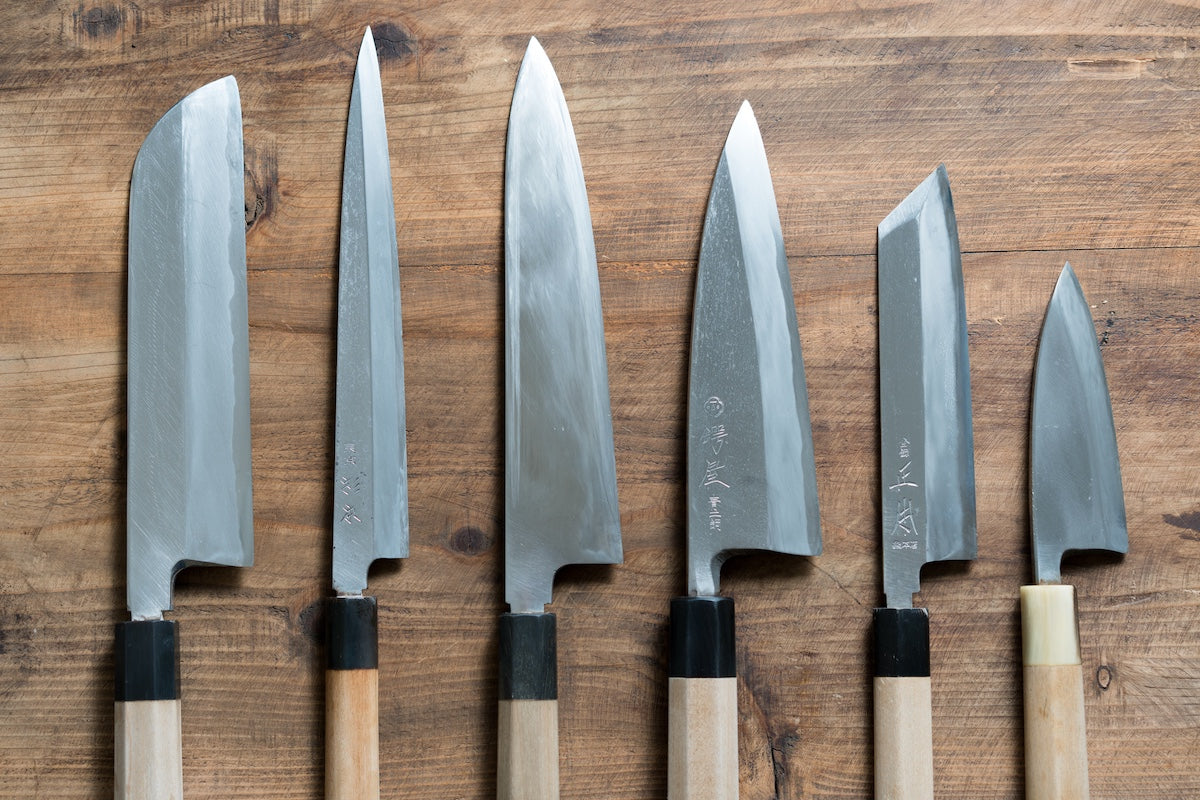
For most home cooks, it makes sense to invest in a high-quality core chef’s knife that can handle the majority of your daily kitchen prep — dicing, mincing, slicing, trimming, and more. The gyuto is an excellent choice. This is a true all-rounder that can move comfortably between vegetables, meat, and fish on the board. It has a hard, thin blade and a slightly curved profile that’s great for slicing and chopping and comes in a variety of lengths from 210mm to 360mm.
Another option for a core workhorse in the kitchen is the santoku — a general purpose knife popular with many home cooks who have smaller hands and not very much kitchen space to work with. Length-wise, it caps out at 180mm (7 inches) and is overall smaller than the gyuto. It is less versatile than the gyuto overall but a solid choice and slightly more approachable for beginner cooks.
That being said, a gyuto is likely a better choice if you’re serious about cooking. Since it is so versatile, it allows you to evaluate future purchases more sensibly. You can ask, “what can this new blade do that my gyuto can’t?” It will be the anchor of your collection, and the benchmark against which every other specialist knife will be judged.

Add a small knife and vegetable specialist
The next step is to add precision and efficiency with a small knife and a vegetable specialist.
A good first small knife is a petty, otherwise known as a utility or paring knife. In the 120-150mm range, this is for small or detailed work such as trimming (eg. fat and sinew), peeling and segmenting fruit, cutting small vegetables, hulling strawberries, slicing a shallot or single garlic clove. Basically, anywhere a gyuto would be too large for comfort. As a bonus, a petty knife makes an excellent travel or picnic knife.
You’ll find that in a pinch, a gyuto plus petty duo covers almost all the general prep you’ll do in the kitchen.
If you prep a lot of vegetables, adding a vegetable knife is the obvious next step. The easy-to-use nakiri is ideal for high-volume vegetable chopping and slicing — you’ll breeze through those heaps of leafy greens and root vegetables in no time.

What if you’re feeling more adventurous with vegetables and keen on improving your knife techniques? You may want to try an usuba, which is what the pros use for ultra-precise cuts and techniques like katsuramuki — paper-thin rotary peeling, such as reducing a whole daikon radish to a long, translucent, unbroken strip.
For more on the differences between a nakiri and usuba, check out this article.
By this point, your core setup should consist of a main chef knife plus one or two supplementary knives — a compact and capable set that covers almost all everyday home cooking.

Add (animal) protein specialists
Vegetarians and vegans need not apply to this next step. Once you’re comfortable with a daily driver set of knives, it’s time to add the appropriate knives for animal proteins, whether that’s fish, poultry, or something else.
The following knives are what you might consider adding at this stage.
Sujihiki
This is a long, slender double-bevel knife designed for clean and effortless slicing of boneless meat, fish, and roasts. Think of it as a Japanese carving knife. Its narrow blade reduces drag, so it’s ideal for brisket, carpaccio, and the like.
Yanagiba
A yanagiba is a traditional Japanese single‑bevel knife designed primarily for slicing raw fish for sashimi and sushi. These knives turn out beautifully clean fish slices. Needs single-bevel sharpening practice. Best if you actually prepare sushi and sashimi on a regular basis, rather than occasionally.

Deba
This is a thick, heavy, single-bevel knife designed to break down whole fish with a surprising delicacy — despite its appearance, a skilled chef can use it to remove a fish head, split it along the backbone, and lift fillets off with minimal damage to the flesh. Many home cooks also use it during poultry prep.
Honesuki
This is a stiff, triangular boning knife for poultry and small butchery, designed to navigate poultry joints and scrape along bones without flex (so not fish bones, usually). Ideal if you often work with whole chickens.

What you add should reflect your kitchen reality — you want to be honest about your kitchen habits so you don’t end up with tools that are rarely pressed into service.
If you mostly roast meat and occasionally slice sashimi from pre‑trimmed fillets, a sujihiki plus a honesuki (or good boning knife) may serve you better than jumping straight into both a deba and yanagiba.
If you’re serious about pulling a whole sushi meal out of whole fish, then a deba plus yanagiba will turn your gyuto-centered set into a capable fish kit.
In either case, it’s better to add one protein specialist at a time, learn what it does for your cooking, and then decide whether the next addition should focus on slicing, butchery, or both.

Fill in the gaps in your collection
By this point, you basically have a knife collection that’s perfect for you. (Emphasis on you.) Now, the goal is to fill in any of the gaps that your current setup doesn’t fulfil. The best way to do this is to observe your own cooking habits and make note of when you catch yourself thinking, man, I wish this bit was easier — and see if adding a different knife would solve that problem.
A serrated knife is an obvious option for most home cooks, since they’re ideal for crusty loaves, soft sandwiches, and delicate cakes. If you don’t eat bread, they’re surprisingly good for tomatoes too. (Stella, use the bread knife, we beg of you!)
Some serious home cooks find that a second gyuto is an excellent addition to the kitchen — say, instead of a yanagiba for sashimi or sujihiki for carving. You might keep a stainless gyuto as a daily workhorse for everyday tasks, and have a lighter, harder, fancier gyuto for ultra-fine slicing and delicate work.
Beyond this, there’s a world of specialist knives to suit your needs in the kitchen, such as the various types of yanagiba designed for specific sashimi shapes, or the aforementioned usuba. Heck, you can even buy a huge knife specifically for slicing soba noodles — as long as you’ll actually use it.