Introduction
Have you ever tried prepping sashimi at home? It’s likely that the slices are never as pretty or as delicious as the ones at your favourite sushi place. Having access to great fish plays a part for sure, but central to the taste and texture of sashimi is the knife used to slice them.
The yanagiba is an essential knife for any aspiring sushi chef — or at least, any home cook who wants sashimi without having to leave the house and talk to other people. Here’s all you need to know about this Japanese fish knife and why you might (or might not) consider owning one.

Meet the yanagiba
A yanagiba is probably what you imagine when someone says ‘Japanese sashimi knife.’ It is typically around 240mm - 330mm in length. The name means ‘willow-leaf blade,’ which describes its slender, leaf-like profile and pointed tip well.
It is a long, narrow, single-bevel blade with a lightly hollowed back and relatively thick spine, created specifically to slice raw fish smoothly, turning blocks of fish fillet into pristine slices. This essentially means you sharpen it only on one side. Some people also use it to skin or fillet small to medium fish.
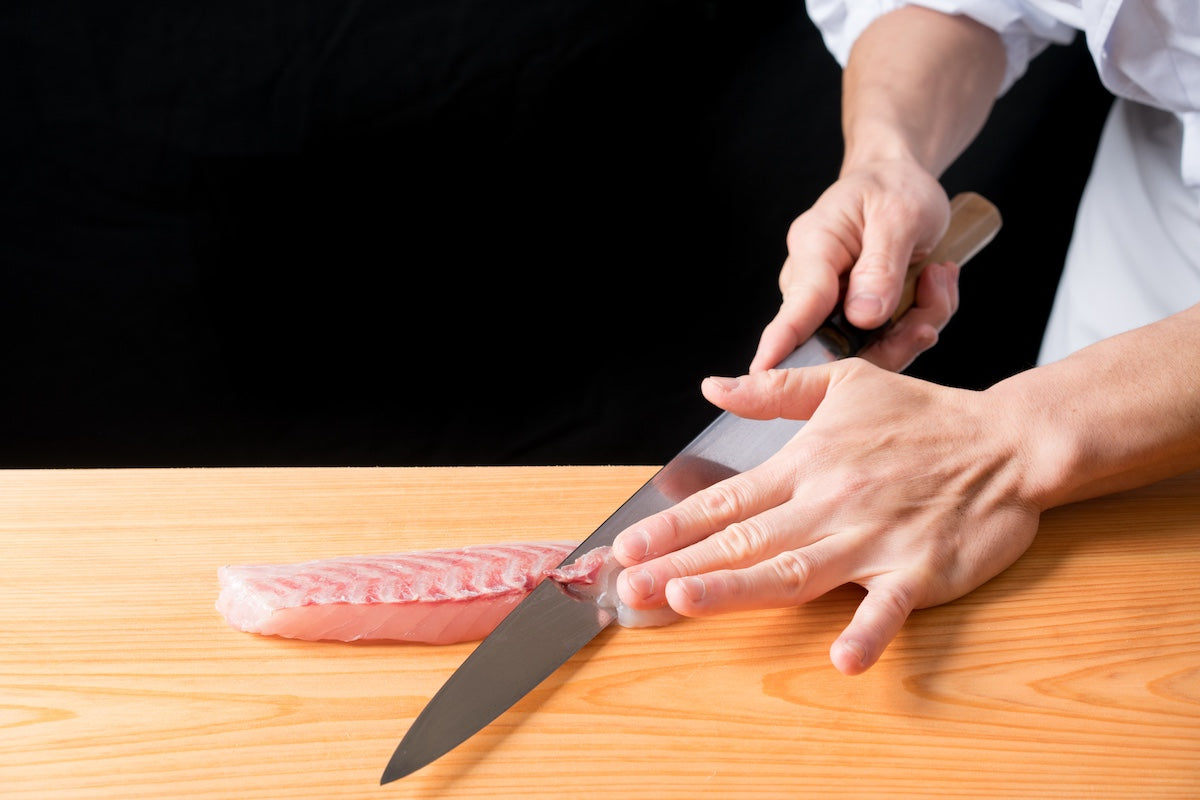
The key to sashimi success lies in both the blade and the technique. The yanagiba is designed for ‘pull cuts’ where you draw the knife towards you in a continuous motion. This allows you to complete a slice in one stroke, rather than sawing back and forth. If the blade is also perfectly sharp, this makes a gorgeously clean cut that doesn’t crush or tear the cells and muscle fibres in the fish flesh. The result is a beautifully smooth, buttery texture on the tongue.
Yanagiba are traditionally forged with a hard high-carbon core steel, then clad in softer iron or steel. This gives it both sharpness and toughness. Modern yanagiba may use stainless or semi-stainless alloys, but retain the same shape and concept.

The members of the yanagiba family
The classic yanagiba is but a single member of a family of long, single-bevel slicers — all designed to slice sashimi, but tuned for different fish, techniques, and spaces. Besides the standard yanagiba, there are other variants like takobiki, sakimaru, fugubiki, and kiritsuke-tipped blades.
You’ve met the classic yanagiba, which is quite common in West Japan (Osaka, Kyoto, and the like). Its Eastern (Tokyo) counterpart is the takobiki or takohiki. At first glance, it looks similar to the yanagiba. But a takobiki has a straighter edge and a blunt, squared-off tip. The blade is also a bit thinner, narrower, and lighter than a typical yanagiba. This makes it great for longer sashimi slices and for working with octopus tentacles.
Then there are sakimaru variants on the yanagiba and takobiki. The lengths are similar, but both display a rounded, sword-like tip reminiscent of a katana tip. Functionally, they slice much like yanagiba or takobiki, but are capable of more detailed tip work. They also look so cool.
Kiritsuke or kengata variants on the yanagiba have what is known as a K-tip (if you’re a knife person) or ‘reverse tanto’ (if you’re a sword person), which is a tip that’s been cut at a rather dramatic angle. (The names are a bit arbitrary, if we’re honest.) Nicely sharp, even a little dangerous-looking, and ideal for super, super precise cuts. They are also fairly balanced, weight-wise, from the heel to the tip of the blade.
As the name suggests, fugubiki or fuguhiki were originally designed to cut paper-thin slices of fugu or blowfish. It is a thin, light version of the yanagiba, and rarely necessary unless it is truly your goal to cut sashimi slices so thin that you can see the decoration on the plate. (Honestly though, it’s giving Mickey Mouse.)
Finally, yanagiba also vary by length and construction. Shorter yanagiba — around 210mm to 240mm — are suited to home kitchens and smaller fish. (Length is all relative, you know?) Mid-range yanagiba clock in at around 270mm to 300mm and are the standard professional choice, long enough for true single-stroke slicing on most fish. Extra-long blades measuring around 330mm to 360mm exist, usually for large fish, but demand more space and greater knife skills.
In terms of construction, there are kasumi and honyaki blades. Kasumi yanagiba have a hard carbon-steel core clad with softer steel, which makes it tough, easy to sharpen, and good for everyday professional use. On the other hand, honyaki yanagiba are forged from a single piece of high-carbon steel much like a sword. This makes them hard and incredibly sharp, but also much more brittle and expensive.

How to use a yanagiba
We touched on this briefly above, but proper yanagiba technique is about making single smooth pull cuts with minimal pressure, letting the knife’s length and edge do the work.
The best way to learn is to watch a video, such as this or this. But in case you prefer written instructions, here they are.
Hold the handle firmly with your dominant hand, wrapping your thumb and middle/ring fingers around the handle and resting your index finger lightly along the spine to control angle and direction. Your other hand stabilizes the fish on the board with relaxed fingertips curled back, so you never have fingers in the path of the blade.
Stand about shoulder‑width apart, slightly leaning over the board so you can pull the knife straight toward you in a controlled line without reaching or twisting.
Start with the heel of the blade resting on the far end of the fish block. Depending on the cut, your knife will rest at different angles.
Draw the knife toward you in one continuous motion from heel to tip, letting the weight and sharpness of the yanagiba carry the blade through the flesh. Avoid sawing back and forth or pressing straight down. Ideally each slice is completed in a single stroke.
If your blade is shorter than the block and you need a second motion, use it only to finish the separation gently rather than as a separate sawing cut.
These are the types of cuts you might make:
-
Hirazukuri: This is the ‘standard’ sashimi slice for salmon or tuna. Your knife is set at 90 degrees — a simple vertical pull cut. You should end up with clean, rectangular pieces around half an inch thick.
-
Usuzukuri: The same as before, but for much thinner slices. Typically used for white fish.
-
Sogizukuri: An angled cut that results in a thin, marginally wider slice of fish. You will hold the fish you want to slice with your free hand, and then pull cut at a 40-degree angle, bringing the knife through the fish and under your fingers. Don’t slice your fingers with the fish.

Things to keep in mind
-
Keep your knife razor-sharp. A dull yanagiba forces you to pull harder, which crushes fibres and tears the surface, resulting in duller-tasting sashimi.
-
Wipe the blade with a damp, clean cloth between cuts to remove any residue, so that the knife can continue to glide smoothly.
-
Avoid rocking, chopping straight down, or twisting the knife during the cut. All this bruises the fish and makes it look ragged and dull-looking, defeating the purpose of a yanagiba.

Should you own a yanagiba knife?
A yanagiba can be a fantastic knife for a home cook, but it is very much a specialist tool rather than an everyday knife.
Where it really shines is in a kitchen where sashimi, nigiri, or carpaccio‑style dishes are a regular occurrence, not once-a-year experiments. Used properly, a yanagiba’s blade delivers clean, single‑stroke slices with noticeably superior texture and appearance, compared with a typical chef’s knife or santoku.
If you enjoy practicing traditional techniques, care about getting restaurant‑style Japanese plating at home, and like the idea of maintaining your own single‑bevel knives, a yanagiba can be a great addition to your knife setup. In this case, a 210mm to 240mm blade is a practical size for home use.
If you only occasionally prepare sashimi, start with a good gyuto or sujihiki and see how far that takes you. These are far more versatile in the kitchen and still give good results if they are kept sharp.
Incidentally, some home cooks also use yanagiba for very clean slicing of soft, boneless ingredients. Examples include cooked meats like boneless chicken and duck breast, fine herb slicing, and some showpiece slicing, e.g. portioning terrines or layered desserts. So fancy. Just remember not to use it on hard or bony ingredients.