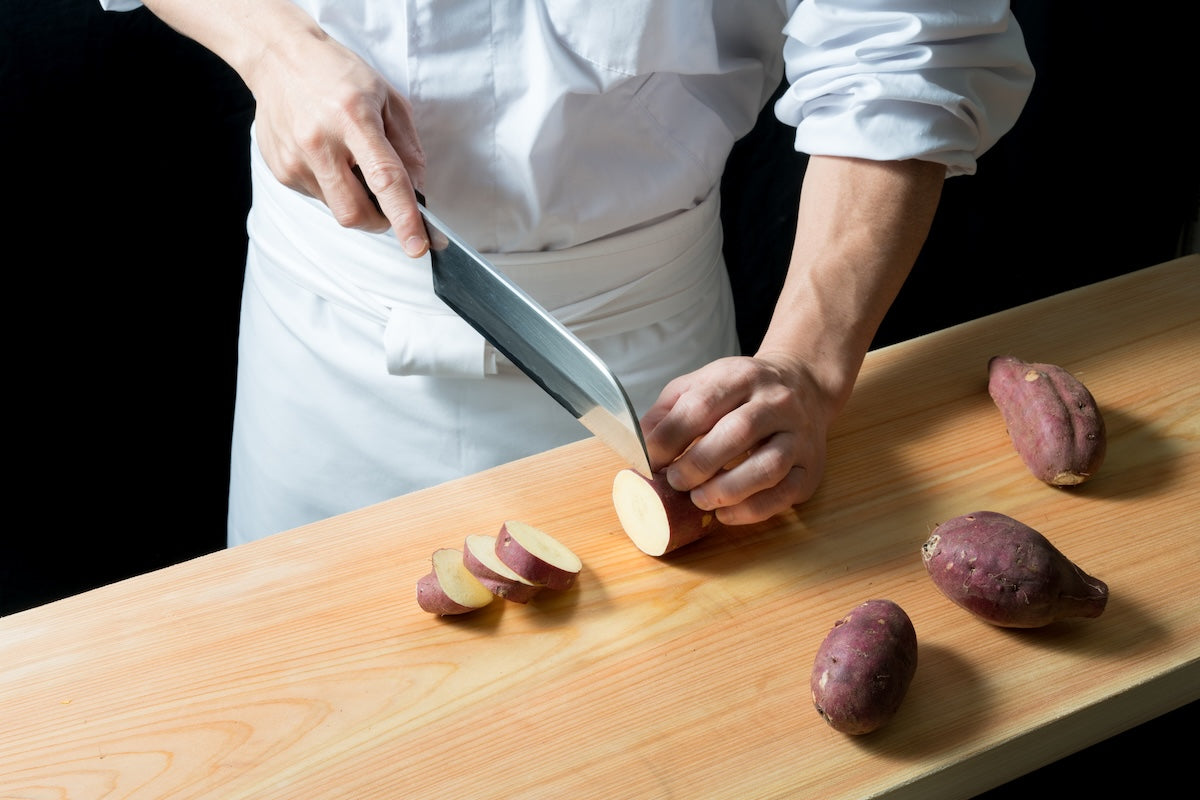
The nakiri does not try to be everything. Unusually, in this multi-tasking world, it makes a point of being just one thing: a Japanese knife designed specifically for vegetable prep.
A flat blade. A squared-off silhouette. A thin blade that turns onions into dice, cucumbers into translucent coins and herbs into fragrance instead of bruised mulch.
And because Japanese knives sometimes carry their purpose in their names, the nakiri tells you what it can do even before you pick it up.
Peeling Back a Name
Nakiri - 菜切り- is a name that reads like a job description: 菜 (na), meaning greens or vegetables, and 切り (kiri) referring to cutting. The origins of this knife are deeply rooted in washoku, a culinary tradition where knives were separated by task - vegetable knife here, fish knife there, sashimi knife at the end of the row.

Anyone who has prepped a mountain of cabbage and carrots with a santoku or Western chef’s knife, then switched to a nakiri, will immediately understand why it’s been prized in Japanese cuisine for generations.
Nakiri Vegetable Knife Geometry
The nakiri’s most important feature is also its simplest: the edge is flat. Not completely flat but flat enough that, when you lower the knife straight down or push forward, the whole length of the edge wants to meet the board.
This changes your prep on a fundamental level because:
- Push-cutting becomes natural. Instead of a rocking motion (the Western chef's knife habit), the nakiri works best with a push-forward and pull-back slice or a straight-down cut.
- Leafy vegetables are sliced all the way through. When the edge stays in contact with the cutting board, you’re less likely to end up with those last threads of cabbage or scallion that keep strands attached.
- The wide blade doubles as a scoop. The tall, rectangular blade lets you gather handfuls of chopped veggies and move them off the chopping board fast.
How Nakiri Differs from Santoku Knives
The santoku runs the home kitchen like a competent manager, juggling vegetables, boneless meats and fish. The nakiri, meanwhile, stays firmly in its department - a specialist who ignores e-mails unless they concern vegetables.
The difference starts in blade shape.
Curving down towards the tip, the blade of a santoku can handle slicing, chopping and a gentle rocking motion.
A nakiri is more rectangular, with a flatter edge designed for push-cutting and full contact chopping.
That thin, flat edge is why the nakiri works so well with vegetables ranging from leafy greens to firm produce such as potatoes.
It’s also why the nakiri is not the right tool for:
- Meat and fish, especially those with bones. The blade is thin; the impact may chip the edge.
- Frozen food - the density and hardness are bad news for for a thin Japanese knife.
- Heavy butchery or cleaver-style work - a nakiri may resemble a cleaver but it doesn’t behave like one. Meat cleavers are thicker and heavier, meant to crack through tougher structures; nakiri are made for precise prep.
Usuba and Nakiri: Single-Beveled vs Double-Beveled Edge

If you’ve ever confused a nakiri with an usuba, welcome to the club. They’re close cousins: both are Japanese vegetable knives with broad, flat faces and a straight cutting edge.
The split happens at the edge. Nakiri knives are typically double-beveled (often evenly balanced 50/50), meaning that both right- and left-handed cooks can use them. The blades are also relatively easy to sharpen.
The usuba is traditionally single-beveled, with different versions for right-handed and left-handed users. Thinner than the nakiri - usuba (薄刃) literally means, thin blade - it needs careful handling and more skill to sharpen.
This knife is indispensable in professional Japanese kitchens, particularly in high-end cuisine such as kaiseki, where precision, presentation and decorative detail are paramount.
An usuba helps transform a daikon radish into a single flowing ribbon, a feat considered among the most exacting in Japanese knife craft.

Once you're sold on the idea of a Japanese vegetable knife, you may find yourself wondering: nakiri or usuba?
A good rule of thumb is this: if you want your knife to help you cook more vegetables more often, choose the nakiri. If you're a professional chef or a home cook chasing extreme precision and technique - and with the skill to maintain a delicate blade - the usuba is waiting.
Cutting Techniques for Nakiri
The flat blade wants to meet the cutting board: use a push-forward and pull-back motion rather than a rolling rock-chop.
Use your non-cutting hand’s knuckles as a guide and curl the fingertips back to keep things safe even when you're slicing at speed.
With harder produce such as pumpkin, resist the urge to rock the knife. When a vegetable is dense, you can add gentle pressure on the spine - the top of the blade - for controlled force but avoid twisting the knife. The nakiri’s thin blade is strong in straight lines, not in sideways arguments..
Nakiri Selection: Blade, Handle and Balance
Choose the right nakiri and you'll find yourself reaching for it without thinking, much like turning to a work buddy who always comes through. Here are a few things to keep in mind when you go shopping.
Blade length
The standard range is 16-18 cm (about 6.3 to 7 inches), with a 16 cm blade recommended for its ease of use.
If your cutting board or your hands are small, a shorter blade - around 14 cm - may feel more maneuverable. But if you prep piles of cabbage and big daikon rounds, a bit more length helps.
Weight: consider the tradeoff
Nakiri are lightweight - this is why you can process a mountain of vegetables without your wrist reconsidering your relationship.
Lighter knives excel at fine work but can feel less forceful; heavier knives power through volume but can tire the hand. Try a nakiri around 150-200 g, a band in the middle of the weight spectrum.
Steel choices: core and cladding
This is where you may feel like you're plunging into a rabbit hole, with jargon - Steel types! Cladding! - thrown at you as you fall.
Here's a guide to some of the terms you may encounter:
Stainless steel: higher corrosion resistance, easier day-to-day maintenance, good for busy home cooks.
VG-10: high-quality stainless steel favored for its ability to retain a sharp, durable edge and resist corrosion.
Blue steel (aogami) or other high-carbon steels: often prized for sharpness and ease of sharpening but requires regular maintenance to prevent rust.
Cladding: A hard steel core is sandwiched between softer layers to combine their rust resistance with the core's edge-retention strength. The outer layers also protect this hard, brittle core.
Damascus patterns: Those swirls and ripples can be seductive. If you love the look, go for it. Just don’t buy Damascus assuming it automatically equals better cutting.
Handle, ergonomics and balance
Handle appearance comes down to personal preference but balance does not. A knife that is too blade-heavy or handle-heavy will be harder to control.
And remember the simplest compatibility question: will the wide nakiri blade fit your knife stand or block?
Right- and left-handed users
Most nakiri knives are double-beveled and are generally geared toward both right- and left-handed cooks. If you're left-handed and planning to get a single-edged knife like an usuba, look for a left-hand model.
Stainless Steel, Carbon Steel and Care

Traditional Japanese knives have a reputation for sharpness and that also applies to the nakiri. To help your blade stay razor-sharp, keep the following points in mind.
The non-negotiables: wash, dry, store
The high moisture content of vegetables increases the risk of rust. Hand-wash and dry the nakiri immediately after use.
If your nakiri is made of carbon steel, add an extra step and oil the blade, especially if you don’t use it regularly.
Patina: what to expect
Carbon steel can discolor over time but patina prevention is simple: don’t leave moisture sitting on the blade and don’t store the knife when it's still damp.
Cutting board choices: protect edge retention
Use a high-quality cutting board made of wood, plastic or rubber and avoid glass, ceramic and stone. Hard surfaces will quickly dull a vegetable knife and can damage the edge.
Don’t scrape the edge on the cutting board
It’s tempting to bulldoze through vegetables with the sharp edge. Don’t. Scraping the blade against the cutting board will dull it faster. Use the spine or the side of the blade instead.
Sharpening: double-bevel ease vs single-bevel skill
For double-beveled nakiri knives, sharpen both sides evenly. Single-bevel knives such as the usuba are harder to sharpen: one of the reasons nakiri is so popular for home use.
The Verdict: Cut Out for Fun
Some people will say you don’t need a nakiri. They’re not wrong, in the same way that, strictly speaking, you don’t need a good cutting board or a properly sharp knife. You can cook without them.
But when vegetables make up a major part of your cooking life, the nakiri starts to feel less like a specialty knife and more like a go-to tool.
If you go through online reviews for nakiri knives, you’ll keep seeing a version of the same surprised confession: 'I never knew chopping vegetables could be enjoyable.'
That line points to what the nakiri really changes. Not your ability to cook; you already have that. It changes your willingness to start and to keep going.
Cooking can be fun - and a nakiri helps to take you to a place where you feel that it really is.
By Janice Tay