Introduction
From ink‑washed Zen landscapes to neon‑bright pop icons, Japanese artists have continually reinvented how the world looks at images. Here, we meet twelve pivotal figures who have reshaped visual culture both inside and outside Japan. Each of their stories illuminates their own facet of Japanese art history, and how they left an enduring impact on the way we see the world today.

Sesshū Tōyō
Sesshū Tōyō was a Zen monk and painter of the Muromachi period. He is widely regarded as Japan’s greatest master of ink painting. Trained under Tenshō Shūbun and later traveling to Ming China, he absorbed Chinese landscape traditions and then transformed them into a distinctly Japanese style that emphasized Zen Buddhist values — material simplicity, attention to nature, and expressive, calligraphic brushwork. His influence was so broad that multiple later schools, including branches of the Kanō school, retrospectively claimed him as a founding figure.
Sesshū’s work is central to the suibokuga (lit. ‘water and ink pictures’) genre, the Japanese form of monochrome ink painting. Suibokuga artists restrict themselves to black ink in varying dilutions, using washes and lines to convey form, light, and atmosphere. For Zen practitioners, this restraint focuses attention on the essence of the subject.
Some of his most influential works include the 15-metre handscroll Landscape of the Four Seasons, often regarded as his masterpiece; the hanging scroll Winter Landscape, a steep mountain landscape exemplifying his dramatic use of line and space; Splashed Ink Landscape (Haboku Sansui), where a few daring brush sweeps suggest mountains and structures; and Huike Offering His Arm to Bodhidharma.

Katsushika Hokusai
Katsushika Hokusai was a prolific ukiyo-e printmaker of the Edo period whose career spanned more than 70 years and tens of thousands of designs. With his bold compositions, innovative perspectives, and liberal use of new pigments like Prussian blue, he helped transform ukiyo-e into a broader art of landscapes, nature, and everyday life.
Hokusai’s prints were widely exported to Europe in the late 19th century and became central to Japonisme, influencing Impressionist and Post‑Impressionist painters such as Monet, Degas, and Van Gogh, as well as later Art Nouveau designers. European artists admired his asymmetrical layouts, cropped viewpoints, and stylized lines, borrowing these ideas to break away from academic realism.
His most famous works include the woodblock print The Great Wave off Kanagawa from the series Thirty-Six Views of Mount Fuji, an image now recognized worldwide. Other celebrated prints are South Wind, Clear Sky (Red Fuji) from the same series, the large-format Fine Wind, Clear Weather landscapes, and his multi-volume sketchbook Hokusai Manga, which collected hundreds of figure, animal, and landscape studies for students.

Ando Hiroshige
Utagawa Hiroshige (also known as Ando Hiroshige) was a late Edo-period ukiyo-e printmaker, celebrated as one of the last great masters of Japanese woodblock landscapes.
Trained in the Utagawa school, he shifted from actor and beauty prints to poetic views of roads, cities, and seasons, depicting travel and everyday life with lyrical colour gradations, unusual viewpoints, and a strong sense of atmosphere. His landscape series were deeply admired by Impressionist and Post‑Impressionist painters.
He is perhaps most famous for his large landscape series. These include the commercially successful The Fifty-Three Stations of the Tōkaidō, which depicts scenes along one of the major highways linking Edo and Kyoto; One Hundred Famous Views of Edo, which presented striking vertical-format views of Edo (Tokyo), including the iconic Sudden Shower over Shin-Ōhashi Bridge and Atake, and Plum Garden at Kameido; and The Sixty-nine Stations of the Kisokaidō.

Ogata Kōrin
Ogata Kōrin was a Kyoto-born painter, designer, and lacquer artist of the early Edo period. Today, he is remembered as a leading figure of the Rinpa school and one of the masters of Japanese decorative art.
The second son of a prosperous merchant family, he studied courtly culture, classical literature, and design, later expressing these influences in his art. His works were characterised by brightly coloured, simplified — almost abstract — forms on lavish gold and silver grounds, so distinctive that “Kōrin pattern” (Kōrin moyō) became a byword for elegant, highly stylised design in Japan.
Kōrin’s influence can be found even today in both Japanese and global art. Rinpa artists after him, such as Sakai Hōitsu and Suzuki Kiitsu, helped canonise Rinpa as one of the main historical schools of painting by reinterpreting his compositions. His graphic handling of nature motifs and use of flat, patterned surfaces also resonated abroad; art historians have linked Rinpa aesthetics, including Kōrin’s work, to the development of Art Nouveau and modern design. Works by Gustav Klimt and Alphonse Mucha almost seem to reference him directly.
Among his most influential works are several iconic folding screens. These include Irises (and the related Irises at Yatsuhashi), Red and White Plum Blossoms, and his version of Wind God and Thunder God.

Utamaro Kitagawa
Kitagawa Utamaro was one of the leading ukiyo-e artists of late 18th‑century Edo, perhaps most known for his sensuous bijin-ga (pictures of beautiful women) series. Working in woodblock prints and paintings, his bijin ōkubi-e — close-ups of courtesans, geisha, and townswomen – captured subtle expressions, fashion details, and the psychology of Edo’s pleasure quarters in a way no one had done before.
Utamaro’s most influential works include series like Ten Studies in Female Physiognomy and A Collection of Reigning Beauties, which represented the first, innovative (for that time period) attempt by a woodblock artist to depict the individuality of his subjects, rather than as idealised visions of femininity. Imagine that.
Other celebrated projects included Twelve Hours in the Pleasure Quarters and his large triptych of hanging scrolls often referred to as Moon at Shinagawa, Cherry Blossoms at Yoshiwara, and Fukagawa in Snow. These depicted courtesans in three famous entertainment districts and seasons. He also produced nature books, such as his illustrated volumes of insects and shells, showing the same precision and sensitivity he brought to human subjects.
Besides the mainstream bijin-ga, Utamaro was a major producer of shunga, or erotic images known as ‘spring pictures.’ Works like the luxurious album Utamakura (Poem of the Pillow) present a wide range of intimate scenarios, from young lovers to married couples, treating sexuality as a source of pleasure, tenderness, and sometimes humour. These shunga prints, richly printed and often accompanied by witty poetry, expanded the emotional and thematic range of ukiyo-e and are now recognised as an important part of his oeuvre.

Tōshūsai Sharaku
Tōshūsai Sharaku has been an enigma for centuries. Various theories have been put forward, but details such as his true name, birthdate, and birthplace ultimately remain unknown. He had a short but prolific career that spanned ten months from May 1794 to February 1795, during which he produced approximately 140 woodblock prints (and a handful of sketches) before disappearing into the annals of history.
Unlike contemporaries like Kitagawa Utamaro, Sharaku did not beautify his subjects. Many of his subjects seem to be mid-gesture, or have been captured in dynamic poses, their facial expressions veering from sly to comically disgruntled. Such unflattering realism was not well-received by the public, which may have played a part in truncating his career.
Sharaku’s most celebrated prints come from his first period, when publisher Tsutaya Jūzaburō issued 28 large ōban bust portraits with luxurious black mica backgrounds. These ōkubi-e (“large-head” prints) show actors mid‑performance with twisted mouths, bulging eyes, and tense hands, turning them into incisive character studies rather than simple fan souvenirs. Among his most influential works are Ōtani Oniji III as Yakko Edobei, in which the actor lunges forward with clawed hands and a menacing glare; Ichikawa Ebizō IV as Takemura Sadanoshin; and portraits of onnagata (male actors in female roles) such as Segawa Kikunojō III as Oshizu.
Modern scholars and collectors have come to regard his actor portraits as some of the greatest achievements in ukiyo-e. Exhibitions and research today treat Sharaku as a pivotal, if enigmatic, figure who pushed kabuki portraiture from decorative likeness toward something closer to modern caricature.

Foujita Tsuguharu
Tsuguharu Foujita (Léonard Tsuguharu Foujita) was a Japanese‑French painter who became one of the most distinctive figures of the Paris School, renowned for blending Japanese ink sensibilities with Western oil painting. He is considered a pioneer of truly hybrid modernism: a Japanese artist who succeeded in Europe, all the while maintaining a distinctly Japanese aesthetic.
Trained in yōga (Western-style painting) in Tokyo, Foujita lived in Paris in the late 1910s to 1920s, moving in the same circles as Picasso and Modigliani. It was around then that he developed the signature ‘milk‑white’ ground, fine calligraphic lines, and muted palette that made his paintings instantly recognisable.
Foujita first achieved major success in 1920s Paris, where critics praised his work as a harmonious meeting of ‘Eastern’ linework and ‘Western’ oil technique. His porcelain-like female nudes outlined in black, accompanied by cats and meticulously rendered fabrics, at once felt modern, yet also met the contemporary fervour for Japonisme. Reclining Nude with Toile de Jouy (1922), shown at the Salon d’Automne, was a breakthrough canvas whose pale, finely outlined nude set against patterned French fabric made him a star. His limited‑edition A Book of Cats (1930), containing 20 exquisitely drawn felines, became a legendary art book and cemented his status as the “painter of cats.”
In the wartime years, he became Japan’s leading war propaganda painter, producing paintings at scale during the Second World War. Later, he discreetly returned to France, converting to Catholicism and living the rest of his life in Montparnasse.

Takehisa Yumeji
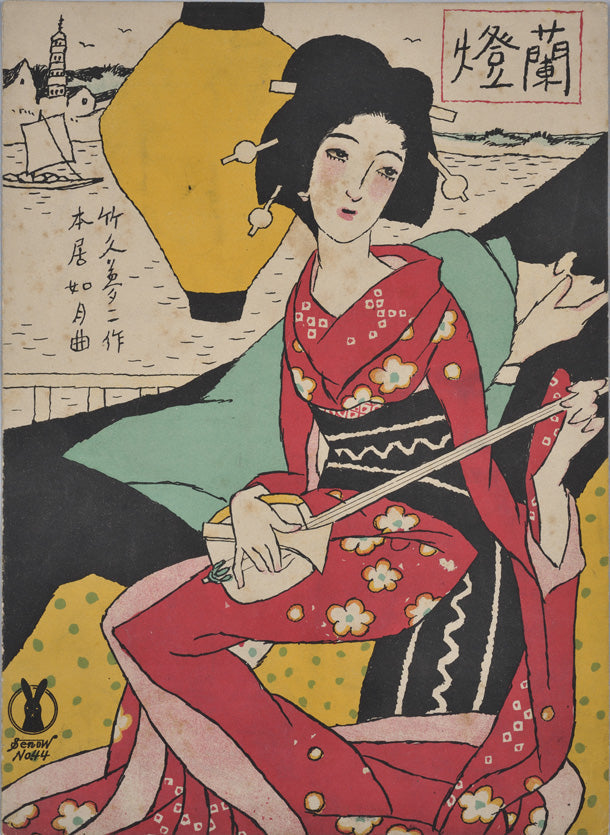
Takehisa Yumeji was a painter, illustrator, poet, and designer who became one of the most beloved visual voices of the Taishō era. He is often called a leading figure of ‘Taishō Romanticism.’
Largely self‑taught, Yumeji made his name through magazine and book illustration from the mid‑Meiji through Taishō periods, producing designs for over 2,000 volumes and pioneering a popular, lyrical graphic style that moved easily between fine art and commercial art. His signature ‘Yumeji‑style beauties’ — slender women with oval faces, long necks, and large, expressive, often melancholy eyes — made him a celebrity and earned him nicknames such as the 'modern Utamaro' and the Japanese Toulouse‑Lautrec or Munch.
Yumeji’s images of women subtly shifted the visual ideal of feminine beauty in Japan. Earlier Meiji-era prints often favored narrow, fox-like eyes, but as Western influence grew, his women with big, emotive eyes and introspective expressions captured a new, modern sensibility of fragility, longing, and romantic interiority. These bijin-ga were reproduced as prints as well as on book covers, textile patterns, stationery, and accessories, helping to normalise this style across everyday visual culture. His melancholic, willowy heroines became a template for depicting modern women — independent yet vulnerable — and strongly influenced later bijin-ga and commercial illustration.
The ‘Yumeji-style’ perception of the feminine fed directly into the emergence of shōjo (girls’) aesthetics and manga. Early 20th‑century shōjo magazine illustrations developed the now-familiar look of girls with large, shining eyes, and scholars identify Yumeji, along with illustrators like Jun’ichi Nakahara, as a crucial source for this visual vocabulary.
His lyrical, decorative images of dreamy young women — surrounded by flowers, patterns, and romantic atmosphere — anticipated the emphasis on emotion, romance, and ornamental detail that became hallmarks of shōjo manga, visible in later artists from Macoto Takahashi to Riyoko Ikeda.

Takashi Murakami
Takashi Murakami is a Japanese contemporary artist known for fusing traditional painting with anime and manga-inspired imagery.
Trained in Nihonga at Tokyo University of the Arts, he became dissatisfied with what he saw as inward-looking, elitist modern Japanese art, turning to postwar pop culture and otaku subcultures as the raw material for a new visual language. His paintings, sculptures, and installations often feature recurring motifs such as smiling flowers, Mr. DOB, skulls, and Buddhist or yokai figures precisely rendered in flat colour.
Murakami coined the term Superflat around 2000 to describe both his aesthetic and a broader postmodern movement. Superflat refers to the compressed, two-dimensional look shared by historical Japanese art (like ukiyo-e and nihonga) and contemporary anime, and, conceptually, to a “flattening” of distinctions between high and low culture, fine art and commercial design, depth and superficial consumerism in postwar Japan. Through exhibitions and writings, he positioned Superflat as a way to understand Japanese visual culture and its unresolved postwar trauma, using cute, glossy surfaces to veil themes of violence, desire, and cultural anxiety.
Murakami has had a substantial impact on contemporary art. He built Kaikai Kiki, a studio system modeled partly on Warhol’s Factory, producing large-scale paintings, fiberglass sculptures, films, and a vast range of merchandise. He also mentored younger artists such as Aya Takano.
By collaborating with brands like Louis Vuitton, musicians like Kanye West, and participating in venues from Versailles to art fairs and streetwear festivals, he forced institutions and audiences to question where “art” ends and “product” begins. Superflat’s mix of Edo flatness, pop spectacle, and sharp cultural critique has influenced a generation of artists in Japan and abroad, helping to legitimise anime-inspired aesthetics and the collapse of high/low boundaries as central strategies in global contemporary art.

Yayoi Kusama
Yayoi Kusama is a Japanese avant‑garde artist whose career spans painting, sculpture, performance, installation, film, fashion, and writing. She is one of the most widely recognised artists in the world.
After early training in nihonga and a move to New York in the late 1950s, in 1961, she began to develop a body of work based on the repetition of identical motifs, including the ‘accumulation’ series of phallic soft sculptures and ‘Infinity Net’ paintings. These linked her to Pop Art and Minimalism movements, but her work remained distinct.
These days, two motifs define her visual language: polka dots and pumpkins. Inspired by childhood hallucinations, Kusama began covering surfaces of all sorts with dots; these represent symbols of infinity, and the dissolution of the self into the universe. In works such as the Infinity Mirror rooms, the Obliteration Room(s), and polka dot-covered environments and sculptures, there is a sensation of boundless space and repetition that has become synonymous with the Kusama oeuvre. Pumpkins, on the other hand, derive from her rural upbringing, and appear as paintings and large outdoor sculptures.
Since the 1990s, major retrospectives and her immersive Infinity Mirror Rooms have drawn record crowds, turning her into a global contemporary art star with her own dedicated museum in Tokyo. Her work bridges elite institutions and popular culture, and as such, her impact on contemporary art has been tremendous — she is a rare phenomenon where personal psychology is transformed into accessible, immersive experiences that appeal to mass audiences.

Tadanori Yokoo
Tadanori Yokoo is a Japanese graphic designer, printmaker, illustrator, and painter whose psychedelic images have made him one of the standout visual voices of postwar Japan.
Emerging in the 1960s, Yokoo broke away from the clean, Bauhaus-influenced modernism that dominated Japanese design by mixing bold colors, photographic collage, hand-drawn elements, and dense symbolism. His work draws on American Pop and traditional ukiyo-e to comment on rapid economic growth, Westernization, and Japan’s conflicted national identity.
His early career centers on poster design, where he created some of his most iconic works. The 1965 self‑portrait poster Having Reached a Climax at the Age of 29, I Was Dead — created for a Matsuya department store exhibition — shows his ‘imagined funeral’ framed by motifs such as the rising sun, Mount Fuji, and the Shinkansen, announcing a new, subversive visual language.
Other seminal posters include Chinsetsu Yumihari-zuki (1969), theatre and concert posters, and album covers for musicians, all characterised by layered collage, pop psychedelia, and the recurring rising‑sun emblem that at once flaunts and questions postwar Japanese nationalism.
From the late 1970s and 1980s his focus gradually shifted to painting, resulting in series such as the ‘Y-junction’ crossroads, ‘red paintings,’ and bathhouse scenes that translated his poster sensibilities into complex, dream-like canvases.
Yokoo’s work remains relevant in contemporary Japan because it addresses tensions that are still alive: those between tradition and globalization, pop culture and “high” art, pride and unease about Japan’s past. His appropriation of mass-media imagery and national symbols anticipated today’s remix culture and has influenced designers and artists who blend manga, advertising, and fine art. Large retrospectives and reprints of his ‘posthumous works’ collection, as well as ongoing exhibitions of his prints and paintings, continue to help Japan think through its modern history and its place in a global visual culture.

Yoshitomo Nara
Yoshitomo Nara is a leading Japanese contemporary artist known for his depictions of big‑headed, wide‑eyed children and animals that appear cute at first glance, but carry complex, often rebellious emotions. His work blends influences from 1960s manga and anime, punk rock, folk art, and Western painting, using deceptively simple, flat compositions to explore themes of isolation, resistance, and inner vulnerability.
A typical Nara work sees a solitary childlike figure with a rounded head and piercing eyes that stare directly at the viewer. This character is often holding an object — a tiny knife, a toy, a musical instrument — or standing in an empty field of colour, straddling the borders between sweetness, anger, defiance, and sadness.
Works such as The Girl with the Knife in Her Hand (1991) and Knife Behind Back (2000) are emblematic, with small gestures and facial expressions that suggest emotional worlds shaped by strict social expectations and the darker side of adulthood. Over time his surfaces have become smoother and his backgrounds more minimal, giving his figures even greater psychological weight and a quieter, contemplative mood.
Nara’s relevance in contemporary Japan and globally comes from how his images transform pop‑culture visual language into a deeply personal diary. His children embody universal feelings of loneliness, resistance, and fragile hope in a world saturated with cute imagery and consumerism. That mix of accessible character design and emotional depth has made his work resonate with museum audiences, collectors, punk fans, and younger artists around the world.