Introduction
From a thunder god descending onto a golden screen to a single, towering wave frozen mid-crash, Japan has produced artworks that are instantly recognisable around the world. Here, we introduce these masterpieces and explain why each one became a touchstone for Japanese culture and global art history alike.

Sesshū Tōyō
Huike Offering His Arm to Bodhidharma
Sesshū Tōyō’s Huike Offering His Arm to Bodhidharma is a powerful painting that condenses Zen legend, religious devotion, and virtuoso brushwork into a single dramatic image. It is oft cited as one of his most audacious paintings.
Painted as a hanging scroll in 1496 and now preserved at Sainen-ji in Aichi, it shows the Indian monk Bodhidharma (Daruma in Japanese), founder of Zen, confronting his disciple Huike at the moment Huike cuts off his arm to prove his resolve.
Executed in monochrome ink, the painting uses bold, angular strokes and strong contrasts of black and white rather than fine shading, typical of Sesshū’s mature Zen style. Daruma is rendered with bushy eyebrows, glaring eyes, and a fierce, almost caricatured expression, emphasizing his spiritual power and uncompromising nature. Huike appears in front of him with a grim or anguished face, visually enacting the tension between human suffering and spiritual aspiration.

Tawaraya Sōtatsu
Wind God and Thunder God (Fūjin Raijin-zu)
This is a pair of early-17th-century folding screens that depicts the Shintō storm deities Fūjin and Raijin hurtling across a dazzling gold background. Each god occupies one screen — Fūjin on one side with his great sack of wind, Raijin on the other encircled by drums — leaving a striking expanse of empty space between them, heightening the sense of motion and suspended energy.
Executed in ink and color on gold-foiled paper, the work is now a National Treasure of Japan and historically associated with Kennin-ji temple in Kyoto, though it is currently entrusted to the Kyoto National Museum.
Visually, the screens exemplify Sōtatsu’s innovative approach that later defined the Rinpa school: bold, simplified forms, limited but saturated color, and the dramatic use of gold as both background and active pictorial space. The gods are drawn with fluid, calligraphic lines, yet their slightly humorous, exaggerated expressions soften their ferocity. By isolating the two figures against an otherwise empty field, Sōtatsu transforms mythological imagery into a highly stylized design, balancing asymmetry and symmetry so that the pair reads as both narrative and abstract pattern.
Fūjin and Raijin are ancient nature deities tied to wind, thunder, and rain. They have long been revered in both Shintō and Buddhist contexts as powerful protectors as well as potentially destructive forces. Sōtatsu’s composition distills this duality: the deities seem to barrel toward the viewer, embodying the chaos of storms, yet the overall arrangement is so controlled that it suggests harmonious cosmic order. The image became a touchstone for Rinpa artists; even now, it continues to shape how Japanese art visualises the relationship between humans, nature, and divine power.

Ogata Korin
Irises at Yatsuhashi
Painted in the early eighteenth century during the Edo period, Ogata Kōrin’s Irises at Yatsuhashi (Eight Bridges) is a pair of six-panel folding screens in which brilliant blue irises rise in clusters against a continuous field of shimmering gold leaf, cut through by an angular zigzag bridge that sweeps across both screens. It remains one of the technical and visual masterpieces of the Edo period.
Behind this bold simplicity lies a dense web of literary and cultural references. The scene alludes to the famous “Eight-Plank Bridge” episode from the classical Tales of Ise. In this scene, the courtly protagonist has been exiled from Kyoto, and is travelling east. He pauses at Yatsuhashi, where a stream divides into eight channels spanned by bridges, and composes a love poem inspired by the irises.
Kōrin omits the human figure and narrative action, instead evoking the story purely through repeating irises and the abstracted bridge, so the viewer encounters not the anecdote itself but its distilled emotional atmosphere of longing and remembrance.

Katsushika Hokusai
Under the Wave off Kanagawa
Better known as The Great Wave, this is not only Hokusai’s most iconic work, but also one of the most recognisable and influential artworks in the world. Entire books have been devoted to this subject; for our take on his print, see this article.

The Dream of the Fisherman’s Wife
For better or for worse, this is probably the most (in)famous example of shunga. Fans of The Great Wave may or may not be surprised to learn that the same artist (Hokusai) was responsible for this memorable piece of erotic art, in which two octopuses — the smaller one is the offspring of the larger — pleasure a nude woman with their limbs and mouths. With its vibrant pinks, yellows and greens, and the expressive linework, it is an artwork at once playful, elegant, and transgressive.
To read more about this print, see this article.

South Wind, Clear Sky (Red Fuji)
South Wind, Clear Sky was one image in Thirty-Six Views of Mount Fuji, a series of woodblock images published by Hokusai and Nishimura Yohachi, presenting the sacred mountain as viewed from different locations and perspectives. In contrast to usual blue-hued renditions, Mt. Fuji here is dyed a striking red; the mountain apparently takes on a reddish hue in late summer and early autumn. Unsurprisingly, Japanese people have nicknamed the print “Red Fuji,” and it is quite possibly the second-most famous depiction of Mt. Fuji.

Kitagawa Utamaro
Uwaki no sō (The Fickle Type) from Fujin sōgaku jittai (Ten Physiognomies of Women)
Utamaro was one of the most successful woodblock artists of his time, and he is perhaps most known for his sensuous bijin-ga, or pictures of beautiful women, series. What is notable about Utamaro’s bijin-ga is that they represent the first, innovative (for that time period) attempt by a woodblock artist to depict the individuality of his subjects, rather than as idealised visions of femininity. Imagine that.
This particular print is part of a series of “types” of women; the term ‘physiognomy’ refers to contemporary pseudo-scientific practices of understanding personality and destiny through people’s facial features. Its title is most often translated as “The Fickle Type,” and occasionally “The Flirt.” The print depicts a young woman emerging from the bath, slightly unkempt, her robe half open and exposing her breast. To convey the quality of a woman who is constantly seeking new suitors, she is seen here casting a glance over her shoulder, her alert expression and disregard for her dishevelled appearance marking her out as the “fickle type.”

Utagawa Hiroshige
Sudden Shower Over Shin-Ohashi Bridge and Atake
Sudden Shower Over Shin-Ohashi Bridge and Atake (1857) is another Hiroshige masterpiece from One Hundred Famous Views of Edo, and is widely considered one of his best. Here, we see a torrential summer downpour at the Shin-Ohashi Bridge that stretches over the Sumida River (still standing today), several Edo-ites scurrying across for shelter.
There is a tremendous sense of visual movement and life in the piece: the rain falls at an angle to the bridge, evoking wind and energy, allowing our eyes to roam endlessly over the lines in this piece; the tiny figures, dwarfed by the elements, are caught mid-scurry, heading out of the picture frame; even the boatman’s lumber barge is en route elsewhere.

Tōshūsai Sharaku
Kabuki Actor Ōtani Oniji III as Yakko Edobei
If there is a Japanese artwork whose fame rivals that of The Great Wave, it must be this 1794 print by Sharaku, depicting the Kabuki actor Ōtani Oniji III in the role of the wicked manservant Yakko Edobei from the play The Coloured Reins of a Loving Wife (Koi nyōbō somewake tazuna). His leering face with red-rimmed eyes has appeared everywhere from posters, book covers, and mugs to advertisements, tourism videos, and restaurant menu designs. (Naturally, it also illustrates the 10-second video of the Kabuki kakegoe, or the “YO sound effect.”)
Despite the renown of this print, Sharaku the woodblock artist has been an enigma for centuries. Various theories have been put forward, but details such as his true name, birthdate, and birthplace ultimately remain unknown.
He had a short but prolific career that spanned ten months from May 1794 to February 1795, during which he produced approximately 140 woodblock prints (and a handful of sketches) before disappearing into the annals of history.
He remains a mystery today, but his iconic prints live on.

Yayoi Kusama
It is impossible to choose a single representative piece from Kusama’s vast body of work; rather, we prefer to highlight the recurring motifs of pumpkins and polka dots that encapsulate everything she is famous for in the art world and beyond.
To vastly simplify, Kusama’s art is an expression of personal psychology. Polka dots first emerged from Kusama’s childhood hallucinations, where she saw fields, walls, and objects covered with spots. She later adopted them as symbols of infinity, the cosmos, and ‘self-obliteration,’ using them to dissolve the boundaries between the self and everything else.
Pumpkins, on the other hand, stem from her childhood of growing up in a seed-merchant family. She has described their modest, lumpy forms as soothing, even a spiritual self-portrait of sorts.
These two motifs are often combined in her art. The pumpkin’s ridged, organic surface gives structure to her dot patterns, allowing her to orchestrate repetition across three dimensions, whether in sculpture, mirrored rooms, or outdoor installations.
While deeply autobiographical, these motifs are instantly legible to a global audience — a distilled symbol of her struggle with fear, and her pursuit of healing through art. Kusama’s polka-dotted pumpkin is one of contemporary art’s most recognisable icons, bridging avant-garde practice, public sculpture, and pop culture.

Takashi Murakami
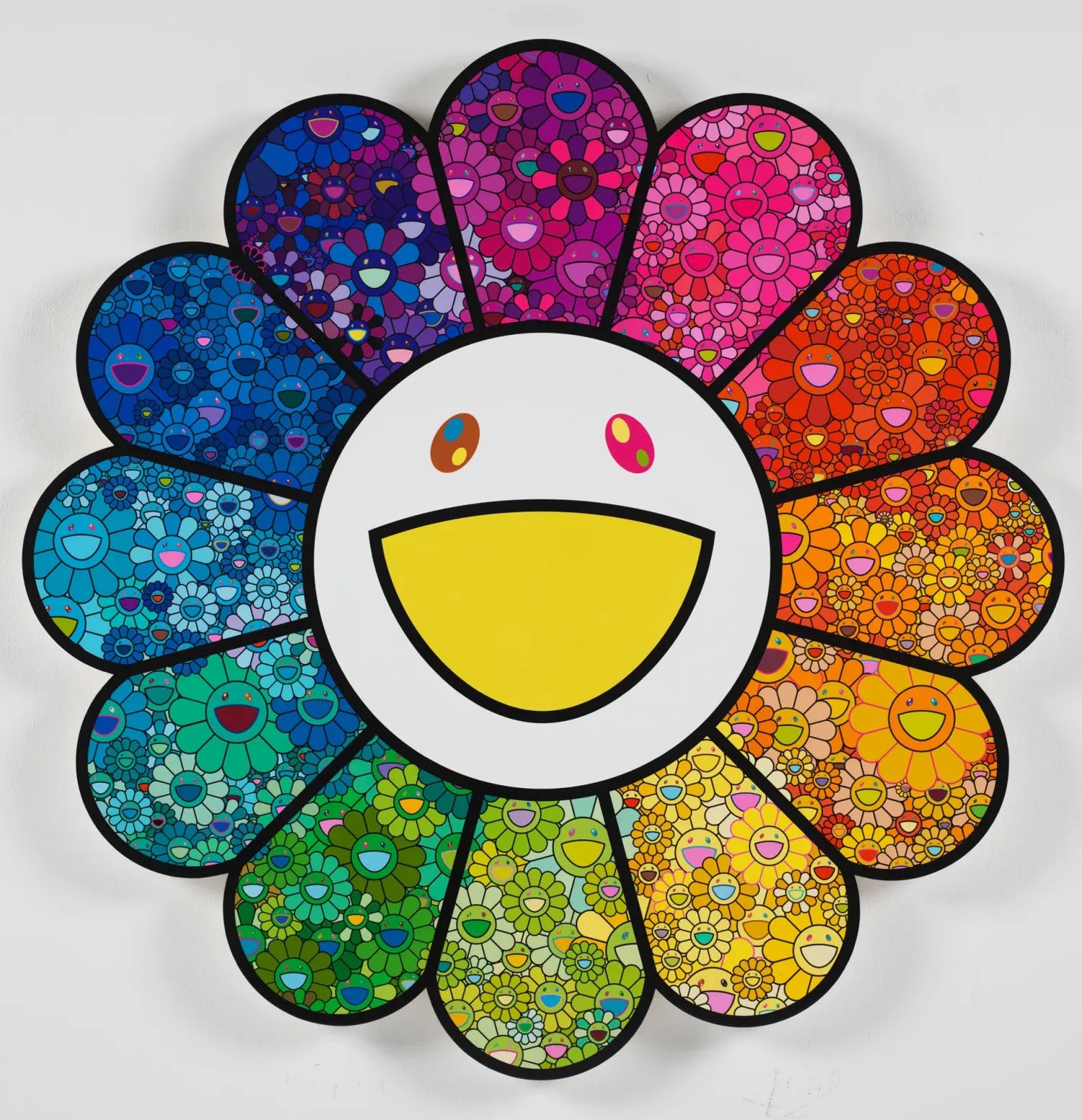
Like Kusama, it is difficult to choose one representative Murakami work, as so much of it is characterised by recurring motifs in a highly recognisable Superflat style. One of his most iconic motifs is the flower.
Takashi Murakami’s recurring flower motif — bright, flat, smiling blossoms with radiating petals — grew out of his training in traditional nihonga painting, where flowers are a classic subject, and became central to his Superflat style.
At first glance, these flowers seem childlike and cheerful, but Murakami has said they also encode collective trauma and “hidden, mixed feelings,” linking their forced smiles to Japan’s postwar experience and to deeper themes of life, death, and impermanence. This tension between surface happiness and underlying anxiety gives the motif emotional depth that rewards repeated viewing.
Formally, the flowers are perfectly suited to Murakami’s Superflat aesthetics. They are rendered with clean outlines, saturated colors, and no shading. They are repeated with almost mechanical regularity across canvases and spheres. Works such as his “Flower Ball” series and “Field of Smiling Flowers” cover the picture plane with near-identical blossoms, turning them into patterns that blur the boundary between fine art, illustration, and product design. This repetition can be read as a commentary on conformity and mass-produced happiness in consumer culture, reinforcing the idea that the flowers are as much critique as they are decoration.
The ubiquity of these flowers — at once high art, brand-like logo, and pop culture symbol — has made them known even to those with no interest in art. Along with Kusama’s polka dots, these flowers are unmistakably Murakami, one of the most recognisable visual signatures in contemporary art.