The origins of ukiyo-e
Ukiyo‑e first emerged in Japan during the early Edo period (1603–1868), when the country stabilised under the rule of the Tokugawa shogunate. Over 250-odd years of relative peace, the city of Edo — now modern-day Tokyo — grew into a bustling urban centre, which boasted one of the highest literacy rates in the world at the time.
A new urban culture developed around theatres, pleasure districts, and popular entertainment. Life could be difficult, and as such, the urbanites of Edo decided that it was imperative to savour each moment, in the same way that one revels in the evanescent beauty of cherry blossoms that scatter in a matter of days. The Buddhist term ‘ukiyo’ — the floating world — was co-opted to refer to this attitude of enjoying the ephemerality of life.
This floating world, then, became a prime subject for artists looking to depict everyday life. Its visual roots lay in earlier painting styles such as yamato‑e and emaki (narrative picture scrolls), which used clear outlines and flat colours, with close attention to figures and scenes from daily life.

Lovers Beneath an Umbrella in the Snow, by Suzuki Harunobu
Painters in the 17th century drew on these to create images of fashionable women, kabuki actors, and lively street scenes, with the bold outlines and simplified forms that later became hallmarks of ukiyo-e. These painted works circulated as hanging scrolls and book illustrations, laying the groundwork for a more widely accessible art form.
Towards the late 17th century, artists such as Suzuki Harunobu began producing single‑sheet images and prints of beautiful women and entertaining scenes, moving ukiyo‑e from hand‑painted scrolls toward mass‑produced woodblock prints.
Early prints were usually monochrome, sometimes with hand‑applied colour, but they could be reproduced in quantity.. Ukiyo-e became the popular images of their day — mass-produced and affordable, they were eagerly snapped up by townspeople who hung them on their walls, much as we might purchase posters or share photos today.
In this way, the origins of ukiyo‑e are deeply tied to the rise of Edo‑period city life, new printing technology, and a cultural shift toward celebrating the beauty and transience of the everyday world.

Kushi, Kitagawa Utamaro, multicolour woodblock print, c. 1795–96
What did ukiyo-e depict?
Ukiyo‑e prints most famously show scenes from the “floating world” of Edo‑period urban life, especially the pleasure districts, theaters, and entertainment quarters.
A core theme is the depiction of beautiful women (bijin‑ga). These were most often courtesans and geisha, portrayed in elegant kimonos, elaborate hairstyles, and fashionable poses that highlight current trends and social status. These images both celebrated and advertised the attractions of the licensed brothel districts and the glamorous nightlife of cities. Indeed, the origins of ukiyo-e are inseparable from these districts and the fantasies they embodied.
The Yoshiwara courtesans in particular became central figures in early ukiyo‑e imagery. High‑ranking courtesans were like celebrities of their day, known for their exquisite kimono, subtle makeup, and refined manners. Artists depicted them in elegant poses and lavish interiors, capturing both their allure and social status. Prints of them were wildly popular as souvenirs, advertisements, and fashion guides, the courtesans’ fame spreading far beyond the pleasure cultures, reinforcing the link between ukiyo‑e and the culture of desire and display.

Nakamura Nakazō II as the farmer Tsuchizō, actually Prince Koretaka. Attributed to Sharaku.
Another major subject of ukiyo-e was kabuki theatre, most commonly of actors in their various stage roles. Yakusha-e captured poses, facial expressions, and costumes. Sumo wrestlers and popular heroes were also popular subjects for prints. Dramatic poses and larger-than-life physiques were favoured, matching the theatrical and combative spirit of the performances. Such prints functioned almost like posters or celebrity portraits, and also helped advertise famous actors and the latest plays among a broad public.
Beyond the entertainment sphere, ukiyo-e subjects also encompassed landscapes, nature, and scenes from history or everyday life. Artists like Hokusai and Hiroshige were famous for their series of iconic views, such as those of Mount Fuji or along major highways like the Tokaido Road or Kiso-Kaido. Seasonal landscapes and market scenes were fair fame, as were folk tales, natural subjects, and even erotica (shunga, literally ‘spring pictures’). Ukiyo-e as a whole offers a vivid visual record of Edo-period society, from its most ordinary moments to its most celebrated spectacles.

Major ukiyo-e artists
Ukiyo‑e produced a large and diverse group of artists, but a few stand out as defining figures of the genre.
Working mainly in the 18th and 19th centuries, these artists helped shape how people saw the “floating world” of Edo‑period Japan, from the glamour of the pleasure quarters to the drama of the theater and the quiet beauty of nature. Their woodblock prints circulated widely, influencing both Japanese popular culture, and later Western art movements such as Impressionism and Art Nouveau.
Among the most celebrated is Katsushika Hokusai, whose name is closely tied to ukiyo‑e itself. Best known for the series Thirty‑six Views of Mount Fuji, including the iconic The Great Wave off Kanagawa, Hokusai combined precise linework, inventive compositions, and a deep interest in everyday life and natural phenomena. His career spanned decades and styles, ranging from bijin‑ga (pictures of beautiful women) to humorous sketches and supernatural subjects.

11: Hakone, The 53 Stages of the Tokaido, Utagawa Hiroshige
Another towering figure is Andō Hiroshige (or Utagawa Hiroshige), famed for his lyrical landscapes and travel scenes. His series such as The Fifty‑three Stations of the Tōkaidō and One Hundred Famous Views of Edo capture seasonal changes, weather effects, and quiet moments along Japan’s main roads and in the capital city. Hiroshige’s atmospheric use of color and delicate spatial compositions helped turn landscape into a major subject of ukiyo‑e, giving later artists in Japan and Europe a rich visual vocabulary for depicting place and mood.

In contrast, Tōshūsai Sharaku left a much briefer but unforgettable mark. Active only for about a year around 1794–1795, Sharaku specialized in striking, often exaggerated portraits of kabuki actors in dramatic roles. His prints emphasize angular features, intense expressions, and psychological intensity, making his characters look almost theatrical in their rawness. Although he produced fewer works than Hokusai or Hiroshige, Sharaku’s bold style stands out as one of the most innovative and memorable in ukiyo‑e.

Kitagawa Utamaro is widely regarded as one of the greatest masters of bijin‑ga. Focusing on beautiful women — especially courtesans, geisha, and women in domestic settings — Utamaro explored subtle gradations of expression, posture, and fabric in a way that feels both intimate and highly stylized. His close‑up “ōkubi‑e” (large‑head) portraits and elegant series of women in everyday situations helped refine ukiyo‑e’s visual language.
We would be remiss not to mention the Utagawa school, which was founded in the late 18th century by painter and print designer Utagawa Toyoharu.
Centered in Edo, the school grew into a large workshop‑style studio that trained dozens of pupils, many of whom took the Utagawa name as part of their art names. The Utagawa school excelled in a wide range of subjects, from kabuki actor portraits and scenes of the pleasure quarters to historical tales, warriors, and eventually landscape prints. Over the 19th century it became the dominant force in Japanese woodblock printing, producing a huge share of popular prints for urban audiences.
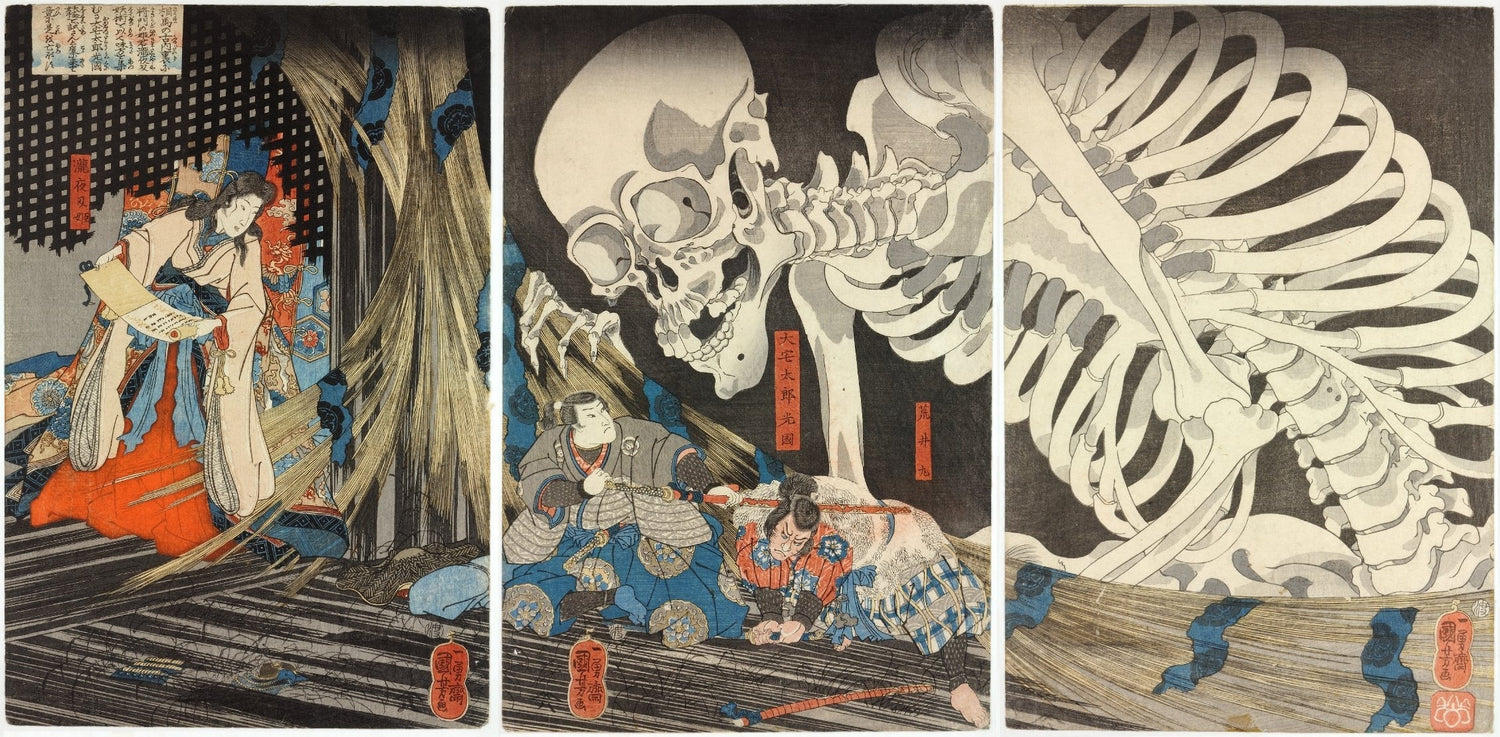
Artists such as Utagawa Toyokuni, Utagawa Kunisada, and Utagawa Kuniyoshi became leading figures in actor and warrior prints, combining bold compositions, strong outlines, and rich colour schemes with a flair for drama and personality. Their work helped standardize many of the visual conventions that people today associate with ukiyo‑e, especially in depictions of actors, samurai, and mythological heroes.
In the mid‑19th century, the school also produced the aforementioned Hiroshige, whose travel series made the genre popular far beyond Japan. Hiroshige’s works helped keep the Utagawa school at the forefront of print culture even as political and social changes accelerated in the closing years of the Edo period.
Thanks to its workshop structure, broad subject range, and prolific output, the Utagawa school shaped the look and distribution of ukiyo‑e for nearly a century.

By …trialsanderrors - Utamaro: Young lady blowing on a poppin, 1790
Tips for collecting woodblock prints
Starting a collection of Japanese woodblock prints is both exciting and highly accessible, but it helps to begin with clear goals and a bit of homework.
First, decide what interests you most. This might be landscape prints, kabuki actors, beautiful women (bijin‑ga), or a specific artist such as Hokusai or Hiroshige. Then, focus your research on this niche. Poring through introductory guides, museum catalogues, and collector-focused websites will help you become familiar with major artists, time periods, and how to distinguish originals from modern reproductions.
Once you have the basics down, pay close attention to condition and provenance before purchasing. Look for clean, intact sheets with minimal foxing, tears, or trimmings. Avoid prints that have been heavily retouched or poorly restored, since these can lose both aesthetic and monetary value.
Check for signatures, seals, and publisher marks. Compare them to trusted reference works or online museum databases. There are many beginner-friendly resources out there to help you spot typical woodblock traits, such as hand‑burnished surfaces and subtle colour variations.
Finally, consider how you will display and care for your prints over time. Woodblock prints are light‑sensitive, so they should be framed behind UV‑filtering glass and kept out of direct sunlight to prevent fading.
When not framed, store them flat in acid‑free portfolios or boxes, in a cool, dry environment with stable humidity. Handle them with clean hands or cotton gloves to avoid oil stains.
With careful research, a modest first purchase, and good conservation habits, you can build a meaningful and lasting collection of woodblock prints.
For more on how to identify original woodblock prints, please see this article.