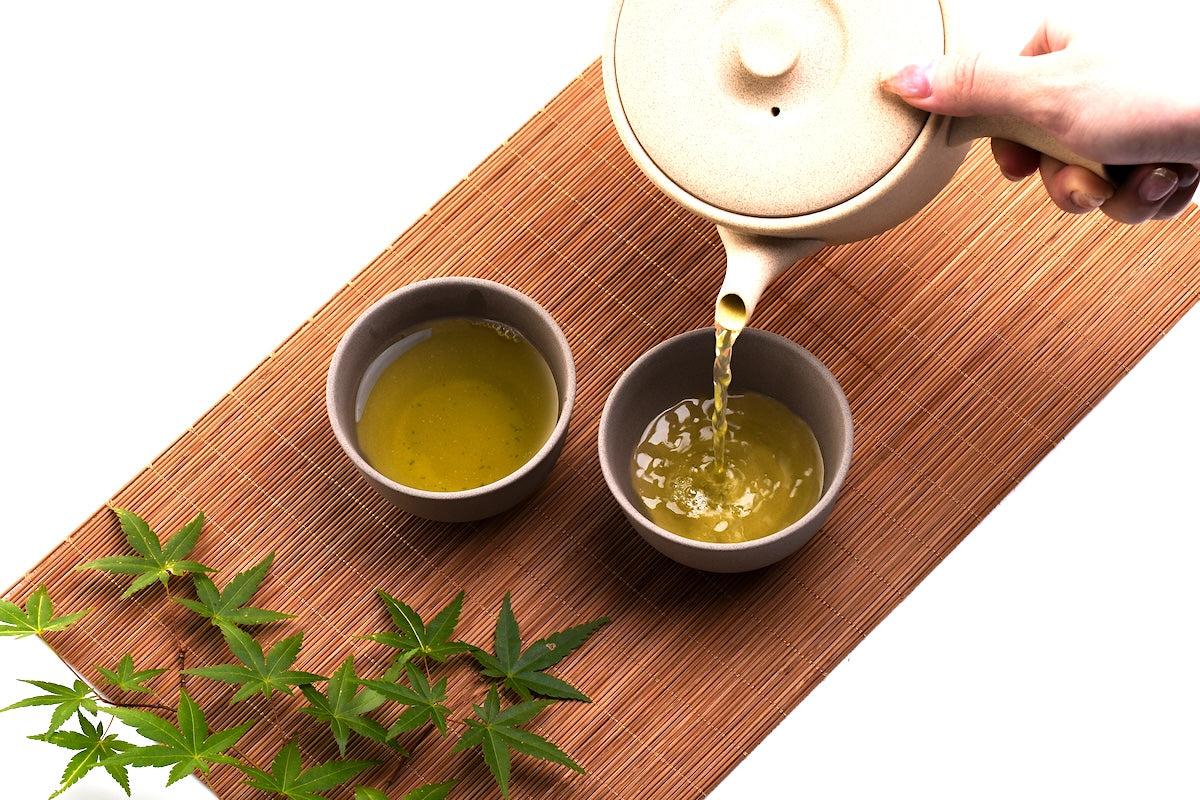
The first time you lay eyes on a yokode kyusu, it may seem as if the factory made a mistake.
The handle juts out sideways. The spout aims in a completely different direction. To anyone raised with Western teapots - those bulbous, back-handled affairs where pouring requires the participation of an entire arm - the kyusu looks like a teapot that took a wrong turn.
It didn't. It just took a better one.
Quite simply, the kyusu is a traditional Japanese teapot with a handle that can be positioned at the back, on top or at the side. But in the West, the term has come to refer specifically to the iconic side-handled style.
A compact vessel that typically holds between 200 and 340 ml, the kyusu is built not for ceremony but for daily use and designed on the premise that there should be no strain when brewing and pouring tea.
Tea in Japan: From the Monastery to the Home
Japan has been shaping tea culture since around the 9th century, when Japanese envoys and monks studying on the continent carried the practice back from Tang dynasty China.
What began as a monastery ritual and a luxury item for the elite - emperors, nobles and samurai - gradually filtered into the homes of ordinary people.
With improvements in production technique, different teas became available and the powdered matcha whisked in bowls was joined by loose-leaf teas that were brewed in teapots. The kyusu was part of that shift, absorbing Chinese side-handle teapot influences and refining them.
The Craft of Brewing and Pouring Tea

At the heart of the yokode kyusu - the side-handled teapot - is a single design insight: position the handle at a right angle to the spout and, suddenly, pouring becomes effortless.
Grip the handle with your right hand. Lightly press the knob on the lid with your thumb. If you want to do a one-handed pour, use your right thumb. Then roll your wrist in a natural, tilting motion. The tea flows out cleanly, without the shoulder rotation that a back-handled pot requires.
There's also a subtler mechanism at work: when the small hole in the lid is aligned toward the spout before pouring, air circulates inside the pot, creating a gentle convection that helps draw out the last drop of tea.
That final drop is not an afterthought. In Japanese tea brewing, it's considered the most concentrated portion of the infusion, where the umami is highest and the flavor most complete.
The lid is also worth a moment's appreciation. In the finest kyusu teapots, particularly those from the celebrated kilns of Tokoname, the lid is fired alongside the body.
Both pieces shrink at the same rate, achieving a fit so close it can feel nearly airtight. Because lid and pot are born together, replacing a broken lid is virtually impossible - which says something either about Japanese craftsmanship or about the importance of not dropping things.
Form and Function: Tea Made From Clay
More than a material, the clay that the kyusu is made from becomes part of the brew itself.

The most celebrated kyusu-producing region in Japan is, arguably, Tokoname in Aichi prefecture.
Tokoname clay is rich in iron, giving finished pieces their characteristic reddish-brown color, known as shudei. That iron content does more than lend a warm hue. It reacts with the tannins in tea, softening bitterness and rounding out flavor.
Banko ware, produced in Yokkaichi in Mie prefecture, works from entirely different material logic. Banko clay contains lithium-bearing minerals that give it exceptional heat resistance - the finished pot barely expands under thermal stress, which means it handles the daily cycle of filling with near-boiling water without structural complaint.
The mineral profile of the clay also interacts with tea tannins to produce a mellower, rounder flavor than you might get from a glazed vessel.

Left unglazed, a Banko kyusu develops its own personality over years of use, the surface acquiring a natural sheen that no factory finish can replicate.
Shigaraki ware, from Koka in Shiga prefecture, is the most expressively rustic of the three traditions. The clay comes from ancient sediment layers beneath Lake Biwa, coarse in texture and with small stones that remain visible in the fired surface.
In the kiln, straw wrapped around a Shigaraki vessel leaves streak patterns known as hidasuki, while ash settles on exposed surfaces to create natural glazes. A Shigaraki kyusu makes no apology for looking handmade. It insists on it.
Those who prefer their tea flavor uninfluenced by clay altogether may prefer porcelain kyusu - such as those produced in Arita, Saga prefecture - which offer a smooth, non-porous surface. These are particularly favored by tea enthusiasts who taste across varieties and want a neutral vessel.
Optimal Strainers: Holes in the Right Places
Most kyusu come with a strainer. While the design varies considerably, what matters is that it should give the tea ample space to unfurl in the pot while keeping the leaves out of your cup.
Kyusu tea strainers are broadly divided into two categories: ceramic and metal.
Ceramic strainers have the advantage of enhancing the tea's flavor while metal strainers are popular because they're easy to clean and can be used for different tea types.
The traditional type of strainer, or chakoshi, covers the base of the spout and is made from the same clay as the teapot body, with small holes pierced by hand.
Unlike metal strainers, these dome-shaped filters introduce no metallic note to the tea, allowing its natural aroma to pass through cleanly.
Sasame strainers, which have smaller holes, are designed for tea with more finely broken leaves such as fukamushi sencha (deep-steamed green tea).
Metal mesh strainers offer a different set of advantages. The obi-ami wraps around the inside circumference of the pot, its large surface area reducing clogging and allowing even voluminous tea leaves to spread freely, which improves extraction.
The hira-ami, a mesh filter covering the base of the spout, is even simpler - and easier to clean.
The choice comes down to what you're brewing and how much you enjoy washing things. For fine-leaf teas such as fukamushi sencha, a sasame strainer is worth seeking out.
For coarser teas - genmaicha, hojicha, bancha, kukicha - almost any built-in strainer will do.
A Pot That Improves with Use
Here's a piece of information that should endear the unglazed kyusu to anyone who has trouble letting go of things: the teapot gets better the more you use it.
An unglazed, high-fired clay kyusu is microporous enough to absorb small quantities of tea compounds with every brew.
Over time, the iron in the clay reacts with tannins to develop a natural patina, a soft gloss called tsuya, that forms on the surface without polishing.
The pot's interior builds up layers of tea oils and aromatic compounds, meaning each successive brew is informed by every one that came before it. This is why dedicated Japanese-tea drinkers assign a kyusu to a single type of tea.
After pouring tea, gently wipe or rub the teapot with a dry cloth. Small amounts of tea oils transferred to the surface will gradually produce a subtle gloss.
To keep an unglazed kyusu in optimal condition, follow this simple rule: never use soap or detergents. These will penetrate the micropores of the clay and leave residues that affect every subsequent cup.
Just rinse the teapot thoroughly with water or hot water immediately after each use, then dry it upside-down in a well-ventilated spot until completely dry.
For deeper cleaning when tea stains accumulate, soak the teapot and lid for about 30 minutes in a solution of 2 tablespoons of baking soda dissolved in 1 liter of hot water. Rinse thoroughly afterward.
Chlorine bleach, metal scrubbers and the dishwasher should not be used - but you knew that already.
Not Just a Traditional Japanese Teapot

The kyusu is, in the end, a study in considered design: a small object that encodes centuries of understanding about how tea should be prepared and shared.
Its side handle is not a stylistic quirk. Its porous clay is not used for aesthetic appeal. Its built-in strainer is not added in a quest for unique features. Each element is a solution to a problem that Japanese tea culture had the patience, over many generations, to solve.
To brew tea in a kyusu - to align the lid hole toward the spout, tilt the wrist and pour out the last drop - is to enjoy Japanese design. That, along with technique and terroir, is what gives every cup its flavor.
By Janice Tay