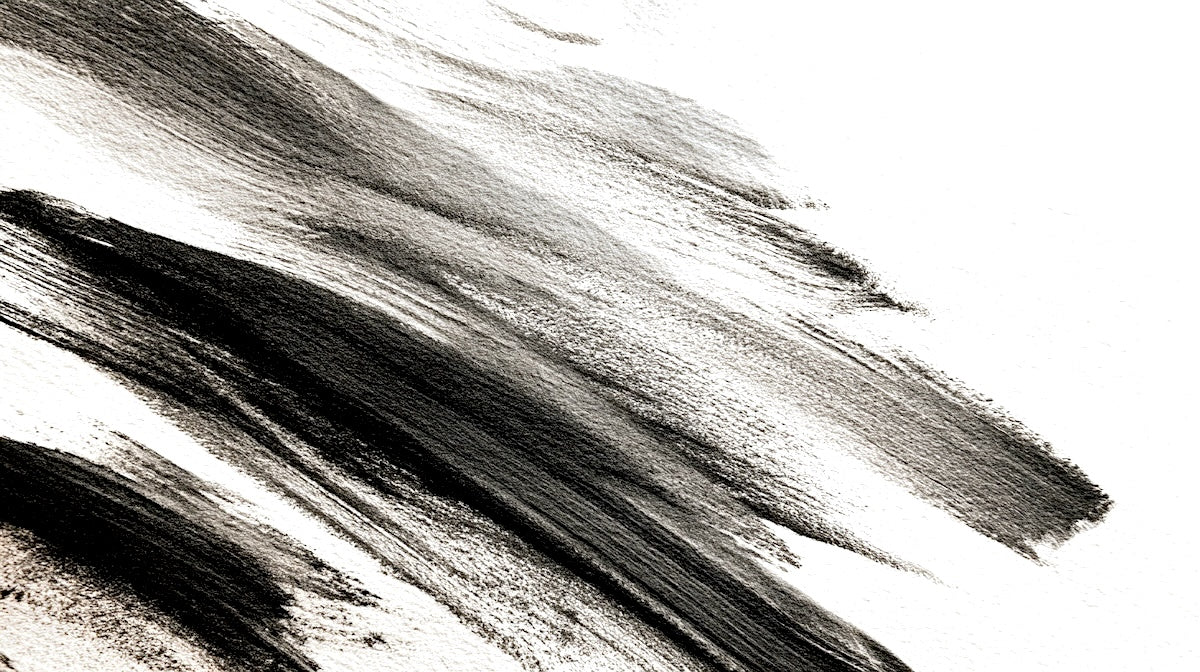
Some people would say that black isn't a color. Sumi ink has been disagreeing for roughly 3,500 years.
What looks like absolute darkness is, in classical Japanese aesthetics, a spectrum. The saying goes: sumi ni gosai ari (墨に五彩あり) - in ink, there are five colors. This dark rainbow spans a range that goes from the charred depth of pure carbon to a light, diluted gray.
The material that produces them is older than most countries; sumi dates back some 3,500 years to China's Yin dynasty, also known as the Shang dynasty.
From China, sumi traveled through Korea and arrived in Japan during the Asuka period (around 592-710). The Nihon Shoki chronicle records that, in 610, two Korean monks were presented at the court of Empress Suiko. One of them was skilled in the making of paper - and ink.
Carbon, Glue and Fragrance: The Anatomy of Sumi

Sumi is simpler than most people expect: soot, animal glue - called nikawa - and a small measure of fragrance pressed into a stick.
The soot gives the ink its deep black, the nikawa fixes it to paper or wood and the fragrance neutralizes the smell of the glue and calms the mind of whoever holds the ink stick or brush.
The soot determines the character and grade of the ink. Historically, the soot from vegetable oils and pine trees have been used. Oil-smoke ink - yuen boku - comes from burning vegetable oils such as rapeseed or sesame. The result is a lustrous, dense black that tips, under certain light, toward blue.
Pine-soot ink - shoenboku - is coarser and its black runs warm with brown or reddish undertones.
Once brushed onto paper, the black may change. Aged ink, koboku, is prized not because of nostalgia but because of chemistry. Over the years, the glue that binds the particles undergoes hydrolysis, stabilizing them and enabling them to settle into the paper rather than sitting on top of it. The nijimi, or bleed, softens and the tones become more varied.
Sumi is usually described as being composed of three ingredients but time could be said to be the fourth.
Nara: The Capital of Ink
The city of Nara has been synonymous with sumi for more than a thousand years. In the Nara period (710-794), when the city served as the imperial capital and Buddhist scribes copied sutras in enormous quantities, ink was regarded as a valuable commodity.
By the Heian period (794-1185), when the capital was moved to Kyoto, demand had grown further still, with the kana script newly invented and the educated classes writing away with enthusiasm.

The pivotal chapter in Japanese ink history involves Nara temple Kofuku-ji (above) and a useful accident of supply. Established as the clan temple of the powerful Fujiwara family, Kofuku-ji managed the production of sesame oil for lamps - which meant it also had ready access to the soot left behind when the oil was burned.
During the Muromachi period (around 1336-1573), a section of the temple called Nitaibo became Japan's first center of production for oil-smoke ink. Soot that came from the burning of lamps offered to the Buddha was collected from where it had accumulated under the roofs, then mixed with glue and made into ink.
Because the temple controlled the sesame oil supply, large-scale production was possible. Nanto yuen - Nara oil-smoke ink - became the standard of excellence across the country, so celebrated that 'Nara ink' became nearly synonymous with ink itself.
In the Edo period (1603-1896), commerce expanded and ink-making moved from the temple into the marketplace. Records from 1670 show nearly 30 ink shops in Naramachi, the merchant district in central Nara; by around 1710, the number had grown to 40.
One of those shops is still in business. Kobaien, founded in 1577, continues to operate in Nara - more than 400 years and counting.
In 2018, Nara inkstick production was certified as a traditional craft by Japan's Ministry of Economy, Trade and Industry. The city now accounts for about 90 per cent of Japan's domestically produced solid ink.
How to Grind Ink
Using a sumi stick to grind ink on a suzuri - an inkstone - is considered part of the calligraphic discipline, a way of settling the mind before the brush ever meets paper.
The suzuri has two surfaces: a flat grinding area called the oka (陸) - literally, land or shore - and a reservoir called the umi (海), or sea. A small amount of water that forms roughly the size of a coin is poured onto the oka.
The ink stick is held nearly vertical and moved back and forth or in slow circles, as if tracing the Japanese character, 'no' (の). Press only with the weight of the stick itself because too much force will make the ink cloudy and can also damage the inkstone. The classic instruction is to grind as a sick person would grind.

As the ink thickens and darkens on the oka, it is moved into the umi and a little more water is added to the flat surface. Rotate the ink stick slightly from time to time to ensure that the wear is even and the stick maintains its shape.
The grinding continues until the ink reaches the desired concentration.
The sign that it's ready? When the ink is rich and dark and a fragrance rises from the stone. In winter, when the glue is more prone to hardening, lukewarm water above 20°C helps things along.
After use, any ink remaining on the tip of the ink stick should be wiped off with paper. Left damp, the stick will crack.
Ink Stick and Bottle: Two Mediums for Black
For most of sumi's history, there was no alternative to grinding. If you wanted ink, you - or someone near you - had to make it.
That changed in 1958, when calligraphy education was reintroduced into Japanese schools after its postwar prohibition. A classroom of children grinding ink is a beautiful idea; in practice, it's a recipe for ink-stained chaos. Liquid sumi - bokuju - was developed to meet the new demand: ink in a bottle, ready to use, no suzuri required.

The technical challenge was genuine. Ground ink that's left standing deteriorates within 24 hours - a condition called shukuboku, in which the water and soot separate and the ink loses its vitality.
Producing liquid ink that maintains its freshness required new dispersion technologies. Modern manufacturers use mills to break soot into uniformly fine particles and liquid sumi today can hold its quality for more than three years if the bottle is left unopened.
The differences between solid and liquid sumi are clear. Ink ground fresh on the suzuri allows the calligrapher to vary concentration and texture, producing the tonal depth that gives brush work its dimensionality.
Bottled ink tends toward a flatter, more consistent black - suited to practice but offering less room for the spontaneous variation that makes a finished piece breathe. High-quality liquid ink has narrowed this gap considerably but the consensus remains: liquid ink for practice; solid sumi for art.
From Student to Master: Sumi Product Grades
Not all black is created equal and sumi's classification system reflects this.
At the beginner end, practice inksticks and liquid bokuju use coarser soot and lower-grade nikawa. The color is a strong, serviceable black. For school lessons and daily practice, this is entirely appropriate - and affordable.

At the professional end, high-grade sumi uses extremely fine soot - oil-smoke or premium pine - that's bound with superior animal glue. Often, the sumi is aged for years.
The most prized category, called komoku, or aged ink, may rest for decades. As the glue slowly stabilizes and integrates with the soot during this long aging, the result is an ink of unusual smoothness.
When ground lightly and used in diluted form, high-end sumi yields delicate hues and tonal variations that bring depth and dimensionality to brush work.
Storing Sumi: Patience, Paulownia and a 10-Yen Coin
Sumi ink sticks repay careful attention. In high humidity, direct sunlight or the direct blast of an air conditioner, the nikawa will deteriorate and the sumi will crack.
The traditional remedy is a paulownia wood box, which regulates humidity naturally. A cool, well-ventilated drawer should work too. Plastic bags are a poor choice: they trap moisture and invite mold. Remove any plastic packaging from the ink sticks you buy to allow the ink to breathe.
After each grinding session, wipe the tip of the ink stick clean with paper. Avoid cloth as the fibers can adhere to the surface of the stick. Air-dry the sumi completely before storage.
There's also a piece of practical folk wisdom: placing a 10-yen coin near a stored ink stick is said to help reduce the ambient humidity. If this works, it may be because of the copper content - or because a person who would bother to do this is likely to be careful about everything else to do with sumi.
Liquid ink has a shelf life of about three to five years unopened and it should be used within one to two months after opening. Store it at room temperature in its container.
Ink sticks, on the other hand, can last even longer, maturing over the years as the internal moisture evaporates. With proper storage, ink sticks become better the longer they're kept.
Preparing More Than Ink
Sumi is often described as a writing material but it is equally a medium for art.
Its ability to produce subtle gradations - from deep black to pale gray - allows for expression that goes far beyond simple lines. The variation in tone, the movement of the brush and the interaction with paper all contribute to the final work.
In a world that usually prioritizes speed and convenience, sumi insists on something else. Through the act of grinding ink, you are asked to slow down and pay attention. Before you can express yourself in words or pictures, you must first prepare the ink - and a space within yourself for it to flow.
By Janice Tay