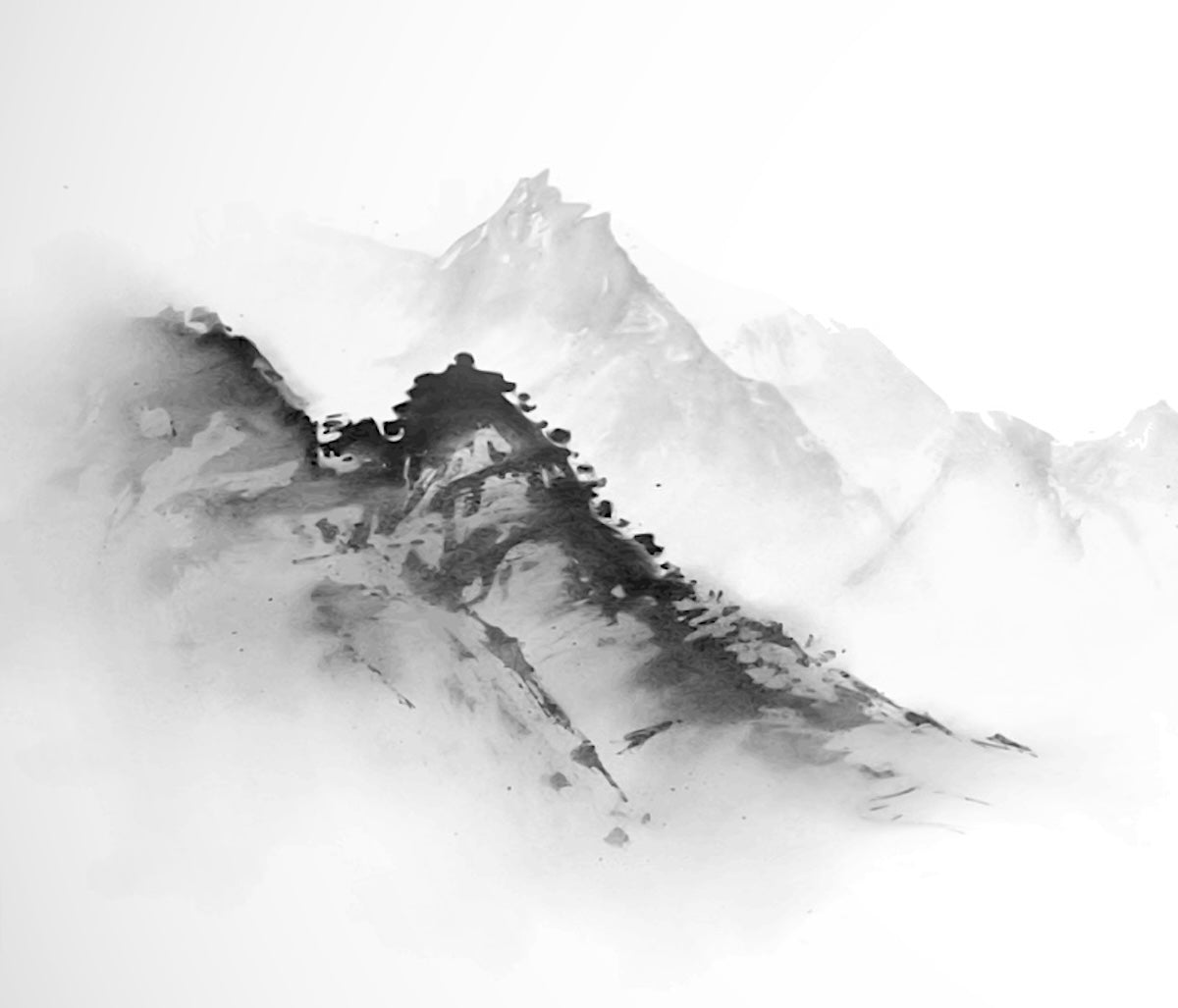
Most art forms offer second chances. You can paint over a mistake in oils or sand back an error in wood. But in Japanese ink painting, you get only one shot. The moment the brush meets the paper, the mark is permanent. There is no going back and no correction.
This can be a terrifying constraint or, depending on your philosophy, the whole point.
Sumi-e (墨絵), also known as suiboku-ga (水墨画, ink wash painting), captures the world using only black ink, a brush, water and white paper. No color. No outline that can be filled in later. The ink is the form and the space around it is its equal because, in sumi-e, what is left unpainted is not a void but a visible form.
The art arrived in Japan from Tang dynasty China, carrying with it a philosophy as exacting as its technique. To understand why Japanese ink painting looks the way it does, you have to follow it back to where it began: inside a Zen monastery.
The Monastery As Studio
Zen Buddhism reached Japan in two main waves during the Kamakura period (1185-1333): Rinzai Zen, brought by the monk Eisai (栄西), and Soto Zen, introduced by Dogen (道元). Both schools arrived from Song Dynasty China with a cargo of cultural objects that included tea, ceramic styles - and ink painting.
That ink painting and Zen arrived together was not coincidental; the form suits the philosophy with an almost suspicious precision. Zen holds that enlightenment cannot be transmitted through language - the direct experience of reality lies beyond what words can reach. Ink painting offers another route. The movement of the brush, the quality of a single stroke, the breath held before ink meets paper - these express what the Zen tradition calls mu (無), the state of no-mind, free of attachment and deliberate thought.

For Zen monks, painting isn't a hobby enjoyed in between meditation sessions. The attention required by seated meditation is similar to that demanded by the brush. Both practices aim at the same thing: a mind so present, so emptied of distraction, that something true can emerge.
The first works produced in Japanese Zen temples were portraits of eminent monks and paintings that illustrated episodes of Zen teaching, moments of sudden insight that couldn't be explained but could be shown.
The Gozan (五山) - the Five Mountains temple system of Kyoto and Kamakura - became the infrastructure through which ink painting spread. With shoguns as their patrons, the great Zen temples of the Muromachi period (1336-1573) functioned as centers of Buddhist and artistic refinement. There, calligraphy, ink painting and garden design were practiced in close proximity, producing the culture we now recognize as Japanese Zen.
The kare-sansui (枯山水) garden, with its raked gravel and considered rocks, emerged in the same temples and the same era. Both garden design and ink painting embody the same principle: remove everything that is not essential and what remains will speak more forcefully than anything you could have added.
Brush Techniques in Japanese Art

The fundamental techniques of ink wash painting center on the controlled use of ink density - often described as gosai, the ‘five colors' of ink - and brushwork, which balances wet and dry strokes to create depth and emotional nuance.
The brush is loaded through a technique called choboku (調墨, ink preparation) - darker ink toward the heel, progressively lighter toward the tip - so that a single side-tilted stroke, sokuhitsu (側筆), produces a gradient from dark to pale within one movement. This is the three-ink method, sanboku-ho (三墨法): dark, medium, light, loaded simultaneously, rendered in one pass.
From here, the technical vocabulary expands. Nijimi (にじみ), the soft-bleeding wet-brush technique - written also as junpitsu (潤筆) - involves applying water or light ink to the paper first, then dropping deeper ink on the wet surface, allowing it to bloom organically. The result suggests mist on a distant mountain, water on stone or the soft fullness of a cloud.
Kasure (かすれ), also known as kappitsu (渇筆) or the dry-brush effect, works in the opposite direction. The brush is stripped of almost all moisture, its bristles splitting as they move, leaving broken, textured marks across the paper. This is the technique for weathered bark, waves striking rock and the force of a waterfall.
Between the softly spreading nijimi and the driving kasure lies the entire emotional range of the form.
Then there is haboku-ho (破墨法, broken ink technique), where concentrated ink is layered over still-wet lighter washes, creating texture and depth. Tarashikomi (たらしこみ) drops ink onto a wet base and lets the resulting bloom form whatever shape it chooses, the painter making peace with controlled accident. With bokashi (ぼかし), diluted ink is applied to damp paper to build atmospheric depth and soften transitions - the dimming of forms as they recede into distance, the spatial sensation that a landscape is not flat.
Underlying all of this is a concept that defines suiboku-ga as surely as the ink itself: yohaku no bi (余白の美), the beauty of empty space. In most painting traditions, the blank areas of a canvas are places waiting to be filled. In Japanese ink painting, the untouched paper is an active element. It is the sky that does not need to be painted to be sky. It is the mist implied by a mountain rendered only halfway up. The spaces left unpainted invite the viewer's imagination to step in and complete the composition.
Three Masters of Monochrome Painting
The three Japanese artists who shaped the history of suiboku-ga worked centuries apart and yet they form a coherent lineage: a line drawn from technical mastery toward spiritual audacity and something harder to classify.
Sesshu Toyo (雪舟等楊, c.1420-1506) remains the dominant figure. Born in Bitchu province (present-day Okayama), he trained at Shokokuji, one of the great Zen temples of Kyoto's Gozan system.
In 1467, he boarded a tributary mission ship bound for Ming China, spending some three years there immersed in the study of painting. His work blends strong Chinese influences with Japanese aesthetics into a distinctive style, illuminating landscapes, portraits and bird-and-flower themes with a Zen sensibility and bold brushwork.
Sesshu's heirs included Sesson Shukei (雪村周継), who developed an idiosyncratic style, and Hasegawa Tohaku (長谷川等伯), whose Shorin-zu Byobu (松林図屏風, Pine Forest Screen) shows pine trees half-consumed by mist, the interval between them as present as the trees themselves.
The Kano school, which served the shoguns from the Muromachi period well into the Edo period (1603-1868), claimed Sesshu as their spiritual forefather, producing generations of technically accomplished painters in his name.
Hakuin Ekaku (白隠慧鶴, 1686-1769) came to painting from a different direction entirely. Considered the reviver of Japanese Rinzai Zen - he reformed and systematized Rinzai practice - he did not begin painting seriously until his 60s. But the work he produced in the two decades before his death constitutes one of the more expressive bodies of art in Japanese history.
Where Sesshu pursued technical skill, Hakuin pursued Zen immediacy. His paintings are deliberately rough, sometimes apparently clumsy, and even funny. They portray Bodhidharma - Daruma - in forms that range from the austere to the absurd, yet each is so compelling that his gaze seems to bore straight into the viewer.
A Living Form: Japanese Ink Painting Today

Contemporary Japanese ink painting no longer confines itself to bamboo and distant mountains, though both still appear. The form has expanded to encompass abstract expression, social imagery and work combining sumi ink with acrylic on canvas, glass or metal - materials that respond differently to ink, producing effects that traditional washi paper does not allow.
The underlying principles have not changed. The shades of black still do the work that color performs elsewhere. The areas of emptiness still carry the weight of form. The brushstroke is still irreversible, which means it continues to ask of the painter the same thing it always has: complete presence at the moment of contact.
Tarashikomi, the ink-pooling technique that Rinpa school painter Tawaraya Sotatsu used so effectively in the 17th century, has found new life applied to acrylic grounds, producing bloom effects more vibrant and three-dimensional than can be achieved with paper.
Taking the form into directions that the early masters could not have imagined, digital artists recreate nijimi and kasure through software. Whether the loss of irrevocability changes the fundamental nature of Japanese ink painting is a question that practitioners are still working out.
Pick Up the Brush
It's just one brush and one color - why not give it a shot?
Single-session workshops are available in Tokyo, Kyoto and other major Japanese cities, typically running for 60 to 90 minutes.
The standard beginner subject is bamboo - not because it's the easiest thing to paint but because painting a single stalk of bamboo requires every core technique: the loaded brush, the side-tilted stroke, the pressure variation that distinguishes a live branch from a dead one. Everything the form demands is present in three or four marks of ink on paper.
Apart from bamboo, the other classic subjects are ume, orchid and chrysanthemum. Known as the four gentlemen (四君子, shi kunshi), each one is chosen for what it teaches the hand that holds the brush.
Painting the Mind
Sumi-e takes thousands of hours to learn and just one second to ruin.
You can practice for months and produce a piece that pleases you, then pick up the brush the following week and produce something that doesn't. Don’t let this dishearten you; this is simply what it means to work in a form that mirrors the state of your mind - and paints it as it is.