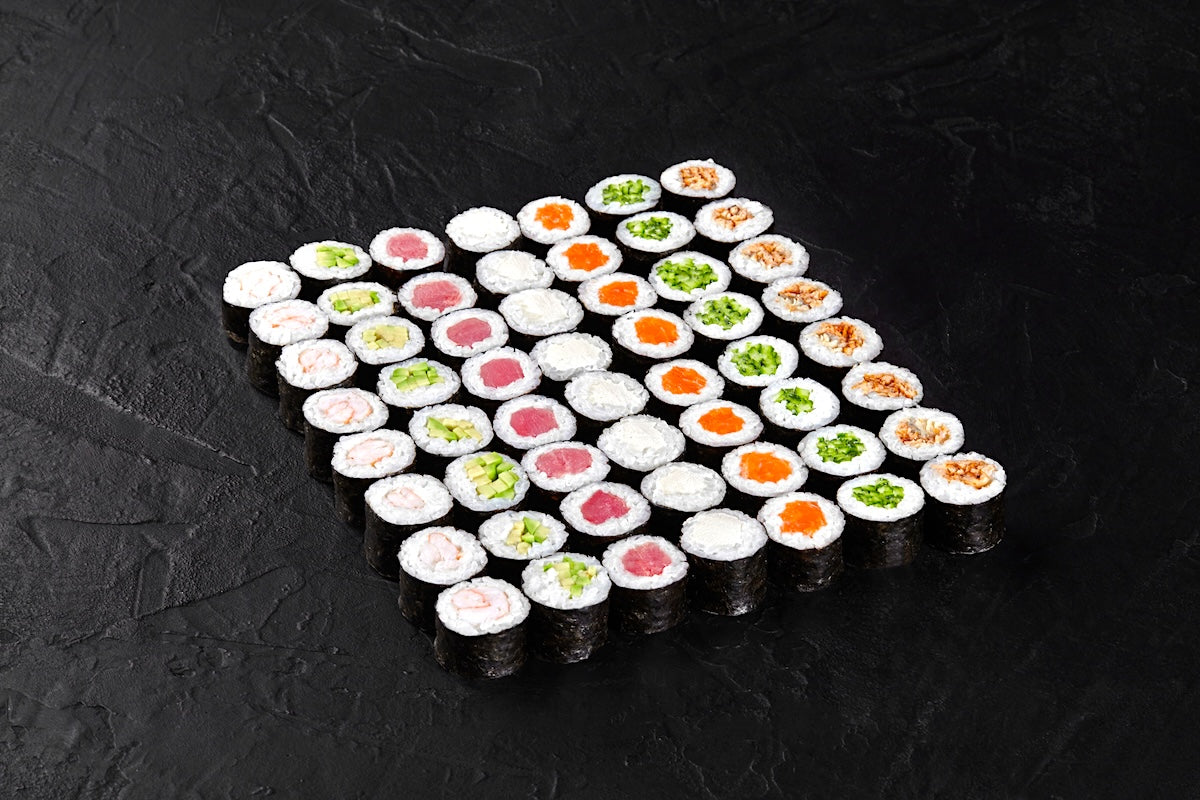
If you've ever dined at a sushi restaurant, chances are, you ate off footwear.
To Japanese eyes, the raised wooden board beneath your nigiri echoes the form of traditional wooden sandals - and takes its name from them.
Composed of a flat base raised by one or two 'teeth', geta are now worn mostly with yukata at summer festivals and perhaps by guests navigating the garden of a ryokan inn. Just as the sandals keep feet clear of mud and puddles, sushi geta raises the food slightly above the table - a detail that's no accident.
Traditional Wooden Platters: Footwear Items in Table Service

If sushi had a preferred mode of transport, it would almost certainly be the geta.
The standard single-serving sushi geta measures roughly 24 cm wide and 15 cm deep. (The version that comes without feet is known as a mori-ita, or serving board.)
Sushi used to be served directly on the counter surface, with leaves known as baran used as a platter. Serving boards were developed in response to two problems: hygiene and moisture. A raised platform keeps the food away from spills and damp counters; it also makes cleaning easier. Critically, it's a durable option; a board can be shaved smooth and refinished when it begins to show wear.
The preferred wood is pale, unlacquered timber cut in what woodworkers call masame (柾目), a straight, parallel grain prized for its visual refinement as well as its ability to resist warping and to absorb moisture better than the common cross-grain alternative, itame (板目). This moisture-wicking quality helps to keep sushi in optimal condition and explains why traditional sake barrels and rice storage boxes are also crafted from masame timber.

Among the wood options, hinoki - Japanese cypress - is the material of choice. Apart from its ability to absorb moisture, it also contains hinokitiol, a compound with antibacterial properties - an asset when you're serving raw fish.
Hinoki carries prestige associations that run deep in Japan. The same wood has been used for centuries in the construction of imperial and religious buildings including Ise Jingu, where 125 shrine structures are rebuilt every 20 years using unpainted hinoki.
There's one etiquette point worth noting before you next sit down at a sushi restaurant. If the geta is presented on a counter, eat from it where it sits. Pulling it closer to you or holding it in one hand as you eat with the other, is not the done thing. The board is the stage the chef has set so leave it where it is.
Platter Types: Beyond the Geta
Sushi is small. This is both its charm and its logistical challenge.
Roughly the size of a large thumb, a single piece of sushi risks looking slightly lost on a standard dinner plate. The traditional solution is not to enlarge the sushi but to choose a plate that displays it to advantage.
A good sushi plate provides space - and contrast. Each piece is given room to breathe as well as space for fingers or chopsticks to slip in and pick it up. Contrast allows the color of the ingredients - the rose and ruby glow of tuna, the inky depths of seaweed - to stand out.
The geta dominates sushi plating but it's only one vessel in a wider vocabulary. Japanese tableware has a far richer taxonomy of shapes than the Western equivalent does and the sushi restaurant draws from all of it.

The long, rectangular plate - nagakaku zara - is perhaps the most common alternative to the sushi geta. Its shape suits the horizontal arrangement of multiple pieces of sushi or sashimi and the parallel lines of the plate reinforce the diagonal flow of the plating without competing with it.
Round plates (maru zara) are standard in casual settings; their geometry suits a circular or scattered arrangement. Oval plates (daen zara) sit between the two.
Then there are the henkei zara - the irregular plates shaped like leaves, gourds or forms with no Western equivalent name. These appear most often in high-end seasonal menus, where the vessel is chosen to echo the time of year: a leaf shape in autumn, a fan form in summer. The plate is doing the same work as a flower arrangement in the tokonoma alcove: signaling the season before anyone has tasted anything.

But while it's fun to build up a collection of tableware with different shapes, there's no need to bust the budget by buying up plates in all the forms available.
Vessels and materials that seem more mass-market, more commercial than handcrafted, can be effective - if you know how to arrange sushi.
Placement Styles: Color, Contrast and Where the Tuna Goes
The Japanese kitchen follows one visual rule: complementary colors. Tuna's deep red reads best against blue-toned or dark ceramic; white fish floats on a black base; salmon - warm, coral-orange - pops on a plate with cool grey or slate tones.
The underlying logic is that color contrast makes both elements more vivid. Two things in the same tonal family cancel each other out; two things in opposition make each other sing.
The same principle governs how pieces are arranged on the plate. For nigiri laid across a geta or rectangular plate, the standard method is nagashimori - the 'flow' arrangement. Pieces are angled slightly, tilted counterclockwise so each one faces diagonally to the lower right and the whole row runs from upper-left to lower-right across the vessel.

For a round platter, the approach shifts entirely. In hosha-mori - radial arrangement - pieces fan outward from a center point, like the spokes of a wheel or the petals of a flower. Maki rolls and gunkan maki are often grouped at the center to anchor the composition; nigiri radiates outward. Because the arrangement has no fixed front or back, it reads well from any angle across a table.
A third method, more demanding and more striking, is chirashibori - scattered arrangement - in which pieces are placed across the plate with wide spaces between them, each one treated as an individual rather than part of a sequence.
At least 30 per cent of the plate should remain empty; some chefs go further. Used correctly, space draws the eye to what is there, not to what surrounds it, and the emptiness becomes part of the composition.
Where should one begin when presented with an array of sushi? The convention is to eat from upper-left to upper-right, then lower-left to lower-right because the chef has placed the pieces in a considered progression from mild to rich. Eating in sequence lets each neta land at its intended moment.
Garnishes complete the picture. Shiso - perilla leaf - anchors the composition and provides the green that sushi, heavy on warm reds and pale whites, tends to need. Gari, the pickled ginger, adds its blush-pink tone and breaks the palette open. Going beyond mere decoration, each ingredient does two jobs at once.
The soy sauce dish sits to the lower right. Wasabi, in a restaurant where it is served on the side rather than pre-applied by the chef to the sushi, should not dissolved into the soy sauce. This dilutes the sauce and flattens the aromatic edge that makes fresh wasabi worth paying for.
Reading the Room: How Plate Style Signals Ambiance
The tableware in a sushi restaurant is on par with everything else in the room.

At the high-end omakase counter, the geta is fine-grained hinoki, unlacquered and almost certainly expensive. If ceramics appear, they are likely from named kilns: Bizen for its unglazed, earthy warmth; Hagi for its soft, porous surface; Kutani for its vivid overglaze painting when a moment of visual drama is called for. Choosing them is part of the chef's craft.
At the mid-range neighborhood restaurant, rectangular plates in sometsuke - blue-and-white painted porcelain - do steady, reliable work. The design is familiar and gives the sushi a cool, clean feel.
At the conveyor belt, the plates are color-coded by price and built to survive dishwasher cyles and energetic stacking by customers - one of the small pleasures of kaiten-zushi dining.
What connects all three is the principle that a vessel and the food it carries are not separate decisions. The plate does not simply hold the sushi. It frames it, seasons it visually and tells the diner something about what they are about to eat before the first piece touches their lips.
Elegant Tools: The Pleasure of Packaging

There are many ways to enjoy sushi. You can dine at a counter in Tokyo, solemnly accepting each piece from the chef as though receiving a small, edible blessing. You can pull it off a conveyor belt at a chain restaurant. You can even pick up a packet of sushi at a supermarket and eat out of the plastic box as you balance it on your lap.
But whichever way you choose, one thing remains true: sushi is not just food. It is presentation.
So the next time you sit down for some sushi, look at what your nigiri is resting on. The chef already did.
By Janice Tay