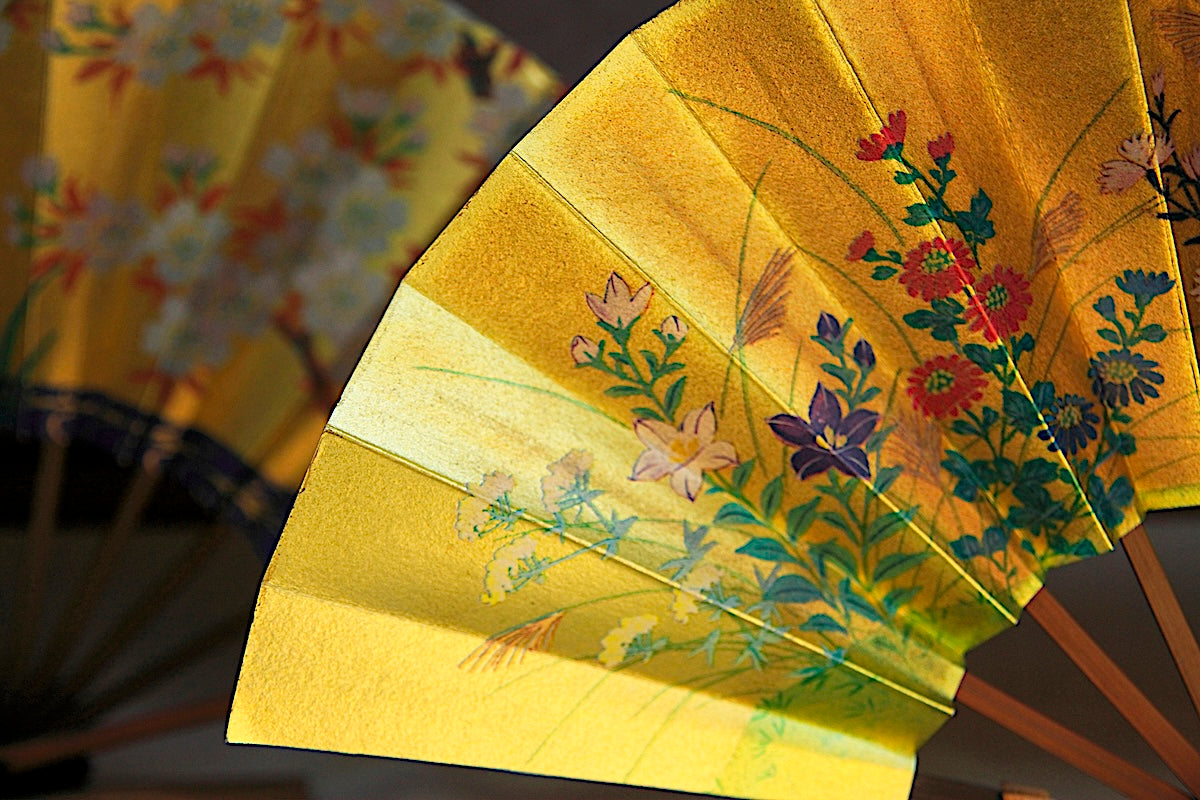
The Japanese folding fan was never just a tool for surviving August. It emerged from the deeply sophisticated Heian court, where aristocrats devoted enormous intellectual effort to matters such as poetry, incense and seasonal color coordination.
So it comes as no surprise that the fan should have become something capable of functioning as an etiquette notebook, flirtation device, ceremonial boundary marker, dance prop and a highly refined method of avoiding eye contact.
This is, in many ways, the ideal Japanese object: deceptively simple and delicate yet capable of carrying centuries of etiquette.
Flat or Folded? The 2 Main Types of Fan
The sensu (扇子) is what most people picture when they think of Japanese fans: slender ribs of bamboo or wood gathered at a pivot, then covered with paper or fabric, flaring out into a shape associated with expansion and growth. That widening arc - suehirogari - makes the sensu an auspicious addition to weddings and milestone celebrations, a lucky charm that also keeps you cool.
The uchiwa (団扇) is a different proposition: a fixed fan, handle plus fan surface, paper over a bamboo or plastic rib structure. This is the fan you see at summer festivals and in the hands of someone trying to coax a reluctant flame to produce dinner.
Both trace their lineage to a single ancestor: the sashiba, a flat, long-handled fan originating in ancient China, carried by attendants to shield high-ranking individuals from view while signaling their presence.
Archaeological evidence places its arrival in Japan during the Kofun period - clay figures shaped like sashiba have been found in 6th-century burial mounds.
From this shared ancestor, Japanese fan culture split in two. One path kept the rigid form and became the uchiwa. The other introduced folds. That innovation produced the sensu and opinion remains divided on precisely where and when it happened, though the evidence leans toward Japan as its birthplace.
The Notebook That Became a Fan
The earliest Japanese folding fan began not as a cooling device but as a notepad. Paper was a luxury in the early Heian period (794-1185); wood was not. Court officials needing to navigate the labyrinthine rituals of aristocratic life turned to the mokkan - thin wooden writing tablets - and bundled several together at one end to produce the hiogi: a fan made of cypress slips, bound at the pivot with cord.
Male courtiers used hiogi in formal settings, sometimes in place of the ceremonial shaku baton held during imperial audiences, sometimes as a notepad for jotting down points of court etiquette.
For women at the imperial court, there were decorated versions. The hiogi served as both adornment and social instrument - used to conceal their faces from men and to communicate their feelings through movement.
From Court to Common Ground
The paper folding fan emerged toward the end of the Heian period, when thinner bamboo ribs covered with Japanese paper - washi - replaced the cypress boards. The shape of the opened fan resembled a bat's outstretched wings; it was called kawahori-ogi, or bat fan.
Lighter than the hiogi and far better at generating a breeze, it spread quickly among both men and women at court.
During the Kamakura period (1185-1333), Japanese folding fans were taken to China, where the folding concept was new. Craftsmen there adapted it, pasting paper on both faces of the frame rather than one, and this double-sided version was imported back to Japan during the Muromachi period (1336-1573). This became the prototype of the modern sensu.
Through maritime trade during the Age of Exploration, folding fans eventually reached European courts, where they became fashionable accessories among aristocratic women - this time, on the other side of the globe.
The sensu was, at first, a possession of the privileged: the imperial court, the priesthood, the warrior class. That began to change in the Muromachi period, when the fan entered the world of Noh and Kyogen theater, tea ceremony and, eventually, Edo-period street life.
By the Edo period (1603-1868), Kyoto fan-making had grown so celebrated that it was elevated to one of the 'three crafts of the capital' - kyo no sanshoku - alongside the making of court caps and ceremonial crowns, and received official government protection.
On the street, vendors sold fans; poets wrote about - and on - them and travelers carried them. The sensu had completed its journey from imperial court accessory to daily necessity, without losing either its associations or its elegance.
The Sensu That Stays Closed

At traditional Japanese tea gatherings, the sensu arrives closed and stays that way. Using it to actually fan yourself in the tea room would be considered a serious lapse in etiquette.
The tea fan - smaller than a summer fan and often plainer in design - is carried into the tea room and placed on the tatami in front of your knees during greetings and during the viewing of the hanging scroll in the tokonoma alcove.
The fan acts as a kekkai: a symbolic boundary placed between the person bowing and the person receiving the bow. In shrine architecture, the kekkai marks the line between the sacred and the everyday; in the tea room, the closed fan laid on the floor says, in effect, 'beyond this point is a space deserving reverence'. The gesture draws a line of respect without a word.
Placement follows precise rules. After greetings, the principal guest moves the fan behind, with the pivot point - the kaname - facing the tokonoma alcove. Subsequent guests reverse this.
The specific conventions differ between tea schools but the underlying logic is the same: the fan becomes indispensable not because of what it does but because of what its presence means.
The Fan in the Performing Arts
In traditional Japanese dance - nihon buyo - the folding fan is called the maiogi (舞扇) and is the most versatile prop in the performer's hands. Where the tea ceremony fan is kept closed, the dance fan never stops transforming.

The open fan can represent the moon, a wave, a sake cup or falling snow - the same object in different positions, angles and velocities. Closing it converts it into a brush, a bottle or a slender blade.
The technique of rotating the fan rapidly around its pivot is fundamental to the vocabulary of Japanese classical dance, a movement that takes years to make it look as easy as it appears.
The maiogi is built for movement. Its bamboo ribs are reinforced with additional thread for durability; a small weight is embedded at the kaname to assist with spinning and to steady the fan during overhead movements.
In kabuki theater, the fan also serves as a sound device: snapped shut against the palm or struck against a wooden surface, it produces a percussive crack that punctuates a dramatic moment. The same fan creates a wave and lands a beat.
In rakugo storytelling tradition, the folding fan can become chopsticks, a fishing rod, a sake flask or a telephone. It is the only prop the rakugo performer uses and it has to be enough.
Two Ways to Raise a Breeze: Kyo-sensu and Marugame Uchiwa
Two of Japan's great fan-making traditions are centered in cities separated by the Seto Inland Sea and by fundamentally different craft philosophies.
In Kyoto, the sensu has been produced for over a thousand years. What distinguishes kyo-sensu is not any single technique but the system by which it is made: about 85 separate processes, each handled by a different specialist. Rib-making, paper preparation, painting and final assembly are all separate disciplines, carried out by separate hands.
By the time a kyo-sensu reaches completion, it has passed through the hands of perhaps a dozen different craftspeople.
Across the Seto Inland Sea, in Marugame on the island of Shikoku, the approach to fan-making starts from a different point.
Marugame uchiwa - flat, non-folding round fans - are made from a single stalk of bamboo, the handle and ribs emerging from the same piece of material, split and splayed. Compared with the kyo-sensu, there is no assembly of parts to speak of; everything that holds the fan together is already in the bamboo when it arrives.
The result is a fan of particular resilience and flexibility. Marugame's uchiwa production accounts for roughly 90% of Japan's domestic uchiwa market, a dominance that began when pilgrims visiting Kotohira-gu shrine in the early Edo period started taking Marugame fans home as souvenirs. The trade made Marugame's reputation.
Japanese Fans: Handle With Care
Made with bamboo ribs and washi paper or fabric joined at a single pivot, the folding fan is not, structurally speaking, a robust object. Just as it was made with care, it needs to be handled with attention.
When opening the sensu, hold the outer ribs lightly between the thumb and forefinger of each hand, then push gently with the right thumb to spread the inner ribs. Never snap it open one-handed; the paper may tear along the folds and the ribs may shift out of alignment.
To close the fan, follow the fold lines back the way they came, both hands guiding the accordion pleats together, one by one. Pressing it flat from both sides simultaneously is the fastest way to break it.
After use, leave the fan open in a ventilated, shaded spot for half a day before closing it for storage - trapped moisture is the most common cause of mold on bamboo ribs and of paper warping at the folds.
When the fan is closed, slip the paper band or elastic that came with the fan around the outside to keep the ribs aligned. Store the sensu away from direct sunlight, damp drawers and the inside of a car in summer.
If the kaname loosens over time, a specialist shop in Kyoto can adjust or replace it. The workshops that handle repairs include Kyosendo, Onishi Tsune Shoten and Hakuchikudo, which has been making and selling kyo-sensu since 1718.
Practicality, Patience and Poetry

Many traditional objects end up trapped behind glass in museums, accompanied by explanatory labels and a faint atmosphere of institutional sadness.
The folding fan avoided this fate by continuing to participate in daily life. It still appears in summer festivals, tea rooms, dance studios, wedding gifts, department stores, commuter bags and the hands of elderly Kyoto gentlemen who somehow manage to look dignified even while using one to cool themselves at a bus stop.
Part of the sensu's endurance lies in the fact that it goes beyond performing a function to creating a mood. Opening a sensu slows the body down slightly. The gesture asks for a small degree of deliberateness and patience that modern life rarely encourages.
In return, the sensu produces not just air but a sense that civilization has not entirely collapsed - and can be revived with one leisurely wave.