Introduction
En-musubi is a word that often crops up in Japanese, especially at Shinto shrines where people pray for love, marriage, and successful relationships. Consisting of the words for ‘fate/connection’ and ‘tie/bind,’ it refers to the idea of making fateful encounters happen, or forging or strengthening one’s romantic relationships. In a larger East Asian context, it is related to the red thread of fate, an invisible magical cord that connects two destined lovers.
What does this have to do with noodles? In short, it’s about wordplay. Some of the noodle shrines below, especially the newer ones, talk about men-musubi, or loosely translated, the noodles of destiny. It can mean all sorts of things — encountering a fateful bowl of noodles, improving your noodle-related fortune, or perhaps even warding off noodle-related misfortunes (like spilling broth on your nice white shirt).
You can assume that all of the noodle shrines below offer divine assistance in finding men-musubi. If you’ve ever wanted to pray for a meet-cute over a bowl of ramen, these are the places to hit up.

Somen
The reader may be familiar with somen from videos of ‘nagashi somen,’ where diners scoop up small mouthfuls of chilled wheat noodles as they flow through chilled water in a bamboo gutter. It's a refreshing summer snack where half of the fun is trying to catch the noodles fast enough with your chopsticks.
Shrines dedicated to somen are decidedly uncommon. It all begins with Ōmiwa Shrine in Sakurai City, Nara, thought to be one of the oldest shrines in Japan. According to shrine lore (to be taken with a pinch of salt) around 1,200 years ago there was a plague and famine in the Miwa area and in desperation, a descendant of one of the shrine’s deities, Ōta-taneko, prayed to the gods for help and relief. This came in the form of a divine revelation that bestowed upon him the method of making somen noodles.
As instructed, he sprinkled the fertile soil with wheat seeds, then ground the matured wheat into flour using a water-powered millstone. (Magic fast-growing wheat seeds, it seems.) He kneaded it with water from the sacred spring, and stretched it into slender, snow-white threads. Such were the legendary beginnings of hand-pulled Miwa somen, the method for which spread to other parts of Japan, including Banshu (present-day Hyogo), Shodoshima (also famous for somen), and Shimabara.

Today, Omiwa Shrine is still considered the guardian deity of somen. Not so surprisingly, one of their summer festivals — Miwa Somen Kanshasai, or the Miwa Somen Gratitude Festival — is all about celebrating these noodles (specifically the sales of these noodles), with dances performed to folk songs about Miwa Somen.
There’s another Ōmiwa Shrine in Tatsuno City, Hyogo Prefecture, better known as Somen Shrine. This is a branch shrine of sorts that dates back to 1869, established when one Yagi Kizaemon enshrined a talisman from the original Ōmiwa Shrine. In 1899, the Hyogo Prefecture Hand-Pulled Somen Cooperative Association (what a mouthful) built the main shrine hall and two other structures on the present premises; the same association funded shrine renovations again in 2004.

Udon
Where else would an udon shrine be located but in Shikoku? Japan’s only udon shrine can be found in Kagawa Prefecture, the holy land of Sanuki-style udon, a chewy noodle with body and bite that’s vastly superior to all other styles of udon. This is a hill we are willing to die on.
Sanuki Udon Shrine — also known as Marukin Udon Shrine — is located on the premises of noodle manufacturer Marukin’s factory in Onohara, Kan’onji City. According to the brief explanatory signboard at the entrance, udon noodles were brought to Japan from China by Kōbō Daishi (774-835), making him one of the very first udon influencers.
The objects of worship here are a sacred stone symbolising the bounty of the sea, and a stone mill representing the gifts of the mountain. One may pray for the development of Japan’s udon culture, and for the financial and commercial prosperity of all and sundry. In another corner of this small sacred space is a heap of discarded bowls — it seems that memorial rites are held for udon bowls that have served their purpose.
Photo of Marukin Udon Shrine by Marukin.

Soba
Given the country’s long love affair with buckwheat noodles, one would expect soba shrines or temples in regions famous for soba, but this doesn’t seem to be the case at all — not even a minor, forgotten shrine in the mountains. However, the closest thing we’ve encountered so far is Jindaiji Temple in Tokyo.
Early in the Edo period, the buckwheat noodles made at Jindaiji Temple using flour offered to the temple by nearby farmers were known as kenjo soba 献上そば — soba that was offered only to people of high status. But by the late Edo period, the Musashino area of Tokyo had become famous for its delicious soba.
There are a few theories as to why and how this happened. One is that the noodles received high praise from Iemitsu, the third Tokugawa shogun, who happened to be passing through the area on a hawking expedition. Another theory says that the soba was offered to a priest of Kan’eiji Temple, who happened to be a member of the Imperial family; it met with his approval, thereby encouraging others to seek it out. Yet another says that the poet and fiction writer Ōta Nanpo tried Jindaiji’s soba between 1804-1830, when he visited the Tama River in his capacity as a government official to conduct inspection work.
It may have been all of the above reasons, or none of them. Regardless, Jindaiji and its surroundings had become irrevocably linked with buckwheat noodles by the end of the Edo period.

Further deepening the temple’s association with soba is the Soba Guardian Kannon statue that stands in front of the Jindaiji bus stop. At first glance, this appears to be a regular standing Kannon statue — except that she is holding a bottle in her right hand, and a sheaf of buckwheat in her left.
The statue is a relatively recent construction dating back to 1963, funded through donations from around 30 individuals in the local community, including soba shop owners, the local blacksmith, members of the Kannon Devotees Association, and one individual known simply as ‘the Rakuyaki pottery grandmother’ according to the list of names carved on the back. It was relocated from the temple grounds to its present location in 2004. The stone monument beside bears a poem, which roughly translates as:
Before the temple gates / the soba is delicious / everyone says so / in this blessed environment / how grateful we are for the divine presence
Jindaiji’s soba legacy remains strong today, with about 20 soba shops around the temple today. In autumn, they hold the Soba Festival, where a ceremony to make fresh buckwheat noodles is held in front of the temple. The soba is then offered to the Sobamori Kannon to pray for a bountiful harvest. The surrounding soba shops also take part, allowing visitors to collect stamps at each shop after a meal there.

Yakisoba
Here’s a fun little shrine if you’re visiting the Fujinomiya side of Mount Fuji – a tiny shrine dedicated to The Great Shining Yakisoba Deity, championing their local style of yakisoba (fried noodles).
Although people in Fujinomiya had been eating their style of yakisoba for a long time, the city only made this dish an ‘officially designated’ yakisoba dish in 1999. (It’s hard to say exactly how it differs from other types of yakisoba, but it is delicious and worth trying.) The shrine was established five years later, when shopping street Omiya Yokocho was opened to the public.
Located next to (and operated by) the Fujinomiya Yakisoba Society’s shop in Omiya Yokocho, its official name is Fujisan Yōgan Shrine, or ‘Mount Fuji Lava Shrine.’ ‘Yōgan’ means ‘lava,’ but ‘gan’ is also homophonous with the word for ‘cancer.’ Their official explanation is that this deity has the divine power to ‘melt away cancer with laughter through the power of Mount Fuji.’
Lava aside, this small shrine is decorated with yakisoba-themed elements full of wordplay. One of the plaques plays on Fujisan Hongu Sengen Taisha, the name of the famous shrine opposite Omiya Yokocho. The plaque states that this small shrine is named Fujisan Hongu Senmen Taisha, or ‘Mount Fuji Main Shrine Select Noodle Grand Shrine.’ Their votive tablets are not called ema 絵馬 but menma 麺馬, subsituting the first character for that of ‘noodle.’ The shrine crest consists of two metal yakisoba spatulas. The text on the offering box reads 開麺 ‘open noodles’ instead of 開運 ‘good luck.’
Unusually for a shrine, a staff member sets it up outside the shop every morning at 9:30am, and brings it back into the store at closing time.

Ramen
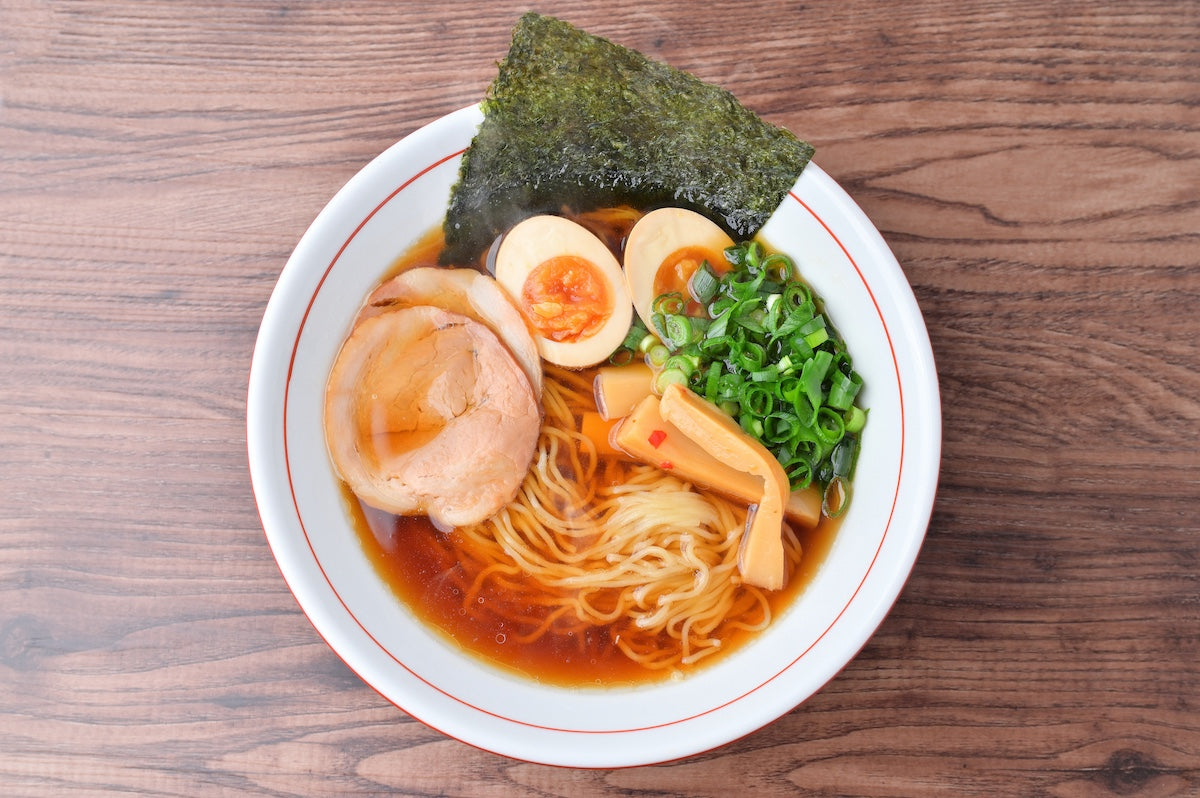
Given the sheer popularity of ramen, it is perhaps a little baffling as to why there are only two shrines across the whole of Japan that celebrate this iconic noodle dish. But we all have to start somewhere.
Our first one is the Kitakata Ramen Shrine in the city of Kitakata, Fukushima Prefecture. It isn’t a dedicated shrine building; rather, it was built in conjunction with and located inside the Kitakata Ramen Museum. It’s impossible to miss the wooden torii gate with a pair of chopsticks as its crossbeam.
As a shrine that has clearly been established as part of a larger effort to draw visitors to this town, it’s shiny, new, more than a little kitschy. (But charming all the same.) The sacred object of worship is a sky-blue ramen bowl standing in front of a calligraphed sign that reads 'menmusubi de enmusubi 麺結びで縁結び', or ‘noodles connect us, just like marital ties.’
Also in the same space is a giant bathtub-sized ramen bowl. The claim is that getting into the giant ramen bowl with your loved one will strengthen your relationship. Then again, it might just be a natural effect of the resulting shared core memory of hopping into a large ramen bowl.
More importantly, visiting the Kitakata Ramen Shrine also gives you an opportunity to try their ramen soft serve ice cream, which comes in soy sauce, ramen, and salt. Soft serve is extruded into a cone much like a tangle of noodles, and topped with a naruto fish cake, black pepper, and dried green onions. We cannot vouch for any of their culinary offerings — try at your own peril.

Photo by Wandaba, CC 3.0, From: https://commons.wikimedia.org/w/index.php?curid=127471108
The second ramen shrine takes us to Asahikawa City in central Hokkaido. The Asahikawa Ramen Village is a collective of famous ramen shops all located under a single roof, and the imaginatively-named Asahikawa Ramen Village Shrine is in a corner of the same building. To paraphrase them, the shrine hopes for human connections (between lovers, spouses, families, friends, etc) to be as hot as soup and as looooooooooooong as noodles.
You won’t find this pair of enshrined deities in the Nihon Shiki or the Kojiki, having presumably been specifically for this shrine. They are Menkoi-ten 麺結び, the deity of romance who brings couples together; and Menma Daiō 麺真大王, the guardian of faithful bonds who wards off infidelity. United, they become the Matchmaking Deity 縁結びの神様, the divine being who governs marital harmony, bestowing blessings upon and eternally binding two people who care for each other.
The first layer of noodle puns in the above names is fairly self-explanatory, but permit me a few more observations. Menkoi is Iwate dialect for ‘cute,’ ‘charming,’ or ‘precious,’ while ‘menma’ is a homophone for seasoned lacto-fermented bamboo shoots, one of the classic toppings for a bowl of ramen. Whether intentional or not, these puns do add a certain extra charm to the whole kitschy affair.
Written by Florentyna Leow