Kyoto on New Year’s Eve isn't a city that shouts.
It listens. Mostly, it listens for the bells.
On the night of December 31, during the hour that crosses into midnight, many Buddhist temples in Japan perform the joya no kane ritual: the striking of a gigantic bell 108 times.
In Kyoto, a city of temples, that sound doesn’t belong to just one precinct. It rolls across neighborhoods. It slips between roofs. It appears and disappears in the cold air like a reminder you didn’t ask for but probably needed.
If you’re visiting Kyoto at this time of the year, joya no kane is one of the most atmospheric events you can attend. Not because it’s loud or flashy but because it's the opposite: a rite that makes a city quieter through sound.
'Tis the Season to Ring the Bell 108 Times

Most temples that offer joya no kane strike the great bonsho bell 108 times, usually around midnight, though the exact timing varies by temple and sect.
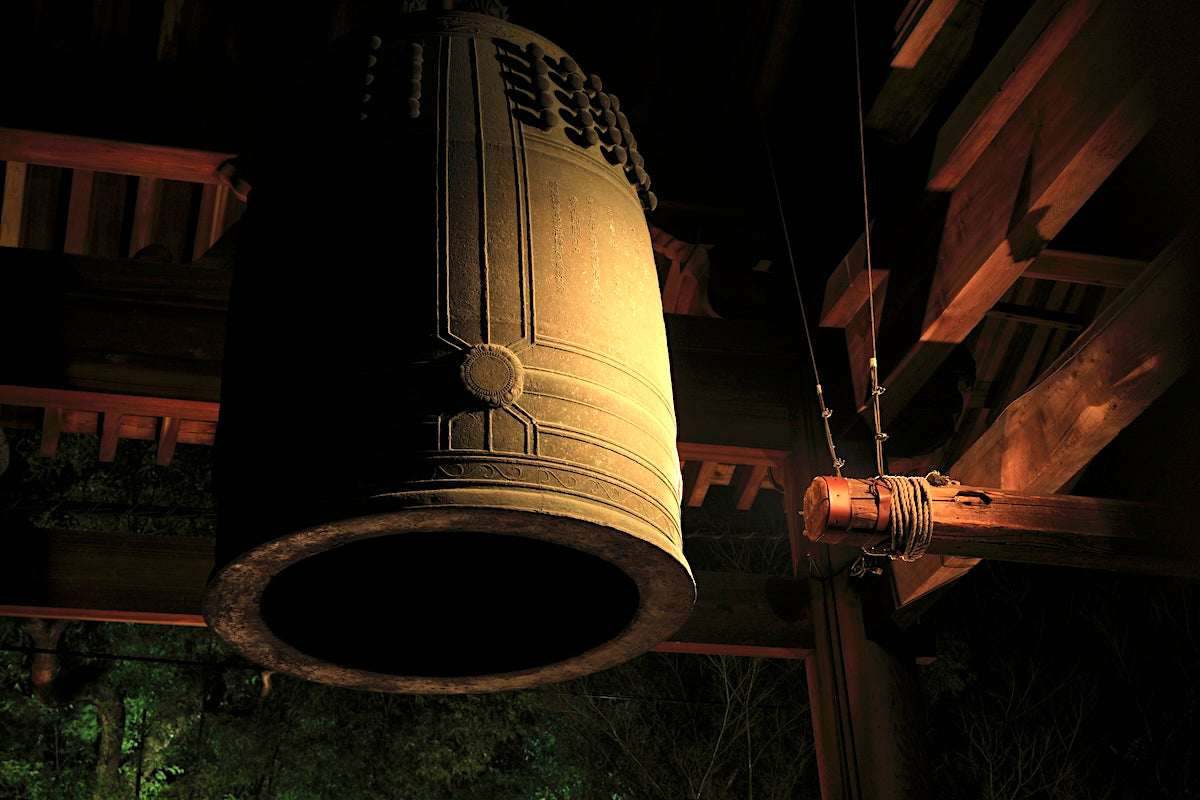
The bell - a large bronze presence, often suspended in an open bell tower - is struck with a heavy wooden beam. The sound is not a ding. It’s a toll that blooms, swells then keeps going, as if the air has decided to remember it.
At some temples, visitors can only watch. At others, you can participate by taking a turn as part of a group. Either way, the basic rhythm is the same: wait, step up to the bell and join your hands in prayer. Then strike, listen, step aside and let the next person do the same.
Why 108 Times?
The custom can be traced to Zen - or Chan - temples in Song dynasty China, with the practice introduced to Japanese Zen temples in the Kamakura period (1185-1333). It didn't take long for the bell ringing to be established as a year-end event.
The number 108 is widely known but has more than one explanation. The most well-known interpretation ties the number to the number of bonno, or earthly desires, that cloud the human heart.
Another interpretation connects 108 to the traditional calendar and the way a year was once measured.
To the 12 months of the year are added the 24 solar terms, an ancient system imported from China. Each of those terms is further divided into three, creating 72 seasonal divisions that track things such as the first frost and the swelling of buds. Twelve months plus 24 solar terms plus 72 seasonal divisions equals 108.
Seen in this way, joya no kane is not only about casting off desire along with the past year but also about completing a circuit of time.
Joya no Kane in Kyoto

Kyoto has many temples and that matters here. Joya no kane is not confined to a single stadium-like gathering. It’s distributed across the city, from the grand headquarters of the different Buddhist sects to hillside precincts and neighborhood temples tucked into the everyday grid.
Here are a few places across the city where you can join in and ring the old year out.
New Year Bell Ringing at Chion-in Temple
Bell ringing: Begins at 22:40 (Observation only)
Tickets: Advance reservation required; online applications accepted through the temple's website. If you're unable to attend in person, consider watching the live broadcast.
Fee: 3,000 yen per person (free for elementary school age and younger)
For those seeking an iconic place to watch joya no kane in Kyoto, the name that comes up again and again is Chion-in, the head temple of Jodo-shu (a branch of Pure Land Buddhism). Its bell, cast in 1636, is known for its size and the method used to strike it.
This is not a 'one monk, one mallet' situation. It takes a team of 17 monks to strike the bell at Chion-in: they use a large beam, coordinated calls and a choreography that looks like ritual and ancient workout fused into one.
The bell is usually described in numbers because they're part of the awe: it measures about 2.8 meters in diameter, 3.3 meters tall and weighs over 70 tons.
If you want the 'big Kyoto moment', Chion-in Temple is it. If you’d rather strike the bell than watch, keep reading.
Kyoto Midnight Special: Where to Take Part in Joya no Kane
Here are some Kyoto temples where visitors can strike the bell on New Year's Eve. A quick note on participation: you generally take part as a group, not as a solo hero, and you should expect lines.
Eikando Temple
Open: 21:00-0:30
Bell ringing: 23:00-0:30
Eikando is known as a place of autumn foliage but it has a different, quieter personality in winter. On New Year's Eve, though, the temple turns lively again.
On the bonsho is the date 1743, indicating that the bell was cast around then. The inscription declares: 'Wherever the sound of the bell reaches, dawn breaks in the long night of life and death; wherever the ringing resounds, one is awakened from the deep slumber of ignorance.'
Kodai-ji

Bell ringing: 23:45~
Tickets: Numbered tickets distributed at 22:00
Kodai-ji sits in the scenic Higashiyama district on a street that looks like a movie set at night, especially when the light from the lanterns is reflected on the stone streets.
On New Year’s Eve, the temple becomes something else again: a place where the line itself is part of the low-key drama playing out.
If you want to ring in the New Year in Kyoto with your own hands, Kodai-ji is one of the more straightforward 'try your luck' options. The key word is tickets, handed out at 22:00, on a first-come, first-served basis.
To avoid disappointment, arrive early enough that '22:00' doesn’t mean 'I arrived at 22:00'. Rather, it should mean, 'I’m already waiting when 22:00 arrives'.
Seiganji
Bell ringing: 23:00~ (Ring as a group of 3-4 people)
Tickets: Numbered tickets distributed at 23:00
Seiganji has one of Kyoto’s most striking contrasts: an old temple presence tucked into the bright commercial energy of downtown. That contrast is part of the appeal. You can step out of a shopping arcade and instantly become part of a centuries-old tradition.
After you strike your one note, you walk back out into the city - and the sound follows you. That’s the strange magic of joya no kane: you carry it, even when the bell is behind you.
Because it's located in the center of town, near hotels and restaurants, Seiganji may work better for travelers who find it hard to travel to a temple on the outskirts.
Mibudera

Bell ringing: 23:30~ (Gates open at 23:00)
Entry/order: First-come, first-served; expect to participate in groups of 10-20 people.
The joya no kane at Mibudera feels more like a local tradition than a tourist attraction, perhaps because the temple is located further away from the city center.
The shorter gap between the gates opening and the start of the bell-ringing may also mean less time spent queueing.
Hyakumanben Chion-ji Temple
Bell ringing: 23:40-0:45 (Buddhist service: 22:45-23:40)
Tickets: Numbered tickets distributed at 22:15
Hyakumanben Chion-ji is a strong option if you want a Kyoto temple bell event that feels substantial but not as tightly controlled as the biggest viewing-only spectacles.
The act of striking the bell is quick. The waiting is not. Which is the point, in a way: the line is a slow unspooling of the old year and, by the time you reach the bell, you’ve already had time to reflect on what you’re leaving behind.
Tips to Enjoy Joya No Kane in Kyoto
A few tips to make this night more comfortable for everyone involved:
- Arrive early for the tickets. If they're distributed at 22:00, people will begin queueing well before that.
- Dress for waiting, not walking. The Kyoto winter cold feels much sharper at night, especially when you stand still in line. Gloves, a hat and warm socks - try wearing two pairs - matter more than you think.
- Keep your group small. The temples can become extremely crowded and it may be hard to stay together if you go in a large group.
- Remember that this isn't a lively countdown party but a temple ceremony. This calls for quieter voices, fewer big reactions and awareness of where you’re standing and how you’re moving.
- Be careful with your cameras and phones. Even if photo-taking is allowed, refrain from using tripods and selfie sticks in crowded areas.
- Plan your transportation, especially if you’re going far. If you’re relying on public transport late at night, check the schedules in advance; New Year’s Eve services can differ from those on normal evenings.
- Most of all: let the sound reverberate in your body and mind. The note doesn’t end when the beam hits the bell - once sounded, the note continues in one form or another.
A Time for Celebration - and Reflection
Japan offers a different kind of holiday tradition: a New Year's Eve ceremony shaped by winter, silence and the long toll of temple bells.
With its many temples, Kyoto is a particularly memorable place to experience joya no kane. Whether you observe from a distance at Chion-in, with 17 monks to ring the bell for you, or join the line at a neighborhood temple, don't miss this ritual that turns the entire city into a listening ear.
By Janice Tay