In some parts of Japan, when someone dies, the rice bowl is smashed. The ceremony takes place at the funeral, just as the hearse is about to depart, and the bowl - the one that belonged to that person alone - is broken in front of the house.
This is done to release the soul from lingering attachments to this world so it can travel safely to the next. The ritual also helps the bereaved to accept that the deceased is truly gone because the message is unambiguous. It says: this bowl was yours. It has been smashed because you are no longer here to use it.
Few objects are as central to Japanese food culture as the bowl. Almost every Japanese meal unfolds around it: rice, soup and side dishes are served in bowls; in one-dish meals, they hold noodles or rice with a variety of toppings. But before we explore Japanese bowls further, we need to talk about the tea.
Chawan: The Bowl That Has Your Name on It

The word chawan (茶碗) means, literally, tea bowl. It arrived in Japan from China sometime between the Nara and Heian periods - roughly the 8th to 10th centuries - as a vessel for drinking tea, which was itself a recent continental import.
At that point, Japan had no domestic porcelain industry to speak of and fine ceramics were shipped across from China in large quantities. So many of those ceramics were tea bowls that chawan became a synonym for ceramic tableware in general - the same linguistic drift that gave English speakers 'china' as a word for porcelain.
When domestic ceramic production spread widely in the Meiji period (1868-1912), people began eating rice from ceramic rather than wooden bowls. They called their new bowls rice chawan.
Eventually, the rice bowl became the default chawan and tea bowls were called matcha wan or matcha jawan.
Despite the name, when most Japanese people today speak of a chawan, they're referring to a rice bowl: a ceramic bowl, approximately 12 cm in diameter, wide enough to hold a generous serving of rice but compact enough to cradle in one hand. This detail is crucial because the rice bowl is almost always lifted rather than leaned over as tends to be done in Chinese dining.
Traditional custom in Japan dictates that each person should have a personal rice bowl, a throwback to the Edo period (1603-1868), when each family member kept a personal set of tableware in a dedicated wooden box. The bowl was yours the way a name is yours. Hence the smashing at the funeral.

The matcha chawan, the tea bowl used in the Japanese tea ceremony, is a different creature entirely. Wider and more open than a rice chawan - wide enough for whisking tea - it's usually made from earthenware rather than porcelain, with a rougher, more individual surface. Many tea bowls also have straight rather than sloping sides and tend to be bigger than rice bowls - but not as big as the donburi.
Donburi: Digging in Deep
Substantially larger than a chawan, a donburi (丼) is designed to hold rice and a topping together in a single vessel. It is the bowl of the working lunch: big, sturdy and not particularly interested in elegance.
Deep, with a gently flared rim and raised foot, the classic donburi bowl is wide enough to display the toppings, whether they're the comfortingly thick sauce of oyakodon or pork cutlet, eel and tempura prawns. The donburi also moonlights as a noodle bowl, where those prawns often make a appearance.
Unlike rice bowls, which are held in one hand as you eat, a donburi bowl stays on the table because the bowl is too large and too full to lift comfortably.
But when the donburi is filled with broth, the bowl may be lifted at the end of the meal to drink directly from it. The satisfaction of raising a large bowl to finish every last drop runs deeper than the donburi itself.
Japanese Soup Bowls: What the Lacquer Knows
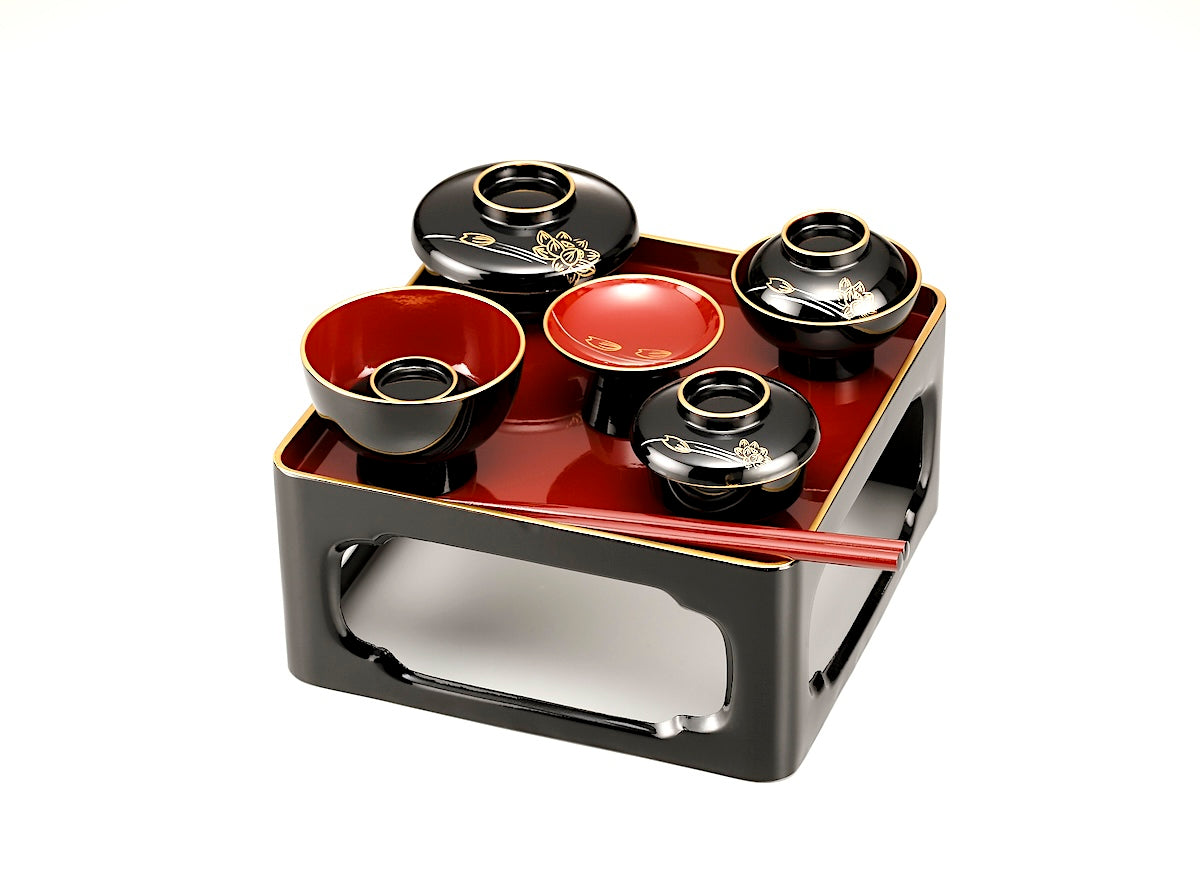
The Japanese soup bowl - shiru wan (汁椀) - is the piece of tableware most likely to change how a meal feels. Not because of what goes into it, though miso and clear soups are no minor matter, but because of what it is made of.
Japanese soup bowls are traditionally made of wood finished with lacquer. Wood conducts heat poorly, which means a bowl full of hot soup can be picked up safely - an assurance a ceramic bowl cannot offer. The lacquered surface, smooth against the lips, makes drinking directly from the bowl a physical pleasure. This is a bowl designed for the hand and mouth.

A standard shiru wan is approximately 11-12 cm in diameter and 6-7 cm high, sized to sit in the palm without effort. The two main lacquer finishes are shin nuri - multiple layers of lacquer that cover the wood grain and produce the deep, mirror-smooth surface associated with formal lacquerware - and fuki-urushi, or suri-urushi, in which lacquer is rubbed into the wood so that the grain remains visible. The latter reads as more casual and is integrated more easily on a modern table that mixes Japanese and Western elements.
Lidded soup bowls, used for clear broths and formal occasions, keep the aroma and warmth inside until the bowl is placed before the diner. When the lid is lifted, the steam carries the scent of the broth before a single drop is drunk.
Properly maintained lacquerware lasts for decades. It cannot go in the dishwasher or the microwave and should be wiped dry rather than left to air. In return for this extra step, lacquerware becomes more beautiful with use, the surface acquiring depth through contact with human hands.
Crossing Borders with Ramen Bowls
Ramen may be Chinese in origin but the bowl that holds it is a Japanese creation. The ramen bachi - wide, deep, high-footed - was designed for Japan's version of the dish but decorated with Chinese-derived motifs to signal the dish's origin.

Probably the most iconic of these motifs is the raimon (雷紋) - the squarish pattern that runs around the rim of a classic ramen bowl. Older than ramen by about 3,000 years, this stylized lightning can be found on Shang dynasty bronzework. The labyrinthine, interlocking structure was thought to confuse malevolent spirits - a maze they could enter but not exit, which may sum up many people's experience with ramen, a notoriously addictive dish.
The ramen bowl is designed to be deep and wide: wide enough to accommodate a full portion of noodles, deep enough to hold substantial broth without spilling when the bowl is set down or nudged by an enthusiastic diner. Like the donburi, the bowl remains on the table throughout most of the meal but the drinking of the broth at the end - after the noodles and toppings are gone - gives it a brief moment of being held.
Contemporary ramen shops are more likely to use plain ceramic or dark-glazed bowls without any patterns, letting the soup's color speak for itself. But the raimon endures in older establishments and in home kitchens where someone has decided that even instant ramen deserves to be served with some flourish.
Hachi: The Bowls That Stay Put

The hachi (鉢) never leaves the table. Where the chawan and shiru wan are personal bowls - held in the hand, belonging to one person - the hachi is not raised to the mouth and the larger versions are used to serve everyone at the table.
The word is an abbreviation of 'hattara' (鉢多羅), a transliteration of patra, which refers to the metal alms bowls that Buddhist monks carried to collect food. That bowl - round, wide-mouthed, designed to receive whatever was offered - is the ancestor of the hachi family.
The family is organized by size. The obachi (大鉢), usually measuring more than 24 cm across, is the largest and functions like a serving centerpiece, holding simmered dishes, large salads and anything else meant for the table as a whole. The chubachi (中鉢), 15-21 cm in diameter, holds enough for one person's portion of a simmered vegetable or dressed salad.

The kobachi (小鉢), up to 12 cm across, is the small bowl that appears at almost every Japanese meal, holding pickles, dressed vegetables or whatever the meal needs as a counterpoint.
From Mashiko to Karatsu
Any guide to Japanese bowls eventually arrives here: the question of where a particular bowl was made and what that means for how the bowl feels and ages.
Japanese ceramics can be divided roughly between toki (陶器, earthenware) and jiki (磁器, porcelain). Earthenware is fired at lower temperatures and produces a porous, matte surface with tactile warmth. Porcelain is fired hotter and is non-porous, smooth and cool to the touch. Earthenware is crafted to feel present in the hand; porcelain bowls are made to carry decoration and age without a scratch.
Mashiko-yaki, the earthenware tradition from Tochigi prefecture, represents the mingei - folk craft - approach at its most coherent. The clay used is sandy, coarse and unsuited to fine detailing, which is precisely why Mashiko bowls have the weight and warmth they do.
Karatsu-yaki, from Saga prefecture, operates in a different register. Making it to the top three in the traditional tea bowl hierarchy - Ichi Raku, ni Hagi, san Karatsu ('Raku first, Hagi second and Karatsu third) - Karatsu has the quiet confidence of something that has been praised for four centuries and no longer needs to announce it. Look out for the e-Karatsu style, where iron pigment is brushed on to create grasses, plant forms or just abstract strokes, producing decoration that feels drawn rather than painted, immediate rather than labored.
Other notable ceramic traditions include Hagi-yaki (Yamaguchi prefecture) - warm, earthy tones and signature cracks in the glaze - and Mino-yaki (Gifu prefecture), the largest production region in Japan by volume and the source of most commercial ramen bowls, donburi and everyday ceramic ware.
Choosing Your Own
A functional Japanese bowl collection for everyday dining doesn't require much. It just requires the right things.

The rice bowl is the place to start because it's the most personal object on the table - choose something you want to hold every day. Earthenware is warmer and more tactile; porcelain is easier to clean and keeps its surface longer. Pay attention to the size and how the bowl sits in your hand. A bowl that's too large will also make the rice look sparse; too small and eating will mean showering the table with grains of rice.
Ceramic rice bowls come in such a wide range of designs that the wooden soup bowl can be overshadowed. Yet a lacquered shiru wan - even a modest one - changes the experience of drinking miso soup in ways that can be understood only when you try it for yourself.
The hachi question is partly about how you cook and partly about how you eat. A large serving bowl at the center of the table transforms a meal from a series of individual portions into something more communal. It's worth having one obachi and two or three kobachi - the small bowls that hold side dishes and, perhaps more importantly, give a meal visual texture. But if storage space is limited, invest in donburi instead - they can easily double up as hachi.
For noodles - ramen, udon, soba - a deep donburi or men-bachi in the 18-22 cm range handles everything, whether you're looking for a dedicated ramen bowl or a vessel that flexes across Japanese and Western dishes. The multi-use tayo-don (多用丼) is the recommended choice for a household that wants just one or two large bowls.
Leading Up to a Smashing Time
Perhaps the easiest way to recreate a Japanese dining experience is to choose a personal rice bowl and to use it every meal or, at least, every meal where rice is served.
It shouldn't be hard to find a chawan you like from all the different shapes and styles available; the challenge will be to stick to just one. But from that fidelity comes familiarity and, finally, comfort when the bowl settles into your hand.
And when it's time to go, perhaps someone will break the bowl for you because, well, you don't want anyone else using it, do you?
By Janice Tay