Introduction
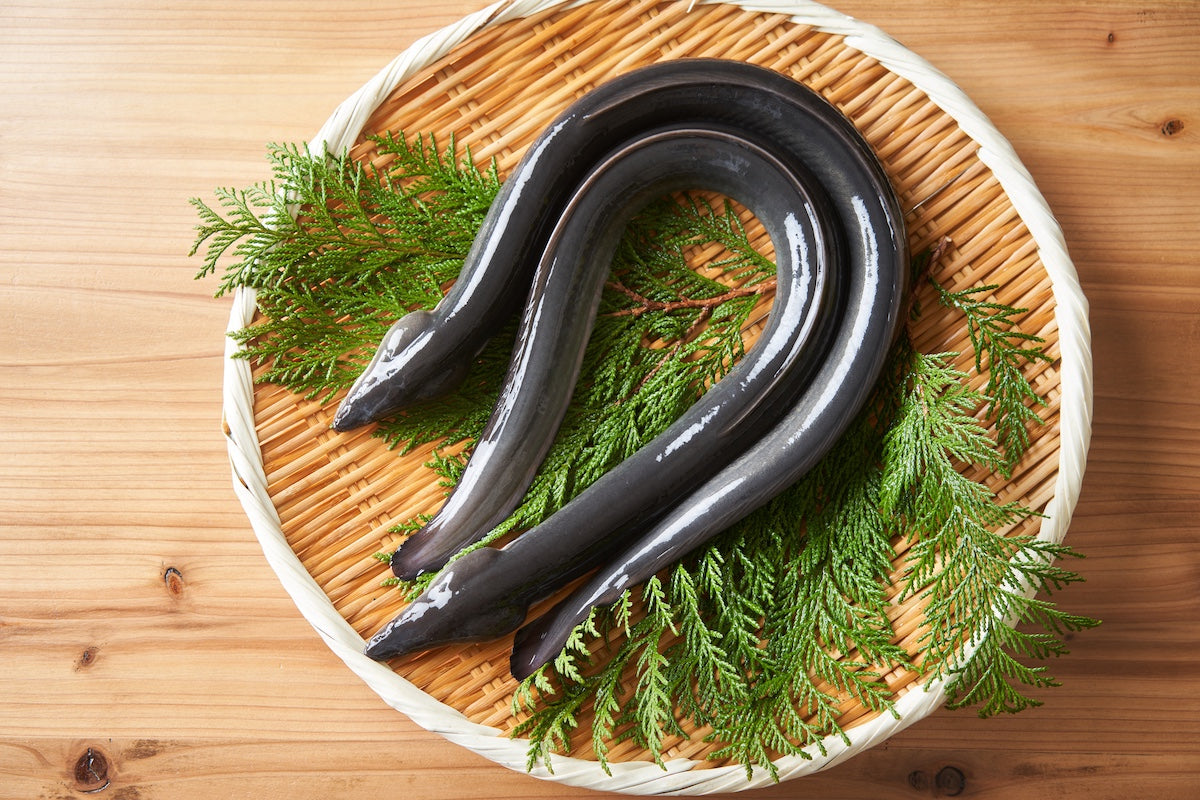
Ross Geller from Friends may have believed that unagi is a “total state of awareness” but Rachel, Phoebe, and the rest of us know better. Unagi, or freshwater eel, is a beloved staple of Japanese cuisine, so much so that there’s a whole day in the year dedicated to eel consumption. This day is Doyō no Ushi no Hi (midsummer day of the ox), when people eat eel in the belief that doing so protects against the summer heat.
There are two major species of eels native to Japan. One is Anguilla japonica, one of the freshwater eel species we consume. (All freshwater eels are generally referred to as unagi.) The other is Anguilla marmorata, the giant mottled eel or marbled eel, which is mostly found in the sub-tropics, such as in southern Kyushu. It is called ‘ō-unagi’ — literally ‘big eel’ — which is also the same term used to refer to all giant eel species. This makes the marmorata… a big deal.
Beyond the dinner table, unagi has a small but significant place in Japanese culture. Some places in Japan, such as the Minami-mura area of Gujo, Gifu Prefecture, consider the eel to be one of the messengers of the gods. (Most animals get their turn as divine messengers in Japanese mythology. Even chickens.) In Kurokawa, Miyagi Prefecture, the eel is believed to be the servant of Unnan-sama, a water deity worshipped at many small shrines in the Tohoku region.
The word ‘unagi’ is also part of the everyday lexicon. For instance, the term unagi-nobori 鰻登り, which translates to ‘an eel climbing,’ is used when something skyrockets — for example, stock prices. During the Edo period, machiya in Kyoto were apparently taxed according to the size of the building’s entrance, so people built houses and shops that were long and thin, like an eel’s bed — unagi no nedoko うなぎの寝所. There’s also the idiom ‘蕪は鶉となり、山芋は鰻となる kabu wa uzura to nari, yama-imo wa unagi to naru’ and its variants. Literally translated, it reads ‘a turnip becomes a quail, a mountain yam becomes an eel,’ and is used to express the idea that sometimes, impossible things do sometimes happen. Pigs might fly, indeed.
Not only are eels in decline due to pollution and climate change, unagi are also severely overfished and endangered thanks to how delicious they are. In fact, European glass eel trafficking — fuelled by global culinary demand —is one of the world’s most lucrative wildlife crimes, generating up to three billion Euros in peak years.
All this is to say that if any species needs an extra prayer or two (in addition to proper conservation efforts), it’s the eel. Whether or not you eat eel, consider visiting one of Japan’s comparatively rare unagi shrines to express gratitude for these slippery creatures — hopefully they’ll still be around for future generations to enjoy.

Mishima Shrine, Kyoto
There are very few eel shrines in Japan, but the most well-known of them is probably Mishima Shrine in Kyoto, whose origins date back to the reign of Emperor Go-Shirakawa during the 12th century. According to this story, his consort, Taira no Shigeko, was unable to conceive an heir, and was told to visit the Great Deity of Mishima at a shrine in Settsu Province (present-day Takatsuki City, Osaka).
Soon after, an old man in white appeared in her dreams, and said, ‘I shall grant you a son who shall become the heir to the throne. Therefore, enshrine me towards the east, in the direction of the Imperial Capital.’ Later, she gave birth to the future Emperor Takakura, and the delighted Emperor had a shrine constructed in the Atago District of Yamashiro Province. Such was the origin of Mishima Shrine.
Exactly how or even whether the eels were involved here is unclear, but like dogs, eels are believed to have smooth, easy deliveries. Pregnant women are traditionally supposed to abstain from eating eels in the hopes of an easy delivery, and afterwards, eat eels to build up their strength after childbirth.
In any case, Mishima Shrine is associated with conceiving children, safe childbirth, and marital harmony, and eels are the divine messengers of the deity in residence. At the shrine is also the Yōkō Stone, which a pregnant woman is supposed to touch before stroking her belly. Apparently, this means that she will be blessed with a fine, healthy boy.
Eel elements abound at the shrine. Two triads of black granite eel statues flank the main torii gate, replacing the usual komainu (guardian lion dogs) statues. An eel-shaped spout dispenses water at the purification basin, while the ema (votive tablets), lucky amulets, and protective clay bells feature unagi motifs.
Of particular note at the shrine is the Eel Festival on 26 October, where three eels are released into the sacred pond on the shrine precincts to bring prosperity to the eel industry. (It does not take place at Mishima Shrine, but at Takiō Shrine a short 5-minute drive away.) Naturally, this festival is attended by many eel industry professionals from across Japan.

Hikokura Kokūzōson, Enmei-in Temple, Saitama
According to Hikokura Kokūzōson’s official website — the self-styled Unagi no Otera dot jp — people in regions that venerate Kokūzō Bosatsu, or the bodhisattva Ākāśagarbha, usually do not eat eel. (The same goes for people born in the Year of the Ox or Tiger.) They also assert that such regions also have a history of frequent flooding and water-related disasters. One other area that shares this belief is the Izumi district in Isumi, Chiba Prefecture.
How the connection between Kokūzō Bosatsu, eels, and floods came about is rather murky. One folk belief says that eels were perceived to be personifications of floods as they appeared during such water-related calamities. During the Kamakura and Muromachi periods, it seems that some Esoteric Buddhist-affiliated monks and Shugendō practitioners combined this belief with the ‘disaster-eliminating’ powers of Kokūzō Bosatsu, resulting in belief that eels are the messengers or incarnations of this bodhisattva.
In Misato City, where Enmei-in Temple is located, a folk tale tells of a terrible flood that occurred one autumn long ago, when the Ōotoshifurutone River swelled and flooded all the surrounding homes. As people rowed out in small boats to search for survivors, they saw young children and the elderly out in the water, clinging to or riding thick logs floating in the muddy. The logs were not logs, but a vast school of eels. The eels had clustered together to form a rope, gripping the bodies of the survivors to prevent them from being carried away by the swift waters. Afterwards, the people of this area vowed never to eat eel again.
As for the origins of the temple itself, there is another folk tale that tells of a young farming couple, who set their baby down near the edge of a large field to rest while they worked in the fields. The parents worked all day as the child slept. Stirred by a cool autumn breeze, the child woke up and cried for its parents, who were too far away to hear. Looking around, the child saw an eel, and crawled towards it out of curiosity. They crawled too far, and fell into the river.
Later, the couple returned to find their baby missing. Frantic, they searched everywhere, even roping the neighbours in, but to no avail. After several hours, they decided to trudge homeward. As they walked past a nearby temple, they heard the sound of their child wailing. They entered the temple, and found a soaking wet statue of Kokūzō Bosatsu, its legs covered with eels, and their child next to it. Both the bodhisattva and the eels had protected and saved their child. From that day onwards, they stopped eating eels, as did everyone else around them.
The Kokūzō Bosatsu statue enshrined at the temple is probably not the same one from the folk tale, but temple records say that it washed ashore in 1486 after a flood along the Ōotoshifurutone River.
On the fourth Sunday of October, Enmei-in Temple holds a memorial service for eels. Anyone involved with eels — whether on a professional, personal, or spiritual basis — is invited to participate and express their gratitude and reverence towards them.

Mishima Taisha Shrine, Shizuoka
Mishima Grand Shrine in Mishima City is famous for two reasons. Firstly, it’s the shrine where Minamoto no Yoritomo, the first shogun of the Kamakura shogunate, prayed for the restoration of his clan while exiled in Izu during the Genpei wars. Secondly, the water that wells up at this shrine is groundwater from Mt. Fuji, and is believed to grant wishes, as well as health and longevity. In recent years, the shrine’s ‘o-mizutori’ or ‘water-drawing’ ritual has experienced a resurgence in popularity.
Less commonly known is the shrine’s connection with eels. The pond near the inner shrines of Mishima Taisha was once home to numerous eels, and people in the area used to believe that eating these divine messengers would invite divine punishment — specifically, one would be cursed with the birth of a hairless, long-necked child. However, one man rebelled against this belief. In 1619, a retainer of Hidetada, the second Tokugawa shogun, declared that ‘divine punishment cannot possibly befall the shogun’s retinue,’ and ate an eel from the sacred pond. In response, the shogun had him nailed to a stake and executed, stating that ‘though it is sorrowful to exchange a human life for that of a fish, the law cannot be changed.’
The Meiji Restoration saw a dramatic shift in the status of eels at Mishima Taisha. One popular theory says that samurai from the Satsuma and Chōshū armies were unaware of the legend and ate these eels, leading local people to realise that they would face no divine punishment for eating Mishima unagi. Today, eels are a culinary staple in Mishima.
Hirayanagi Hoshinomiya Shrine, Tochigi
Hirayanagi Hoshinomiya Shrine has stood at its present site since 1432, after being relocated from what is now Ōmachi in Tochigi City. It was known as Hirayanagi Daimyōjin during the Edo period. Although it was ostensibly a Shinto shrine, like many religious institutions it practiced a form of Shinto-Buddhist syncretism, so one of its principal deities was the bodhisattva Kūkōzō Bosatsu.
This would remain the case until the Meiji period, when the separation of Shinto and Buddhism forced the shrine to re-define itself as wholly Shinto. Nevertheless, old traditions die hard. Since the eel is Kokūzō Bosatsu’s divine messenger — they apparently arrived at this mortal plane riding on an eel (or a crab, while holding an eel as their staff) — Hirayanagi Hoshinomiya continues to revere eels, and the priests maintain the custom of abstaining from eel consumption. As it was before the Meiji period, the shrine is still affectionately referred to as Kokūzō-sama because of its history.
All around the shrine precincts are eel-themed decorative elements. For example, next to the purification basin on the shrine precincts is the ‘nade-unagi’ or ‘Stroking Eel’ sculpture, consisting of three swimming eels surrounded by the twelve animals of the Chinese zodiac. Stroking this eel and one’s zodiac sign is supposed to bring blessings for good health, household safety, and business prosperity. Naturally, one can also pick up eel-themed amulets, goshuin, and fortune slips from the shrine’s gift shop.

Harayama Shrine, Yamanashi
Eels aren’t the first thing that come to mind when one thinks of the Kofu Basin — it’s more famous for fruits — but wild eels were once abundant in Kofu’s rivers, and widely consumed by people living in the area. Fittingly, Kofu City is also home to one of Japan’s few eel shrines — Harayama Shrine. People pray here for relief from abdominal ailments — ‘hara’ is a homophone for ‘stomach’ — and for safe childbirth.
Details about Harayama Shrine’s origins (and the shrine more generally) are scant. It supposedly began with a Buddhist statue that drifted down from the upper reaches of the Aikawa River, which was then enshrined as the principal object of worship at this shrine.
Later, repeated flooding of the Aikawa River beside the shrine led to epidemics in the area. Distressed locals prayed at Harayama Shrine, and were instructed (by an oracle) to release three eels into the Aikawa in order to appease the river deity’s wrath. Thus it was that both floods and plagues ceased to trouble them. In the spirit of this legend, the custom of releasing three eels into the river every August continues to this day.
Even with only a small handful of shrines and temples thus far, we can see how the similarities between eel-related folk beliefs extend across the Kanto region.

Unagihime Shrine, Oita
Unagihime Shrine’s name sounds like it might translate to ‘Princess Eel,’ but the kanji used have nothing to do with these freshwater fish. Instead, it is named for the eponymous deity of Mount Yufu in Oita. One theory suggests that the ‘unagu’ refers to magatama pendants such as those ritual necklaces worn by shrine maidens, which may have become deified. Another theory posits that Unagihime is a reincarnated eel, possibly based on the idea that eels were believed to help with flood control in the Yufuin marshlands (if properly worshipped).
There are a number of local legends associated with this goddess about the origins of Lake Kinrin and the Yufuin Basin. Oft-repeated is how the beautiful Unagihime commanded her mighty (and ugly, some stories emphasise) servant, the demon deity Kesaki Gongen, to kick down the mountain to the west of the huge lake that once covered the entirety of the Yufuin Basin. The lake waters gushed forth, becoming the Oita River that flows into Beppu Bay.
Now, a great dragon dwelt in this huge lake, but as the waters receded, the dragon felt its supernatural powers ebbing away. It pleaded with Unagihime to grant him even a small pond where it could peacefully exist. In return, it would ensure that its waters were clean and beautiful, and that it would protect the surrounding villagers. This is the supposed origin of Lake Kinrin.
Established over 1,200 years ago, Unagihime Shrine is also known as Rokushogu as it venerates six (roku) Shinto deities, including Kunitokotachi-no-mikoto, the eternal god of the land. Curiously, the enshrined kami do not include Unagihime. Precisely why this is the case is unclear, but Unagihime does seem to be a deity local to the Yufu area rather than part of the wider Shinto pantheon, which may have informed a decision at some point in the past to not include her as an official focus of worship. Furthermore, the shrine operated as a syncretic institution alongside Bussanji Temple until the Meiji Restoration, which has likely further muddied the waters of its history.

Bonus: Unagi Mound, Miyagi
According to a 1643 book by Neo-Confucian scholar Hayashi Gahō, Matsushima Bay in Miyagi Prefecture is one of Japan’s three most celebrated scenic sights. (The other two are Amanohashidate in Kyoto, and Itsukushima Shrine in Hiroshima.) Since several centuries have elapsed since its publication, you’d think that this list would have evolved, or at the very least that other contenders would have emerged to vie for a place on the top three. This does not appear to be the case.
A Japanese publishing company did attempt to determine a new list by holding a national election in 1915, so technically speaking, the ‘New Three Views of Japan’ does in fact exist. However, none of these locations appear to have made much of a dent in public consciousness — the spectre of Hayashi Gahō’s canonical list looms too large in cultural history, overshadowing any attempts at revising this narrative.
Matsushima Bay may have retained its celebrated status for another reason — the town is home to Zuiganji Temple, the magnificent ancestral temple of the Date clan who ruled Sendai Domain for centuries. Both the view and the temple are undoubtedly major draws for sightseers.
Directly near the main entrance of Zuiganji Temple, along the approach to the main hall, is an imposing stone monument standing 2.85 metres tall, inscribed with the characters 鰻塚. This is the Unagizuka (Eel Mound), a clear nod to Matsushima’s past as a leading domestic producer of wild eels. The prevailing account says that it was built and installed here in 1923, its construction funded by 126 eel merchants and wholesalers from Matsushima as well as Hokkaido and Tokyo. Exactly why it was built is unclear, but one theory says that it was built to memorialise the eels and their drastic decline (presumably due to over-fishing).
Regardless of the reason, the Matsushima Unagizuka Support Association holds an annual memorial service on 13 May. It’s a fairly small affair attended by the local mayor and a few eel merchants — around 20 or so people — that ends with participants releasing live eels into Matsushima Bay. These days, wild eels are almost impossible to catch in Matsushima, and the eel population is unlikely to ever recover. At the very least, the existence of the mound and the memorial service keeps that small slice of Matsushima’s unagi history alive.

Bonus: Unagi Jizō, Ibaraki
Deep in the mountains of Higashi Ibaraki is a town by the name of Shirosato, and somewhere along the winding road that runs past the Fujii River is a weathered-looking statue dressed in a red bib and hat. This is the Unagi Jizō (Eel Jizō). It is unclear as to who built it and when, but there is a local folk tale about its supposed origins.
There was once a Rinzai Buddhist temple in the area called Seionji, which no longer exists. Dozens of young monks and acolytes lived here, and among them was a particularly beautiful young man. He diligently performed his daily tasks, but spoke to no one, and befriended none. He did something curious every day: he would make an offering of steamed glutinous rice (sekihan or okowa, depending on the version of the story) to the Kannon Bodhisattva. No one ever knew where he obtained the rice.
One day, the feudal lord of the domain came to this village with his retainers, and went fishing at the Fujii River. Soon, his rod was pulled by some strong force, and after a prolonged tussle, he and his retainers hauled the catch in to find that they had caught a huge eel nearly three metres long. All present were overjoyed, and immediately set to gutting the eel. But no sooner had they sliced its belly open that they found it to be full of steamed glutinous rice.
‘Oh no,’ cried the villagers. ‘This eel must be the Fujii river deity!’ Revising their dinner plans, they quickly buried the eel by the river. Someone later realised that the young beautiful monk had also mysteriously disappeared, leading everyone to (rather bizarrely) conclude that he had been the river deity reincarnated. (And therefore… also the eel?) They then built the Unagi Jizō at the burial site to pay their respects to the monk.
There have been far weirder stories, but this certainly ranks among one of the stranger eel-related folk tales, raising far more questions than we’ll ever have answers to.
Written by Florentyna Leow