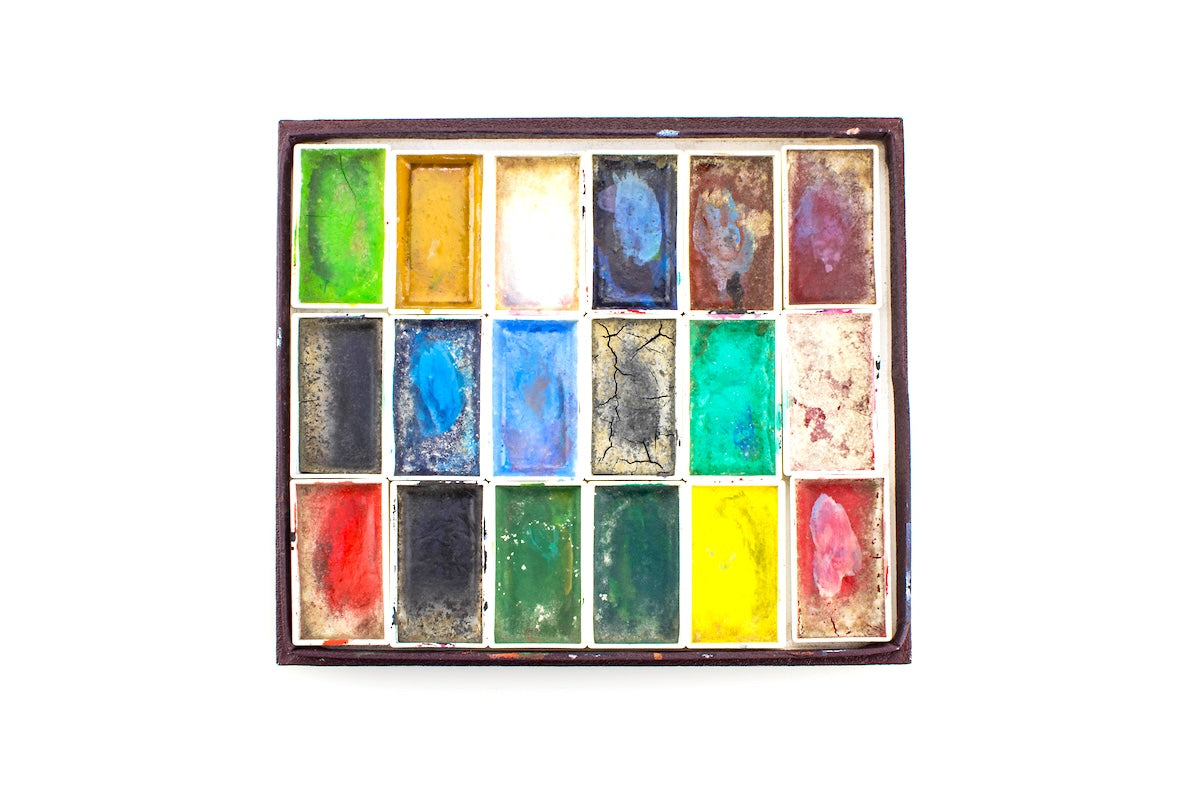
Call nihonga 'Japanese watercolor' and you will be sort of right, in the way that calling okonomiyaki a Japanese pancake is sort of accurate.
Both paint media are water-based, producing results that can be luminous and transparent. But while Western watercolor binds its pigment with gum arabic, a water-soluble plant resin, nihonga uses mineral pigments made from crushed stone bound with nikawa, a glue extracted from animal collagen.
This calls for a different technique - layering rather than blending, placing rather than brushing. The colors produced - deep, faintly sparkling - are the colors of the earth because they are, quite literally, the earth.
How Nihonga Got Its Name
The word nihonga (日本画, 'Japanese painting') did not exist before the Meiji period (1868-1912). Before Western oil painting, known in Japanese as yoga (洋画), arrived in significant quantity, there was no need to label the indigenous tradition; it was simply painting. The coining of 'nihonga' as a category was an act of distinction, not of invention.
The term was catalyzed in 1882, when American art historian Ernest Fenollosa delivered a lecture in Tokyo in which he positioned nihonga as superior to Western oil painting at precisely the moment when Western culture was being aggressively imported. That a foreigner had to make the case for Japanese painting to Japanese audiences says something about the era. The Tokyo University of Fine Arts was established partly to preserve and advance the form and the term entered common use in the 1890s.
The materials that define nihonga - mineral pigments on washi paper or silk - are considerably older than the label. The wall paintings inside Japan's ancient burial mounds, some dating to the 4th and 5th centuries, already used ground mineral pigments. By the 12th century, most of the major natural pigments in use today were already in play. The name was new. The art was not.
The Stones Before the Painting
Iwa-enogu (岩絵具) - 'rock paint' - is the collective term for the mineral pigments used in nihonga. They look like colored sand because that is essentially what they are.

The production process begins with raw ore. Natural mineral pigments - tennen iwa-enogu (天然岩絵具) - start as actual minerals: azurite, the copper carbonate ore that yields gunjo (群青), the deep blue associated with the night sky; malachite, another copper carbonate, the source of rokusho (緑青), a green that ages with grace; hematite, the iron ore behind the warm reddish-browns.
The stones are broken down then ground until the powder is as fine as flour. Impurities are picked out by hand. What remains is washed repeatedly in water - a grading process that sorts particles by their settling speed, the larger sinking first, the finest carried off last.
The modern alternative is shin iwa-enogu (新岩絵具) - synthetic mineral pigments. These are made by fusing synthetic color into glass using metal oxides, firing the result at extremely high temperatures then crushing the glass into powder.
This technique yields around 1,000 colors that are far more affordable and resist discoloration better than their natural counterparts do. Most nihonga painters use a combination of both - natural pigments for their depth and warmth and the synthetic version for the colors that nature simply does not produce.
There is also a third category: gosei iwa-enogu (合成岩絵具), made by coating powdered crystal or calcite with synthetic dyes, which adds fluorescent tones and pastels to the palette.
Gofun (胡粉) sits in a separate category - not mineral but shell. Ground from powdered oyster and clam shells, this white pigment is used as a primer and base coat, laying a luminous ground for colors applied above it. Its calcium carbonate composition gives it a particular chalky softness that titanium white, the brightest white pigment used in contemporary Western art, cannot replicate.
Particle Size Is Everything
Here is what makes iwa-enogu unique among paint materials: the same mineral, ground to different coarseness levels, produces entirely different colors.
In the bante (番手) numbering scheme, particles are graded from coarse to fine, roughly No. 1 to No. 13.
Larger particles scatter light irregularly, producing a grainy, three-dimensional shimmer - the texture you see in classical Japanese paintings when light catches the surface at an angle. Finer particles produce softer, denser tones with a matte surface that reads more like a field of color than a collection of individual crystals.
Contemporary nihonga painters often layer these deliberately: fine particles in the lower layers for stability and depth, coarser particles toward the surface to introduce sparkle. The eye reads both simultaneously, which is why nihonga surfaces have such depth.
The Glue That Makes It Stick

The most characteristic material in nihonga is not the pigment; it is the glue.
Made from the collagen extracted by simmering animal hides, tendons and bones, nikawa is sold in dried granules or sticks and dissolved in water before use. Mix the resulting liquid with mineral pigment powder and you have paint. The balance is crucial: too much nikawa and the dried surface becomes unnaturally glossy; too little and the pigment flakes away from the paper after drying.
Nikawa concentration is also managed across layers. Lower layers generally contain stronger glue to anchor the ground firmly while weaker glue is used in the upper layers, creating visual depth.
By mixing quartz, calcite and other minerals into the ground layer, artists produce fine surface irregularities that reflect light in intricate ways, enhancing the luminosity of the pigments.
Gold and silver leaf are also incorporated beneath or between pigment layers, their reflective surfaces amplifying the luminosity of the mineral colors applied on top.
Some contemporary artists have begun replacing nikawa with synthetic resin. But other practitioners who have worked with both argue that nikawa, because it grips less aggressively than resin does, allows the mineral crystals to sit more naturally on the surface - and it is that slight looseness that brings out the characteristic sparkle.
What You Paint On
Washi generally absorbs water more readily compared with standard watercolor paper, while its long fibers create soft edges and gradations that are difficult to achieve on conventional surfaces. Below is a guide to choosing the right washi.
Check Whether the Washi Has Dosa Sizing
Untreated washi tends to absorb watercolor very quickly, causing pigments to spread freely across the surface. To improve control and pigment adhesion, many papers are treated with dosa, a sizing solution traditionally made from nikawa glue and alum.
Pigment spreads dramatically on unsized washi, known as kigami (生紙; raw paper), producing especially beautiful bleeding and soft blur effects. However, this can also make the paper more difficult to control.
Bleeding is more restrained on sized washi - processed paper - giving the paper behavior closer to that Western watercolor paper while still preserving the distinctive character of washi.
Choose According to Thickness and Strength
Because watercolor techniques use significant amounts of water, the paper must be strong enough to resist buckling and tearing.
Heavy papers of around 200-300 gsm or more are generally recommended.
Washi made from kozo (mulberry fiber) or hemp remains strong even when wet, making it especially suitable for layering techniques and repeated washes.
Choose Surface Texture According to Painting Style
Paper with a smooth surface is best for delicate work and detailed painting. Medium or rough surfaces are better suited to landscapes, expressive washes, bold brushwork and atmospheric blending.
The two papers most associated with nihonga are kumohadamashi and torinokoshi, and they are nearly opposite in character.
Produced primarily in Fukui prefecture, kumohadamashi (雲肌麻紙) - 'cloud-skin hemp paper' - is thick, strong and slightly textured, its surface roughness visible as a faint cloud-like pattern. It can hold heavy pigment application - if you want to paint boldly and layer without hesitation, this is the paper.
Torinokoshi (鳥の子紙), also pronounced as torinokogami - 'bird egg paper' - takes its name from its color, the warm ivory of a bird's egg. Its primary material is ganpi fiber, which gives it a smooth, lustrous surface closer to silk than to conventional paper. This is the paper for fine-lined, detailed work such as precise gradations and delicate color transitions.
For beginners, starting with small sample packs or dosa-sized washi sample sets is often the best approach, allowing them to understand how different papers respond to water and pigment.
How to Use Mineral Pigments
The canonical nihonga technique is not to brush pigment across the surface but to place it - gently setting color down from the tip of the brush in thin layers, letting each dry fully before adding the next. Wet mineral pigment applied on top of insufficiently dried nikawa will dissolve the layer beneath it and the whole structure will come apart.

The core techniques build from this foundation. The basic method: repeated thin applications, each one adding depth until the surface reads as complex rather than flat.
Tarashikomi (垂らし込み) drops a second wet color into a still-wet area, allowing the pigments to bleed into each other organically, the mineral particles settling into naturally diffuse edges that no brush could produce.
In moriage (盛り上げ) - 'raised application' - a thick mixture of gofun (powdered seashell white pigment) and nikawa glue is built up on the surface with a brush or palette knife to create a three-dimensional texture that changes depending on the angle of the light. The result is a richer sense of depth and atmosphere than flat pigment alone can provide.
Historically, moriage was used in screen paintings to depict mist and clouds and as an underlayer for raised gold leaf decoration. Contemporary nihonga artists, however, frequently paint the raised surface with mineral pigments, allowing color to interact with the textured ground beneath.
A useful rule for particle grades: apply fine particles first, coarse particles later. Fine grades create a stable, adhesive ground. Coarser grades, placed on top, introduce texture and sparkle without the instability that would result from anchoring heavy particles to bare paper.
One practical note that surprises beginners: nikawa darkens color slightly as it liquefies the pigment during mixing, but lightens as it dries. Painters learn to apply color slightly darker than they want the final result to be.
Nihonga Now
After the devastation of World War II, critics declared nihonga effectively dead. To some, its mineral pigments, silk surfaces and historical themes seemed unable to survive the rapid westernization and globalization of post-war Japan.
Yet nihonga refused to disappear. Instead, artists dismantled and rebuilt the form from within, experimenting with new techniques, abstract styles and contemporary subject matter while still working with traditional materials such as crushed minerals, shells and animal glue.
The expanded range of synthetic pigments available from the 1950s gave painters colors that natural ore never offered and allowed works to scale up dramatically. Post-war masters including Higashiyama Kaii and Hirayama Ikuo incorporated the oil-painting-like texture of Western matière into their Japanese surfaces, creating a visual language unmistakably nihonga yet modern.
The generation working now has pushed further. Hiroshi Senju, who was born in 1958 and holds a doctoral degree in nihonga from Tokyo University of the Arts, makes monumental waterfall paintings not by brushing mineral pigment but by pouring it - letting translucent paint run down the surface of Japanese paper, its creases and folds dictating the composition.
In 1995, he became the first Asian artist to receive an Honorable Mention at the Venice Biennale, exhibiting The Fall, a waterfall mural 3.4 m high and 14 m wide.
Among contemporary nihonga artists, few unsettle the viewer as deeply as Fuyuko Matsui. Born in 1974, she works within the traditional techniques of Japanese painting - silk surfaces, mineral pigments and painstaking brushwork - yet fills them with visions of psychological anguish, bodily decay and suppressed emotion.
Her most famous works draw upon kusozu, the Buddhist visual tradition that depicts the nine stages of a corpse decomposing after death. The decaying female body becomes a meditation on mental suffering, violence, memory and existential dread in contemporary society.
What makes her paintings so striking is the tension they sustain: the refined stillness of nihonga colliding with imagery that many viewers would rather turn away from. In doing so, Matsui has carried nihonga into new psychological territory.
Where to Find Nihonga Supplies
If you want to see nihonga materials up close before committing, PIGMENT TOKYO in Shinagawa is the right first stop.
The art materials lab carries around 4,500 colors - from natural ores and synthetic pigments to soils and shells - displayed in small jars across floor-to-ceiling shelves. PIGMENT TOKYO also runs beginner workshops on mineral pigments and stocks starter sets.
For more serious supply sourcing, visit Kiya (喜屋) in Bunkyo-ku, Tokyo. This long-established store specializes in Japanese mineral pigments, brushes and paper.
Moving at the Pace of Geology
Western painting often celebrates spontaneity - the bold gesture, the expressive sweep of the brush, the artist attacking the canvas like someone trying to win an argument. Nihonga, meanwhile, behaves more like an elderly Kyoto craftsman repairing a temple beam. One layer. Then another. Then perhaps a cup of tea.
In an era of AI-generated images and digital paintings produced faster than instant noodles, nihonga remains gloriously inconvenient. The glue must be mixed carefully. The layers dried patiently. The pigments themselves have already spent several million years as rocks; they are used to taking their time.
Why not slow down with them and see what surfaces when nothing is rushed?