Introduction
If you’ve been researching Japanese knives, the Miyabi brand has probably popped up on your radar.
Built around hard steels and meticulous finishing, they are a premium Japanese knife brand that brings traditional Japanese craftsmanship and modern German engineering together. And, like most brands, they have their fans and detractors.
Miyabi knives are simply one of many excellent Japanese knife brands out there. This article may help in deciding whether one of them will be right for you.

A quick overview of the Miyabi knife
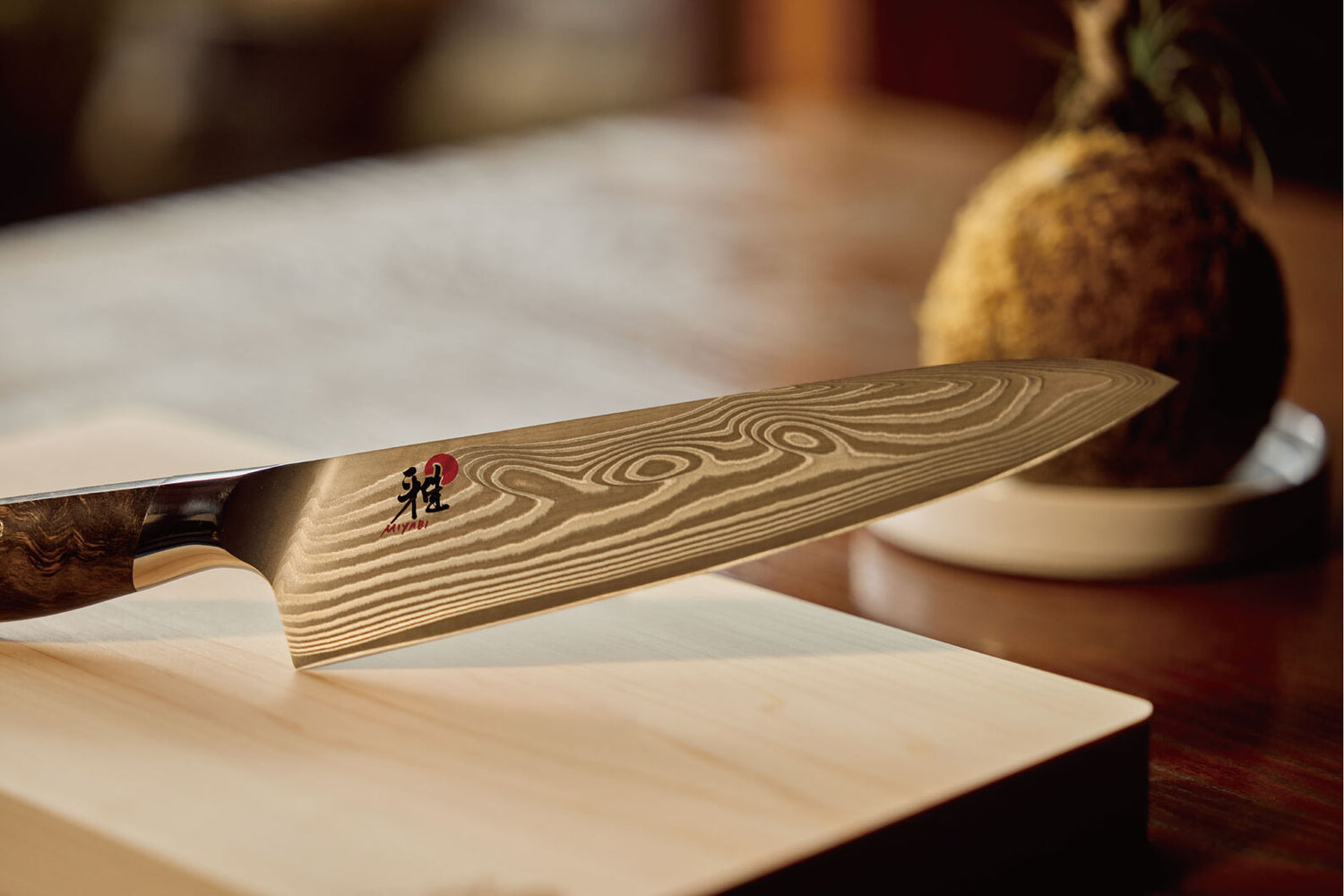
Miyabi is Zwilling Henckels’ dedicated Japanese knife brand. The word ‘miyabi’ means ‘elegance’ or ‘refinement,’ qualities that each knife is meant to embody. Performance and aesthetics are equally important — the blades are as sharp and fine as the damascus patterns, hammered finishes, and wooden handles are beautiful.
Miyabi knives are manufactured in Seki City, Japan, a historic center of sword and knife making, using multi‑step, largely hand‑finished processes that can exceed 100 individual steps over more than 40 days per knife. One aspect worth highlighting is that each knife is sharpened to very acute edges—typically around 9–12° per side—using honbazuke-style processes. This gives them exceptional sharpness and the fine, precise cutting feel that serious home cooks and professionals look for in modern Japanese knives.
The brand has multiple knife lines which vary in steel hardness, handle material, durability, and overall aesthetic. They typically use high-end steels such as VG10, SG2/MC63, and FC61, with hard cores (around 60-66 HRC). These steels are then coated with multiple layers of stainless damascus steel (which has a distinctive and rather lovely rippled appearance) to make them tougher and more resistant to corrosion.
All of them target serious home cooks and professionals — people looking for refined, high-performance Japanese knives and who don’t mind investing a little extra in their tools.
(A quick side note on HRC: This is a measure for knife hardness or resistance to indentation according to the Rockwell scale. Most high-quality kitchen knives have 54-65 HRC. The higher the number, the better the edge retention, but the more brittle and harder it is to sharpen. The lower the number, the more durable and easy it is to sharpen – but also quicker to lose its edge. It’s all about finding a balance between all of these qualities.)

A Japanese knife by… Zwilling Henckels?
Once upon a time, Zwilling Henckels sold “Japanese-style” knives. But it wasn’t enough — they decided that they needed a genuine Japanese knife brand. So it was that in 2004, the group acquired a knife factory and OEM maker (Nippa) in Seki, Japan’s historic “city of blades,” and used this site as the base for Miyabi: a distinct, Japanese‑made sub‑brand within the Zwilling portfolio.
Zwilling’s own histories point to this 2004 purchase as the turning point. The Seki facility would produce knives with Japanese steels, profiles, and finishing, while Zwilling contributed engineering know-how, capital, and global distribution. Around 2004-2005, the new Miyabi label entered the market as Zwilling’s dedicated Japanese knife line.
From the start, Miyabi was framed as “German engineering meets Japanese craftsmanship.” Having a factory in Seki gave them this credibility — the city has around seven centuries of sword and knife-making tradition to draw on — while their own expertise in modern production systems and materials gave them a serious, excuse the pun, edge. Additionally, Miaybi’s design, QA, and process control follow Zwilling’s industrial standards, offering consistency, lifetime‑style warranties in many markets, and global availability.
Miyabi is positioned to consumers not as a fully artisanal product, but as a deliberate hybrid: Japanese performance and aesthetics produced in Seki, under German‑run systems, at a scale that makes high‑end Japanese knives more predictably obtainable worldwide.

Harder, better, sharper, stronger
The term ‘CRYODUR’ sounds like a Viking insult, but the reality is more prosaic. Combining ‘cryo’ (extreme cold) and ‘dur’ (hard or durable), CRYODUR is the name for Miyabi’s ice-hardening process, a way of using extreme cold to make the blade steel harder and more stable, without making it excessively brittle.
After the blades are heated and quenched, they are cooled down to around −196 °C (−321 °F) and then gently tempered (or reheated, in layman’s terms). This low-temperature stage changes more of the steel into its hard martensite form and evens out the tiny carbides inside the metal, boosting hardness, wear resistance, and overall dimensional stability.
In practical terms, CRYODUR allows different steels to be pushed to relatively high levels of hardness while keeping some flexibility and good rust resistance. Knife lines like Kaizen are usually around 60 HRC, while powder-steel lines like Birchwood, Mizu, or Black reach roughly 63-66 HRC. That extra hardness is what allows Miyabi to grind very thin, acute Japanese‑style edges that stay sharp for a long time, as long as you use appropriate cutting boards and avoid abusing your knife.
Which Miyabi knife is right for you?
The answer to this question depends on your needs — for instance, how often you cook or how hard you drive your knives. Some of their lines are quite expensive and perhaps a little more for show and special occasions than everyday use. Some quarters of the internet consider them overpriced for what they are, even if they are well built and useful.
If you’re hankering after a Miyabi knife, you may want to wait until it goes on sale. Also, it is generally better to test a knife out in person for yourself where possible, since it’s hard to really know whether you like a knife you see online.
Evolution Series / Koh (FC61 steel)
- An entry-level Miyabi
- 61 HRC
- Suited to everyday Western‑style cooking
- Great for beginners or busy home cooks who want sharp knives with lower risk of chipping and easier care
Kaizen / Kaizen II (VG10 / FC61 hybrids)
- ‘Entry premium’ all-rounders — thin, sharp, pretty
- Around 60-61 HRC
- Good for serious home cooks or someone trying their first high-end Japanese knife
- Relatively forgiving of improper handling
- Good edge retention, easier to sharpen than Birchwood line knives and less fragile too
Artisan / Mizu (SG2, hammered or polished)
- Made with a high-performance stainless steel made with powdered metallurgy – great edge retention, corrosion resistance
- Around 63 HRC
- Double-beveled, relatively thin blade
- A ‘fancy workhorse’ type of knife
- Cuts like a laser
- More brittle, and sensitive to lateral stress/harder ingredients like bones and frozen food
Birchwood (SG2, 5000MCD)
- SG2 steel with a very hard core
- Around 63 HRC
- Ornate handles, intricate patterning on the blade
- Super sharp, of course – but more prone to chipping if abused
- Not very tolerant of scraping, lateral movements, or rough chopping
- Requires a user with good knife habits
- Best for enthusiasts and pros who like showpiece knives
Black (MC66 / SG2 at higher HRC, 5000MCD67)
- Ultra-premium, super hard high-end steel — around 66 HRC
- High-end powder steel core
- Dramatic appearance, aesthetically stunning
- Outstanding edge holding and slicing, ultra-specialised
- Technique matters here: a push- or pull-cut on soft chopping boards. Nothing rough. No scraping.
- An excellent but delicate knife best for careful, experienced users.
- Hand-washing ONLY
- Requires familiarity with whetstone sharpening – maintenance can get demanding
- In other words, the Black is finicky and this should not be your first rodeo with a fine Japanese knife. Regular cooks looking for everyday workhorses should stay away.