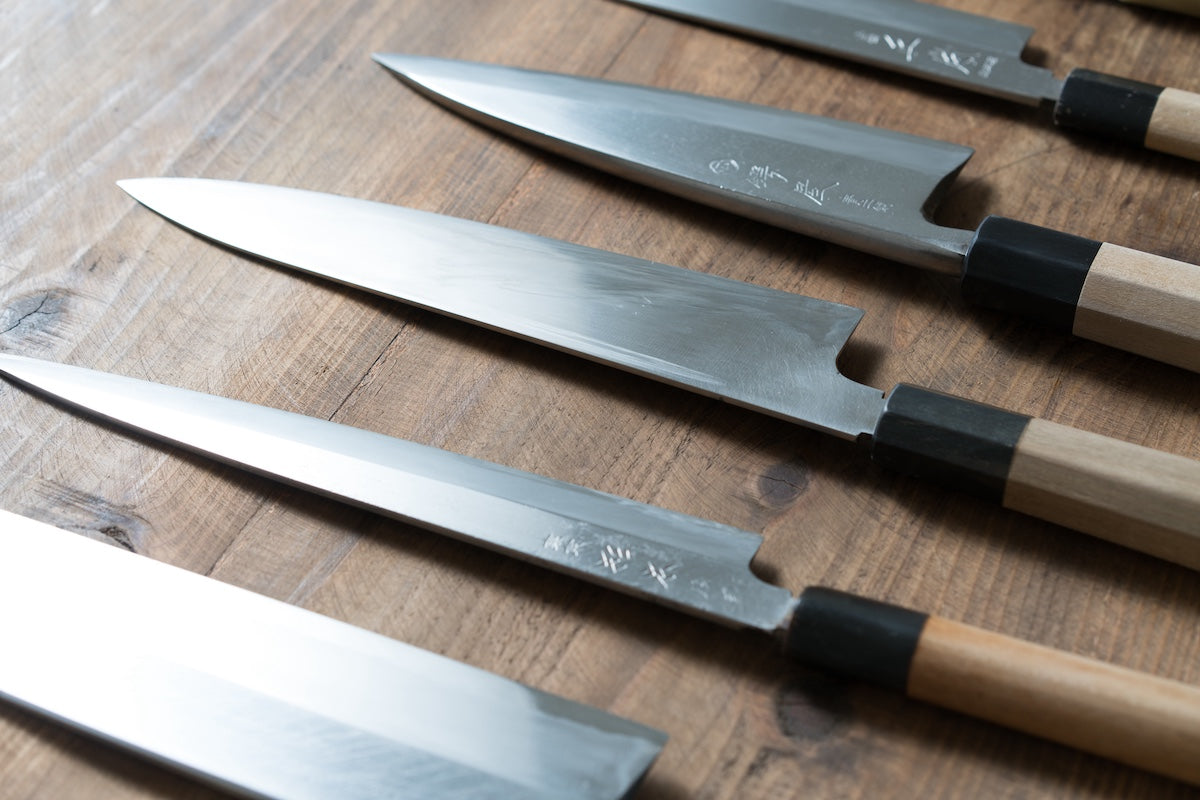
Introduction
Japanese knives are beloved by chefs and home cooks around the world. But are they really all that? We’d say so — as long as they suit what you like to do in your kitchen. Still, each knife represents the culmination of centuries of forging traditions in Japan, and as a bonus, are often works of art in their own right.
Whether you buy a Japanese knife or not is entirely up to you. We’re just here to provide some clarity for that decision.

Major knife-producing regions
Seki, Gifu Prefecture
California has the City of Angels. Gifu has the City of Blades. Seki has around 700-800 years of sword and knife-making history, beginning with katana forging during the Kamakura and Muromachi periods. It has all the elements needed for blade-making: locally available iron sand, clean water, and forests for charcoal.
Over time, as demand for swords declined, Seki’s craftspeople shifted from forging swords to kitchen knives, scissors, razors, industrial components, and other bladed tools. Today, the city is a major industrial center that produces a wide range of kitchen and utility knives for both domestic and international markets.
Interestingly, Seki seems to be best known for producing Western-style knives.
Sakai, Osaka Prefecture
Sakai is one of Japan’s historic knife capitals, with over 600 years of knife-making history. During the Edo period, they were particularly known and even officially recognised by the Tokugawa shogunate for producing the sharpest tobacco knives around — knives specifically for chopping tobacco leaves.
Today Sakai is well known for professional kitchen knives with very refined single-bevel blades. There’s a strong division of labour in blade production, too. Each aspect of the process, such as forging, polishing, sharpening, and handle-fitting, is handled by a different specialist.
Tsubame-Sanjo, Niigata Prefecture
Although Tsubame and Sanjo are two distinct areas, their proximity and reputation for blade-making means that they’re usually lumped together when it comes to marketing knife-making centres in Japan.
Sanjo was a blacksmith town that produced primarily practical things, such as nails and carpentry tools, long before they expanded into kitchen knives. Even today, their excellent kitchen knives have a sturdiness that hints at their history.
Tsubame, on the other hand, is better known for its sophisticated, beautifully polished kitchen knives. One example that you may have encountered: Global knives.
Like Sakai, blade-making in the Tsubame-Sanjo region relies greatly on division of labour among specialised craftspeople and factories. There’s a tight network that enables the speedy production of high-quality knives.

Takefu, Fukui Prefecture
Takefu — in the city of Echizen — has a history of blade-making that dates back to the 14th century. This supposedly began with a travelling swordsmith named Chiyotsuru Kuniyasu, who settled in the region and began forging sickles for farmers. This became the foundation of one of Japan’s most famous blacksmithing traditions.
One of the highlights of visiting Takefu today is the Takefu Knife Village, a cooperative of 13 knife-making companies all working under the same roof. Equipment is communally used, and technical knowhow is freely shared. As a bonus, it makes shopping for the Japanese knife of your dreams really easy.
Tosa, Kochi Prefecture
Tosa has a reputation for tough, practical knives thanks to its history of making blades for forestry, farming, and fishing — no ornate showpieces here, thank you very much. Craftspeople here use a ‘free-forging’ approach, hammering and shaping hot steel by hand.
Another distinctive aspect of Tosa-made knives is the deliberate use of black rust (black iron oxide) during forging. They actually leave it on the blade surface, polishing only the cutting edge that comes into contact with food. While red rust corrodes and weakens steel, black rust actually acts as a stable protective layer, shielding the steel underneath from further oxidation. If you ever needed a knife that can withstand a bit of abuse, a knife from Tosa might fit the bill.
Miki, Hyogo Prefecture
Situated in southwest Hyogo, Miki has had a long history of metalworking — blacksmiths were operating in that region in the 8th century, probably earlier. By the Edo period, Miki was known for its swords, but also practical bladed tools like saws, chisels, axes, and planes. It is no surprise that they have applied the same excellence to their hand-forged, hand-finished kitchen knives, which are durable and dependable.

What makes Japanese knives special?
Why do so many people adore Japanese knives? Let us count the ways.
Razor-sharp cutting performance
One purchases a knife to cut things. Ergo, it has to be able to cut things well. Japanese knife design tends to prioritise sharpness by using harder steels so blades can be sharpened to much steeper angles. This is often 10–15° per side, or single-bevel on one side.
A finer edge glides through ingredients with less cell damage, which improves texture, mouthfeel, and how cleanly flavors come through. It’s especially noticeable with sashimi and fine vegetable work.
Hard, high-quality steels
Japanese knives are often made from high-carbon or powder steels that reach higher hardness on the Rockwell scale — commonly around 60–65 HRC for many premium knives, versus slightly lower values for typical Western knives. This has its roots in a long history of swordmaking. Not a bad tradition to draw from.
This hardness results in thin, keen edges that stay sharp longer, and require less frequent sharpening, assuming that users have decent boards and good technique.
Thin, lightweight blades
Lightweight knives are a dream to use, most of the time. Japanese blades are often thinner and lighter than their Western counterparts, in part because traditional Japanese knives have no bolster, the band that joins the blade of the knife to its handle. This reduces strain on the wrist and forearm during long prep sessions, and makes the knife feel more agile and precise. Swoosh!
Refined balance and ergonomics
With no heavy bolster and lighter handles, the balance point is typically closer to the blade. Many cooks find that they are able to control their knives more easily – crucial for fine detail work.
Varied, ergonomic handle designs
Knife handles typically come in a variety of shapes so users can choose what feels best for their grip. For instance, oval handles are traditional and elegant, octagon handles offer a secure grip even when wet, and D-shape handles provide excellent grip but are typically suited for right-handed users.
They’re often made from high-quality woods, which has the added bonus of looking very stylish.
Strong edge retention and longevity
Thanks to hard steels and careful heat treatment, Japanese knives maintain a sharp edge for a long time, so you “touch up” rather than fully sharpen as often. With proper care — hand-washing, suitable cutting boards, the occasional hone on a sharpening stone (not steel) — a good Japanese knife can be a faithful kitchen companion for life.
Sharpening potential and user control
Japanese knives have a higher threshold for sharpening overall. One can get a much finer angle due to the harder steel. Also, learning how to sharpen them on waterstones is relatively straightforward.
Because they can take very fine edges, users who invest in sharpening skills can dial in the exact feel they want, from ultra-slicey “laser” edges to slightly more robust working edges.
Aesthetics and cultural heritage
Aesthetics are often as important as performance. Many Japanese knives showcase visible forging or cladding—Damascus patterns, kurouchi (black) finishes, or polished kasumi transitions—which reflect centuries of swordmaking traditions.
More than mere kitchen tools, they embody a craft lineage where performance and beauty are intertwined.

Comparing Japanese and Western knives
Japanese and Western knives are built around different priorities, so they end up feeling and behaving quite differently in the kitchen. Here are some of the ways in which they vary. We won’t get into the Chinese cleaver, which is a marvellous, versatile blade in its own right.
Harder steels and sharper angles
Japanese knives commonly use harder steels (often around 58–65 HRC, and for some high-end lines even higher), while many Western chef’s knives sit closer to the mid‑50s HRC range.
Because of this extra hardness, Japanese blades are usually sharpened to more acute angles so they can reach and hold a noticeably keener, “razor‑sharp” edge. This is roughly 10–15° per side for many double‑bevel Japanese knives, versus about 18–22° per side for Western knives.
Thinner, lighter blades and different balance
Japanese knives tend to have thinner cross‑sections, around 2 mm at the spine tapering to a very thin edge. They are often lighter overall than Western knives, which usually have thicker, heavier blades. The trade‑off is that harder, thinner edges are more brittle.
Western knives frequently include a full tang and a thick bolster, which adds weight and shifts the balance toward the handle, while many Japanese knives omit the bolster and use lighter handles. This moves the balance point closer to or slightly forward on the blade for more agile, precise cuts.
Single‑bevel vs double‑bevel geometry
Traditional Japanese knives are often specialised for certain tasks, and tend to be single‑bevelled — sharpened on one side with a hollow ground back. This allows for extremely fine, controlled cuts for tasks like slicing sashimi, which requires much more specialised skill. (Such knives are distinct from knives like santoku and gyuto which are designed to be more versatile.)
Western knives are almost always double‑bevelled, sharpened on both sides in a symmetrical V, prioritizing versatility and ease of use for a wide range of ingredients and techniques.
Cutting style and task emphasis
Japanese blade profiles are usually flatter with more emphasis on push‑cutting and slicing—ideal for clean, low‑damage cuts through vegetables, fish, and boneless meats; the thin edge and acute angle minimize cell crushing and juice loss, which is important in Japanese cuisine.
Western knives tend to attract people who want knives that can survive rough use. They’re designed to tolerate mistreatment: being slammed into boards, steeled aggressively, run through dishwashers, or pushed through joints and small bones. The downside is that they lose their edge more quickly and need regular honing; they also won’t reach quite the same “surgical” cutting feel as a hard, thin Japanese blade, even when freshly sharpened.
You could say that both styles of knives can handle core kitchen tasks, but approach the problem from opposite ends of the durability–performance spectrum.
Handle construction and feel
Many Japanese knives use wa‑handles (oval, octagonal, or D‑shape) mounted on a hidden stick tang, skipping the bolster altogether. The handles are light and replaceable, contributing to the blade‑forward balance and allowing users to choose different shapes and woods for comfort and aesthetics.
Western knives typically feature full‑tang, riveted handles designed for robustness and familiarity, which, together with the bolster, give a more solid, “hefty” feel but less of the nimble, tip‑light sensation common in Japanese designs. They can feel noticeably heavier over a prolonged prep session.

Caring for your blades
This comes down to three things: cleaning (and therefore preventing rust), protecting the edge, and sharpening blades the right way.
Cleaning and rust prevention
- Always wash by hand immediately after use with mild dish soap and a soft sponge. Then, dry it thoroughly with a towel.
- Don’t let the knife air-dry.
- Never put it in the dishwasher.
- Wipe the blade promptly if you’ve been cutting acidic or salty foods, such as tomatoes, citrus, onions, fish, anchovies, etc. These can stain or corrode both carbon and stainless steels over time.
- For carbon steel knives, get into the habit of wiping the blade during use and drying it as soon as you’re done. For long breaks or humid climates, apply a very thin coat of food‑safe oil like camellia or mineral oil before storage.
Protecting the edge in daily use
- Use suitable cutting surfaces. Wood, soft rubber, or decent plastic boards are all acceptable.
- Avoid using cutting boards made of glass, stone, metal, or very hard bamboo, which will quickly dull or chip a thin edge.
- Unless they are specialised knives for the task, don’t use them on bones, frozen foods, shells, or very hard rinds.
- Never twist or pry if the blade sticks—gently back it out with a straight or slicing motion.
- Store knives so their edges can’t hit other metal. For example, in a block, on a wooden or well‑made magnetic strip, or in sayas/blade guards, not loose in a drawer.
Sharpening
- Sharpen with waterstones (or ceramic/water sharpener) than traditional steel hones, which are mostly too aggressive for hard Japanese steels.
- For most double‑bevel kitchen knives, a basic progression of about 1000 grit (to restore sharpness) and 2000–3000 grit (to refine and polish) is enough.
- Use light, even strokes at a consistent angle, generally in the 10–15° per‑side range unless the maker specifies otherwise.
- It is best to touch up edges before they become very dull so you’re maintaining the bevel rather than rebuilding it from scratch.