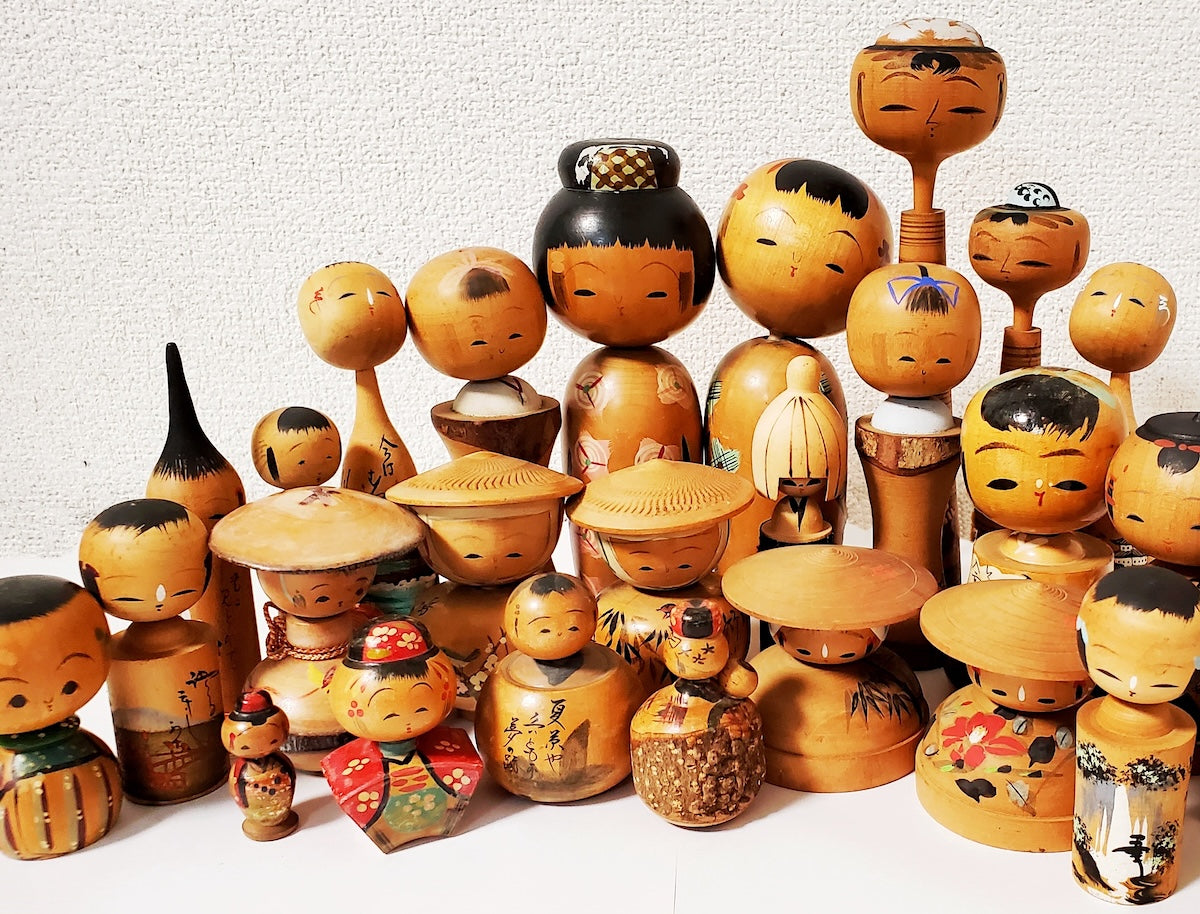
For a doll with no arms and no legs, the kokeshi has come a long way.
Its journey took off when it was sold to travelers visiting the hot spring towns of Japan’s Tohoku region.
Tucked into luggage as a souvenir and later lifted onto shelves as folk art, the kokeshi traveled out of mountain valleys and into homes across the country - and then far beyond as emblems of Japanese craftsmanship and culture.
Origins of Kokeshi Doll-Making
The roots of kokeshi can be traced back to the hand-held and freestanding dolls that carpenters in north-eastern Japan made for the children of farmers.
In the early 19th century, the dolls began to be sold as souvenirs to people visiting hot springs in the region.
The craftsmen behind kokeshi were not toy-makers by alone. They were skilled woodworkers who built teahouses, residences and temples.
During the long winter months, when construction slowed under snowbound conditions, the carpenters turned to lathe work, making use of the foot-powered hikimono technique and wood left over from building projects. In this way, kokeshi dolls were born not only of creativity but also of seasonality, practicality and an intimate knowledge of wood.
Most of the dolls were lathe-turned from a single piece of wood. They featured a spherical or slightly elongated head set atop a cylindrical body slender enough to fit into a toddler's hand.
Some early versions did not even stand upright. Historical accounts describe girls carrying them on their back during games of make-believe, treating the dolls like little children.
In some regions, kokeshi were also talismans for protection, fertility and the healthy growth of children. The red patterns were more than decoration; the color was traditionally associated with the power to ward off diseases such as smallpox.
Traditional Kokeshi Dolls: The 12 Regional Styles
Today, scholars and collectors generally recognize 11 main types of traditional kokeshi dolls, each tied to a specific region and family. A 12th style, Nakanosawa from Fukushima, has more recently been recognized as an independent lineage.
Though all share the recognizable format - round head, cylindrical body - each region developed distinct silhouettes and motifs.
Aomori Prefecture
Tsugaru

This style stands out for its decorative bands and dynamic painted lines.
Some Tsugaru kokeshi also incorporate motifs inspired by the Nebuta Festival or peonies. The bodies are often tapered at the waist and richly ornamented.
Akita Prefecture
Kijiyama
Many of these dolls come with distinctive bangs framing the face and feature kimono designs or apron-like patterns.
The bold, simple lines of the Kijiyama style make it one of the most instantly recognizable types of traditional Japanese wooden dolls.
Iwate Prefecture
Nanbu
With its beginnings in wooden teething toys; this is the only style of kokeshi with unpainted dolls.
Later versions introduced modest decoration. Even so, Nanbu remains the most minimalist of the main types.
Miyagi Prefecture
Yajiro

Lively and colorful, these kokeshi often feature multicolored rings on the crown. The bodies carry bold designs and strong horizontal bands.
Yajiro dolls are loved for their cheerful, expressive qualities.
Togatta
Regarded as one of the oldest kokeshi lineages, Togatta dolls are recognizable by their large heads and red radiating lines on the crown.
Floral patterns - chrysanthemum, plum or cherry blossom - decorate the wooden bodies.
Naruko
Their charm lies largely in their defining feature: a head that can turn and produce a soft squeaking sound.
Naruko dolls can also be identified by their square shoulders, a slightly narrowed waist and bold chrysanthemum motifs.
Sakunami (Miyagi/Yamagata)
This style originated in the hot springs area west of Sendai and spread into parts of Yamagata.
The dolls are characterized by slip-in construction, with the head inserted into the body.
The most typical pattern features horizontal chrysanthemums known as kani kiku because the flowers (kiku) are thought to resemble a kani, or crab.
Yamagata Prefecture
Yamagata
Narrow-bodied with small heads, these dolls often carry plum and cherry blossom motifs.
The lines are delicate and the overall expression, serene.
Zao-Takayu
These dolls from the Zao Onsen area tend to have larger heads and slender bodies. Radiating floral patterns on the crown connect them to the Togatta style.
Hijiori
Stout and sturdy, these dolls have thicker heads and shorter bodies. Heavy floral designs and a robust silhouette reflect the mountainous character of Hijiori Onsen.
Fukushima Prefecture
Tsuchiyu
Originating in the Tsuchiyu Onsen area of Fukushima, these kokeshi are known for their relatively small heads and slender, slightly tapered bodies.
Their heads often bear concentric rings. Fine horizontal lines created on the lathe - known as rokuro moyo - wrap around the body. Floral motifs are typically understated, painted in red and black.
Nakanosawa (Fukushima)
Recognized as an independent style in recent years, Nakanosawa kokeshi are known for their wide-eyed expressions and bold red accents.
The Art of Making Kokeshi Dolls
Kokeshi are rooted in the woodworking traditions and materials of northeastern Japan.
Common woods include mizuki (dogwood), cherry, maple and other local hardwoods. Mizuki is especially prized for its fine, even grain and resistance to cracking. Cherry wood offers warmth and subtle color variation.
Logs are cut, transported and carefully dried - sometimes for years - to prevent warping. Each piece of wood is selected with attention to grain and density.
Turning on the Lathe

Historically, kokeshi were shaped using hand-powered or foot-powered lathes. In earlier times, two people - often a married couple - operated a pole lathe: one turning the wood with a rope, the other shaping the wood with tools.
The head and body might be turned separately or carved from a single piece of wood, depending on regional style.
Decoration is typically applied freehand with ink and red pigment. Floral designs - cherry blossom, chrysanthemum, plum - reflect seasonal motifs embedded in traditional Japanese aesthetics.
Modern artisans may use motorized lathes but the handicraft element remains central.
Handmade vs Factory Reproductions
For collectors, distinguishing handmade kokeshi dolls from factory reproductions is essential.
Key indicators include:
- Signature: Many postwar artisans sign their dolls on the base.
- Tool marks: Subtle variations from hand-turning.
- Brushwork: Delicate hand-painted lines rather than uniform printed designs.
- Wood grain: Natural variation rather than synthetic finishes.
Mass-produced souvenir versions may lack the nuance of true craftsmanship. They may be painted by stencil, lack a signature or be made from inferior wood.
A visit to the Zao Kokeshi Museum in Miyagi offers an education in stylistic differences with its collection of kokeshi, the largest in the country.
Sosaku Kokeshi: From Folk to Contemporary Art
If traditional kokeshi dolls follow established regional lineages, sosaku kokeshi - creative kokeshi - break free from them.
Emerging in the early 20th century and flourishing after World War II, sosaku kokeshi allowed artisans to move beyond inherited family motifs.
Artists began experimenting with larger forms, multiple wood types, wood-burning techniques, chisel carving and abstract or fashion-inspired kimono designs.
Today, sosaku kokeshi are exhibited internationally as art objects, bridging folk art and modern design.
Display Tips: A Kokeshi Exhibition in Your Home

For the collector, kokeshi offer both aesthetic pleasure and cultural significance. Here are a few tips on how to display these wooden figures to advantage:
- Keep the dolls away from direct sunlight to prevent fading and cracking.
- Keep the humidity in the room stable.
- Avoid putting the dolls in overheated, sealed spaces.
- LED lighting is gentler on kokeshi than fluorescent or incandescent bulbs.
- Black ink tends to endure. Red pigment is more vulnerable to moisture damage.
- Arrange the dolls at varying heights. A cluster of traditional kokeshi dolls from different regions creates a visual dialogue. On the other hand, a single sosaku kokeshi can command a space like a minimalist sculpture.
Whether displayed in a modern penthouse or a tatami-lined room, kokeshi add narrative depth to the space.
An Intricate Piece of Japan
Behind kokeshi dolls lies a journey that has seen them grow from playthings to souvenirs, then to collector’s items, contemporary art and ambassadors of Japanese craft.
It may have no arms but the small piece of wood that is a kokeshi holds a large piece of Japan.