Japan may have an established soup culture but it is one that has little need of spoons. Miso soup is drunk directly from the bowl; suimono is sipped from lacquered vessels without any utensil at all.
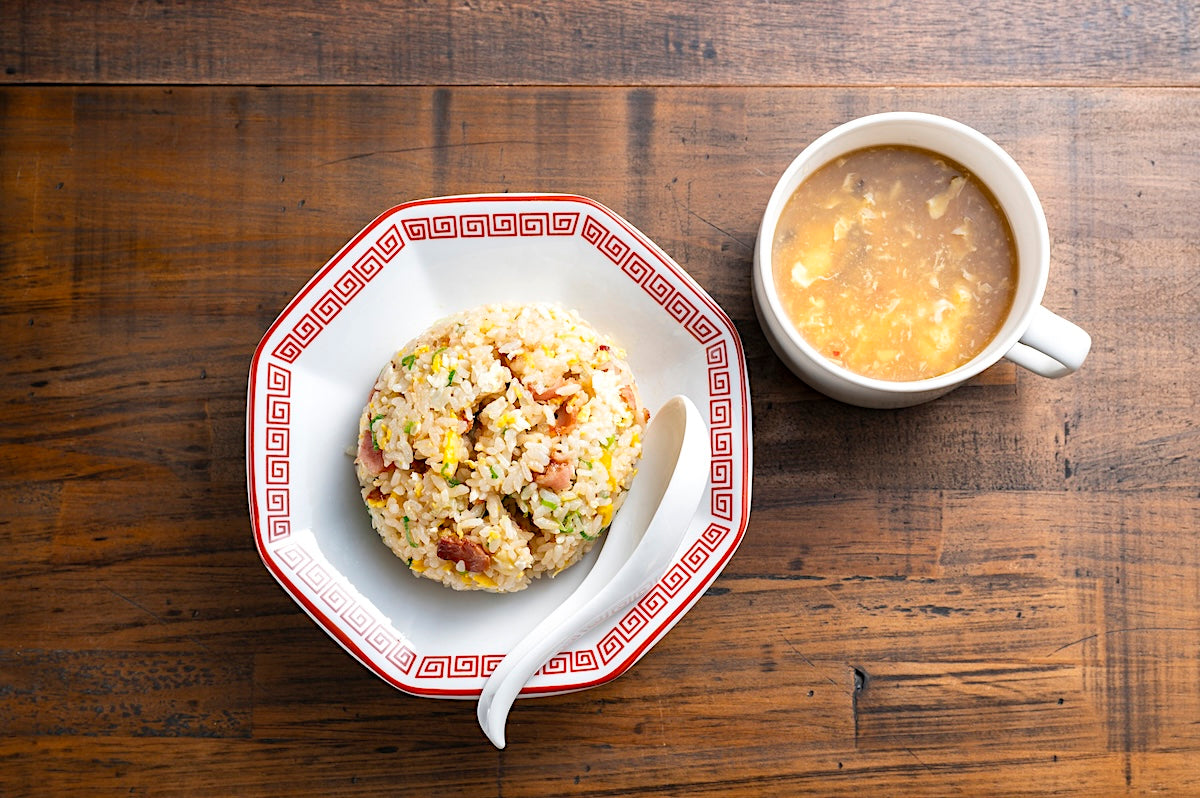
And yet the renge has a place in Japanese cuisine. Present at every ramen counter and most Chinese restaurant tables in Japan, the ceramic spoon has been around since the Heian period (794-1185), when it arrived from China as a deep-bowled scoop known today as the tangchi (汤匙).
Somewhere in the crossing, it acquired a Japanese name considerably more poetic: chirirenge (散蓮華), meaning a scattered lotus petal. The shape of the spoon - rounded at the front, narrowing back to a short handle - does indeed suggest a petal from the lotus flower dropping onto still water, though it takes a certain willingness to see it that way at seven in the morning over congee.
What happened after the renge arrived is the more interesting story. Japan, which had its own spoon tradition stretching back to the Yayoi period, was already in the process of abandoning it. By the late 8th and early 9th centuries, the upper class had shifted to eating almost entirely with chopsticks. Spoons lingered in temples, in formal ritual and in the medicinal world - the physicians who served Edo-period shoguns and other feudal lords were colloquially called osaji, or 'the honorable spoon', because they used one to measure out their powders. For everyday meals, though, the spoon had effectively been retired.
The renge kept going. It occupied a different category from the broad saji tradition: it was a tool of Chinese cooking that never lost its footing in Japan. But it remained a niche object until, sometime in the 20th century, something changed.
Japanese Ramen Culture and the Renge
The story of the renge in Japanese cuisine is inseparable from the story of ramen. As ramen culture took hold across the country in the postwar decades - the ramen boom is generally dated to the late 1950s - the renge spread with it, eventually becoming a fixture at ramen counters.
One of the small pleasures of Japanese ramen culture is the construction of a miniature ramen bowl on the spoon itself - a mouthful of noodles and toppings balanced in a small scoop of broth before being brought to the mouth. This is not something a Western spoon facilitates well and it's not something found in the formal dining traditions of Japan.
Japan also did something no Chinese maker had found necessary: it added a hook. The kake renge, a spoon with a small notch that catches on the rim of the bowl, exists because Japanese ramen bowls are deep and nobody wants to fish a spoon out of hot broth.
What Your Renge Is Made Of
The original chirirenge was ceramic and, for most of its history in Japan, it stayed that way. Today, the material options are wider; here's a look at how they stack up against each other.
Because ceramic conducts very little warmth, the handle stays cool even when the bowl it rests in is steaming. Unlike stainless steel, which announces its presence in the mouth, the texture of ceramic is far subtler. There are also artisanal versions, which are sold as craft objects in their own right.

Smoother, thinner and lighter, porcelain renge are the standard for restaurants. The surface feels glass-like and the glaze has a luminosity that ceramic, with its earthier character, cannot match.
The trade-off: porcelain conducts heat more readily so the spoon can become warm if left resting in a hot broth.
Most porcelain renge are dishwasher-safe - an important consideration when you run a ramen shop that serves hundreds of bowls a day. Commercial restaurant-grade renge are typically made from porcelain reinforced with alumina oxide: an engineering development that acknowledges the reality of professional kitchens.
Melamine renge are the third option and the practical one. They are lightweight, nearly impossible to break, inexpensive and available in every glaze color a designer might want. But they cannot go in a microwave and they can absorb odors over time.
Still, for households with young children, or for outdoor use, or for any situation where the spoon is more likely to end up on a concrete floor than in a dishwasher, they make sense.
A note on shapes: a deeper renge, closer in profile to a small ladle, is best for broths; a shallower, wider version works better for fried rice. Both types can be found across all three materials.
How to Hold a Renge
Gripping the handle in the fist - thumb on top, fingers wrapped underneath - is the instinct for anyone raised with Western cutlery. But the renge isn't a Western spoon and it requires a different approach.
The correct technique: place the index finger in the groove or indentation along the top of the handle, while the thumb and middle finger lightly pinch the handle from either side. The ring and little fingers follow naturally, folded gently alongside the middle finger. The result is a hold that is more like supporting the spoon than controlling it - the utensil rests in the hand rather than being gripped by it.
When held well, the renge moves differently. The wrist stays loose. The spoon is brought toward the mouth parallel to the table, then tilted at the side so that the broth enters from the edge of the bowl rather than from the pointed tip - drinking straight off the tip is considered ungainly. The aim is a motion that is controlled, level and unhurried.
Leaning forward to meet the renge is considered poor form; the spoon is always moved to the mouth, never the other way around.
None of this should be treated as a source of anxiety at a noodle shop. Most ramen counters in Japan operate on the principle that you eat as you like. But understanding the technique - the index finger in the groove, the relaxed wrist, the angled sip - does add ease and enjoyment to the meal.
The Aesthetic of the Wooden Spoon

At a kaiseki meal - the formal multi-course Japanese dining experience - the renge does not usually appear. The lacquered soup bowl is held in both hands and the suimono, a clear seasonal broth, is drunk directly from it. The bowl itself is the utensil.
But the lacquer spoon does exist. Carved from wood - Japanese cherry birch, zelkova, horse chestnut - the base is shaved thin enough that the spoon can glide along the bottom of a lacquer bowl without scratching it.
Multiple coats of lacquer are then applied and polished. The finished surface has no metallic odor, no cold shock against the lips and a thermal conductivity so low that even steaming soups do not transfer their heat to the handle.
The standard finishes are tame-nuri, a deep translucent brown-black, and shu-nuri, the vermilion that makes a dish look even more appetizing. Both are classic features of Japanese tableware; where they appear, they help diners savor the meal with the eyes and the hand.
Elegance in Functionality
The renge isn't an object people usually discuss. No one travels internationally to photograph famous soup spoons. There are no renge museums attracting queues of tourists. Most people who encounter a renge in Japan find it beside a bowl of ramen. They use it without much thought, return it slick with broth and move on with their lives.
Yet the spoon holds a long history of cultural interaction.
Chinese in origin, Japanese in adaptation, the renge exists at the intersection of multiple dining worlds. It survived in a country that largely did without spoons. It adapted itself to ramen culture so thoroughly that it now feels inseparable from it. It even acquired a hooked handle because enough people, over enough years, became tired of fishing submerged spoons out of hot soup.
The utensil rewards balance over force. It works better and looks best when held lightly rather than gripped. The path to the mouth is level and controlled. Even at a ramen counter - one of the least formal dining environments in Japan - there remains a preference for composed, deliberate movement.