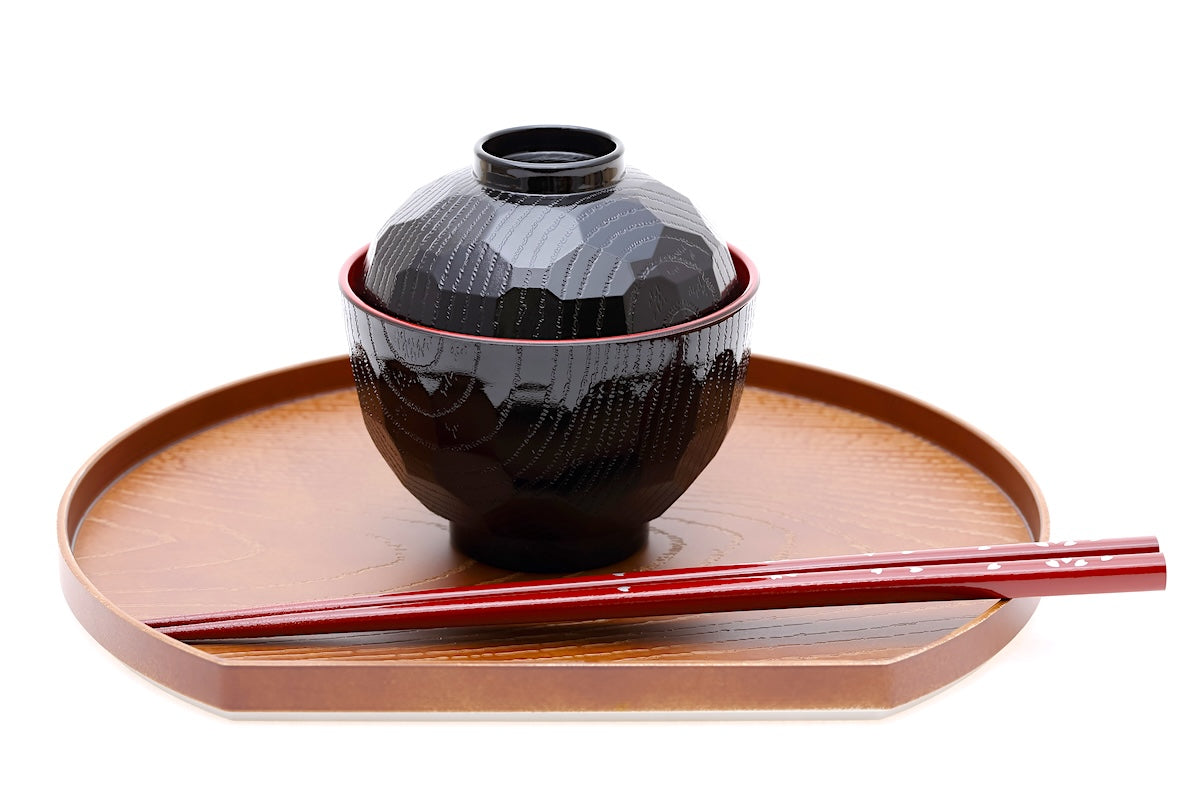
The earliest lacquered objects found in Japan date to around 9,000 years ago - funerary accessories excavated in Hokkaido, coated in the sap of the urushi tree long before anyone thought to call the technique an art form.
But the Japanese bowl as we know it took longer to arrive. It was in the Heian period (794-1185) that the wan settled into its characteristic shape, accompanying aristocratic meals in which the quality of the vessel was understood to say something about the quality of the host.
In this era, owning lacquerware meant access to serious money. Each bowl required multiple coats of urushi - a slow, exacting process of applying, drying and polishing that pushed up the prices of the finished pieces.
Around the 11th century, craftsmen developed a workaround: a base coat of fermented persimmon tannin, known as kakishibu, mixed with charcoal powder, requiring just a single coat of lacquer on top. The price dropped; the market expanded. By the 16th century, even farming households had lacquered bowls.
During the comparatively stable Edo period (1603-1868), lacquerware production spread across Japan and regional traditions matured into styles still recognized today. Among these, Wajima, on the Noto Peninsula of Ishikawa prefecture, is noted for an undercoating material called ji-no-ko, a diatomite powder found only in Wajima that gives the finished lacquer its lauded durability.
The lacquer itself - that dark, lustrous resin - is the natural sap of the urushi tree, processed and layered until it becomes one of the most durable coating materials in the natural world. It resists acid, alkali and alcohol. It has antibacterial properties. And it does something no synthetic coating manages: it deepens with use, growing richer and more luminous over years of handling.
The Lidded Bowl and Its Moment of Theater

In formal Japanese dining - kaiseki courses, New Year meals, the careful hospitality of a well-set table - the soup does not come naked. It arrives covered.
The suimono-wan, or lidded lacquer soup bowl, performs a function that has nothing to do with keeping dust out. The lid traps the aroma of the dashi - the broth drawn from kombu and katsuobushi - inside the bowl from the moment it is served until the moment the diner chooses to release it. When the lid comes off, steam rises together with the fragrance of the soup and its ingredients: a small, private event repeated at every place setting simultaneously.
The lid also exploits a useful property of lacquered wood: low thermal conductivity. Where a ceramic bowl transfers heat straight through its walls, a wooden bowl coated in urushi acts as a gentle insulator, keeping the hot soup warm while the exterior stays comfortable to hold. Lift a well-made lacquer bowl filled with miso soup and you will notice it immediately - the bowl is warm but not punishing, light in the hand, soft against the lip in a way that no ceramic can be.
If you're in Japan when the calendar moves from one year to the next, you may see a variant: the zoni-wan, a lidded bowl slightly larger than the standard suimono-wan, used specifically for ozoni, the celebratory soup served during the New Year holiday.

One practical note about the lid that no one mentions until it's too late: hot soup inside a covered bowl cools the air slightly as it sits, lowering the pressure and causing the lid to cling. If the lid won't budge, press the rim of the bowl gently inward with thumb and forefinger. A small gap forms, air enters and the lid comes off without drama.
Ceramic Soup Bowls: The Everyday Choice
Not every bowl of miso soup needs ceremony, especially before 9am, when the ceramics are better than the conversation.
For daily use, ceramic soup bowls may be the more practical answer. Japanese pottery traditions are long, regional and various: Mashiko-yaki from Tochigi, with its thick forms and natural glazes that came to stand for the mingei - folk craft - aesthetic; Hasami-yaki from Nagasaki, a porcelain tradition that produces the clean, slightly Scandinavian-influenced bowls now filling lifestyle shops in Tokyo; Mino-yaki from Gifu, Japan's highest-volume ceramic production area and the source of an enormous range of everyday ware. Each carries a different character; all are made in Japan and designed to be used.
The technical distinction worth knowing: Japanese ceramics divide into toki, or earthenware - fired at between 1,000 and 1,300°C, porous unless glazed, with the warm, matte surface associated with Mashiko and the wabi aesthetic of imperfect, functional beauty - and jiki, or porcelain - fired higher, at 1,300 to 1,400°C, non-porous, with the clean white body and faint ring when tapped that characterizes Hasami and Arita.
Both are typically dishwasher-safe and microwave-compatible - advantages that make ceramic soup bowls a sensible first choice for anyone building a Japanese tableware collection.
Where the Soup Bowl Sits in Japanese Dining
Understanding the soup bowl means understanding what surrounds it. A traditional Japanese meal is not a single plate but a table setting composed of several vessels, each with its own purpose and position.
The rice bowl - the gohan chawan, a smaller, deeper vessel for steamed rice - sits to the left. The soup bowl sits to the right. This pairing of rice and miso soup is the foundational unit of the Japanese meal, appearing at breakfast, lunch and dinner. Chopsticks rest in front, on a chopstick rest, parallel to the edge of the table.
Beyond this core pairing, the Japanese table expands. Small bowls - hachi - hold pickles, side dishes, simmered vegetables or a small serving of tofu. A slightly larger serving bowl might carry a simmered dish with broth.

Deeper bowls, the kind used for noodle dishes, are a different category entirely: the ramen bowl is a generous, wide-mouthed vessel built for broth, noodles and toppings - chashu pork, a soft-boiled egg, nori, garnishes of spring onion - rather than for lifting to the mouth.
The donburi bowl, used for rice dishes like oyakodon or katsudon, occupies a middle ground - deeper than a rice bowl, with enough volume to hold a generous portion of rice topped with ingredients and sauce.
How to Handle a Japanese Soup Bowl
In Japan, leaving a soup bowl on the table and bending toward it is a breach of etiquette called oki-wan, literally 'placed bowl'. The practice of lifting the bowl to the mouth goes back to a time when Japanese meals were served on individual low trays, with the food positioned at a distance that made leaning down impractical. The habit outlasted the tray and became a rule.
Today, it applies in homes, restaurants and formal settings alike and it's one of the more visible ways in which Japanese dining culture diverges from almost every other tradition in the world.
The correct technique has a specific sequence. Lay the chopsticks down first. Then lift the bowl with both hands - right hand to the right side, left to the left - raising it to roughly chest height before transferring it to the left hand alone, with the thumb resting lightly on the rim and the remaining four fingers supporting the raised foot ring, called the kodai, from below. Only once the bowl is settled in the left hand should the chopsticks be picked up again with the right.
To drink, tilt the bowl rather than tilting the chin. Tipping the head back to meet the broth is considered inelegant - the bowl comes to the mouth, not the other way around.
For lidded bowls, the sequence has its own choreography. Steady the bowl with the left hand placed lightly on the rim. Use the right hand to lift the lid upward, tilting it slightly as you go so that any condensation on the inner surface falls back into the bowl rather than onto the table. Place the lid with its inner surface facing upward, to the right side of your setting. After finishing, replace it exactly as it arrived.
Caring for Lacquerware
The basic principle: treat the bowl more or less as you would treat yourself. Prolonged soaking is bad for it. Very hot water is bad for it. Hard abrasion is bad for it. Extreme dryness causes it to crack; strong direct sunlight causes it to fade. None of this should be surprising from an object made of wood.
Washing
Hand wash only, using a soft sponge and a small amount of neutral dish detergent. The dishwasher is not an option for traditional lacquerware - high heat and water pressure cause the lacquer to peel and the wooden base to warp.
Modern resin bowls finished with urethane lacquer are sometimes designed to withstand machine washing; check before assuming that this is the case.
Wash lacquerware separately from ceramic bowls, glassware and metal cutlery to prevent scratches. Never use abrasive scrubbers, scouring pads or wire wool.
Do not use boiling water. Liquid at a temperature comfortable for drinking is fine.
If food is stuck to the bowl, leave it in water for about 10 minutes. The food should come off; do not soak the bowl for longer than necessary.
Drying and storage
Wipe dry immediately with a soft cloth after washing. Do not air-dry - mineral deposits from tap water leave marks on lacquer. Do not use a drying machine or a microwave.
Pay particular attention to the kodai, the raised foot ring at the base, where water collects.
Store away from direct sunlight and away from the airflow of air conditioning units, which create the dry environment that lacquer dislikes most.
If stacking bowl sets, place a piece of soft cloth between pieces to prevent surface contact.
If the lacquer has dulled, chipped or peeled, the bowl can be sent to a craftsman for restoration. A lacquer bowl, properly cared for, can last a lifetime.
Heat and Aroma: Building a Japanese Soup Bowl Collection
The most practical approach to tableware in a Japanese household is a matched set of five. This number covers the modern nuclear family with a spare and can also accommodate a small gathering of guests.
For that single set, the consensus recommendation is a wooden lacquer bowl in a subdued finish. Tamenuri - a deep, translucent lacquer that lets the grain of the wood show through - is one of the most versatile choices, as is a clean matte black. Both pair well with the rest of the Japanese tableware on the table rather than competing with it.
Avoid heavily decorated maki-e pieces for daily use; the gold and silver lacquer work is beautiful but requires gentler handling than the daily wash cycle permits.
Look for a well-formed kodai: a raised foot ring reduces heat transfer to the table and makes the bowl easier to lift when filled with hot soup.
For those who prefer to start simply, a good ceramic bowl from Mino or Hasami makes an excellent daily miso soup bowl that needs no particular care. Alongside it, lidded lacquer bowls set a fine table for guests. For the full Japanese table setting, add a gohan chawan - rice bowl on the left, soup bowl on the right - and the meal, however simple, will look complete.
Japanese Culture, Souped Up
The Japanese soup bowl occupies that curious category of object Japan specializes in producing: something humble that becomes strangely profound once enough generations have thought about it.
At first glance, it's only a vessel for soup. Then you notice that entire regional industries have formed around its production. That craftsmen have perfected lacquer formulas durable enough to survive centuries. That dining etiquette has evolved around the manner in which it is lifted.
The oshiru-wan turns an ordinary act into one that looks - and feels - beautiful.