There are places you go to buy food and places where food culture actually happens. In Japan, these are often the same building - specifically, a 24-hour konbini, the convenience store that has evolved into one of the most sophisticated snack ecosystems on the planet.
In dense urban areas, konbini appear every few hundred meters, which means that, at almost any moment in any Japanese city, you are within a five-minute walk of something worth eating.
The Konbini as Snack Laboratory
What sets the Japanese konbini apart from its American ancestor - the format that originated in the United States - is the product development intensity behind it.
The three dominant chains, 7-Eleven, Lawson and FamilyMart, each operate private-label lines; 7-Eleven's Seven Premium snacks and desserts, in particular, merit investigation.
Products change roughly every two months, timed to the seasons. Autumn brings roasted sweet potato and chestnut flavors; spring fills the aisles with sakura-themed sweets and strawberry variations; limited-edition releases appear and disappear within weeks, sometimes days.
The permanent roster covers a remarkable range. Pocky - chocolate-coated biscuit sticks manufactured by Glico since 1966 - is so ubiquitous it has its own national holiday (November 11th, for reasons the date makes obvious).
Other staples: Baby Star ramen snacks, Umaibo corn puffs, Black Thunder chocolate bars, Alfort chocolate biscuits and Kinoko no Yama - mushroom-shaped chocolate snacks - and its rival Takenoko no Sato, bamboo-shoot-shaped ones. Consumers have been debating the relative merits of the last two since the 1980s. Naturally, there is no resolution in sight.
How Kit Kat Became the Most Japanese Thing Britain Ever Made
Invented in 1935 by British confectionery company Rowntree's as a snack for factory workers, Kit Kat arrived in Japan in 1973.
At first, it was simply an imported chocolate bar, pleasant but unremarkable. Then Nestlé acquired Rowntree's in 1988 and Nestlé Japan began manufacturing Kit Kat domestically in 1989, making the crucial decision to reduce the sweetness of the bar. Another adjustment was to add a strawberry flavor - launched first in Hokkaido as a test then extended nationally when it sold well.
That was the moment Japanese Kit Kats stopped being a foreign product and became something else entirely. Strawberry led to grape, mango, yuzu, kinako, miso, sake, wasabi and a long list of other flavors.
The bar was also reengineered for scale: in Japan, Kit Kat comes as a 2-finger product rather than the standard 4-finger bar, adjusted for the Japanese preference for smaller portions and individual packaging. The total number of flavors developed since 2000 now exceeds 300, with some counts putting the figure closer to 450 once every regional and seasonal variety is included.
Of the current line-up, the standout category is the regional Kit Kats developed to showcase specialties from across Japan, the first being a yubari melon flavor from Hokkaido. Today, roughly 20 regional varieties are sold. They include another Hokkaido version, one which uses azuki red bean paste powder and strawberry powder.
Kyoto's is made with matcha from Itoh Kyuemon, a long-established Uji tea shop. Matcha green tea chocolate has become the Japanese snack most reliably sought by international visitors, and the Kit Kat version is frequently the most accessible entry point.
The Kikyo Shingen Mochi variety from Yamanashi is built around kinako soybean flour, kuromitsu dark syrup and mochiko rice flour - essentially a regional confection inside another regional confection. Shizuoka offers a Kit Kat made with real wasabi; Okinawa, a purple sweet potato version that turns the bar a slightly uncanny violet.
These products can be found at convenience stores, souvenir shops in airports and major train stations, retailers such as Don Quijote, and through online shops including Amazon. The KitKat Chocolatory boutiques - upscale shops developed with patissier Yasumasa Takagi - offer a premium tier and limited-edition varieties.
Two Rices, Three Snacks

The Japanese rice cracker predates Kit Kat by roughly a millennium and it arrives with considerably more genealogical complexity.
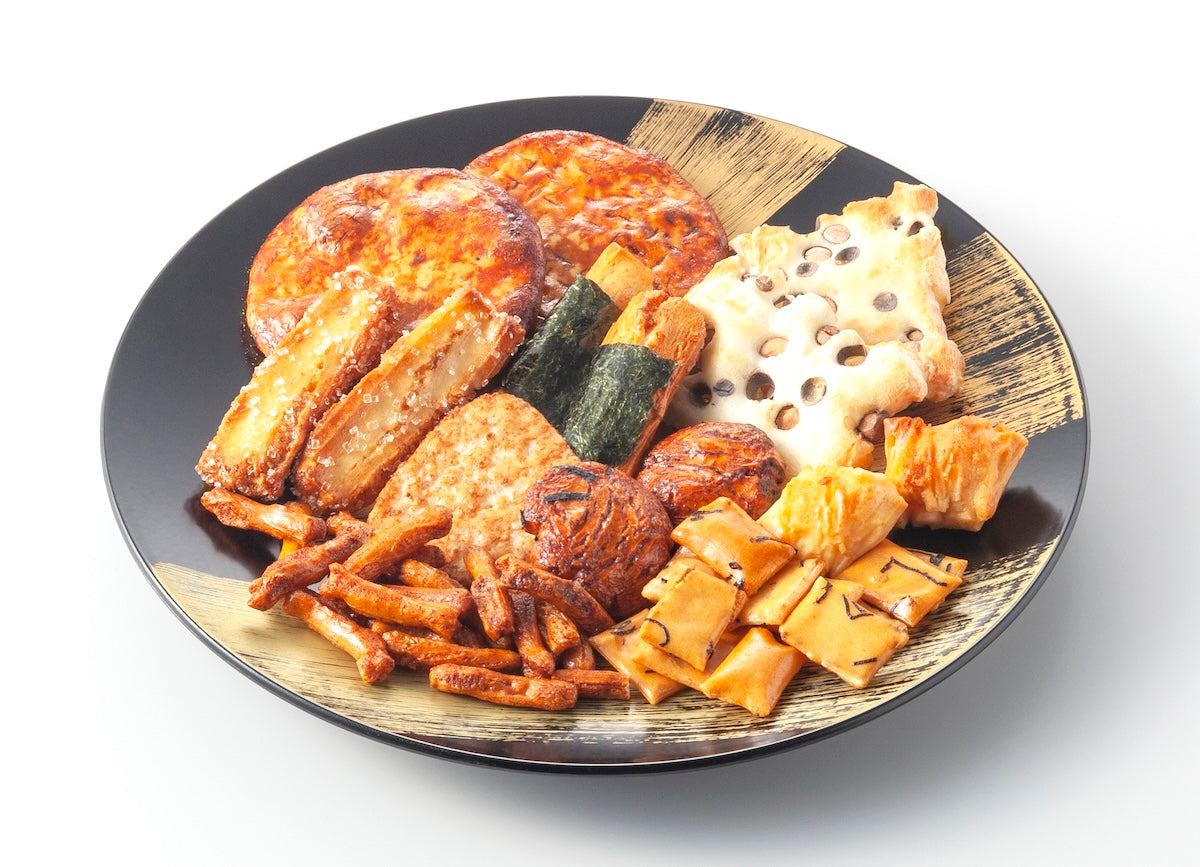
The key distinction runs through the rice. Senbei - the flat snacks most people picture when Japanese rice crackers are mentioned - are made from uruchi mai, the same rice eaten daily at Japanese tables.
Because uruchi mai lacks the glutinous starch that causes mochi rice to puff when heated, senbei don't expand. They stay crispy and firm, with a snap that is, for many people, the whole point.
But okaki and arare are made from mochigome - glutinous rice - which does puff under heat, producing a lighter, airier texture. The distinction between okaki and arare is simply size: larger pieces are okaki; smaller ones, arare, which translates to 'snow pellets' or 'hail'.

The written records for senbei go back to an 8th century document but the version enjoyed today became widely popular only during the Edo period (1603-1868), particularly in the region east of what is now Tokyo. The fuel was soy sauce: as production expanded along the Tone River, the practice of brushing fired senbei with soy sauce spread and took hold.
Modern senbei flavors have expanded well past soy sauce and seaweed into sesame, shrimp, wasabi, matcha, mentaiko and even chocolate-coated versions.
Adding to the complexity - or the confusion - the term 'senbei' in the Kansai region often refers to sweet varieties such as kawara senbei and tansan senbei, which are made not from rice but from wheat flour, sugar and eggs.
The term 'okaki' also originates in Kansai. The name can be traced to the custom of breaking apart kagami mochi - the rice cakes offered to the gods during the New Year - and eating them afterward.
Because cutting the mochi with a knife carried associations with seppuku and was, therefore, considered unlucky, the cakes were broken apart by hand or with a hammer before being grilled or fried. This act of breaking (kaku) eventually gave rise to the term 'okaki' in the refined language of court ladies in Kyoto.
Which means that, at the heart of this crunchy snack, lies a long-standing determination not to begin the year by symbolically disemboweling the rice cakes.
Japanese Sweets and Snacks: The Omiyage Map
Japan has a word for the souvenir food you bring back from travel: omiyage. The obligation to return from any trip - domestic or international - bearing something edible and local is so thoroughly embedded in Japanese social life that it has produced an entire industry of prefecture-specific confections.
The ranking of these snacks is a serious matter. In national surveys, these three products generally appear in or near the top: Shiroi Koibito - butter cookies sandwiching white chocolate - from Hokkaido, Tokyo Banana from Tokyo and Hakata Torimon - buns filled with a buttery white bean paste - from Fukuoka.
But the omiyage map covers much wider ground. For those seeking snacks with a kick, there's menbei from Hakata city in Fukuoka prefecture. This rice cracker is flavored with mentaiko - spiced pollock roe that is, arguably, Fukuoka's most famous ingredient.
If this sounds too adventurous, there's Jaga Pokkuru, made by from Hokkaido-grown potatoes fried skin-on, and Okinawa's chinsuko - a crumbly shortbread dating back to the Ryukyu Kingdom's royal court. The confection now comes in a range of flavors that includes purple sweet potato and pineapple.
Niigata's Salad Hope, a lightly salted rice cracker, has been a local institution for generations. Aichi has its Star Shiruko Sand - a biscuit sandwich filled with red bean paste cream - while Akita produces potato chips with the smoky flavor of iburigakko, the region's smoked pickled daikon, which sounds wrong and tastes right.
Tokyo Banana deserves its own paragraph. The banana-shaped sponge cake filled with banana custard cream has become the default Tokyo omiyage - soft, individually wrapped and visually distinctive. Its presence at airports and shinkansen departure halls has made it nearly impossible to leave Tokyo without seeing a stack of those yellow boxes.
The regional snack landscape beyond the obvious names is where things get interesting. Ishikawa prefecture produces Bever - a fried rice cracker kneaded with kombu seaweed from the Hokuriku coast - as well as a regional Alfort chocolate biscuit made with Gorojima Kintoki sweet potato.
Nagano makes shichimi potato sticks seasoned with the spice blend from Yawataya Isogoro, one of the oldest spice makers on the Zenkoji temple approach. Hiroshima offers potato chips flavored to taste like the prefecture's famous kaki furai - fried oysters. Chiba makes clam-flavored chips using asari extract from the Boso Peninsula.
Each of these products is, in its way, a mini version of its prefecture - the whole flavor profile of a place compressed into something you can eat on a train.
Buying Japanese Snacks from Abroad

For those not currently in Japan, the snack culture is accessible - within limits. The easiest route for a curated selection of japanese snacks is a subscription box service such as those offered by Bokksu and TokyoTreat.
For those who prefer to choose snacks individually rather than receiving a curated box, Rakuten Global Express allows purchases from Japanese domestic shops to be shipped to overseas addresses. Online retailers including Japanesenoodle.net stock a range including rice crackers and okaki. For traditional Japanese confectionery - wagashi with a shelf life of 20 days or more - some Kyoto producers ship internationally.
A note for anyone planning to order: products containing meat extracts or dairy may be restricted or held at customs depending on your country's import rules but dry packaged snacks - the majority of what's available - generally travel well and clear customs without difficulty.
The Mission: Something Old, Something New
If a trip to Japan is on the horizon, the snack aisle of any konbini deserves at least 20 minutes of serious attention.
Go in with an open mind and a flexible budget. Leave with something you've never seen before and something you already know you love.
In Japan, both are usually available on the same shelf.