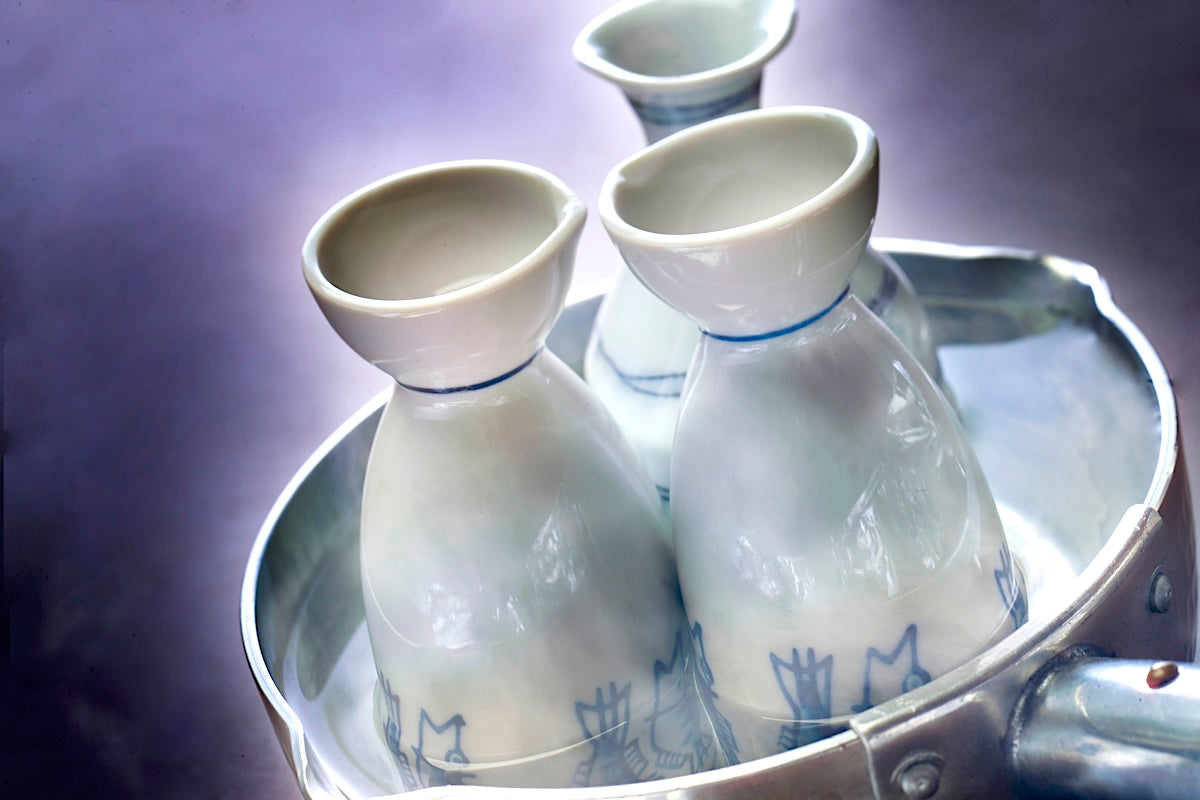
Some vessels in Japanese tableware are named for what they hold. The tokkuri - a narrow-necked sake flask - is named instead for the noise it makes. Pour sake through that throat and the liquid emerges with a soft, rhythmic toku-toku, a sound so pleasing that Japanese drinkers apparently decided that it would do as a name.
Another theory traces the word to the Korean word 'tokkuru', meaning a jar or earthenware vessel. A third links it to the kanji characters used in its name (徳利) - virtue and profit - because a tokkuri always seems to contain slightly more sake than it actually does.
Whichever explanation is true, none of them improves your ability to stop after one flask.
Before the tokkuri became the companion of late-night izakaya tables and winter hot pots, its predecessor - the heishi or heiji (瓶子) - served as a vessel for offering rice wine in Shinto rituals. It also poured rather badly. Over time, practicality prevailed. The tokkuri's rounded body and narrower neck held heat better, poured more cleanly and suited everyday drinking in a way the more aristocratic heishi never quite managed.
Over centuries - fom the Edo period to the early Showa era - the tokkuri became embedded in ordinary life through the kayoi tokkuri system. Sake merchants lent ceramic flasks to customers, who carried them back for refills. These sake bottles were durable, inexpensive and often stamped with the shop's name - part household object, part membership card.
Today, the tokkuri remains one of the most iconic objects of Japanese sake culture, though its role extends far beyond simple storage. The shape affects aroma. The clay affects temperature. The act of pouring from one person to another carries its own etiquette, choreography and social meaning. Which is how a little flask ended up containing not only sake but also several centuries of craftsmanship, ritual and accumulated national opinion about the correct way to drink.
Finding the Right Sake Carafe
There's an assumption that all tokkuri carafes will work with every kind of sake. But if you match the tokkuri to the temperature, to whether the sake is served warmed or chilled, you may find that the sake experience changes completely.
For warm sake - from 30°C to 50°C - the ideal tokkuri is a wide-bellied, narrow-necked ceramic flask. The rounded body heats more evenly in a hot water bath. the narrow neck slows the escape of aroma and the ceramic body, with its excellent heat retention, keeps the sake warm.

For cold sake - between 5°C and 15°C - you want a smaller vessel, since the point is to drink the sake before it warms, and a 360ml tokkuri left on a summer table does not stay cold long.
Tokkuri come in different materials. Glass works well for cold sake: transparent, visually cool and neutral enough not to interfere with the fruity, floral aromas of ginjo and daiginjo styles.
Tin, with its high thermal conductivity, chills the moment you pour into it and holds that chill.
Porcelain tokkuri offer a middle path for cold sake: dense and smooth, they do not absorb its aroma. They may not conduct temperature with tin's efficiency but they present the sake cleanly and look at home on any table.
A rougher earthenware tokkuri, by contrast, is said to soften and round the flavor of sake over time - particularly junmai and other full-bodied styles where that mellowing is welcome. Nigori sake, unfiltered and cloudy, is also well-suited to an earthenware vessel.
Sake carafes also include the katakuchi: a wide-mouthed vessel with a spout. Rather than the classic tokkuri silhouette, the katakuchi resembles a small pouring bowl. Its broad opening allows aromas to rise freely, making it particularly well-suited to cold sake.
For ginjo and daiginjo styles, where the delicate aromatic profile is the point, a katakuchi can coax out what a narrow-necked flask might contain.
Handcraft: Earth, Fire and Five Colors
The ceramic traditions that produce the most celebrated sake vessels in Japan span wildly different aesthetics.
Seto ware (瀬戸焼), from Aichi prefecture, has a claim no other kiln can match: it lends its name to the Japanese word for ceramics in general: setomono. Seto became Japan's early center for glazed ceramics; the kilns there have been running for over a thousand years, producing both earthenware and porcelain.
The line-up ranges from everyday vessels to formal pieces in sometsuke (blue-and-white underglaze painting using cobalt pigment) or the warm, flowing yellows of kiseto glaze. A Seto tokkuri is as likely to be an unobtrusive workhorse as a showpiece - the tradition is too broad to be defined by any single character.
Kutani ware (九谷焼), from Ishikawa prefecture, can often be recognized by the five colors known as the kutani gosai: red, green, yellow, purple and deep blue. A Kutani tokkuri is essentially a painting; it offers a visual effect particularly suited to festive or formal occasions.
Bizen ware (備前焼), from Okayama prefecture, takes the opposite position. No glaze. No painted decoration. Bizen is fired at high temperatures using clay specific to its region and whatever pattern emerges on the surface is created entirely by the kiln and the firing.
The tradition has run unbroken for approximately a thousand years and its reputation among sake drinkers rests on the belief that the slightly breathable fired surface mellows sake's flavor and opens its aroma. Whether the theory holds up under controlled conditions or not, it feels like exactly the sort of question that deserves prolonged field research over several cups of sake.
How to Serve Sake Warm
The standard name for hot sake is atsukan but there are, in fact, different named temperature bands for warmed sake: hinata-kan at 30°C, hitohada-kan at 35°C, nurukan at 40°C, jokan at 45°C, atsukan at 50°C and tobikiri-kan for sake heated to 55°C and above.
The correct method for warming sake at home is to submerge it in the yusen (湯煎), or hot water bath. The most important step is the one that looks like doing nothing: you boil the water, then turn off the heat before the tokkuri goes in. Actively boiling water runs too hot and drives the alcohol off too aggressively. The goal is a slow, even transfer of heat that softens the sake's sharper edges and coaxes out its umami.
The procedure: fill the tokkuri to about 80-90% capacity (sake expands as it heats), cover the mouth loosely with plastic wrap to keep the aroma in, boil a pot with enough water to reach the tokkuri's shoulder, turn the heat off and submerge the flask.
For nurukan at around 40°C, about two and a half minutes; for atsukan at 50°C, about three. The ideal hot-water temperature is 70-80°C. Once you remove the tokkuri, give the sake a gentle stir with a muddler or spoon to even out any temperature variation before pouring.
Drink in Sake Etiquette
The act of pouring sake for another person - o-shaku - carries social weight in Japan. You do not pour your own drink, especially in formal settings. You fill other people's cups and wait for others to fill yours.
In the world of Japanese drinking etiquette, even the direction of a hand can carry centuries of unease. Sakate - reverse hand - refers to pouring sake while holding the bottle or tokkuri with the palm facing upward. Traditionally, this gesture was associated with seppuku, giving it an unsettling undertone at the table. To pour in sakate style isn't considered impolite so much as deeply improper - even if no one present is a samurai.
The proper way: keep the back of the hand facing upward while pouring. The bottle or tokkuri is usually held around the middle with the right hand, while the left hand lightly supports the base.
The greatest danger of accidental sakate often comes when pouring for someone seated to your right, where the wrist may twist into the forbidden position. Opt for graceful adjustment over heroic flexibility: rather than contorting the arm, simply turn the body slightly toward the other person and pour calmly.
Fill the ochoko to about 70-80% - never to the brim, which makes the cup difficult to hold. The pour should start narrow, widen, then taper again as you finish, and a final wrist turn inward lifts the spout cleanly without dripping. Do not let the tokkuri's lip clink against the rim of the cup.
When receiving sake, hold the sake cup with both hands - dominant hand on the body of the ochoko or guinomi, fingertips of the other hand at the base - and raise it slightly toward the person pouring. Once the sake is poured, take a sip before setting the cup down.
Peering into the tokkuri to check how much is inside, shaking it or leaving an empty flask on its side are all considered gauche and one of them will also cool your hot sake.
After the kampai toast, keep an eye on everyone's cups. Japanese culture is fundamentally communal; when your cup is watched and filled, return the gesture. There are times when the drinking experience feels better as a solo act but many more occasions when having sake isn't as fun as sharing it.
Tokkuri and Ochoko: The Art of the Matched Set

The standard sake service - one tokkuri and two small cups, often presented in a paulownia wood box - can be found in every ceramic tradition Japan produces.
Choosing a matched set from a single kiln or series creates visual unity on the table; a Kutani tokkuri paired with a Bizen ochoko produces a genuinely jarring effect, as if a figure in a formal portrait were depicted wearing trainers.
The practical logic of matching follows the temperature of the sake being served. For atsukan and nurukan, a ceramic tokkuri with ceramic ochoko retains heat through the meal.
For cold sake, pairing a glass carafe with glass cups or tin with tin maintains chill and creates a visual coolness appropriate to summer drinking.
If you want to appreciate the color and clarity of the sake itself, ochoko with white interiors present it most beautifully, the same way a white plate clears the stage for whatever is placed on it.
Brewing Up Special Occasions
At its best, sake culture is full of small adjustments: a warmer temperature here, a different clay there, a careful pour for someone else before refilling your own cup. None of it is especially dramatic. There are no flaming cocktails or theatrical garnishes suspended from miniature wooden scaffolding. The pleasures are subtler than that.
The tokkuri reflects this. A Bizen flask, rough and unglazed, changes with years of use. A ceramic flask warmed gently in a hot bath produces the kind of comfort that makes entire evenings disappear without anyone noticing the time.
The genius of the tokkuri lies in the fact that it makes ordinary drinking feel slightly ceremonial without making it difficult.