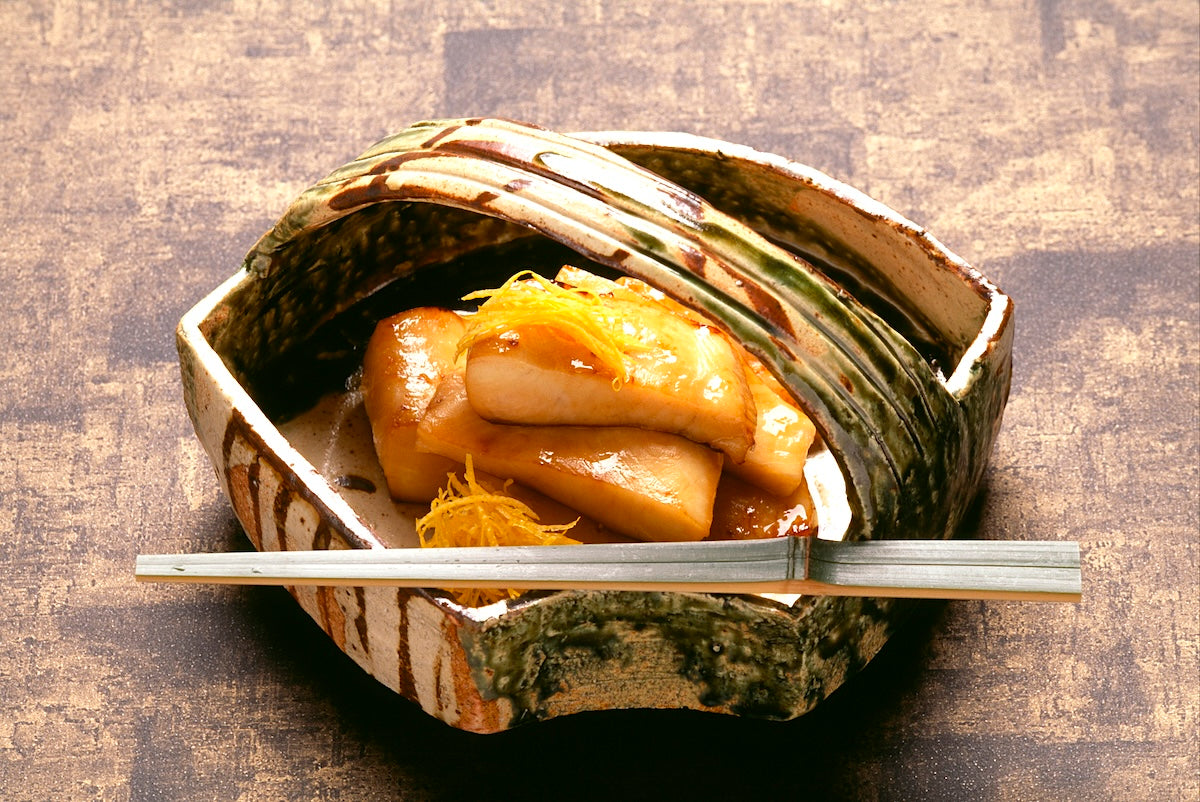
It may feel like a piece of cake to put food on a plate.
When the cooking is done and something needs to make the short journey from stove to table, the process is almost automatic. You open a cabinet. You reach in. Your hand settles, without hesitation, on a plate.
A round plate.
It is, after all, the default tableware setting. Reliable. Symmetrical. Entirely free of opinion. It simply receives whatever is placed upon it and gets on with the job.
And yet, this certainty begins to wobble when you encounter Japanese table settings because, here, the plate is not neutral. It has a point of view.
It may stretch into a long rectangle and insist that this is the plate to use if you have grilled fish. It may fan outward, when the meal is part of a celebration. It may arrive shaped like a leaf, urging you to acknowledge the season before the first bite is taken.
At which point, the round plate - still perfectly respectable - starts to feel less like the obvious choice and more like just one possibility among many.
A World That Isn't Round
Japanese tableware encompasses an extraordinary range of forms, many of them designed around specific foods and specific moments in a meal.
The most useful categories for anyone building a collection or learning to read a Japanese dining table are the rectangular, the fan-shaped and the leaf-shaped - each with its own logic, food affinities and visual weight.

The rectangular plate is the standard vessel for grilled fish, rolled omelet and the small, composed arrangements served at the start of a multi-course meal.
The long, straight edges of the plate emphasize linear presentation - food arranged in a row, head to the left, belly facing the diner, the way grilled fish has been plated in Japan for as long as people have been eating it that way.
The fan-shaped plate carries its symbolism in its silhouette. The fan opens outward in a shape long associated in Japan with expanding prosperity, making these plates a natural choice for celebratory meals.
The leaf-shaped plate does something subtler. It evokes the bamboo leaves traditionally laid beneath sashimi and grilled fish - a way of signaling freshness, of bringing the natural world briefly to the table.
These three are just scratching the surface of Japanese plate shapes. There is mokko-gata, named for the quince flower, with its four-lobed outline; rinka-zara, with petal-edged rims; sumikiri-zara, the square plate with its corners clipped to soften its geometry. Irregular shapes - the category known as henkei-zara - exist not for their own sake but in service of presentation, bringing visual rhythm to multi-course meals when alternated with round forms.
Reading the Kiln: How to Identify Style at a Glance
The quickest way to place a piece of Japanese ceramics is to work through three questions.
The first question: is there glaze? If the surface looks glossy, it has been glazed. Oribe, Shino and Arita porcelain, including Imari ware, are all glazed.
If the surface is rough and matte, you are looking at unglazed stoneware - most likely Bizen, or perhaps Shigaraki, both among the Six Ancient Kilns of Japan. Bizen pieces, in particular, are known for their rustic, earthy appearance.

The next question to ask: what color is it? Vivid green - almost certainly Oribe. A deep green glaze over a white clay ground, often with geometric patterns, is the Oribe signature.
Reddish-brown, warm grey or near-black with no painted decoration and a hard, almost metallic surface texture points to Bizen.
Thick white with a soft, slightly mottled surface indicates Shino. Blue-and-white underglaze painting on a bright white ground suggests Arita/Imari ware, Japan's first domestically produced porcelain.
The third question: what does the form look like? Bizen tends toward practical, grounded shapes. Shigaraki and Karatsu - the latter known for its simple iron-glaze or painted underglaze designs - also lean towards the functional and unshowy.
Oribe vessels, on the other hand, are deliberately distorted: a tea bowl that leans, a plate that refuses to be symmetrical, a square dish with one end warped upward - these are choices, not accidents.
The style arose under the influence of Furuta Oribe, a warrior-turned-tea-master who studied under Sen no Rikyu and then cheerfully dismantled everything Rikyu stood for. Where his teacher prized restraint, Oribe preferred playfulness, even eccentricity - a quality that showed up in the ceramics he championed.
New Hands on Old Forms
Oribe's spirit lives on in the contemporary Japanese ceramics scene, where old techniques continue the conversation with new sensibilities.
Contemporary artists draw on the full inheritance of the tradition - the hand-painted brushwork of Karatsu, for example, or the faceted shinogi carving of older folk pottery - and interpret them according to their own aesthetics.
Takuro Kuwata (桑田卓郎) takes traditional tea ceramic textures - the kairagi crackle-glaze finish, the ishibaze stone-burst effect - and scales them up into almost cartoonish exaggeration, then floods them with pop colors.
Riyoo Kim (金理有) works with Jomon-period vessel forms - the ancient pottery of pre-agricultural Japan - and renders them in metallic glazes and hollow eye-motifs that look as though they arrived from a different century entirely.
Born into a family of ceramic artisans, Gaku Shakunaga (釋永岳) studied sculpture at a Tokyo university before going on to open his own studio. He draws on traditional Toyama metal-coloring techniques, applying them to ceramics to create unconventional, sculptural surfaces.
The Cultural Logic Behind the Empty Space
Japanese plating is built on a principle that may seem counter-intuitive: absence is not lack; it is composition.
The standard guideline in Japanese cuisine is that food should occupy 60-70% of the plate, leaving the remaining area as yohaku, the term borrowed from ink painting for the space that is intentionally not filled. This empty area is the visual equivalent of silence in music: it defines the shape of what surrounds it. A plate crowded to its edges looks effortful. A plate with breathing room looks confident.
Asymmetry works the same way. Japanese plating does not aim for symmetry; food is arranged in odd numbers - three pieces, five, seven. Items are placed in a triangular composition, higher at the back and sloping down toward the diner, creating depth on a flat surface. The arrangement has a front face, or shomen, the side designed to be viewed from the diner's position.
Seasonality is expressed - and cherished - as much through the vessel as through the food.
In practice, this means glass vessels in summer for their visual and tactile coolness and heavier, darker ceramics in winter for warmth. It means kinome - the young leaf of the sansho pepper - placed on top of a spring dish, green maple leaves on an early summer plate and red ones on an autumn platter.
Every element of the Japanese table communicates something and the plate is where that communication begins.
Bringing Color and Texture to Your Tabletop

Building a collection for home entertaining doesn't require a matched dinnerware set. The approach that works is closer to building a wardrobe: start with the pieces that do the most work, add items that expand the range and let the collection develop a character over time.
In concrete terms: begin with a base of simple, medium-to-large white or neutral-tone plates - porcelain or stoneware, around 21-24 cm. These plates should be able to handle salad, pasta or whatever you decide to cook on a weeknight; they are the pieces that set the table without calling attention to themselves.
Then add a long rectangular plate for fish and tamagoyaki omelet, a handful of rice bowls and lidded bowls for miso soup, larger donburi bowls for noodles and simmered dishes, and tiny mamezara plates in various designs for pickles, dipping sauces - and individuality.
Be sure to ask the pragmatic questions: can these dishes be stacked up easily? Can they be washed by hand or machine without anxiety? Can they go from the refrigerator to the table without cracking from temperature changes? Ceramics that are beautiful but brittle tend to spend most of their lives in the cupboard, which helps no one. Bizen ware, fired for two weeks at over 1,200 deg C, is unlikely to give you trouble on this front.
Mix materials without fear. Glass alongside ceramic, a wooden tray beneath several small dishes, a lacquered soup bowl among stoneware plates: the contrast of textures is part of the dining experience. Season the collection the same way you season the table - lighter and cooler in summer, heavier and earthier as the year turns.
Ware Is This Going? Making Every Meal Mindful
The next time you reach into the cabinet, your hand will still hover, out of habit, over the familiar stack of round plates.
But you might hesitate.
Because somewhere along the way, you have learned that a plate can do more than hold food.
You might reach instead for something longer, or sharper at the edges, or shaped like it once belonged to a tree.
And that's the subtle shift. The meal has not changed. The act of eating has not changed. But the way it arrives - how it presents itself, how it settles onto the table - has.
The round plate is still there; it always will be. It has simply been given some company.