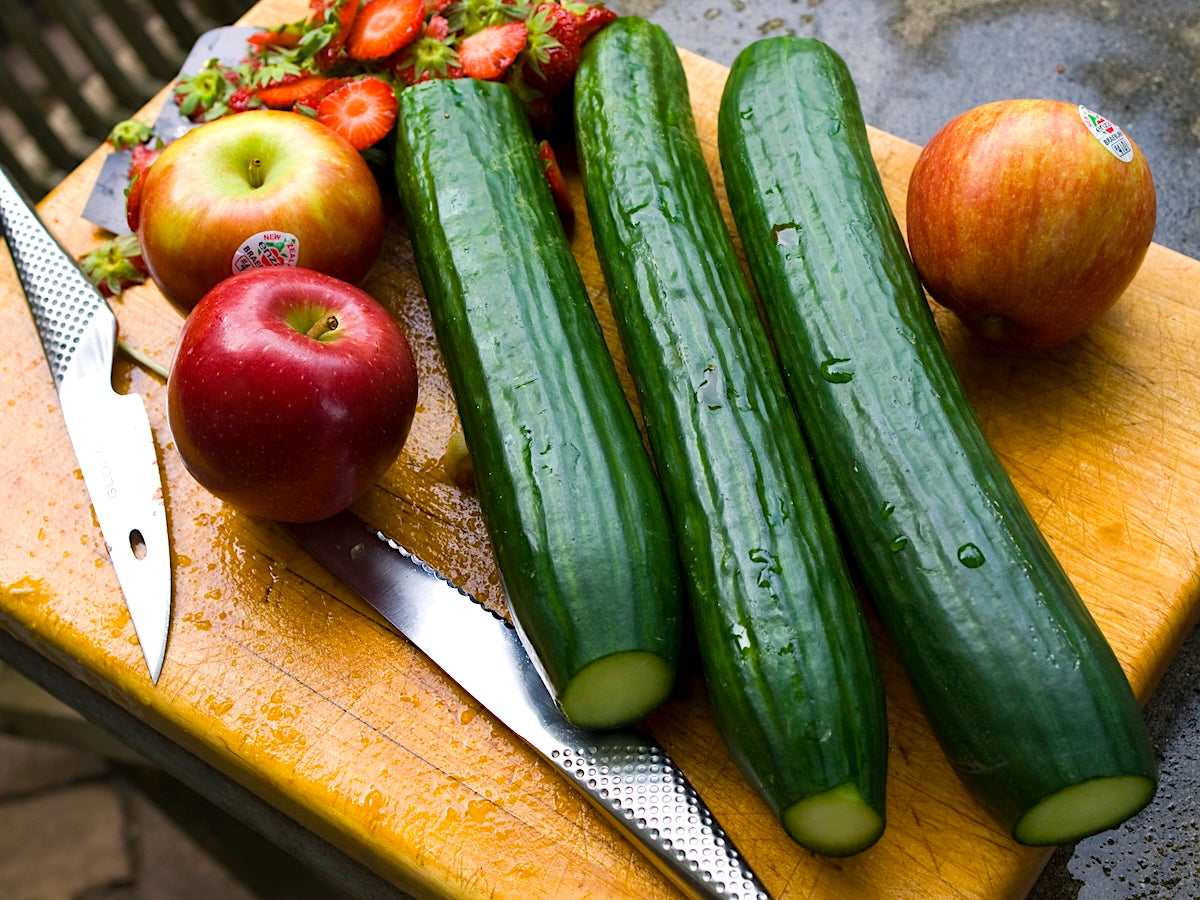
Every kitchen has a mystery drawer. You know the one - the drawer where the things that are almost useful end up. The cocktail stirrer. The rusty corkscrew. And, quite possibly, a small knife that you picked up at some point and haven't quite figured out what to do with.
That small knife might be a petty. And if it is, it deserves better than a life in drawer limbo.
Petty knives take their name from the French word for small. The word 'petit' arrived in Japan during the Meiji era (1868-1912), when Western cooking and its associated tools began to spread through the country.
The gyuto - the chef's knife, literally 'cow knife' - was one of those early imports; the petty came with it as a companion. Japanese blacksmiths refined both knives through the 20th century and the petty settled into its current form: a double-bevel blade running between 80mm and 150mm, narrow and pointed, built for precision.
Versatile, Delicate, Precise: What the Petty Knife Does - and Doesn't
A fruit knife is designed to make tasks such as peeling and trimming safe. The petty shares the same compact dimensions but is built for a wider range of prep work; it's sharp enough that you feel the difference the first time you use it on a strawberry, shallot or sprig of thyme.
What petty knives excel at is detail-oriented tasks: peeling apples and potatoes, removing seeds, mincing herbs on the cutting board then turning the knife for detail work in the hand - the kind of motion that feels natural with a 130mm blade and slightly reckless with a 210mm one.

The versatility of Japanese petty knives becomes clear here: the same knife moves between board work and in-hand work without pause, something that paring and chef knives cannot manage as cleanly.
In restaurant kitchens across Japan, chefs reach for the petty whenever a pointed tip and fine control are needed: general garnish work, for instance, or the kazarigiri decorative cuts that turn carrots into plum blossoms and pumpkin pieces into leaves.
That same logic applies at home. If you cook regularly, the petty can handle a surprising share of the detail work that a santoku or gyuto either can't do comfortably or does with more blade than the task requires.
What the petty knife does not do: large ingredients. This is not the tool for halving a cabbage, breaking down a whole chicken or working through a large cut of meat.
Size Matters: From Garnish Work to General Prep
The best petty knife is the right petty knife.
The typical blade length for a petty is about 120-150mm and the right choice depends on what you already own and what you're planning to cut.
At the shorter end - 80 mm to 120 mm - the knife is compact enough to use entirely in the hand, holding the ingredient rather than setting it on a cutting board. This is the size for peeling fruit, removing potato eyes, carving garnishes, trimming stems. The blade stays out of the way because there isn't much of it.
The 130-135 mm range is where most people land first and for good reason. A petty in this range handles both in-hand work and board tasks and functions well as a sub-knife alongside a larger one such as a santoku or gyuto. If you're choosing your first petty, this is a good place to start.

At 150 mm - the larger end of the range - the knife starts to behave like a small chef's knife. The slightly larger blade gives it enough length to slice small vegetables and prep proteins without switching to the gyuto, which makes it a practical choice for someone who wants to use the petty as a primary knife for everyday cooking.
Carbon Steel or Stainless? The Acid Test
Most knife debates eventually reduce to this one. Both steel types cut. The difference is in how they age and what they ask of you in return.
Carbon steel takes a sharper edge and gives it up more willingly on a whetstone. The angle comes faster, the sharpness is more acute and experienced cooks tend to prefer it for the way it responds to careful maintenance.
The tradeoff is reactivity: carbon steel rusts quickly in contact with moisture and when it meets acid - citrus juice, vinegar, the liquid from a pile of diced tomatoes - the oxidation is almost immediate.
Stainless steel knives invert the equation. They resist rust, handle acidic ingredients without protest and turn the other cheek when left damp on the counter. They retain their edge longer but this edge is slightly less acute than carbon steel at its best, and sharpening requires more effort as well as specialized abrasives.
Here is where the petty-specific argument comes in. The petty spends much of its working life on exactly the ingredients that punish carbon steel: fruit, in particular citric acid bombs such as lemons, and yakumi condiments.
In other words, the case for stainless steel is stronger than usual. If edge retention is a priority, look high-performance types such as VG10 and silver steel no. 3 - these close much of the gap with carbon.
For home use, stainless steel is the more practical choice.
Handle Logic: Wa vs Western
Blade steel hogs the limelight but the handle of a knife also deserves attention.
With the traditional wa, or Japanese, knife handle, the tang - the part of the blade that goes into the handle - is inserted into the wood rather than running through and across it. The smaller tang means a lighter handle.
Often octagonal in cross-section, the Japanese handle prevents rotation in the hand and creates a forward balance that suits the precision grip that most petty work requires.
The wood is typically magnolia or something denser and darker for premium versions: ebony, cherry, oak. The handle can be replaced when it wears out, which is the traditional logic: the blade is the long-term investment; the handle is a consumable.
In the Western handle, the full tang is run through two parts of handle material and fixed by the rivets visible along the side. The handle is heavier, more balanced toward the rear and feels familiar to anyone who's used to a European-style chef's knife.
For someone transitioning to Japanese knives, the Western handle on a petty reduces the adjustment period. The tradeoff is that the handle cannot be replaced and the added weight - while minor - is more noticeable on a small knife than on a larger one.
The Japanese handle is good for cooks who want lightness and traditional aesthetics; the Western handle suits those who prefer a sturdier, more familiar grip.
If you're new to Japanese kitchen knives, the octagonal handle is worth trying even if it's unfamiliar. The forward balance changes how the knife sits in the hand and, for precision work, that balance is part of why the knife performs the way it does.
One Gyuto, One Petty: The Two-Knife Kitchen

How many knives does a cook actually need? According to one answer, just two.
Here's why: pair a gyuto with a petty and you'll have covered the overwhelming majority of what home cooking asks of a knife. The gyuto handles large protein prep, chopping, bulk vegetable work, anything where a long blade and forward weight are an advantage.
The petty handles everything the gyuto is too unwieldy for. The division of labor is almost complete: a chef's knife and a paring knife arrangement, except that the petty is more versatile than a paring knife and the gyuto is, arguably, more capable than a standard Western chef's knife.
The classic combination for serious home cooking is a 210 mm gyuto paired with a 150 mm petty; for smaller kitchens or lighter cooking, a 180 mm gyuto with a 120 mm to 135 mm petty.
If your primary knife is a santoku rather than a gyuto, the logic is identical. The santoku handles general prep; the petty handles detail.
The Small Knife That Does Big Work
What often surprises people who come to the petty late is how quickly it becomes indispensable for the small tasks that add up to most of a meal's preparation: peeling, mincing, slicing and trimming.
The petty may not make the biggest impression. It doesn't have the length of a gyuto or yanagiba or the cleaver-like presence of the usuba. What it has is utility: one petty plus one gyuto covers a remarkable amount of culinary ground.
Add a bread knife if you don't believe in pre-sliced bread and you'll have, for most purposes, a complete set of kitchen knives.