Introduction
From gilded folding screens in castle halls to oil paintings in modern galleries, Japanese art is a millenia-long tale of constant reinvention; a lifetime is not enough to learn about it all.
Here, we look at Japanese painting from the 16th century to the modern day, focusing on several major genres of Japanese painting. A reading list at the end offers you an opportunity for deeper dives into the subject.

Pair of screens with tigers scared by a storm-dragon by Kanō Sanraku, Public Domain
Kanō school
Would it be a little gauche to describe the Kanō school of painting as a four century-long trend? Perhaps, but it’s not too far from the truth.
Founded by Kanō Masanobu (1434–1530), the Kanō school began as a professional atelier with close ties to Zen temples and elite patrons. Over the course of roughly four centuries, it developed into a hereditary family network of painters with multiple branches in Kyoto and Edo, effectively becoming the ‘official art style’ for the ruling government, and monopolising high-level painting patronage and training in Japan.
Early Kanō painters adopted Chinese ink painting (kara-e), emphasising strong brushwork and depicting Chinese themes such as landscapes and Zen patriarchs. Masanobu’s son Kanō Motonobu (c.1476–1559) synthesised this with Japanese decorative sensibilities, adding bold colours, patterns, and narrative subjects, thereby expanding the school’s appeal.

Birds and Flowers of the Four Seasons, a National Treasure by Kanō Eitoku
During the Azuchi-Momoyama period (1574-1600), masters like Kanō Eitoku (1543–1590) were tasked with creating large screen and wall paintings on gold leaf for castles and residences. These works featured classical motifs — tigers, pines, plum blossom, birds-and-flowers — on flat, decorative compositions with powerful outlines, projecting the authority and splendour that their clients sought to convey. This ‘ink and gold’ combination became one of the school’s signature styles in castle decoration.
Institutionally, the school functioned as a workshop system in which the head painter designed compositions, while the senior and junior disciples executed large commissions according to established modes and practice. Over time, distinct family branches formed, most notably the Kyoto line and the Edo Kanō line. The latter was centered around Kanō Tan’yū (1602–1674), one of the foremost painters with whom the Kanō school reached its apotheosis — he was appointed as the shogunate’s first official painter in 1617.
The Kanō atelier trained not only blood relatives but many outside students. By the 18th century, it had come to enjoy a near-monopoly on the teaching of painting, its idioms and axioms permeating other schools and provincial workshops. This workshop model emphasised the continuity of styles and formula over individual experimentation; it also led to an inevitable ossification in the type and quality of artworks produced over the centuries.

Meeting between Emperor Wen and Fisherman Lü Shang, attributed to Kano Takanobu. Via the Metropolitan Museum of Art
The Kanō school maintained a dual practice across its history. On one side, large, brightly-coloured works on gold leaf for architectural settings; on the other, more intimate ink paintings in ‘Chinese’ styles. Painters were highly literate in Chinese pictorial modes, able to imitate or adapt the styles of Song or Yuan masters while filtering them through a distinctly Japanese sense of flatness and surface design. Outlines were crisp, and decorative surface values were emphasised, especially on screens and sliding doors. Blending Chinese brush culture with Japanese decorative tastes allowed the artists to meet both Zen-elite and warrior-courtly expectations.
By the late Edo period and Meiji Restoration, the Kanō school’s dominance waned as new styles and institutions emerged. The hereditary system itself eventually dissolved. Still, it had had a profound impact on Japanese art. The school standardised many conventions in Japanese painting, created a huge corpus of castle and temple decoration, and shaped how painting was taught for generations. Many Kanō masterworks have been recognised as Important Cultural Properties and National Treasures. Indeed, its legacy is central to understanding Japanese painting as a whole, especially the visual culture of samurai government and elite architecture.

Wind God Fujin (right) and Thunder God Raijin (left) by Tawaraya Sotatsu (1570-1643) Public Domain
Rinpa school
Emerging in Kyoto during the early 17th century, the Rinpa (or Rimpa) school is known for its highly decorative style. It began with Hon’ami Kōetsu and Tawaraya Sōtatsu, who collaborated on works that combined calligraphy, painting, and luxurious materials; this approach was later developed and ‘branded’ by Ogata Kōrin and his brother Ogata Kenzan in the late 17th to early 18th century.
Unlike hereditary schools such as Kanō or Tosa, Rinpa was not a family atelier, but a loose lineage of artists connected across generations, especially through a conscious revival of shared motifs and techniques. The name itself, ‘Rinpa,’ combined ‘rin’ from Kōrin with ‘pa’ for school, and was only coined in the Meiji period as a way of describing this stylistic tradition.
What defines Rinpa? This style is characterised by its bold, highly stylised depictions of nature, with themes drawn from classical Japanese poetry and literature, such as The Tale of Genji and The Tales of Ise.
A Rinpa painting might feature flowers set against a shimmering gold or silver ground, with flat areas of bright colour and strong contours. Compositions tend to favour asymmetry, large empty spaces, and recurring patterns. Forms are reduced to elegant, almost abstract silhouettes and rhythmic curves. Techniques such as tarashikomi — adding a second wash of pigment onto a still-wet first layer to create soft pooled edges — add subtle variation and texture within flat shapes.
These descriptions might evoke other styles like Art Nouveau — with good reason. Rinpa art was among the categories of Japanese art enjoyed by those involved in Japonisme, itself an antecedent of Art Nouveau, whose botanical patterns and flowing curves seem to pay direct homage to the Rinpa artists.
The first Rinpa ‘generation’ of artists really centers on Kōetsu and Sōtatsu, who created luxurious fans, screens, and decorated papers for calligraphy, all of which interpreted yamato-e traditions in fresh, striking ways.

Red and White Plum Blossoms, Ogata Kōrin, early 18th century Public Domain
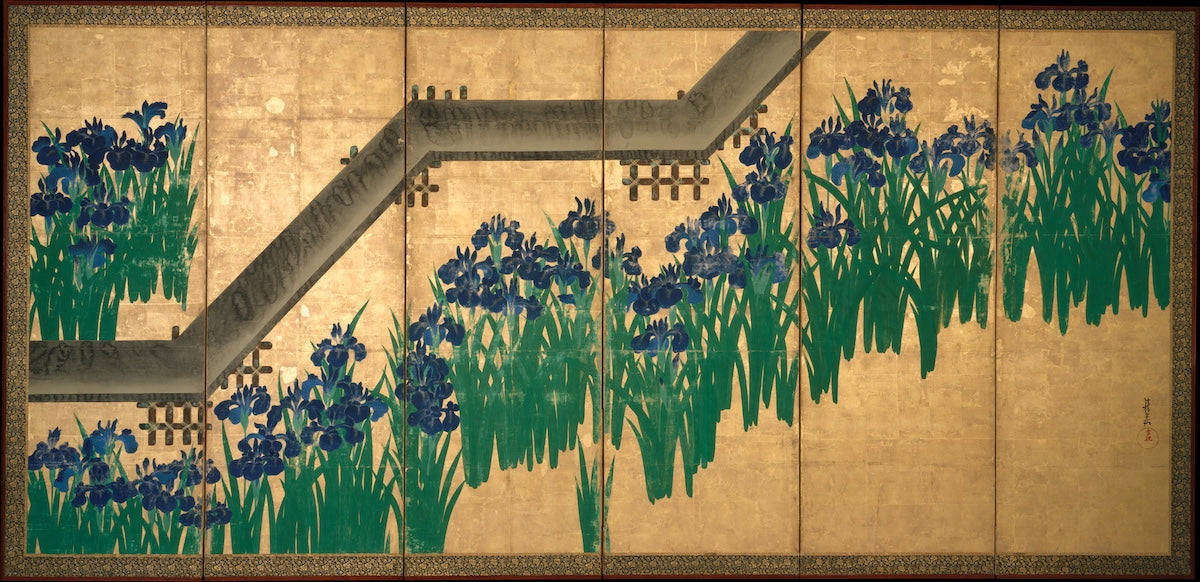
Around a century later, Ogata Kōrin revived and systematised this style, producing iconic works such as Irises at Yatsuhashi and Red and White Plum Blossoms. His brother, Kenzan, extended Rinpa idioms into ceramics, showing how this style could be expressed through different media. Indeed, Rinpa can be thought of as much a design language as a school of painting, as it blurred the boundaries between painting and the decorative arts.
In the late Edo period, Sakai Hōitsu and his pupil Suzuki Kiitsu in Edo re‑engaged with Kōrin and Sōtatsu’s imagery, establishing an “Edo Rinpa” that ensured the style’s continuity into the 19th century.
A distinctive feature of the Rinpa movement is how it operated more as an ‘aesthetic network’ than a closed workshop. Later artists learned primarily by studying, copying, and reimagining earlier masterpieces, rather than through direct master-disciple transmission. This meant that Rinpa artists tended to be from more diverse social backgrounds — merchant or artisan families, rather than hereditary painter lineages.

Attributed to Kanō Sanraku (ca.1559 - 1635). Pair of six-panel folding screen, ink, gold and colors on silk. Suntory Museum of Art. Important Cultural Property of Japan in Tokyo.
Nanban art
Nanban art refers to art produced from the late 16th to early 17th centuries that reflects contact with European — mainly Portuguese, and later Spanish — traders and missionaries who arrived via southern sea roots.
The word ‘nanban’ literally means ‘southern barbarian.’ It doesn’t describe a specific style of art; rather, it is a broad category of works — screens, paintings, lacquerware, metalwork, and Christian objects — that responded to and engaged with this unprecedented encounter with Europeans and their religion, ships, clothing, and material culture.

Western Kings on Horseback, byōbu of c.1611-1614, Kobe City Museum.
The best known examples of nanban art are nanban byōbu. These are large folding screens that depict European ships entering ports like Nagasaki, or processions of foreigners and missionaries through the streets of Japan. As they were painted mostly by Kanō and Tosa school artists, many feature beautifully-detailed figures on a familiar gold leaf background.

A Japanese lacquerware produced and exported at the request of the Society of Jesus. Azuchi–Momoyama period, 16th century, Kyushu National Museum
Alongside such screens, workshops also produced Christian devotional images, church furnishings, and ‘southern barbarian lacquer’ for export — luxury lacquer objects decorated with Japanese techniques but tailored to European tastes. Production of such objects was limited to a few decades during the Momoyama period, and as such are comparatively rare.
There was a brief — if fervent — with foreign peoples and customs at the elite courts and among wealthy merchants around the 1590s to early 1600s, which fed the demand for nanban art. But for an art form termed ‘southern barbarian,’ the European influence manifests more in subject matter and motifs, than in the adoption of any Western pictorial techniques. Japanese painters preferred to convey these subjects with their own approach to space, pattern, and gold, even if they occasionally experimented with, say, rudimentary perspective.
Nanban art declined after Christianity was outlawed in 1614, and especially after the Tokugawa shogunate imposed sakoku policies that sharply limited foreign contact from the 1630s onwards. Surviving nanban screens and lacquer pieces give us a glimpse into Japan’s first engagement with early modern Europe, and have their own aesthetic value in how they blended Japanese formats with vivid, almost ethnographic images of the foreigners visiting Japan.

Peacock and Peahen, by Maruyama Ōkyo, at MIHO MUSEUM, Public Domain
Maruyama-Shijo School
One rarely associates a naturalistic style of art with Japanese art as a whole over the centuries. One exception is the Maruyama-Shijo school, which was a Kyoto-based movement that grew from the work of Maruyama Ōkyo (1733–1795), and continued by his pupil Matsumura Goshun and others on Kyoto’s Shijō Street.
The Maruyama and Shijo schools were technically separate schools, but historians tend to treat them as a combined tradition as both shared a commitment to basing their compositions on direct observations from life (‘shasei’) rather than on copying old models, while still using traditional Japanese media and materials.
To most modern artists, sketching from nature is one of the most fundamental tenets of learning how to draw. Nevertheless, this was precisely what made Ōkyo’s Maruyama’s approach unusual in his time. His school broke with the highly codified conventions of Kanō and Tosa painting by sketching from nature, but also incorporating elements of Western perspective, shading, and realism that he had encountered through prints and European natural history images. Combined with Kanō‑style structure and a Rinpa‑like sense of decorativeness, his works were recognisably Japanese, yet unusually lifelike for their time. Large screens and sliding doors could thus be built from observed details — herons in mist, pine and bamboo — carefully composed, but grounded in empirical observation.

Quail Feeding Amidst Susuki and Kikyo, by Matsumura Keibun (1830)
The Shijō school proper arose when Matsumura Goshun, an Ōkyo student who had also absorbed literati (bunjinga) influences, combined the ‘shasei’ approach with the more subjective, poetic spirit of literati painting. Shijō painters pursued a softer, more lyrical realism than Ōkyo’s studies. They valued capturing the “inner spirit” or mood of the subject rather than precise, almost scientific depiction, imbuing much of their work with a gentle playfulness.
Both schools favoured accessible subjects — birds‑and‑flowers, animals, everyday figures, and tranquil landscapes — over grand themes, marking a shift towards catering to the tastes of urban commoners over the court elites. The Maruyama–Shijō style would become one of the dominant Kyoto styles in the late 18th and 19th centuries, strongly influencing later Nihonga and modern Kyoto painting.

Pine, Plum and Cranes by Shen Quan, 1759. Hanging scroll, ink and colour on silk. The Palace Museum, Beijing
Nagasaki School
Nagasaki school painting is a loose label for Edo‑period Japanese painters and printmakers who absorbed Chinese — and to a lesser extent Western — naturalistic styles through the port city of Nagasaki.
Nagasaki was one of the only places where Chinese and Dutch ships could dock, so painters had access to visiting Chinese artists, imported paintings, and books, as well as some European images and scientific illustrations. Out of this environment emerged artists who blended bright colour, careful observation of nature, and elements of Chinese and Western realism with Japanese formats like hanging scrolls and screens.
The Nanpin school is perhaps the best known sub-genre of the Nagasaki school, so named for the Chinese painter Shen Nanpin (Shen Quan), who stayed in Nagasaki during the 1730s and taught bird‑and‑flower painting. Hallmarks of this school include meticulously rendered subjects with strong outlines, rich pigments, and a sense of volume influenced by Chinese court painting, alongside some Western shading.

Dutch with elephant at Nagasaki, c. before 1868. Unknown artist.
Another closely related genre here is Nagasaki-e, or ‘Nagasaki images.’ These were woodblock prints and paintings depicting the port, foreign ships, Dutch and Chinese traders, and exotic animals. Such works catered both to local curiosity and visitors purchasing souvenirs, combining simple, folk-like carving with a surprisingly detailed eye for foreign dress, flags, and ships.
Taken together, Nagasaki school paintings and prints show us one of the key channels through which foreign pictorial ideas were interpreted and absorbed into Edo period Japanese art practice.

Kuroda Seiki, Lakeside, 1897, Kuroda Memorial Hall, Tokyo
Yōga and nihonga
Yōga
No sun salutations here. Yōga — literally “Western-style painting” — refers to Japanese painting that adopts Western materials and techniques such as oil on canvas, modeling, or perspective, rather than traditional inks and mineral pigments on paper or silk. The term emerged during the Meiji period to distinguish these works from its ‘rival’ movement, Nihonga.
The late 19th century saw the idea of ‘modernisation = Westernisation’ take root. Japanese artists studied in Europe, absorbing academic and avant-garde styles — Realism, Impressionism, Fauvism, Cubism — and bringing them back to Japan. Institutions and state exhibitions eventually formalised two parallel categories of art — yōga and Nihonga — resulting in the development of Japanese modern art as a dialogue and occasional rivalry between Western-style and Japanese-style painting.
Key figures in the yōga movement include:
-
Kuroda Seiki (1866–1924): Considered one of the pioneers of yōga. He absorbed academic realism and plein‑air Impressionism in Paris, and went on to reform art education at the Tokyo School of Fine Arts. Major oil works include Lakeside and Wisdom. Impression, Sentiment. His teaching and exhibitions helped make Western‑style painting an accepted, institutionalised part of modern Japanese art.
-
Asai Chū (1856–1907): One of the earliest yōga painters; played a central role in establishing Western techniques in Japan and teaching a first generation of oil painters. Helped bridge government-sponsored early Meiji yōga and the more artist‑driven movements that followed, influencing students who would themselves become major figures in the art world.
-
Fujishima Takeji (1867–1943): A student and colleague in the Kuroda circle, he later studied in Europe and brought in elements of Symbolism and Art Nouveau, softening strict academic realism with more lyrical, decorative colour and line.
-
Kishida Ryūsei (1891–1929): A Taishō‑era yōga painter known for intensely realistic and psychologically piercing portraits, especially of his daughter Reiko, Kishida pushed Western realism in a highly personal, modernist direction. His work marked a shift from Meiji “academic Impressionism” toward more expressionistic and individual yōga styles.

Right panel of the Ryūkozu (竜虎図, Dragon and tiger) by Hashimoto Gahō, 1895. Important Cultural Property. Seikadō Bunko Art Museum.
Nihonga
Nihonga is a modern category of “Japanese-style painting” that emerged in the Meiji period to distinguish works using traditional supports (paper, silk), pigments (mineral colours, ink, gold/silver), and formats (hanging scrolls, screens, sliding doors) from Western-style oil painting (yōga).
Nihonga developed as a conscious response to rapid Westernisation. Artists, critics, and educators sought to preserve and renew classical Japanese painting, while electively incorporating elements like Western perspective and naturalism. Institutions such as the Tokyo School of Fine Arts, founded in 1887 under Okakura Tenshin and Ernest Fenollosa, formalised the split between Nihonga and yōga, and provided a training system for “modern” Japanese-style painters.
Materials and techniques are central to Nihonga. Painters build up multiple translucent layers on washi or silk, using a mix of natural mineral pigments, ink, gold and silver leaf, and animal glue binder. Themes draw on nature, seasons, classical literature, Buddhist or Shinto imagery, and other traditional genres, but treated in ways that can feel surprisingly modern in composition and colour. Famous works include Yokoyama Taikan’s large, flowing landscapes, Hishida Shunsō’s luminous cats and autumn scenes, Seihō’s dynamic animals, Gyoshū’s spider and insect paintings, and Shōen’s iconic portraits of women, many of which are now Important Cultural Properties.
Nihonga remained (and still is) a major force in official exhibitions and art education, even as it absorbed Cubist, abstract, or photographic influences and as some artists moved between Nihonga and yōga categories. After the war, graduates of Tokyo University of the Arts’ Nihonga program—including artists like Hiroshi Senju and Makoto Fujimura—have used Nihonga techniques in large-scale contemporary works shown globally, treating it as a flexible, living medium rather than a nostalgic style.
Where to see historic Japanese paintings
There’s no shortage of places where you can view an incredible array of Japanese masterworks, and then some. Here are major museums where you can view works from all of the art traditions described above:
-
Tokyo National Museum (Tokyo, Ueno): Japan’s oldest and largest museum; outstanding for pre‑modern painting (Kanō, Rinpa, Maruyama–Shijō), sculpture, calligraphy, armour, tea utensils, and ceramics including major kiln wares.
-
Kyoto National Museum (Kyoto): Focuses on pre‑modern Japanese art, with major holdings of classical painting, Buddhist art, lacquer, textiles, and ceramics tied to Kyoto schools such as Kanō, Rinpa, and early Nihonga precursors.
-
Nara National Museum (Nara): Especially strong in Buddhist sculpture and painting, but also shows early painting and decorative arts that contextualize later schools like Kanō and Rinpa.
-
Kyushu National Museum (Dazaifu, Fukuoka): Emphasises Japan’s exchanges with Asia and Europe; a good place for Nanban art and material related to early foreign contact.
-
National Museum of Modern Art, Tokyo (MOMAT): Surveys Japanese art from the late 19th century onward, with important works of Nihonga and yōga (e.g., Yokoyama Taikan, Kawai Gyokudō, Kishida Ryūsei) plus modern reinterpretations of Kanō/Rinpa aesthetics.
-
National Museum of Modern Art, Kyoto (MoMAK): Modern and contemporary art with a particular strength in Nihonga and crafts, including works encompassing Rinpa, Maruyama–Shijō, and mingei-related traditions.
-
MOA Museum of Art (Atami, Shizuoka): Renowned for classical Japanese painting and decorative arts; frequently highlights Rinpa masterpieces and tea-related arts in focused exhibitions.
-
Nezu Museum (Tokyo, Aoyama): Exceptional private collection of pre‑modern painting (notably Rinpa screens such as Kōrin’s irises), calligraphy, tea utensils, and ceramics.
-
Suntory Museum of Art (Tokyo, Roppongi): Specialises in traditional Japanese arts of daily life, with rotating shows on painting, lacquer, ceramics, and textiles that often feature tea wares and works tied to mingei and kiln traditions.
-
Yamatane Museum of Art (Tokyo): Dedicated to Nihonga, from Meiji pioneers to contemporary masters, including works that consciously draw on Rinpa and older schools.
-
Sato Sakura Museum (Tokyo, Nakameguro): Focuses on modern and contemporary Nihonga; has shown exhibitions explicitly linking Rinpa and Nihonga.
Further reading
- Penelope Mason, History of Japanese Art (Pearson/Prentice Hall)
- Nobuo Tsuji, History of Art in Japan, trans. Nicole Coolidge Rousmaniere (Columbia University Press)
- Joan Stanley‑Baker, Japanese Art (Thames & Hudson World of Art)
- Noma Seiroku, The Arts of Japan (2 vols., Kodansha)
- Stephen Addiss, How to Look at Japanese Art
- John Reeve, Japanese Art in Detail (British Museum Press)
- Greg Irvine, Japanese Art and Design (V&A)
- Noriko Murai et al. (eds.), Japanese Art: Critical and Primary Sources (Bloomsbury, 4 vols.)