- Japanese Knife Basics for the Home Cook
- Petty Knife: Small-Scale Japanese Craftsmanship
- Santoku: The Compact, Multi-Purpose Knife
- Gyuto: The Cow Sword
- Japanese Kitchen Knives vs Western Knives: Blade, Steel and Technique
- Choosing the Right Size
- The Next Step: Traditional Japanese Knife Recommendations
- Nakiri: The Vegetable Specialist for Home Use
- Bunka: Multi-Purpose Knives with a Sharp Tip
- Deba: Fish and Poultry Work
- Maintenance for High-Quality Japanese Knives
- A Samurai in the Kitchen: What Japanese Knives Offer
The first slice with a good Japanese knife can make your kitchen feel less like home and more like a televised cooking showdown.
Your onions fall into neat little cubes. Your tomatoes stop looking like they lost a bar fight. You feel like a chef, someone who can send out three dishes in 15 minutes and still have time to check your phone.
That’s why Japanese kitchen knives carry so much cachet: they promise precision, sharpness - and a transformation of the cooking experience.
But the emotional response to the hype tends to split people into two camps.
First, those who run towards the blades with monkey-in-a-banana-plantation glee: 'So many knife types! So many steel types! I will make cucumbers as small as matchsticks! I will become unstoppable!'
Then there are those paralyzed by the choices and the jargon: 'Gyuto… Santoku… Nakiri… Kiritsuke... And...Damascus? Can I just prep with scissors?'
This article is for both groups. We’ll start simple then suggest how you can expand your collection. Finally, we'll talk maintenance so your high-quality investment doesn’t die an early death in the dishwasher.
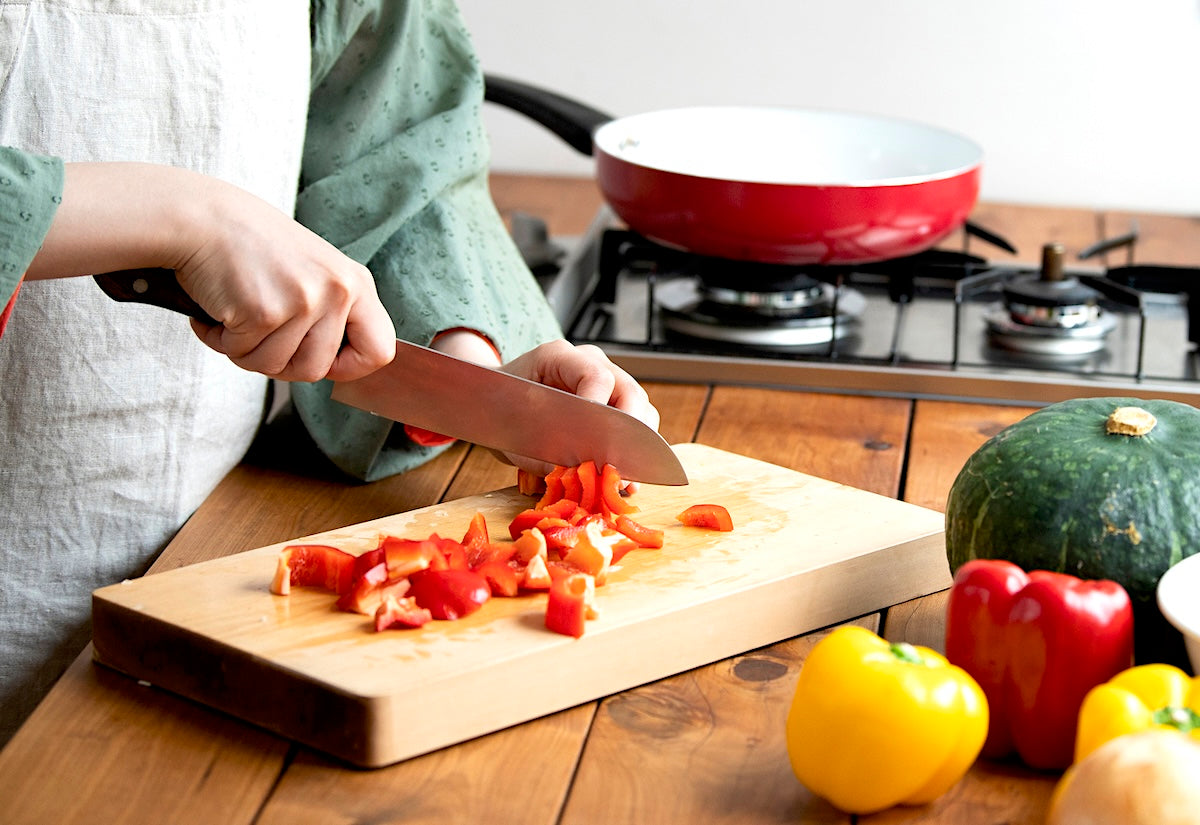
Japanese Knife Basics for the Home Cook
Japanese kitchen knives are thinner, harder, lighter and razor-sharp compared with many Western knives.
That combination is a big reason they feel so good in the hand and move so smoothly on the cutting board.
The secret to not being overwhelmed is to start with the essentials and add specialist tools when your cooking needs - and skill - justify them.

If you’re building a home kitchen from scratch, start with two blades: the petty knife and the santoku or gyuto. This combo covers the majority of kitchen knife tasks.
Petty Knife: Small-Scale Japanese Craftsmanship
A petty knife - also known as a paring knife - is a compact blade designed for the fussy, detailed jobs that make a larger chef knife feel like you’re trying to write your name with a broom.
Kitchen tasks for petty knives, typically around 12-15 cm, include peeling, paring, trimming, coring and precise blade work.
In real life, the petty knife becomes the blade you grab for small fruits and vegetables, quick garnish work and those moments when you just need to cut one thing and don't want to dirty the big knife.
Santoku: The Compact, Multi-Purpose Knife

The santoku is the most popular home-use knife for a reason: it’s a multi-purpose knife built to handle vegetables, fish and meat - the 'three virtues' of its name.
Santoku characteristics:
- generally 16.5-18 cm
- a broad blade that offers good knuckle clearance
- a profile that favors up-and-down chopping and push-cutting.
If your home kitchen is short on space or your cutting board is the size of a paperback, the santoku feels like it fits right in - it doesn’t demand you clear the counter like you’re preparing for a duel.
Gyuto: The Cow Sword
The Japanese version of a Western chef’s knife, the gyuto was originally designed for cutting large pieces of beef; its name is often translated along the lines of 'cow knife' or 'cow sword'.

Gyuto characteristics:
- commonly 21-27 cm (though you can find shorter versions)
- longer and narrower blade compared with the santoku.
If you cook larger volumes or tackle bigger vegetables, or you have larger hands, the gyuto may be the kitchen partner you're looking for.
Japanese Kitchen Knives vs Western Knives: Blade, Steel and Technique
Let’s talk about why your Japanese knife feels different from Western knives.
Steel Hardness and Sharpness
Japanese knives often use harder steels, which helps them take and hold a sharper edge.
The result is the kind of sharpness that makes a tomato fall into clean slices: less crushing, less juice leaking out onto the board. That’s not just aesthetics - clean cuts can preserve texture and reduce bruising.
Thinner Blade Geometry
Japanese blades tend to be thinner, so they glide through food with less resistance.
Western chef knives are often thicker and tougher, designed to survive rougher treatment and the occasional accidental encounter with a chicken bone.
By contrast, Japanese knives often assume you will… treat them right.
Technique: Rocking vs Push and Pull
Many Western chef's knives encourage a pronounced rocking motion whereas many traditional Japanese knives are more suited to push-and-pull cutting.
You can still rock with a gyuto. You can still rock with a santoku. Just do it gently.
Choosing the Right Size
Knives that are too large can be hard to use but longer blades can also make cooking more efficient.
For beginners, a blade length of around 16-18 cm is often recommended; with experience, you might move up to 21 cm then 240 cm.
The size of your prep space should also be considered. A blade length of around 15-18 cm is widely manageable and 19-21 cm may suit larger prep areas.
Finally, the handle has to feel right in your hand. If it doesn’t, the knife will never become your favorite kitchen tool, no matter how 'premium Japanese' or artisanal it's purported to be.
The Next Step: Traditional Japanese Knife Recommendations
Once you have your petty knife and your santoku or gyuto knives dialed in, the question becomes: what next?

This is where knife types get fun - because now you’re adding tools based on specialized tasks, not just vibes.
Nakiri: The Vegetable Specialist for Home Use
With a thin, rectangular blade designed for vegetables, the nakiri looks like a tiny cleaver but behaves like a precision instrument.
It's usually double-beveled, which makes it suitable for both right- and left-handers, and is often recommended for home use as it's easier to maintain.
How it's designed for plant-based cooking:
- its flat edge supports straight-down chopping
- its thin blade reduces splitting and cracking in firm produce
- the tall blade makes it easy to scoop chopped vegetables off the board.
Bunka: Multi-Purpose Knives with a Sharp Tip
The bunka has a tidy little origin story: it’s often linked to the late 19th to early 20th century, when Japan began exploring Western food culture and home kitchens needed one blade that could prep meat, fish and vegetables.
Its name, bunka ('culture'), is thought to nod to that era of modernization and cultural change, and it developed alongside the santoku, a knife with a similar all-purpose mission.
But where the santoku tends to have a rounded tip that feels steady and beginner-friendly - and is also safer in homes with children who wander into the kitchen - the bunka’s defining feature is that sharp, angular tip, designed for precision work such as decorative slicing and scoring.
The relatively wider blade, influenced by vegetable knives such as nakiri and usuba, feels especially comfortable for horizontal cutting motions and fast, clean vegetable prep.
While the bunka can be used for light deboning, the hard steel that gives the blade its precision also makes it brittle so, if you prep a lot of poultry, consider investing in boning knives like the honetsuki or deba instead.
Deba: Fish and Poultry Work
A heavy knife designed for fish prep and breaking down poultry, the deba is excellent for filleting and working through joints and cartilage.
But here's an important reality check: even though the deba looks like it could chop through anything, its hard, brittle edge can chip if abused. This is not the tool for hacking through big bones or frozen blocks of meat or seafood.
Still, if you regularly buy whole fish and want to learn proper breakdown techniques, a deba makes sense.
Maintenance for High-Quality Japanese Knives

Stainless steel is commonly recommended for beginners because it’s more rust-resistant and easier to maintain.
Carbon steel can take a very keen edge and is often easier to sharpen compared with stainless steel but it must be cleaned and dried promptly to prevent rust and stains.
Daily Care: 30 Seconds that Save Your Blade
- Hand wash promptly with mild soap.
- Dry immediately and thoroughly.
- Never leave it wet for just for a minute - that minute becomes an hour and then your blade develops a warped personality.
- Do not put it in the dishwasher. Heat, harsh detergent and rattling around combine to tell a story in which a knife dies.
- Use wood or quality plastic boards. Avoid glass, marble and ceramic unless you enjoy turning razor-sharp into butter-knife chic.
Storage: Protect the Edge
- Use a knife block, magnetic strip or blade guards.
- Avoid tossing your knives loose into a drawer where the edges collide like shopping carts.
Whetstones for Long-Term Care
If you want to maintain knife sharpness properly, whetstones are the classic route. A common home progression is a medium grit stone for regular maintenance and a finer stone for polishing and finishing.
If sharpening feels intimidating, start with a reputable local sharpener or a knife that you’re not emotionally attached to and can use for practicing - learning basic whetstone work is how you keep exceptional craftsmanship performing like it should.
A Samurai in the Kitchen: What Japanese Knives Offer
If Japanese knives have been calling to you, start small and smart.
From there, you can build a collection that matches your cooking and sharpening skills.
The goal is not to own every knife type. The goal is to enjoy cooking in your home kitchen - and maybe feel a little bit like a samurai chef while you’re doing it.
By Janice Tay