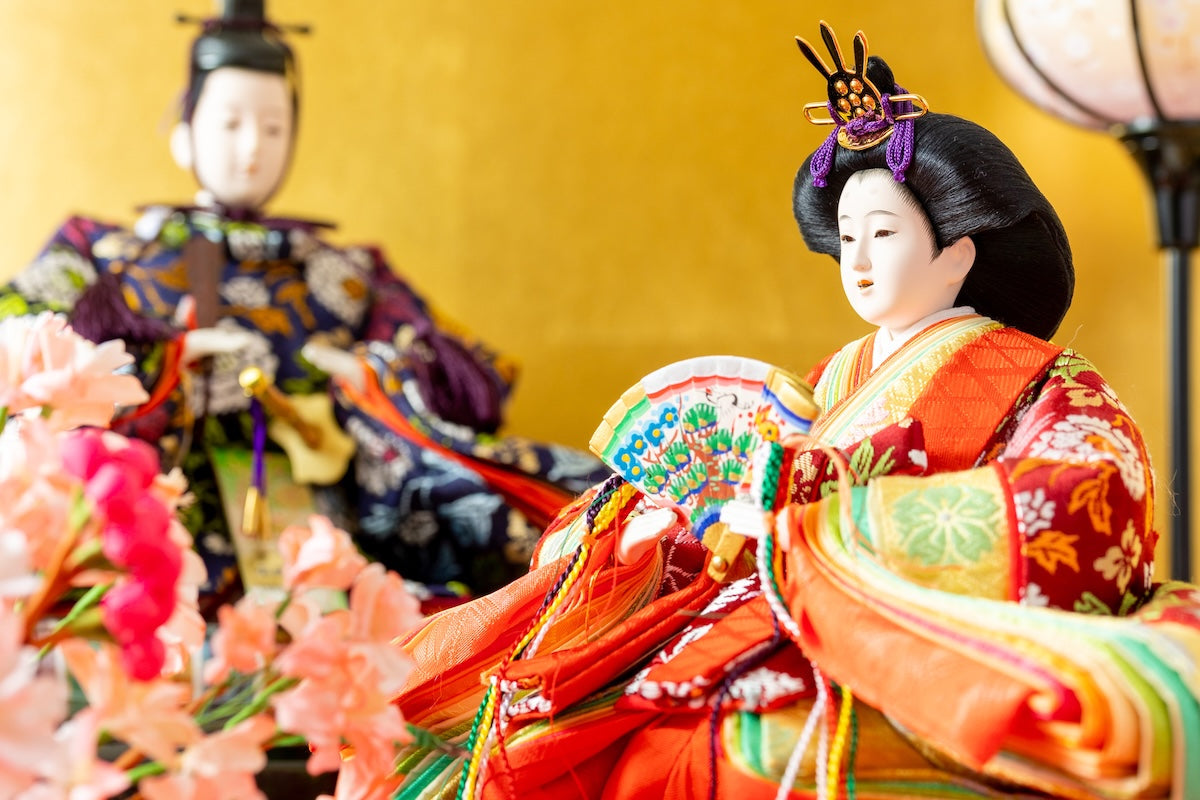
Most countries mark the seasons with weather reports. Japan, being Japan, also does it with dolls.
Not content with merely having spring arrive, the nation stages it. Out comes a red felt carpet, peach blossoms, miniature lacquer furniture, tiny sake vessels, tiny court attendants and a tiny emperor and empress who preside over the whole thing without blinking.

These displays appear in the weeks leading up to Hina Matsuri, the doll festival observed on the third day of the third month in the old calendar and now celebrated on March 3rd in most parts of Japan.
The event is sometimes called Girl's Day but the history of hina dolls is older, stranger and more spiritually loaded than a simple children's holiday might suggest.
These dolls did not begin as pretty things arranged on red felt. Their roots lie in purification rites in which nagashi bina - simple paper dolls or grass figures - stood in for human bodies, absorbing impurity and misfortune before being floated away on rivers or the sea.
Over time, those substitutes merged with aristocratic doll play in the Heian period (794-1185). The dolls inherited the protector role even as they became grander, absorbing illness and misfortune on behalf of children.
By the Edo period (1603-1868), the doll festival had become firmly established as part of the Japanese calendar. More than ritual stand-ins, the dolls also recreated the elegant world of the imperial court, in particular, the wedding of an emperor and empress with officials, musicians and servants in attendance.
Japanese Doll Festival: That Seven-Tier Court
If Hina Matsuri could be summed up in one image, it would probably be of the classic seven-tier arrangement.
The full set of dolls contains 15 figures, plus furnishings and ceremonial accessories, with the emperor and empress positioned at the top. Modern families often opt for compact versions: a pair-only display or a five-person set featuring the emperor and empress with three court ladies.
On the top tier sit the dairi-bina - the emperor and empress dolls - who represent marital harmony. Behind them stands a gold folding screen, with bonbori lanterns and offerings nearby.

The second tier belongs to the three court ladies, the sannin kanjo. They serve the empress and help with ceremonial acts such as the pouring of sake.
The senior attendant is seated in the center, her age indicated by the fact that her eyebrows are either missing or positioned so high that they are almost lost in her hairline. This reflects the old custom of married women shaving their brows, sometimes repainting them high on their forehead.
The court ladies standing on either side hold traditional sake pourers while the seated figure carries a sanbo stand with a sake cup. Together, the women present a picture of refined service, education and court accomplishment.
Seated on the third tier are the gonin bayashi, the five Noh musicians. These are youthful performers, not yet adults, and their hairstyles reflect that status. Viewed from right to left, the arrangement builds in volume from chanter and flute through the small and large hand drums and culminating in the taiko drum.

The fourth tier holds the zujin: two ceremonial guards carrying bows and arrows. The one with the white beard is also known as the Minister of the Left; the younger man is the Minister of the Right. In court hierarchy, the left side was the higher seat so, from the viewer's perspective, the higher-ranking Minister of the Left appears on the right.
The fifth tier features the three palace servants called shicho. Because of their wonderfully expressive faces - one is angry, one crying and one laughing - they are also known as the Three Drunken Attendants. They hold practical implements: a large sunshade, an umbrella and a shoe stand.
Below them are more miniature objects: trousseau items such as chests and sewing boxes as well as decorative trees evoking the imperial palace.
Doll Sets for Hina Matsuri: The Ichimatsu Companions
Not every figure at the doll festival belongs to the seven-tier court.
Ichimatsu ningyo, realistic child dolls dressed in kimono, are sometimes displayed alongside hina dolls and play the same protective role.

First created around 1735-1740, they were named after popular kabuki actor Sanogawa Ichimatsu, whose youthful stage appearance inspired the type. Earlier childlike dolls already existed but the actor's fame helped to fix the form and the name.
Many Ichimatsu dolls have movable arms and legs and older versions, which were sold without clothes, were used for sewing practice as well as for dress-up play.
These dolls also acquired protective associations. They were given to daughters, sometimes as part of their marriage trousseau, and especially to pregnant women to safeguard both mother and unborn child.
Festival Displays for Children's Day
As spring turns into summer, peach blossoms give way to sakura and then to irises. On May 5th, the seasonal spotlight shifts to Tango no Sekku, now observed as Children's Day.
Historically, however, this festival was associated with boys and, with the shift of political power from the court to the warrior class, the day took on a more samurai flavor.
Where the third month brings an emperor and empress in silk, May offers armor and kabuto helmet displays - and warrior dolls.

May dolls are displayed with the hope that boys will grow up strong, healthy and safe from accidents and illness. The armor and helmets are rooted in samurai practices; such objects were offered at shrines and valued as equipment that protected life itself.
In modern homes, compact displays are popular but the meaning remains the same: protection, courage and flourishing life.
Carp streamers, or koinobori, complete the picture. Their symbolism comes from the Chinese legend of the carp that swims upstream, leaps through a gate and becomes a dragon.
The message is not subtle: persist. Rise. Become magnificent. Basically, the fish has a better personal branding strategy than most adults on LinkedIn.
Families also mark the day with customs involving iris leaves, iris baths and foods such as chimaki dumplings and kashiwa mochi.
How to Display and Store Traditional Japanese Dolls
Japanese dolls are sturdy in cultural meaning and delicate in physical fact.
Proper display starts with the location: avoid direct sunlight, blasts from a heater, and places with high humidity.
Hina dolls are commonly displayed after the start of spring and ideally by at least a week before March 3rd; May dolls are usually put out after the spring equinox period or by mid-April, though earlier display is not considered wrong. The point is to give the dolls a respectful season in the light without roasting their silk.

When the festival is over, store the dolls on a sunny day so moisture doesn't join the dolls in their boxes. Wear gloves if possible, remove dust gently with a feather duster or soft brush and wrap the dolls' faces in soft paper before packing.
Dolls should not be crushed tightly together and any insect repellent added to the box should not touch the figures directly.
Storage should be in a well-ventilated place with low humidity, ideally off the floor and away from dramatic temperature swings.
There’s a saying that if hina dolls are not packed away promptly, the girl they belong to will take longer to marry. Superstition? Perhaps. More likely, it was a way to remind people to keep the dolls before the rising humidity of spring could damage them.
If only Christmas trees came with a similar saying.
Contemporary Doll Artists in Japan
Traditional Japanese dolls are not relics trapped in the Edo period. Contemporary doll artists continue to work in established forms while bringing new sculptural ideas, expressions and materials into the field.
Among notable modern figures is Hayashi Komao, who specialized in hinamatsuri dolls and was recognized as a Living National Treasure. Lauded for his refined aesthetics and deep engagement with court culture and traditional performing arts, he showed how dolls can carry historical depth without becoming stiff or antique in spirit.
With a long career of exhibitions and honors behind her, Okuda Sayume represents another major current in contemporary doll art. Her work is described as emotionally rich and dreamlike.
Ishikawa Yoshimasa, who works under the artistic name Rai, blends craft traditions with sculptural mastery. His dolls clearly stem from Japan's cultural past yet their expressiveness and playful proportions make them modern masterpieces.
Prayers Passed Down Through Generations
In Japan, festival dolls are never just cute objects lined up for seasonal effect. The word for doll, ningyo (人形) - literally, human form - sums up their role as talismanic stand-in and human-like companion.
Embodying aspiration and artistry, these dolls were made to protect.
By Janice Tay