- From Samurai to Patissier: The Meiji Sugar Rush
- The Cake That Forgot It Was Foreign: A History of Castella
- Momiji Manju: The Most Famous Leaf You'll Ever Eat
- Mont Blanc: The Peak of Japan's Pastry Ambition
- Where Wagashi Ends and Something Else Begins: Modern Japanese Patisseries
- Regional Sweets Worth the Trip
- More Than a Sweet Treat
When people think of Japanese sweets, they tend to picture wagashi - those seasonal, aesthetically precise confections that fit neatly in the palm of your hand: Mochi. Manju. Nerikiri shaped like cherry blossoms, birds or maple leaves.
But those people are only half right.
Japan's confectionery story is also a story of borrowing, adapting and outdoing the original. Portuguese missionaries left behind a sponge cake that Japan turned into a national institution. France supplied a mountain-inspired chestnut dessert that Japan split into two distinct schools of thought, each convinced the other is missing the point. And all of it arrived somewhere on a spectrum between diplomatic necessity and outright obsession.
From Samurai to Patissier: The Meiji Sugar Rush
When the Meiji Restoration opened Japan to the world in 1868, the government's relationship with Western confectionery was less culinary enthusiasm than political calculation.
Dessert was diplomacy. Rokumeikan, the grand reception hall built to impress foreign dignitaries, served Western sweets alongside the state dinners. The message was clear: Japan had modernized and it had the cream puffs to prove it.
The first Japanese-owned Western confectionery shop was opened not by a baker but by a former samurai. Murakami Mitsuyasu had served the Imperial Household Ministry before being dispatched in 1870 to the Yokohama foreign concession, where he trained under a French confectioner.
In 1874, he opened Murakami Kaishindo in Tokyo; the sword had been exchanged for a sieve. The shop is still in operation today and has a waiting list of months for its cookie tins.
After spending 11 years in the United States studying confectionery, entrepreneur Taichiro Morinaga returned to Japan, opening a small shop in Tokyo’s Akasaka district in 1899.
His ambitions did not stop at the candy counter. In 1918, his company became the first in Japan to mass-produce chocolate, helping to transform what had once been an imported luxury into something that the masses could enjoy.
Alongside the chocolate and caramels that would become the company’s signature items, Morinaga also produced biscuits, fruit drops and dairy products, contributing to the gradual Westernization of Japanese sweets in the modern era.
Kobe, which had its port opened to foreign trade in 1868, also developed a confectionery identity of its own as French, German and Dutch pastry craftsmen settled in the Kitano and Motomachi districts. Among them was the Russian émigré Morozoff family - they opened a chocolate shop in 1931 that has since grown into a luxury confectionery brand.
The Cake That Forgot It Was Foreign: A History of Castella

Sold everywhere in Japan from supermarkets to specialty shops, castella has become so thoroughly Japanese that it can be hard to remember that it arrived from Portugal in the 16th century, when it was introduced by traders and missionaries.
The name goes back to the kingdom of Castile; the Portuguese version - Pão de Castela - means 'bread from Castile'.
Japan kept the name but changed the recipe. Nagasaki confectioners reduced the flour, refined the egg-whipping technique and, in the mid-Edo period, began adding mizuame - a thick starch syrup - to create the cloud-soft interior that defines castella now. The bottom layer of zarame, the coarse crystal sugar that gives each slice a crunchy, caramelised base, is also a Nagasaki invention.
Because castella arrived before the Meiji period (1868-1912) - an era of rapid Westernization - it is considered a traditional Japanese confection rather than a Western one, placing it in the same gray zone as konpeito (from the Portuguese confeito) and boro cookies (bolo). Japan absorbed these sweets so thoroughly that the categories shifted to accommodate them.
Momiji Manju: The Most Famous Leaf You'll Ever Eat
Miyajima, the sacred island in Hiroshima prefecture where a torii gate appears to float on the sea at high tide, draws visitors for its shrines, its deer and - if you ask the souvenir shops - its maple-leaf manju.
In 1906, a Hiroshima confectioner named Takatsu Tsunesuke was approached by the proprietress of the Iwaso ryokan, located in Momijidani Park - a valley famous for its autumn maple colors. She asked him to create a souvenir sweet worthy of the valley's name. He spent time developing a maple-leaf-shaped yaki-manju, a baked bun with a spongy batter shell, and filled it with smooth koshi-an, the fine red bean paste made from strained azuki beans.

Takatsu chose not to patent-protect the recipe aggressively which is why different manufacturers now produce their own versions across Hiroshima.
The traditional filling is anko, the sweet red bean paste that underpins so much of Japanese confectionery. Modern versions include custard, cream cheese, matcha, chocolate and seasonal variants that arrive and disappear like cherry blossoms - briefly, enthusiastically and with considerable Instagram documentation.
Mont Blanc: The Peak of Japan's Pastry Ambition
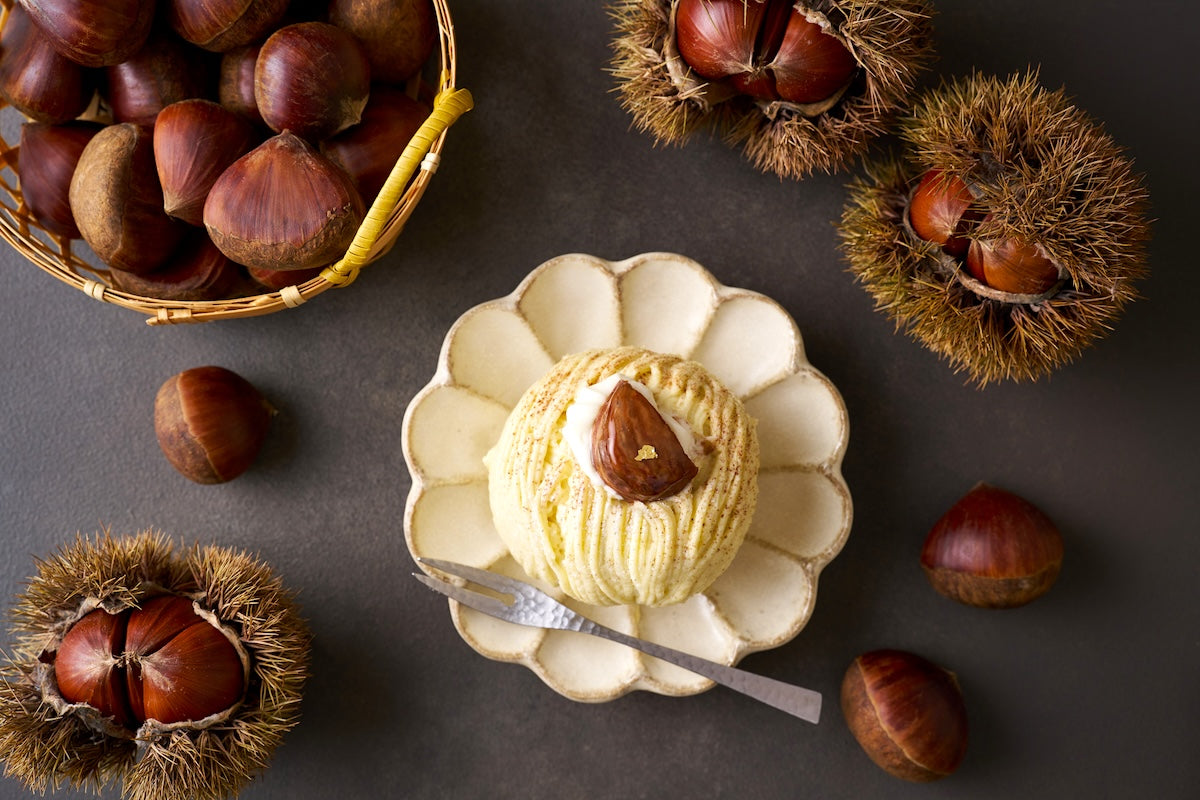
The mont blanc - chestnut paste extruded in fine strands over cream and sponge, named for the Alps peak it vaguely resembles - arrived in Japan in 1933 when a café called Mont-Blanc opened in Tokyo's Meguro ward.
The founder adapted the French original to Japanese tastes: sweeter chestnut paste, a castella base, a structure designed to be carried and eaten as a confection rather than served at a restaurant table. The yellow version - made with sweetened marron paste from preserved chestnuts - became the Japanese standard.
It stayed that way until 1984, when Parisian café Angelina opened a branch in Ginza and introduced its own interpretation: a darker, denser chestnut paste in the European style, the brown mont blanc that French and Italian patisseries had been making all along.
The two versions now coexist in Japan with the polite but firm disagreement of rival schools of flower arrangement - each convinced the other lacks depth.

There is also a technical detail worth noting. Japan's mont blanc cream is piped through nozzles originally designed for wagashi, which are finer than the European equivalents. The result is more delicate in appearance, the strands thinner and more numerous. French technique; Japanese precision of presentation.
Where Wagashi Ends and Something Else Begins: Modern Japanese Patisseries
Japan's contemporary patisserie culture has settled into a pattern that neither France nor Japan invented independently. The format is French - mousses, entremets, tartes, macarons - and the flavors are Japanese: matcha, hojicha, yuzu, wasanbon sugar, miso, azuki, Japanese chestnuts and sansho pepper.
The results can be fascinating. Sadaharu Aoki, working from Paris, built an international reputation on a matcha opera cake called Bamboo and genmaicha éclairs - textbook French pastry construction, Japanese soul in every mouthful.
In Tokyo, Hironobu Tsujiguchi of Mont St. Clair uses wasanbon, the fine Shikoku-produced cane sugar that dissolves on the tongue like snow, in baked goods that sit in the soft register between French sablé and Japanese namagashi.
Kyoto, where traditional wagashi culture and European pastry craftsmanship share the same real estate, is particularly well placed for this synthesis.
Malebranche, a confectioner with branches all over the city, produces Cha no Ka. This version of the langue de chat - the thin butter wafer France developed - sandwiches white chocolate against koicha, the concentrated matcha used in formal tea ceremony gatherings. It has become one of Kyoto's defining souvenir confections since its launch.
Patisserie S in the Muromachi area offers hojicha and yuzu cakes that use classical French construction as scaffolding for flavors that are entirely Japanese. The Kyoto branch of Murakami Kaishindo, founded in 1907, occupies a slightly different lane - its Russia Cake and hand-baked cookies are rooted in the Meiji-era Western tradition and have changed little since then.
Regional Sweets Worth the Trip
Japan's omiyage culture - the obligation to return from any trip with sweets for colleagues and family - has been running as a commercial engine since the Edo period, when mass pilgrimage routes gave rise to souvenir shops across the country. Every region has its meibutsu: the famous thing you buy as proof of presence.
Some of these, such as Nagasaki castella and Hiroshima's momiji manju, are historic. Others are more recent but no less embedded: Hokkaido's haskap berry cookies from Morimoto, their jam sandwiched between thin wafers and edged with couverture chocolate; the soufflé cheesecake from Snaffle's in Hakodate, made with Hokkaido eggs and cream cheese and barely holding itself together.
Okinawa has its beni imo tart - a sweet potato so purple it looks like a confectioner's argument - from Okashi Goten. Gunma has Gateau Festa Harada's butter rusk, a sweet so simple it should not be this good.
The pattern across all of them is the same: a regional agricultural product, a locally rooted technique and a package designed to survive a bullet train ride.
More Than a Sweet Treat
Japan has never encountered a foreign dessert it couldn't absorb, improve and package in boxes of individual portions for sale at a train station.
This is one of the country's lesser-discussed national talents. Somewhere between the arrival of Portuguese missionaries, the collapse of the samurai class and the modern department store basement food hall, Japan developed a confectionery culture where the usual categories begin to blur. A Portuguese cake becomes traditional Japanese confectionery. A French mountain dessert divides into competing Japanese schools.
What survives after all this transformation is not imitation but something entirely new: confectionery that showcases Japan's belief in craftsmanship and seasonality as well as packaging that suggests that somebody, somewhere, lost sleep making sure your cake aligned with the month.