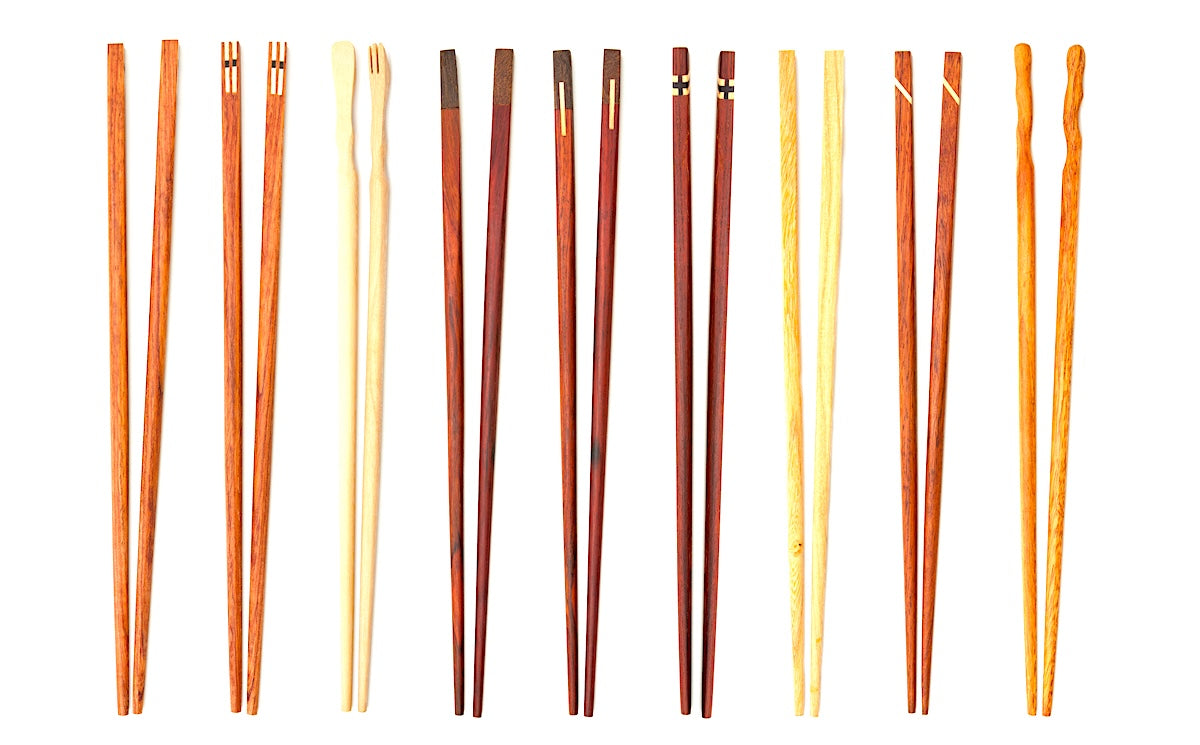
In Japan, chopsticks are more than everyday tableware - they are tied so closely to the individual that many households keep a designated pair for each family member. To take someone else's chopsticks uninvited would feel as strange as using another person's toothbrush.
Chopsticks arrived in Japan from China in the 7th century or earlier, initially as implements for the aristocracy and Buddhist rituals. Over the centuries, they became common household items and the primary dining tool for an entire nation.
At present, about 14 billion to 20 billion pairs of disposable chopsticks are used in Japan each year.
Beneath that staggering statistic lies an older world of handcrafted chopsticks that speak to a very different relationship. This is reflected in the word, ohashi, where the honorific 'o' is affixed to the Japanese word for chopsticks. No one says 'ofuooku' or 'osupuun' when speaking of fork and spoon.
A Bridge Between People: Why Chopsticks Make a Meaningful Gift
In a happy linguistic coincidence, the Japanese word for chopsticks - hashi (箸) - sounds just like the word for bridge (橋): a pun that has shaped the cultural significance of chopsticks as gifts in Japan.
To give a pair of chopsticks is to offer a bridge between people and between one phase and the next in the recipient's life.
At weddings, couples receive meoto-bashi: a pair of chopsticks, with the husband's being slightly longer. The symbolism is elegant: two individuals, distinct yet matched, moving through life's meals side by side.

For housewarmings, a set of chopsticks carries the hope that the new home will always have food on the table. For a celebration such as a kanreki, or 60th birthday, chopsticks embody the wish that the recipient will keep eating well through many more years.
This wish also applies when chopsticks are presented as a retirement gift. It says: may the table continue to be set, may daily life remain full.
There is a Buddhist tale traditionally told in Japan of chopsticks measuring three shaku and three sun (3尺3寸) - about 100 cm - that are used in heaven and hell. In the nether world, the denizens starve because they cannot feed themselves with utensils too unwieldy to reach one's own mouth.
But in paradise, the same chopsticks serve everyone abundantly because they have learned altruism - and use the chopsticks to feed one another. By extension, the meaning embedded in a gift of chopsticks is mutual care.
Giving Chopsticks: How to Choose the Perfect Pair
For those seeking Japanese souvenirs, chopsticks - light, compact yet packing centuries of culture - make a practical choice.
Look beyond cute motifs and bright colors - they may catch the eye but chopsticks made from high-end hardwoods or finished with Japanese lacquer such as wakasa-nuri offer durability along with artistry and will outlast any sushi-shaped fridge magnet.
Selecting Japanese chopsticks as a gift involves more consideration than it may appear but by being mindful of the material, finish, color and size, you'll find a pair that fits naturally in the recipient's hand and life.
Material and Craftsmanship
Natural wood is the most traditional material for Japanese chopsticks. Hinoki cypress, cherry wood and chestnut are all used, each bringing a different grain pattern, texture and warmth to the hand.
Natural wood chopsticks develop character with use - their color deepens, their surface takes on a subtle luster - making them a fitting expression of the wish that a relationship, like the wood itself, will only improve with time.

If you're looking for something that makes a subtle statement, consider chopsticks made from the three great karaki: hardwoods imported to Japan over centuries from Southeast Asia and India.
Kokutan - ebony - is the densest and heaviest of the three; its deep, uniform black polishes to an almost lacquer-like sheen without any coating at all.
Shitan, or rosewood, offers a rich reddish tone and a tightly packed grain that takes lacquer finishes beautifully. Literally meaning 'iron sword wood' in Japanese, tagayasan is extremely hard and durable, its heartwood threaded with dark and reddish tones.
These chopsticks are made for a lifetime of use and then some. They're also becoming increasingly rare as export restrictions tighten in source countries, making these chopsticks a treasure in more ways than one.
Lacquerware chopsticks are another way to bring Japanese craftsmanship to your dining table. Among Japan's most distinctive lacquerware traditions is wakasa-nuri, a term which refers both to Wakasa lacquerware and the craftsmanship behind it.
With production centered on Obama city in Fukui prefecture, wakasa-nuri begins with layers of lacquer, or urushi, applied to the wooden base. Into those layers, artisans embed materials such as seashell fragments, pine needles, rice husks and even thread.
Once the layers have built up, the surface undergoes a painstaking polishing process called togidashi in which the lacquer is carefully worked down with charcoal and polishing stones until the buried materials emerge through the surface like a landscape seen through clear water.
The result - shimmering, layered, iridescent - is sometimes compared to the floor of a shallow sea.
Finish and Color
Red and black are the classic combination for chopstick gifts in Japan. Red, associated since ancient times with vitality and protection, is the celebratory color par excellence.

Black carries gravitas and refinement. Together, they signal festivity and seriousness in equal measure - appropriate for weddings, milestone birthdays and significant occasions.
Natural wood finishes suit recipients who prefer simplicity. For everyday use, bamboo chopsticks - lightweight and with natural antibacterial properties - are another practical option.
Lacquered chopsticks require a little care. They should be washed gently by hand, stored away from direct sunlight and never soaked in water, which can damage both the lacquer and the wood beneath. With proper care, a well-made pair of lacquered chopsticks can last years, even decades.
Size
The length of chopsticks matters more than it might seem. The traditional measurement for finding the right length is hito ata han (一咫半): one and a half times the span between the thumb and forefinger when they're extended to the point where a right angle could fit in between them at the joint.
In practical terms, this translates to roughly 21.5 to 22.5 cm for women and around 23 cm for men. For children, chopsticks should be sized to fit growing hands - changed, like shoes, as the child grows.
In comparison with their East Asian cousins, Japanese chopsticks are more rounded than Korean chopsticks, which tend to be flat and made of metal.

Japanese chopsticks are shorter and more tapered than Chinese chopsticks, which are longer as these chopsticks are used to take food from shared dishes at the center of the table. On the other hand, in traditional Japanese dining, the dishes are portioned out onto individual trays set in front of each person.
What Not to Do: Taboos and Table Etiquette
Giving and using chopsticks in Japan comes with its own set of considerations. Some are rooted in Buddhist funeral customs and others in simple good manners but all of them are worth knowing.
Passing food from one person's chopsticks directly to another's is among the most serious of chopstick taboos. This is how cremated bones are transferred at a funeral and recreating the act at a dinner table is deeply uncomfortable for most Japanese people. Similarly, chopsticks should never be stuck upright in a bowl of rice as this is another funeral practice.
When choosing chopsticks as a gift, avoid sets of four pairs; 'shi', the reading for four, sounds like the word for death. One pair or sets of two (for a couple), three or five pairs are safer choices for celebratory occasions.
And while the hashi-as-bridge symbolism is auspicious, be careful not to frame the gift in terms of 'crossing a bridge' - for some, particularly older recipients, that phrasing can evoke crossing over into another world.
Personal Chopsticks: Engraving and Presentation
A pair of chopsticks becomes a keepsake the moment something personal is added to it.
Engraving - a name, initials or an anniversary date - transforms a beautiful pair of chopsticks from something that is aesthetically pleasing into something that could not belong to anyone else.
For weddings and anniversaries, a couple's names inscribed on their respective pair of meoto-bashi makes the gift a lasting record of the occasion. For a significant birthday, celebrate with a few characters expressing a hope for health or long life on the chopsticks.
The Beauty of Japanese Chopsticks
In Japanese gift and dining culture, presentation matters. A pair of fine chopsticks laid in a kiri-bako - a paulownia wood box, a traditional Japanese container for precious objects - arrives with a level of formality and care that the recipient immediately understands.
Add a cloth pouch, chopstick rests or a small handwritten card explaining the hashi pun and you present more than chopsticks. You have given context, meaning and a story that can be told to someone else.
This is, perhaps, the deepest message behind chopsticks as gifts: the wish that the recipient will sit down to many more meals, hold these chopsticks and be reminded that someone, somewhere, was thinking of them.