Most kitchen objects lead uncomplicated lives.
A saucepan boils things. A frying pan fries things. A colander stands in the sink wondering why pasta water always arrives at terminal velocity. But the tetsubin - the Japanese cast iron kettle that has spent the better part of four centuries turning water into slightly better water - has managed to become one of the few household objects capable of generating confusion before breakfast.
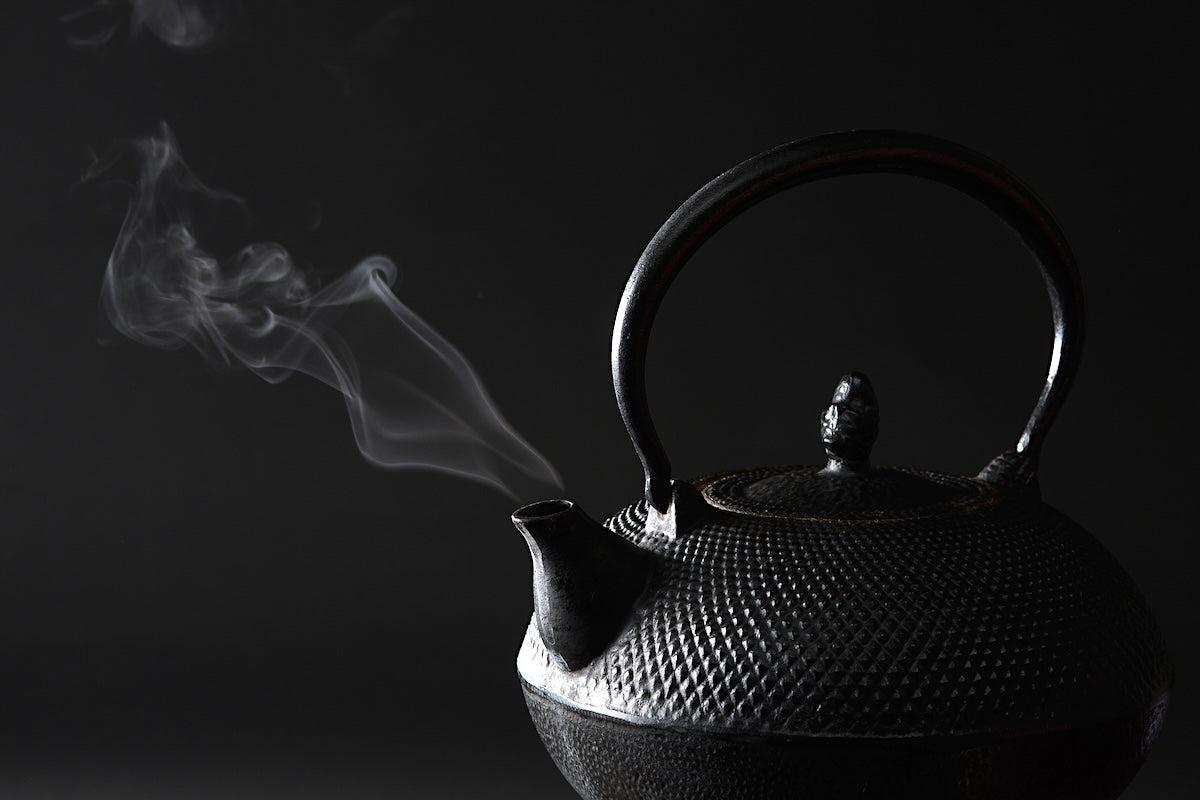
Part of the problem is visual. A tetsubin looks almost exactly like what many people outside Japan would confidently call a teapot. It has a handle. It has a spout. But its job is not to brew tea but to boil water. Everything else is mission creep.
This distinction may sound fussy until someone places an enamel-lined iron teapot over direct heat and discovers, in real time, the exciting acoustic properties of cracking enamel.
People persist with tetsubin not because they are convenient - they are not. Not because they are lightweight - absolutely not. A decent tetsubin feels less like kitchenware and more like a medieval training device for forearm strength.
But water boiled in one tastes softer and rounder - calmer, somehow, as though the kettle has personally negotiated a peace treaty between minerals and heat.
This is the story of the Japanese cast iron kettle: a craft born from tea ceremony prestige, sustained by iron, fire, patience and several generations of people willing to spend 30 years learning how to make a better object for boiling water.
History of the Tetsubin: From the Tea Ceremony to the Kitchen
Japanese kettles have been closely bound to the Tohoku region in north-east Japan for centuries. The story of tetsubin runs through Iwate prefecture - specifically, through the cities of Morioka and Oshu - and it begins, as so many Japanese craft traditions do, with a feudal lord and a desire to impress other daimyo.
In the mid-17th century, the lord of the Nanbu domain invited kettle craftsmen from Kyoto to Morioka to produce tea ceremony kettles. Tea culture - also known as chanoyu or chado, the Way of Tea - was already being used as a performance of refinement and political authority and a well-made kettle was part of the theater.
Morioka had something Kyoto did not: abundant iron ore, high-quality river sand from the Kitakami River, clay from the surrounding mountains and charcoal from the forests. The raw materials were all there. What the city needed was the people who knew what to do with them.
The craftsmen arrived, the domain protected and promoted the trade and Morioka's ironware developed a reputation for high artistic quality. Often elaborately decorated with relief designs, these chanoyu kettles were presented to the shogunate and other domain lords as gifts.
From these larger kettles emerged smaller versions designed for everyday water boiling: the tetsubin was born. Its popularity is thought to have grown alongside the rise of sencha - loose-leaf tea that became fashionable during the Edo period (1603-1868). A compact kettle that could rest on a small brazier made tea preparation far more accessible to ordinary households.
The beginning of the Meiji era (1868-1912) brought railways through the Tohoku region; distribution expanded and tetsubin made in Iwate found their way across the country.
The city of Oshu - specifically, the Mizusawa district - tells a different story. The roots of ironworking there stretch back to the late 11th century, when samurai warlord Fujiwara no Kiyohira invited metal casters from Omi province - roughly present-day Shiga prefecture - to the region, where weapons, farming tools and iron pots were already being produced.
In 1959, the two regional cooperatives formally united under the name Nambu tekki - Nanbu ironware - and, in 1975, it became the first craft to receive designation as a traditional craft product under Japan's Act on the Promotion of Traditional Craft Industries.
It takes a minimum of 15 years to become proficient in the craft. And to become a master, a kama-shi who produces signed work? About 30 to 40 years are needed - almost half a lifetime.
Kettle or Cast Iron Teapot?
Like the yakkan - a copper kettle used to heat water - the tetsubin is used for boiling water, not for brewing tea. The iron version of the kyusu teapot is handy for tea brewing but placing it over direct heat can damage or destroy it.
The difference between the two comes down to the interior. A tetsubin has an uncoated iron interior, left bare after the kama-yaki firing process, where the kettle is baked at 800 to 1,000 deg C after casting to develop an oxidised protective skin. The kettle cannot have tea leaves steeped directly inside it because the tannins in tea react with the exposed iron. But it can sit over a charcoal brazier or gas flame and some modern versions are even compatible with IH cooktops - all in service of boiling water.
A cast iron kyusu is glazed with enamel - a glass-like coating fused to the iron surface - making it resistant to rust and easy to maintain.

It comes with a built-in strainer for tea leaves and is usually made of ceramic in its traditional non-iron form; the cast iron version simply adopts the same brewing function in a heavier body. The enamel coating prevents iron from dissolving into the liquid, which means it cannot be used for iron supplementation and cannot provide the water-mellowing effects associated with the tetsubin. The tetsu kyusu is a fine object. It is simply not a kettle.
A hybrid product that can both boil water and brew tea using a built-in strainer does exist though this, naturally, entails compromises.
What the Iron Kettle Does to Your Water
When water is boiled in a tetsubin, small amounts of iron dissolve naturally into it. The iron released is divalent iron, a form thought to be absorbed by the body more easily than the trivalent iron found in most plant foods. Spinach and hijiki seaweed are often cited as sources of iron but this is the harder-to-absorb variety. The iron from a tetsubin is closer to the form found in meat and fish.
The amounts involved are small; a tetsubin is not a supplement and should not be treated as a treatment for serious iron deficiency. But as a daily habit, using one to boil water for hot drinks or cooking is a natural iron supplement that costs you nothing beyond the price of the kettle.
Boiling water in a tetsubin also removes chlorine from tap water, which enriches and improves its taste. The word most commonly used in Japanese to describe the result is maro yaka - soft, round, without sharp edges. Whether you are making green tea, coffee or simply drinking hot water, the difference is noticeable.
How to Care for a Tetsubin
The iron-clad rule: empty and dry it after every use.
When hot water is allowed to cool inside the kettle, the drop in temperature drives rapid oxidation of the bare iron interior. A single instance of leaving water to cool inside can produce significant rust.
The correct routine after boiling is to pour out the remaining water, remove the lid and let the residual heat of the kettle evaporate whatever moisture is left. The kettle is traditionally heated over charcoal - usually the remains of a charcoal fire - to dry it out.

Do not use soap or detergent. Do not scrub the interior with a cloth or sponge. Do not pour cold water on a hot kettle. The interior should be touched as little as possible - the surface is delicate.
Over the first month of daily use, the interior starts to develop yu-aka, a pale mineral deposit formed from the calcium and magnesium in tap water. This natural coating gradually covers the iron surface, protects it from rust and further softens the taste of the boiled water.
Tetsubin are traditionally described as something you raise, the way you raise a plant or a child - and the yu-aka is the sign that the raising is going well. Hard water is better than filtered water for building this deposit quickly; the minerals have to come from somewhere.
Rust appearing on the interior is not automatically a crisis. As long as the boiled water remains clear and odorless, the kettle is still usable. If the water turns red or develops a metallic smell, the traditional remedy is to simmer green tea leaves - loose or in a tea bag - inside the kettle for 20 to 30 minutes, then leave it undisturbed for about 10 hours.
The tannins in the tea react with the iron to form a protective film. Discard the contents, boil and discard plain water two or three times and the problem is usually resolved. Severe rust that resists this treatment can be sent back to the producer for professional repair.
One care tip for the exterior: while the kettle is still warm after use, lightly wipe it with a cloth dampened with brewed tea to help it maintain its deep black finish.
For long-term storage, dry the kettle completely, wrap it in newspaper and keep it somewhere dry and well-ventilated, with the lid slightly ajar. Avoid the cabinet under the sink and anywhere near a stovetop where oil might settle on the surface.
Traditional Cast Iron Kettles, Recast
For most of their history, tetsubin came in one color: the deep black of charred iron, occasionally with traces of brown or grey where the casting had aged unevenly.
Then, in the early 1990s, a French tea shop asked Iwachu - founded in Morioka in 1902, one of the industry's largest producers - for something colorful. It took the company several years of development to work out how to apply color lacquer over the fired base coat and hand-polish it to a stable finish. But once it succeeded, tetsubin designs went from basic black to a palette that included red, green, blue and every shade between.
The result was not universally welcomed among traditionalists but colored tetsubin now represent the majority of Iwachu's sales.
IH-compatible tetsubin are also widely produced across Morioka and Mizusawa, making the kettles accessible to modern homes without gas hobs. Sizes have come down from the traditional one-sho (about 1.8 litres) to one-litre formats that better suit smaller households.

The arare dotted surface - pressed into the soft clay mold one dot at a time with a pointed rod before firing - remains on most traditional models, not only for appearance but also because the texture adds thickness to the kettle wall and improves heat retention.
Lasting for Generations
There's something comforting about an object that improves through repetitive care rather than technological upgrades. No firmware updates. No subscription model. No app requiring permission to access your contacts in order to boil water. Just iron, heat and the increasingly radical proposition that, if you look after something properly, it may remain useful for the next 50 years.
In a world where most things are designed to become obsolete before you've even figured out how to clean them properly, a heavy black kettle from northern Japan that does its job generation after generation begins to feel less like kitchenware and more like a rebuttal to disposable living.