Introduction
The closest place to a ‘vegetable shrine’ that we’ve encountered so far is Kayatsu Shrine in Aichi Prefecture, which venerates the deity of pickles. Then again, this series is all about strangely specific things to worship, so an all-purpose vegetable shrine would miss the mark.
The following shrines and temples feature vegetables in a variety of forms — as decorative elements, divination tools, offerings, hemorrhoid cures, and spiritual wards. Unfortunately, it looks like I’ll still be waiting for that natto (fermented soybean) shrine.
 Daikon radish
Matsuchiyama Shoden Temple (Honryuin), Tokyo
You’d be forgiven for thinking that Asakusa begins and ends with the perennially-congested Sensoji Temple. Skipping this area would be a shame, though, as Matsuchiyama Shoden Temple is a charming and off-the-beaten-path alternative to the crowds.
Located a short 10-minute walk north of Sensoji Temple, Matsuchiyama Shoden (official name Honryuin) is actually one of Sensoji’s sub-temples. It is nicknamed ‘Daikon Temple’ for reasons that are immediately apparent as soon as you walk into the temple. Daikon imagery is everywhere around the temple, particularly in the form of a split-root/two-pronged daikon (futamata daikon) which represents marital harmony. There’s almost always a huge pile of daikon radishes stacked in front of the altar, as devotees bring them as offerings.

The temple itself supposedly dates back to 595, when a sacred hill (Matsuchiyama) erupted from the ground. At the same moment, a golden dragon flew down from heaven and coiled itself around the hill to protect it. Six years later, the area experienced a terrible drought. The deity Kangiten appeared on the hill, and, feeling pity for the suffering people, ended the drought. In response, Honryuin was built to worship Kangiten.
Kangiten translates to ‘deity of joy,’ so worshippers usually pray for happiness or to find a marital partner. He is the Buddhist manifestation of the Hindu God Ganesha, who is the elephant-headed deity of conjugal bliss. His symbol is the daikon, and he is sometimes depicted holding one. It’s a fitting and obvious nod to virility. However, daikon — its white colour symbolising purity — can also purify one's mind and body. According to the temple, daikon represents “our minds trapped in deep ignorance, emanating poison of anger.” By offering a daikon to Kangiten, they say, “that poison will be purged from our body and soul.”

The priests definitely do not eat all the offered daikon. In fact, the temple lets visitors take yesterday’s offerings home for free — visit early enough and you might get one of those free daikon. Alternatively, you can join the Daikon Festival on 7 January, when the staff cook up all the daikon that was offered over the New Year’s period and serve it to visitors alongside sake.
A fun extra: Matsuchiyama Shoden is also home to the Sakura Rail, Japan’s shortest monorail line that opened in 2015.

Garlic
Maruyama Shrine, Akita
Japanese cuisine isn’t exactly known for garlic-forward dishes. Indeed, most chefs are rather delicate in their use of garlic. This isn’t to say that people here don’t like it — those who love garlic, really love it. Who else would frequent all these garlic-themed restaurants in Tokyo? Perhaps garlic lovers should add another destination to the bucket list: Maruyama Shrine in Akita, home to the God of Garlic.
Not much is known about Maruyama Shrine beyond two newspaper articles published by the Tokyo Asahi Shimbun and Akita Sakigake Shimbun in 1935. The shrine’s origin story begins sometime in the 1780s with a sumo wrestler named Ichinoseki, who had travelled from the Sendai Domain to visit the Shimomori family in what is now Yokote, Akita. (His reasons are unclear.)
At the time, the area suffered from poor irrigation, making it difficult to cultivate crops. What the villagers needed was water from the Yokote River, which meant digging a tunnel through the foothills of Nishigasaka, extending towards Asahikoyama. At over two hundred metres worth of tunnel, this was a major undertaking. But Ichinoseki was tall and strong, and wished to repay the Shimomori family’s kindness, so he took it upon himself to dig this tunnel.
Working feverishly day and night, Ichinoseki dug, and dug, and consumed garlic to stave off colds and exhaustion. Tragically, just as the tunnel was about to be completed, he perished in a landslide. The villagers mourned his death and built a small shrine in gratitude for his sacrifice, and for their now-irrigated fields. He is honoured as a benefactor of regional agricultural development, and as the deity of garlic and colds. To this day, worshippers offer garlic in his memory, and take a clove home, hanging it on the house eaves to ward off evil spirits and diseases.
As with all mythic origin stories, this should probably be taken with a pinch of salt. However, Maruyama Shrine does display sumo wrestlers’ ceremonial belts, lending credence to the Ichinoseki legend.

Myoga (Japanese ginger)
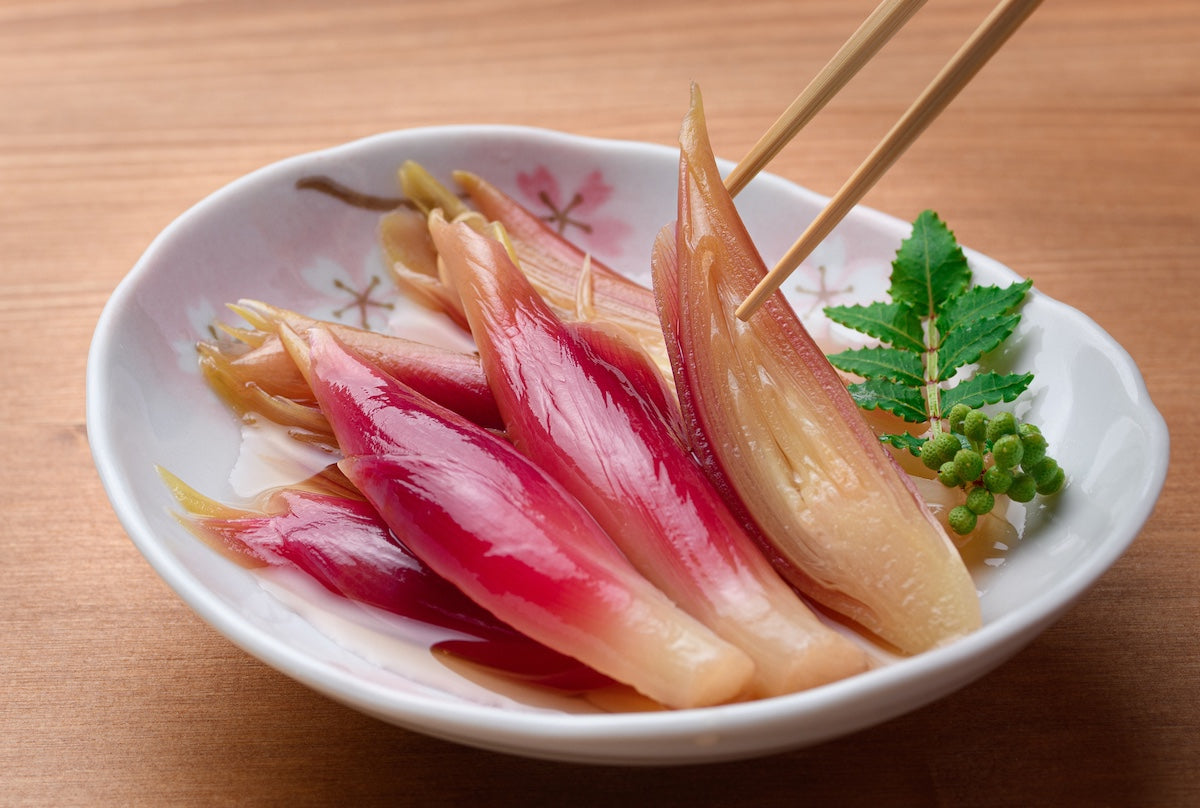
Myōga 茗荷 (Zingiber mioga, Zingiberaceae) is edible, tasty, and good-looking — you’ll have seen its reddish-pink flower buds finely shredded and used as a garnish in many Japanese dishes. It evokes ginger but has a more floral flavour and perfume.
Beyond its culinary properties, however, myoga plays a more esoteric role at a few shrines across Japan, specifically as a divination tool for predicting harvests and other conditions for the coming year. But why myoga? It might have something to do with its name — a homophone for 冥加, meaning ‘divine protection’ or ‘good fortune.’
Menuma Shrine, Hyogo
Located on the slopes of a hill in Shin’onsen Town, Hyogo, Menuma Shrine 面沼神社 looks like any other Japanese shrine in the countryside — appropriately old, tranquil, surrounded by lush forest.
The shrine’s major annual event is the Myoga Festival, which takes place on 11 February, or rather, the seventh day of the first lunar month according to the old calendar. It takes place on the shrine precincts, at Menuma Pond 女奴池 — yes, written with different characters from the shrine name — where myoga shoots grow. While myoga typically sprouts around April, they have usually emerged in February at this pond for reasons unknown.
Worshippers gather early in the morning, around 5 or 6 am, to watch the head priest wade into the pond and gather three stalks of newly-sprouted myoga. He purifies them with pond water, and places them on a tray lined with sekishō (Japanese sweet flag or rush; Acorus gramineus) before offering them to the shrine deities. Then, the worshippers themselves will divine the year’s fortune and prospects based on the myoga shoots. For instance, a straight shoot indicates good harvests ahead; a crooked shoot hints at drought. A glossy upper section suggests favourable conditions for early-ripening rice, while a glossy lower section points to better conditions for late-ripening rice. Afterwards, everyone shouts 命賀めでたや (May we enjoy long life!) before partaking of special myoga mochi and sushi, and locally-made black bean tea.
As far as we know, this festival is not open to the public now. Only those taking part in the myoga divination are permitted to join. It used to be that women were barred from attending, and people would make pilgrimages here to participate in the nude.
(Note for the curious: 女奴 ‘menuma’ can be variously translated as female servant, handmaiden, and slave girl. Unfortunately we haven’t been able to find out anything more about the etymology of the pond’s name.)
Asusugi Shrine, Kyoto
Like Menuma Shrine, Asusugi Shrine in Ayabe City also conducts an annual myoga divination ritual to forecast the outcome of the year’s rice crop, using myoga grown in the shin’den 神田 (sacred field) on the shrine precincts. Their Myoga Festival takes place on 3 February (Setsubun), on the spring equinox.
According to the shrine, the beginnings of this ritual date back to around 1,400 years ago, when a descendant of Prince Taima-no-miko (also known as Maroko Shin’no) planted myoga ginger at what is now present-day Asusugi Shrine to pray for national peace and prosperity for his descendants.
As with Menuma Shrine above, the priest divines the year’s rice harvest prospects and weather patterns based on the condition of the myoga shoots. It’s unclear whether this is open to the public, but it’s probable given that the shrine receives local media coverage every year for this ritual.

Kichijoji Myoga Inari, Tokyo
Despite the name and what we’ve seen so far, this little shrine in Komagome Kichijoji Temple, Bunkyo Ward, doesn’t use myoga for divination. Kichijoji Myoga Inari is supposedly one of many haemorrhoid shrines in Japan, and was once renowned for ‘miraculously’ curing them as long as devotees abstained from consuming myoga. The object of prayer is the Myoga Gongen statue that stands behind the Konjō-dō Hall.
Kichijoji Temple was relocated from within the capital to its present location in 1657 after the Great Meireki Fire that burned down most of Edo. The halls were destroyed again in the wartime bombing, but was rebuilt in 1953.
Myoga Shrine, Hiroshima
Myoga Shrine on Ikuchijima Island, Onomichi, has nothing to do with the food or plant. The name of the shrine is written as 名荷 rather than 茗荷, and refers to the name of the ritual dance they perform on the first Sunday in April — Myoga Kagura. This thirteen-part dance was historically performed as part of a set of prayers and rites to expunge disease and bring bountiful harvests.
Myoga Shrine’s goshuin and lucky amulets aren’t myoga-themed. Instead, they’re mostly lemon and mikan-themed, since the island grows most of the lemons sold around Japan. Adorable.

Soybeans
Sano Shrine, Miyazaki
Is this Japan’s only deity of soybeans? We wouldn’t like to say, but the possibility is high. Sano Shrine is a good bet for tofumakers, since a tofu shrine proper doesn’t yet exist.
The soybean deity at Sano Shrine is a pair of Nio Guardian statues that date back to 1734. Nio Guardians are usually powerful, wrathful figures placed in pairs at temple entrances to ward against evil. In this region, their connection with soybeans stems from a local folk tale, as follows.
Long ago in Hyuga Province, there was a small village nestled deep in the mountains. The surrounding land was poor; whatever the villagers planted failed to grow, and each day was a struggle. At their wits’ end, they decided to try appealing to the Nio guardians standing at the mountain gate of Jintokuji Temple, praying daily for crops to grow.
One day, as if their prayers had been answered, plump, round soybeans began to fall from the statue’s eyes. The delighted villagers took them back to the village, and scattered them in the fields. The soybeans sprouted and grew tall and strong, the once-fallow fields filled with soybeans as far as the eye could see.
Thanks to the annual harvest of soybeans, the villagers no longer suffered from hunger or poverty. The village became famous far and wide for delicious soybeans. Every household enjoyed immense wealth, which — surprise, surprise — had a corrupting influence. The men spent their days in drunken revelry, while the women indulged in expensive kimono. No one visited the Nio Guardian to pray anymore.
Then, one night, the neglected Nio Guardian statue toppled into the valley below. Overnight, the once-vigorous soybean seedlings withered. No matter how many times the villagers replanted them, the beans failed to grow. The village began to decline and revert to its former state. The villagers came to realise that this was divine punishment for neglecting the statue, and resolved to retrieve it from the valley.
They fashioned a thick rope, secured it to the statue, and with tremendous effort hauled it back up the mountain, returning it to its rightful place. The villagers made deep obeisances for their neglect, and began regularly tending to the temple and the statue again. After that, the soybeans in the fields gradually grew back. So it was that the Nio statue became the deity of soybeans for this village.
Written by Florentyna Leow