There are many ways to boil water. Most involve pressing a button and walking away.
A tetsubin asks for a bit more attention, both in its use and maintenance. But, in return, it will keep working, generation after generation, long after your electric kettle has gone to the great appliance graveyard.
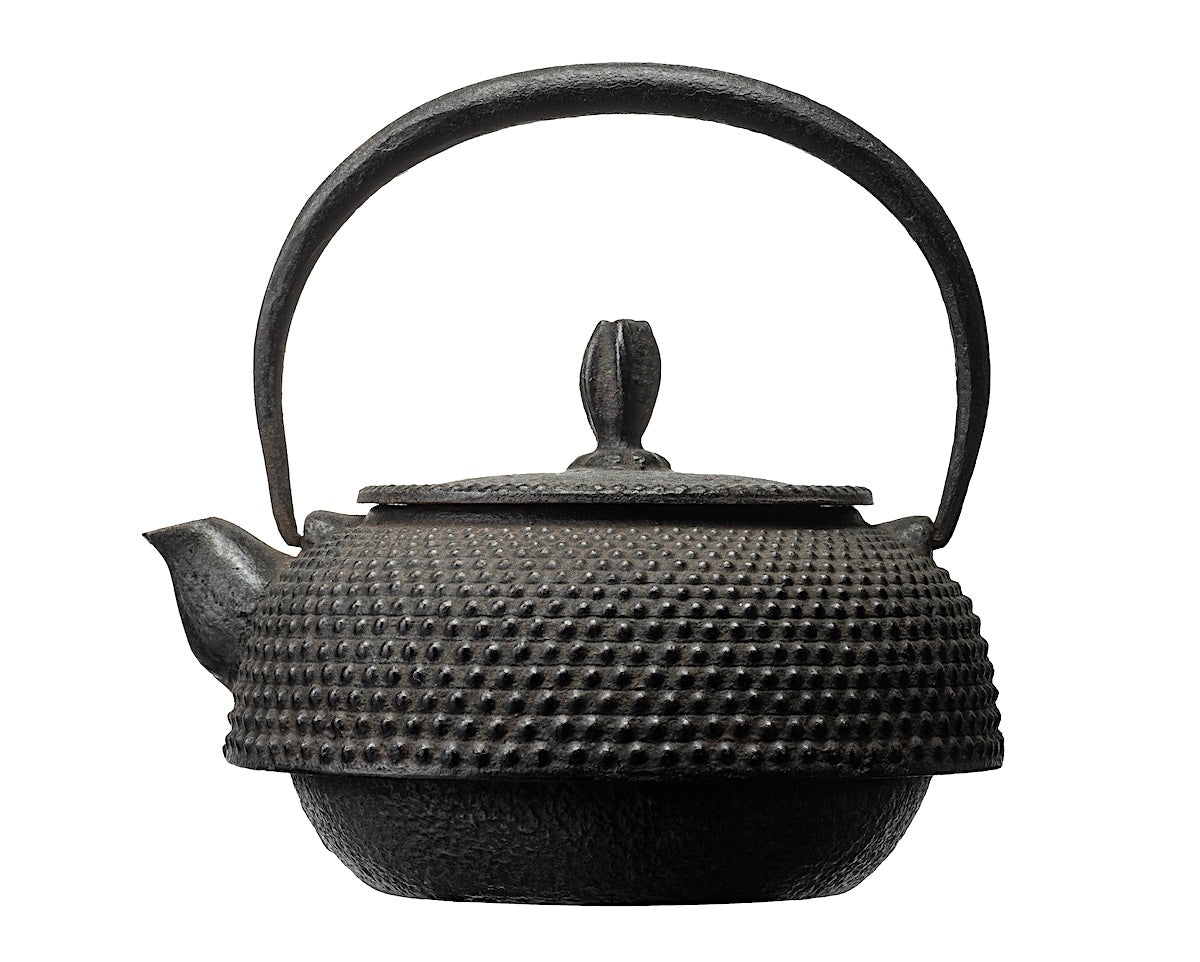
At first glance, the tetsubin seems uncomplicated: a kettle heavy enough to survive a kitchen mishap and attractive enough to spend the rest of its life on display. Yet behind the silhouette lies a story that stretches across a thousand years of ironworking, Japanese tea culture and a 19th century fire that devastated a city but galvanized an industry.
How Nambu Tekki Stumbled on Rust-Proofing

'Made in Japan' usually means one of two places when it comes to tetsubin kettles: Morioka or the Mizusawa area of Oshu, both in Iwate.
In 1659, the lord of the Morioka domain did what feudal lords with cultural ambitions tended to do: he imported talent. He invited Koizumi Nizaemon I, a kettle master from Kyoto, to come and make kettles for chado, or the Japanese Way of Tea. Because the region had abundant supplies of charcoal and iron sand, the industry took off.
About 80 km south, in the Mizusawa area of present-day Oshu city, ironworking had already been going on for centuries. In the late Heian period (around the mid-11th century to 1185), the Oshu Fujiwara clan based in Hiraizumi brought in foundry craftsmen from Omi province - modern-day Shiga - to make cast ironware for daily life.
Morioka got the tea ceremony; Mizusawa got the cookware. But both share the name of nambu tekki - southern ironware - for reasons to do with geography; Mizusawa sits in the southern half of Iwate and nambu simply means 'southern'. (The area has another claim to fame as Shohei Ohtani's hometown. A figurine of his hand made with nambu techniques can be seen at the Oshu City Traditional Industry Hall Nanbu Ironware Museum.)
Tetsubin kettles didn't come into being until around 1750, when the third-generation Koizumi Nizaemon introduced changes to the large, heavy tea ceremony kettle. Basically, he made it smaller and added a pouring spout as well as a handle that arched over the lid, producing something more suited to everyday use.
One explanation for the rise in the tetsubin's popularity: the sencha boom in the 18th century. To brew this loose leaf tea, people needed something that could go straight over a flame without cracking - something ceramic teapots couldn't do.
But the real breakthrough came by accident. In the autumn of 1884, an inmate at Morioka Prison started a fire that spread on strong winds to become an inferno. More than 1,400 buildings in the city were destroyed.
When the burned workshops cooled enough for them to enter, craftsmen recovered iron kettles from the ruins - and discovered something remarkable. The kettles produced less rust than usual and the water boiled in them tasted noticeably better.
Inspired by this, the official foundry craftsmen to the domain did further research. Their efforts led to the development of a technique known as kanakedome (metallic-taste prevention), in which the interior of an iron kettle is heated to about 900°C. This process creates a protective layer of black iron oxide, or magnetite, on the inner surface.
This discovery addressed two of the greatest drawbacks of iron kettles - their tendency to rust and the metallic flavor sometimes imparted to the water - and the technique remains a defining feature of Nambu ironware today.
In 1959, the foundry associations in Morioka and Mizusawa merged, officially standardizing the name of their ironware as nambu tekki - nambu ironware. If you find a kettle engraved with the year 1959 in an antique shop or market, you may be holding something cast to commemorate that historic moment.
Drink Your Iron: What's Really in the Water
A tetsubin doesn't just hold water; it changes it.
When water is boiled in an uncoated cast iron kettle, small amounts of natural iron dissolve into it - specifically the form your body absorbs most readily. Nobody is claiming that a tetsubin will cure anemia. What it can do is add a small, steady contribution to your daily iron intake, just by being used to boil water.
There's a second, more immediately noticeable effect: the water itself changes. The chlorine taste of tap water reacts with the iron during boiling and is reduced, producing water with a noticeably softer mouthfeel.
Tea made with tetsubin-boiled water is often described as smoother, with the rough edges sanded off. Coffee drinkers report the same softening effect. Whether this is the iron, the chlorine removal or simply the side effect of using a kettle that costs more than your coffee maker, the result is the same: people who switch to a tetsubin for their daily cup rarely switch back.
Old Foundries, New Forms

The tetsubin world is not, contrary to what the word 'traditional' may suggest, frozen in the 1750s. Tetsubin are traditionally made using molds - the same mold producing dozens or even hundreds of nearly identical pieces, each with the irregular texture that distinguishes a handmade tetsubin from a machine-stamped one. None of that, though, means the form has stood still.
Cast iron tetsubin historically came in only one color: black, often decorated with motifs inspired by the natural world - chrysanthemums, ume blossoms and pine trees. It's the kind of detail that turns a kettle into something closer to a small sculpture.
Iwachu, a Nambu ironware maker with roots going back more than a century, has introduced a contemporary color palette - kettles in shades that would have been impossible in 1750.
Other workshops have gone further still. Chushin Kobo, working in the Yamagata cast iron tradition, produces kettles with wooden handles and lid knobs, a small detail that goes a long way to softening the industrial feel of iron. Their flat-bottomed kettles have attracted design recognition for making a centuries-old object feel native to a kitchen built in this century.
The Art of Drying: A Daily Ritual
If there's one rule that determines whether a tetsubin lasts thirty years or three, it's this: never let water sit inside it.
The interior of a tetsubin is bare iron - no glaze, nothing glazed with enamel, nothing standing between the metal and the water. That's what allows the iron to dissolve in the first place. It's also what makes standing water the kettle's natural enemy.
After use, pour everything out and, while the kettle is still warm, remove the lid so the remaining heat can evaporate the moisture inside.
If necessary, dry the kettle over very low heat for about 20-30 seconds to remove any residual moisture. Avoid prolonged empty heating over high heat, as this can damage the kettle.
Something else to avoid: touching the interior surface directly or cleaning it with detergent. That whitish coating that develops inside over the first few weeks of use looks like it needs cleaning. It is, in fact, doing you a favor so don't scrub it off.
Never pour cold water onto a hot tetsubin; the sudden temperature change may cause cracking or structural damage. Always allow the kettle to cool naturally.
Store the kettle somewhere with decent airflow; humidity is the other enemy.
If rust does appear, put a small amount of green tea in a tea bag, drop it in the kettle with water filled to about 80 per cent and simmer for 20 to 30 minutes, making sure that the kettle does not boil dry.
Then turn off the heat and leave it overnight. The tannins in the tea will react with the iron, leaving a coating that will help to prevent rust.
Discard the water, rinse several times then boil water in the tetsubin again. If the water boils clear, the treatment is complete.
Minor rust is generally not harmful as long as the water remains clear and the iron released into the water can contribute to dietary iron intake.
Kettle, Teapot or Something Else Entirely?
Japanese tea ware has accumulated a vast array of forms and, along with it, confusion about which should be used for what. Here's a quick guide to teapots and kettles.
A tetsubin is used for boiling water, full stop. The yakkan is the closest relative to the tetsubin in terms of pure function - both are used to heat water - except that a yakkan kettle is made from copper, brass or another non-iron metal, which means no iron content and no transformation of the taste of the water.

By contrast, a cast iron teapot, or kyusu, is for making tea: it has a tea strainer built in and its interior is finished with an enamel coating, a glaze that gives it a glass-like sheen and means it cannot be used to heat water over direct flame the way a tetsubin can. Put a glazed cast iron teapot on a stove and the enamel coating will crack. No iron will leach into your tea, either - that's the trade-off for being dishwasher-friendly and rust-resistant.
Then there's the dobin - a ceramic or porcelain teapot that comes in handy when you brew tea in volume. For this reason, the dobin is often used for teas such as genmaicha, hojicha and bancha.
The smaller cousin of the dobin is the kyusu, which comes with a side handle instead of one over the top. This is the teapot of choice for most high-quality green teas, which are typically served in smaller quantities.
The practical upshot is a kind of relay: heat water in a tetsubin, then pour it into the vessel - dobin, kyusu or Western teapot - that's doing the actual brewing.
Water Boiled - Like Magic
Most kettles boil water. A tetsubin boils water, improves it, survives for generations and somehow convinces perfectly rational adults to become emotionally invested in a piece of cast iron.
If that isn't craftsmanship, it is, at least, a very successful form of magic.