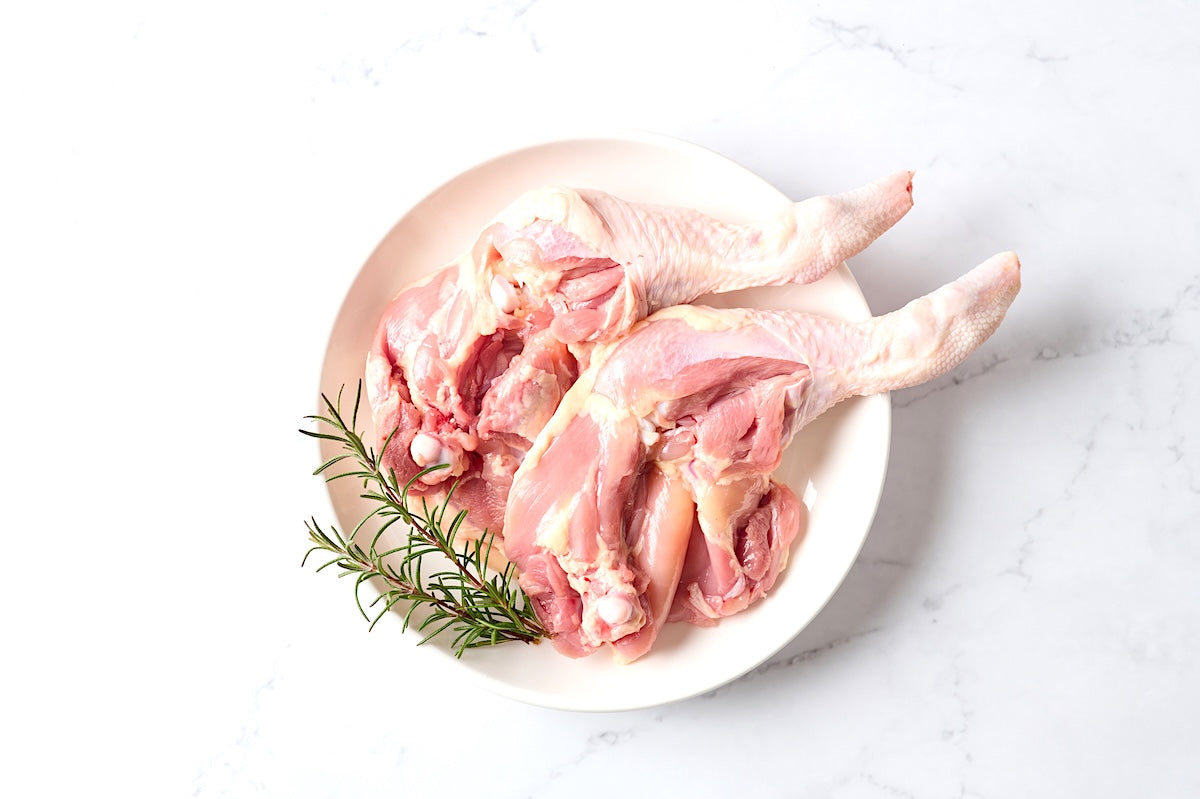
There are many ways to ruin a chicken.
You can attack it with a large chef's knife. You can poke vaguely at joints then try to saw your way out. You can buy one of those supermarket trays containing six anonymous thighs and decide that this is as close to butchery as you need to go.
Or you can do what Japanese chefs do: use a knife designed for the problem.
The honesuki is Japan's answer to the boning knife. Its primary use: breaking chicken down with minimum waste and maximum control. It does not aspire to slice tomatoes elegantly or chiffonade herbs for Instagram. It has one job: chicken. Possibly duck. Fish, if circumstances become complicated.
Once you use one properly, supermarket chicken trays begin to feel faintly tragic.
The Honesuki: Japan's Dedicated Poultry Knife
The name tells you what it does. Hone (骨) means bone; suki (スキ; from the verb 'suku') means to scrape or strip away. Put them together and you have a knife whose entire design is organized around the act of separating flesh from skeleton.
The blade runs 12 to 18 cm in length, with most around 15 cm. Narrow across the face, the knife has a spine thick enough that it will not flex or deflect when pressed along the curve of a bone.
Traditionally, the honesuki is single-bevel - ground and sharpened on only one side - which puts a Japanese boning knife in the same lineage as the deba and the yanagiba. The flat back of the blade can ride flush against the surface of the bone, reducing the gap between knife and skeleton. Professional models are almost exclusively single-bevel; double-bevel versions exist and are easier to use for beginners, but they sacrifice some of that bone-hugging precision.

The honesuki is sometimes compared to the deba, Japan's fish-butchery knife. The comparison is understandable - both are thick-spined boning blades - but the deba is a heavier instrument designed for the specific geometry of fish: scaling, decapitating, filleting in long strokes. The honesuki is lighter, shorter and built for the more intricate three-dimensional geography of a bird.
Why the Triangular Blade Works
The defining feature of the honesuki, the thing that separates it visually from almost every other knife in a Japanese kitchen, is its blade profile, which narrows dramatically toward the point. The result is roughly triangular - wider and heavier at the heel, tapering to an acute tip.
The sharp tip is what initiates most of the knife's important work. You locate poultry joints by feel: pressing the tip into the tissue around a hip or shoulder joint until it finds the small gap between cartilage and bone - and then you let the blade follow. An acute tip can enter that gap cleanly and precisely. A rounded or blunt tip cannot, at least not without the kind of force that damages the surrounding meat and dulls the edge.
The thicker spine gives the knife its structural rigidity. Because the blade is narrower in width than most knives but deeper front to back at the spine, the honesuki resists lateral flex even when you apply sideways pressure along a curved bone surface. This is tip strength working in combination with a stiff blade: the knife can make precise cuts in tight spaces without the blade wandering. A connective tissue strand running close to bone, a tendon wrapped around a joint - the honesuki addresses these situations with a stability that a chef's knife, applied to the same problem, does not.
The wide heel section provides a different kind of leverage - the blunt force needed when cutting through cartilage or pressing cleanly through a joint. You do not chop with a honesuki. But the heel allows you to apply concentrated downward pressure at the base of the blade, which is useful when the tip has located the joint and the rest of the knife needs to follow through.
The single-bevel or asymmetrical grind of the traditional honesuki adds one further advantage: the flat back face can be laid against the bone itself, allowing the cook to scrape along the skeleton with the blade almost parallel to the surface, removing flesh with very little left behind. This is Japanese butchery at its most waste-free.
Kaku vs Maru: Two Schools of Thought
The honesuki comes in two main configurations. The kaku-gata is the eastern version, more commonly associated with Kanto and Tokyo. It has a pronounced angular heel called an ago, a notch at the base of the blade where it meets the handle. This ago acts as a finger guard and provides a natural pivot point for detail work: trimming tendons, navigating tight spaces around joints, cutting with precision in areas where a larger blade would be clumsy.
The overall silhouette is sharper and distinctly geometric. Many professional yakitori chefs prefer the kaku-gata for exactly this reason - when you are breaking down chicken after chicken, precision around joints matters more than versatility.
The maru-gata - maru meaning 'round' - is the western counterpart, more common in Kansai. It lacks the ago entirely; the transition from blade to handle is smooth, with no angular interruption. The tip profile is less acute.
The result is a knife that moves more fluidly in longer strokes and handles fish butchery and filleting fish more comfortably than the kaku version does. It is the more versatile of the two, which in knife terms usually means it is also the less specialized.
Both the kaku and the maru are heavier-spined than a Western boning knife and more durable in construction. Neither is suitable for chopping through large bones - that's the deba's territory or a cleaver's. Within their intended domain of poultry and light meat work, however, both are more precisely engineered for the job than anything the Western knife tradition has produced for this specific task.
From Whole Bird to Yakitori Prep
High-end yakitori restaurants in Japan buy whole birds - eviscerated but otherwise intact - and break them down on-site. The reason is freshness: once a chicken is divided into retail portions, the surface area exposed to air multiplies and the meat deteriorates faster.
Breaking chicken down for yakitori follows the outside-in principle: wings first, then thighs, then breast, then the smaller cuts.
To remove the wings, pull each wing away from the body to expose the joint. Begin by cutting through the skin around the joint, then bend the wing outward until the joint loosens with a slight pop. At that point, guide the knife directly into the gap in the joint rather than forcing it through bone.
Once removed, the wing can be separated into the drumette, middle wing and wing tip. In yakitori preparation, the middle wing section is especially prized for its balance of skin, fat and meat.
Next, remove the thighs with the chicken positioned breast-side up. Cut through the skin between the thigh and the body, then pull the leg outward to expose the hip joint. Bend the leg backward until the joint loosens before slicing cleanly through it.

When breaking chicken down for yakitori, aim for the cartilage and joint connection instead of cutting through bone. This preserves clean meat surfaces while also protecting the knife edge. The thigh is among the richest and juiciest cuts used in yakitori.
To remove the breast and tenderloin, turn the chicken over and work carefully along the backbone and breastbone. Run the knife close to the rib cage, using shallow slicing motions to peel the meat away from the bone. The tenderloin, or sasami, can then be removed from beneath the breast. Delicate and lean, it is often lightly grilled in yakitori restaurants to preserve its soft texture.
The secondary cuts are where the honesuki earns its reputation among specialists. The sori, or soriresu - what French cooks call the oyster - sits in a small depression in the pelvic bone and cannot be reached without a blade narrow enough and pointed enough to follow the cavity's contour.
Neck skin, thick and richly flavored, must be separated from the carcass without tearing. The yagen nankotsu, the keel cartilage, comes away cleanly when the blade is angled correctly. All this needs careful, methodical work and the honesuki is the tool for it.
Keeping the Edge That Does the Work
A honesuki works only as well as its edge. Maintaining that edge isn't complicated but it does require consistency.
The choice of steel determines the care needed. Carbon steel produces a sharper edge and is easier to resharpen on a whetstone but it rusts readily if left even briefly wet. At home, where the knife might sit damp for 20 minutes while dinner finishes cooking, stainless is the more durable choice. It will not reach the same razor sharpness as carbon, but it will stay functional without demanding constant vigilance - and a sharp stainless honesuki is still a considerably sharper instrument than most knives in a domestic kitchen.
For sharpening, a medium whetstone - around #1000 to #1200 grit - used once or twice a month is the standard recommendation for regular use. A finishing stone at #3000 to #6000 refines the edge after the medium stone does the work.
For a single-bevel honesuki, sharpen primarily on the front bevel face, holding the blade at roughly 10-15 degrees - a 7 to 10 mm gap between spine and stone - until a burr forms on the back. Then lay the back face flat against the stone and make a few light passes to remove it.
The goal is to preserve the clam-shaped cross-section of the edge, the hamaguriba, which concentrates the knife's cutting geometry at the very tip of the bevel rather than flattening it out.
Carbon steel users have one extra step: pour a little hot water over the blade before drying. The heat helps evaporate the last of the moisture from the steel surface.
One Knife, One Bird
Modern kitchen marketing likes to promise universality: one blade that dices onions, carves roasts, fillets fish and even slices bread. The honesuki refuses this ambition entirely. It exists for one creature with wings and joints and awkward little pockets of cartilage. That narrowness of purpose is precisely what makes it exceptional.
Perhaps that is why the honesuki feels so satisfying to use. It transforms butchery from brute force into conversation. The blade finds the joint. The cook follows the structure already hidden inside the bird. Very little is wasted. Very little is forced.
Which is a surprisingly elegant outcome for an object whose entire career revolves around disassembling chickens.