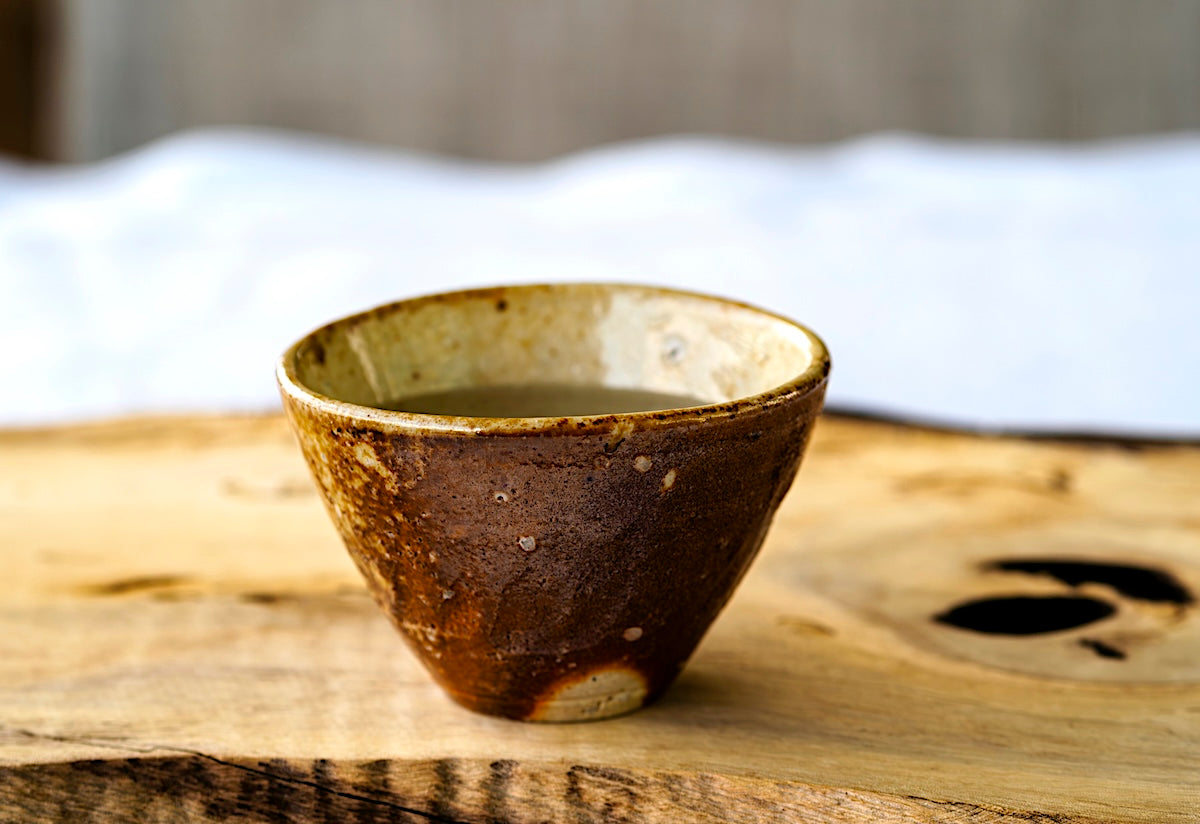
A guinomi is technically just a vessel for alcohol, in much the same way that a grand piano is technically a wooden box with strings. But the point goes beyond utility alone; it encompasses weight, texture, memory and the deeply satisfying feeling of holding something that appears to have survived at least three centuries and possibly a small fire.
Unlike the tiny ochoko cups designed for endless refilling, the guinomi belongs to a slower way of enjoying sake. It's the cup of solitary evenings, jazz records and winter rain. The cup becomes your companion; sometimes, it's the only one you need.
This may explain why guinomi collecting can be so absorbing. One moment, you're learning the difference between Bizen and Hagi ware. The next, you're turning cups upside down to inspect the foot ring like an appraiser on an antiques roadshow. The transformation is almost certainly irreversible.
Wood, Glass, Ceramic or Porcelain?
A choko - or ochoko - the small cup that arrives at your table along with a tokkuri flask, is designed for one or two sips. Pour, drink, refill: the rhythm is social, almost percussive.
A guinomi is something else. Larger, deeper and typically filled straight from the bottle rather than a flask, it holds enough sake - usually between 60ml and 90ml - to be held and considered. The ochoko is the cup of the shared table. The guinomi is the cup of the quiet evening.
The ochoko appears at izakaya tables with their culture of constant pouring. In traditional Japanese drinking etiquette, you fill a companion's cup and that person will fill yours in turn. Small cups used in this way become a form of communication between two people.
A guinomi is built around a different kind of attention - less toward other people, more toward the sake itself and the cup holding it.
Japanese sake culture recognizes several vessels alongside the ochoko and guinomi: the flat sakazuki used mainly in ceremonies, the masu wooden box and, increasingly, the wine glass, particularly for aromatic sakes, which are shown off to advantage by a wider opening.
But none of these vessels occupies quite the same contemplative register as the guinomi. It is, in the end, the most personal of the sake utensils - and the one that drinkers tend to collect.
Small Vessels for Food - then Sake
The name is onomatopoeic, or close to it. Gui (ぐい) is the sound and sensation of a satisfying, unhurried swallow. The guinomi (ぐい呑み) - literally, gui drinking - is the vessel for that motion.
The origins of the cup lie in kaiseki cuisine during the Azuchi-Momoyama period - the late 16th century, when the tea ceremony was reshaping Japanese aesthetics. The kaiseki meals served during tea gatherings included a small dish called the mukozuke (向付): the dish placed beyond - muko - the rice and soup. Once the food was finished, the empty vessel would be used for drinking.
The reverse also holds true. In yet another demonstration of the fluidity of Japanese tableware, sake cups and katakuchi pourers are now repurposed as small bowls for side dishes and pickles.
Earth and Fire: The Craft in Your Cup
The range of ceramic traditions available for guinomi collecting is, on reflection, a slight embarrassment of riches.

Bizen-yaki, produced in Okayama prefecture, is one of the most storied of the lineages. Ranking among Japan's Six Ancient Kilns, the tradition stretches back more than a thousand years. Because it is fired slowly - 10 to 14 days - at high temperatures of above 1,200°C without glaze, the clay is left exposed to the unpredictable work of minerals, ash and flame, creating unique patterns celebrated as yohen (‘kiln transformations') or keshiki (‘scenery’).
The surface irregularities of Bizen ware are also said to generate tiny bubbles and soften the mouthfeel of sake - the same effect, incidentally, that enthusiasts claim for Bizen-fired beer mugs. Whether the science supports this or whether it's simply a story told by people who like Bizen, the pleasure of drinking from a rustic, handmade cup is real.
At the other end of the ceramic spectrum is porcelain: smooth, white and non-porous. Japanese porcelain developed from the early 17th century after Korean artisans brought advanced kiln technology and kaolin clay deposits were discovered in Arita.
The white porcelain that emerged from this tradition carries none of Bizen's roughness. It is thin, elegant and cool against the lips. The sake sits in it the way water sits in glass and the cup brings clarity to the drinking experience rather than warmth.
Between these poles sit Hagi-yaki, with its soft porous clay and tendency to change color as sake is absorbed into the vessel over years - the phenomenon known as Hagi's Seven Changes, or shichihenge.
The careful firing process, the regional clay, the glaze or deliberate absence of one are why guinomi cost what they do and why collectors keep acquiring more of them.
Seeking the Perfect Sake Cup
When evaluating a guinomi or simply appreciating it, your focus should go to four elements.
The first is the overall form: the shape of the body and, crucially, that of the rim, perhaps the most important element when it comes to actually drinking sake. A vessel with a thin, sharp lip delivers the liquid differently from one with a thick, weighty edge, dramatically altering the mouthfeel and the way the sake spreads across the palate.
Pay attention to the interior as well. Part of the pleasure lies in watching the color of the sake shift once poured into the vessel, while some cups reward closer inspection with painted designs or hidden details revealed only at the bottom.
The second element is the glaze or the lack of one. Look at how metallic elements such as iron or copper within the glaze have reacted during firing and other ways the kiln has transformed the surface of the clay.
Where the delicate, crack-like patterns known as kannyu appear, they are viewed, not as flaws, but as one of the beauties of Japanese ceramics.
The third element is tezawari - the feel in the hand. Weight, warmth, the way the thumb finds a natural resting place on the body of the cup: these cannot be judged from a photograph, which is why serious collectors prefer to handle pieces before buying.
Finally, the kodai: the foot ring at the base of the vessel. Turn the guinomi over and examine how the clay was trimmed. The cuts made in this area often reveal the potter’s confidence and craftsmanship most clearly.
If the artist’s signature or kiln mark is carved into the base, it too becomes part of the vessel’s story and an important aspect of its appreciation.
Matching Cup to Aroma and Flavor
A sake cup is part of the drink itself, shaping aroma, texture, temperature and even the pace at which the sake is enjoyed.
This becomes especially clear in the contrast between ochoko and guinomi. The small ochoko suits soshu - light, crisp and dry sake styles meant to be enjoyed cold and finished quickly. Its modest size keeps the sake chilled while encouraging short pours and steady replenishment.
Guinomi, by contrast, invite lingering. Larger and broader, they are better matched to richer junshu or mature jukushu styles with aromas that unfold as the sake warms in the hand. The vessel itself becomes part of the performance, releasing deeper layers of fragrance and umami as it sits on the table.

Shape and material play an equally important role. Neutral and cool, glass delivers chilled sake - ginjo, daiginjo, the aromatic styles best served between 5°C and 15°C - exactly as it is. Glass lights beautifully with cold, clear sake; the liquid itself becomes part of the display.
Versatile and refined, porcelain suits many kinds of sake. Its smooth texture on the lips presents sake with clarity, allowing its nuances to emerge naturally. The non-porous surface means it doesn't absorb anything, so the aroma profile of a sake stays intact. Narrower-rimmed porcelain cups - the bud shape - concentrate those fragrances inside the cup.
Earthenware, particularly Bizen and Hagi, suits the full-bodied junmai styles and other types of sake that benefit from warming. A thick-walled ceramic guinomi retains that warmth far better than glass or thin porcelain can. The temperature shifts are gradual and the flavors open in stages.
Said to mellow the flavor of sake, tin also conducts heat so fast that it becomes cold within moments of being chilled. Aged sake, jukushu, responds particularly well to tin and porcelain alike.
Wood and lacquerware offer excellent insulation and suit the same full-bodied styles as earthenware - with the additional pleasure of holding something that feels more like a bowl than a cup.
How to Start - and Never Stop - a Guinomi Collection
Few hobbies begin so innocently and escalate so unobtrusively. A single guinomi becomes two, then five, then an entire shelf arranged according to kiln, glaze or increasingly abstract emotional categories known only to the owner.
Some advice from experienced collectors: start with what you're drawn to, not with what you're told to buy. Taste and knowledge develop together.
Once you have a few pieces, pairing them with sake naturally becomes a secondary pleasure. You might find yourself choosing a Bizen guinomi for one evening's junmai and a glass one for the next night's ginjo, the way you would choose different music for different moods.
A collection stands out when it develops a sense of coherence over time. Some collectors focus on particular regional traditions such as Bizen or Arita ware, while others are drawn to specific materials such as glass, metal or porcelain, allowing their choices to gradually form a distinct aesthetic language.
Another tip: look beyond guinomi alone. Tokkuri and katakuchi pouring vessels open up further dimensions of sake culture and create opportunities to think about how vessels interact with one another.
Don't be afraid to experiment with combinations: pair a favorite guinomi with different sake flasks, trays and even table linens. Not every choice will work but each combination will create a drinking atmosphere that feels uniquely your own.
The Riches Guinomi Can Hold
The Japanese word sometimes used for the long relationship between drinkers and their guinomi is sodateru - to raise, or to cultivate, as you would a plant.
The idea is that the cup grows in its time with you: absorbing sake into its clay, developing a patina from the oils of the hand, perhaps even changing color. You are, over time, making it yours.
Start with one. See what happens.