Spanning 265 years, the Edo period produced two entirely different art worlds - simultaneously and in the same cities.
When Tokugawa Ieyasu became shogun in 1603 and consolidated power after the chaos of a long civil war, he set in motion something that would reshape Japanese culture. Political stability meant long-term patronage. Long-term patronage meant specialization. Specialization, over 250 years of relative peace, meant an extraordinary expansion of what Japanese art could be - and whom it was for.
The result was a visual culture that ran on two tracks at once. On one side: monumental gold-leaf screens in castle audience chambers, painted by hereditary ateliers on official commissions. On the other: multicolor woodblock prints of kabuki actors, sold for the price of a bowl of soba.
And the line between them, as the period wore on, became less a wall than a conversation.
The Elite and the Economic Influencers
The social hierarchy of Tokugawa Japan was codified into four ranks - warriors, farmers, artisans and merchants - but the actual flow of money told a more complicated story. At the top, the shogun, the daimyo lords and the imperial court aristocracy in Kyoto commissioned art that projected political or cultural authority.
Lower down, and increasingly flush, the merchant class spent their money on art and craft that reflected their own world - the pleasure quarters, the kabuki theater, the fashion trends of Osaka and Edo.
The first stream of patronage produced the official painting schools, the monumental architectural works and the ceremonial crafts. The second produced ukiyo-e, popular fiction and a commercial culture of images so vigorous that it eventually made it all the way to France.
The two cultural flowerings of the Edo period map roughly onto geography and chronology: Genroku culture, centered on Kyoto and Osaka in the late 17th and early 18th centuries, was lavish, decorative and driven by wealthy merchants with aristocratic tastes. Kasei culture, rooted in Edo from the 1800s to 1830s, was more populist and more commercial; it marked the moment when Japanese urban culture reached confident maturity.
The sankin-kotai system - the Tokugawa requirement that daimyo alternate residence between their home domains and Edo - kept luxury goods and artistic ideas moving across the country.
But by the later Edo period - from the 1780s to around 1850 - the boundaries had begun to dissolve. Financially struggling samurai leaned on wealthy merchants. Prosperous townspeople collected the refined paintings associated with the warrior class. Merchants became the private patrons who funded artists, craftsmen and writers outside any official structure. The art was still sorted by who footed the bill. But, increasingly, more people could afford it.
The Official Painters and Their Golden Brief

Formal art in the Edo period (1603-1868) belonged to the Kano school - Japan's largest painting lineage. It was also the longest-running, staying active for some 400 years until the end of the Tokugawa shogunate, which also brought the Edo period to a close.
The Kano school had built its reputation on Chinese-style ink painting but what made it the shogunate's indispensable visual arm was a style forged in the turbulent Azuchi-Momoyama period (1568-1600) just before the Edo era began.
Kano Eitoku, working for powerful warlords Oda Nobunaga and Toyotomi Hideyoshi, developed monumental gold-leaf painting rendered in brilliant mineral pigments. This meant vast gold surfaces. Immense pines, tigers and guardian lions. Compositions designed not to decorate a room but to tell all those who entered exactly where in the hierarchy they stood.
The atelier's greatest organizational advantage was its size. When Nobunaga needed Azuchi Castle decorated on a warlord's schedule - which is to say, urgently and at enormous scale - the Kano workshop could mobilize painters capable of covering entire architectural complexes in coordinated compositions. No individual painter, however talented, could have done that alone.
Their works were political theater as much as visual arts. Someone moving through a castle decorated by the Kano school would encounter tigers, pines and Chinese sages all radiating the same message - power, permanence and legitimacy.
The Tokugawa shogunate inherited this language and institutionalized it. Their official painters were given stipends, residences and samurai-equivalent status. The four main Kano family branches held hereditary appointments awarded by the shogunate, working on commissions that ranged from castle screens to wedding trousseau folding screens and paintings gifted to Korean kings. They also gave art lessons to the shogun's children.
The system that sustained all this was the funpon - the master sketchbooks and template copies that every Kano painter studied and worked from. This guaranteed quality and consistency across the studio's enormous output.
It also, critics argued, stifled creative development. The school that had begun by absorbing Chinese and Japanese traditions with flexibility became, in later generations, primarily an institution for maintaining what it had already achieved. When the shogunate fell in 1868, the Kano school's dominance ended with it.
Rinpa: Artists Connected by Admiration
While the Kano school had its stipends and its government brief, a very different artistic lineage was developing - one with no institutional structure, no hereditary succession and no patron other than personal reverence.
Each generation of Rinpa artists learned not from a living teacher but from the works of a master who was already dead: absorbing them, copying them and then departing from them to create something new. No other major school in Japanese art history works this way.
The lineage runs across three centuries and four key figures. Hon'ami Koetsu (1558-1637) came first - the calligrapher, lacquerer and tea ceremony devotee whose cross-medium sensibility made the whole thing possible.
Working closely with painter Tawaraya Sotatsu for roughly 15 years - Koetsu doing calligraphy on paper that Sotatsu decorated with gold and paint, the two men developed a visual language at Koetsu's artist colony northwest of Kyoto.
Sotatsu, for his part, established the vocabulary: gold and silver leaf backgrounds and bold motifs - irises, peonies, wind gods - rendered in flat, rhythmic compositions. A key technique was tarashikomi, in which ink or wet pigment was dropped onto still-wet paint, creating richer textures, soft shadows and organic patterns.
About 100 years later, Ogata Korin (1658-1716) studied Koetsu and Sotatsu's work intensely and built on it; 100 years after that, Sakai Hoitsu did the same with Korin's.
Korin arrived at that lineage partly through family: Koetsu was his great-granduncle. Born into a wealthy family of textile merchants, Korin inherited money, spent it freely and began serious painting only in his late 30s at the urging of his younger brother Kenzan, a well-regarded painter who brought Rinpa aesthetics into ceramics.
The delay didn't seem to matter. By the time he died in 1716, Korin had produced three works now designated National Treasures.
His Kakitsubata-zu - that iconic pair of iris screens - reduces an episode in the Ise Monogatari (Tales of Ise) to a single decision: eliminate everything except the irises. No protagonist, no landscape, no narrative. Just the flowers, arranged across a gold field.
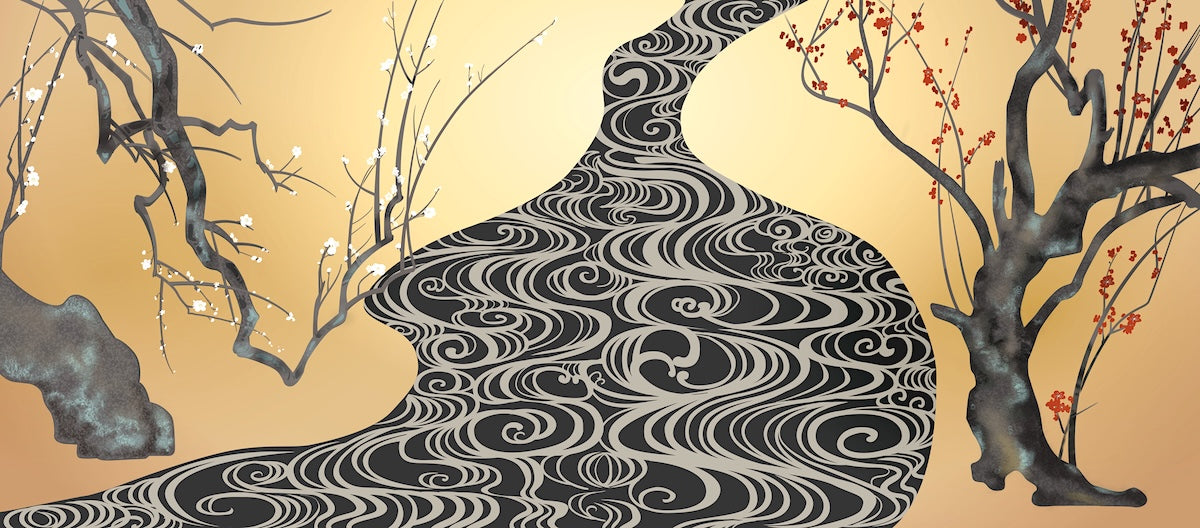
His Kohaku Baizu - Red and White Plum Blossoms - was his final masterpiece and one of the most well-known works in Japanese art. Two plum trees flank a central stream that runs through the composition in black and silver. Placing something so prominent in the center of a paired screen composition was, by convention, not done. Korin did it anyway.
About a century later, the fourth great Rinpa figure arrived. Sakai Hoitsu (1761-1829) was born in Edo, the second son of the lord of Himeji Castle.
He studied under different art lineages including the Kano school as well as the populist form of ukiyo-e but, in 1797, he became a Buddhist priest and retreated into seclusion. It was in this seclusion that he studied Korin and Kenzan with an intensity that amounted to devotion.
In 1815, to mark the centenary of Korin's death, Hoitsu organized a memorial exhibition of Korin's works and published Korin Hyakuzu - 100 illustrated plates of Korin's designs - a document that later traveled to Europe and fed directly into the Japonisme movement.
Hoitsu also painted his masterpiece on the back of Korin's copy of Sotatsu's Wind and Thunder Gods screen. The Natsu Aki Kusa-zu byobu shows summer and autumn grasses against a silver ground, responding across the screen's surfaces to the gods on the other side. The work brings three Rinpa artists - Sotatsu, Korin and Hoitsu - into one object unified by admiration and reinvention.
Ukiyo-e: Woodblock Prints of the Floating World

The word ukiyo originally carried Buddhist weight - the sorrowful, transient world, full of suffering and impermanence. Somewhere in the Edo period, the connotation was flipped entirely. By the 17th century, the floating world meant the pleasure quarters, the kabuki theater, the fashionable streets: the world you should enjoy precisely because it wouldn't last.
Ukiyo-e (浮世絵) - pictures of the floating world - began as hand-painted works by artists such as Hishikawa Moronobu in the late 17th century, but its explosive reach came from woodblock printing. The technology evolved across the Edo period in distinct stages, each one expanding what was visually possible: single-color ink prints first, then two and three colors then, in 1765, the full multicolor nishiki-e: brocade pictures.
The whole thing worked because it was a division-of-labor industry: the publisher - hanmoto - planned and financed the work, the artist designed it, a carver cut the blocks and a printer produced the sheets. Multiple craftsmen, one image - and, eventually, an image priced close to a bowl of soba.
The subjects were the subjects of the floating world itself: beautiful women, kabuki actors, the pleasure quarters, scenes of urban life and then - as the 19th century approached - landscape.
Katsushika Hokusai's Thirty-Six Views of Mount Fuji, including The Great Wave off Kanagawa, triggered a landscape print boom and demonstrated what the medium could do with perspective and shading techniques that showed the influence of exposure to Western art via Dutch trading through Nagasaki. Another (wood)blockbuster was Utagawa Hiroshige's Fifty-Three Stations of the Tokaido, a series of prints that made people want to travel the highway.
Ukiyo-e functioned more like media than like art. It carried information about what actors were appearing in which productions, what the famous beauties of the day looked like and what fashions were current in the city. When there was no newspaper, the woodblock print filled the gap.
Publishers like Tsutaya Juzaburo operated with the instincts of modern media producers - finding talent, reading the market and managing distribution. He supported artists such as Kitagawa Utamaro and Toshusai Sharaku; the latter produced his entire known body of work in roughly 10 months and then vanished from the historical record entirely, identity unknown. Even now, no one is quite sure who he was.
The irony of ukiyo-e's legacy is that what Japan treated as disposable became, outside Japan, a revelation. By the 19th century, Japanese prints were reaching Paris and their flat compositions, bold outlines and unusual perspectives were sending European artists into a spin. Van Gogh copied them. Monet collected them. Cézanne studied them. Works that sold for soba money in Edo were, a generation later, significantly influencing the direction of Western modern art.
Craft as High Art
Across both patron worlds - warrior and merchant - Edo-period craftwork operated at a level of refinement that collapsed the usual distinction between art and object.

Lacquerware was both a luxury and an industry, with regional traditions establishing themselves across the country: Wajima-nuri in Ishikawa, Aizu-nuri in Fukushima and Tsugaru-nuri in Aomori, among many others.
More delicate techniques flourished: raden, or mother-of-pearl inlay, and chinkin, gold-filled engraved carving. Korin's Yatsuhashi Maki-e Raden Suzuribako - an inkstone box combining lacquer, raden inlay, lead and silver - is simultaneously a National Treasure and something you can use to store brushes.
As warfare declined and swords became status objects rather than weapons, the decorative metalwork on sword fittings such as hand guards became increasingly intricate and collectible in their own right.
Textiles underwent their own transformation. Kyoto painter Miyazaki Yuzen (1654-1736) was known initially for his work on fans but is remembered for developing yuzen dyeing: a resist-dyeing technique that enabled freehand, multi-colored designs to be created on silk, turning the kimono into a wearable painting. Meanwhile, Nishijin weaving in Kyoto produced brocaded silks of extraordinary complexity.
For the townspeople, even everyday tableware and cotton garments carried the aesthetic ambitions of the era. By the late Edo period, craft had become democratic - not in price but in intention. The belief that daily objects deserved to be beautiful might well be the most radical idea the period produced.
Beauty in the Everyday
Perhaps this is the most enduring achievement of Edo art: it dissolved the border between the important and the ordinary. Beauty was not treated as an occasional luxury reserved for exceptional moments. It was expected to accompany daily life.
This may explain why Edo-period art still feels relevant. In an age where images appear by the thousands before breakfast and disappear by lunchtime, there is something reassuring about a culture that believed that objects should be made properly, looked at carefully and perhaps admired for slightly longer than the average social media post survives on a phone screen.