Introduction
The late Anthony Bourdain had strong opinions on every subject under the sun, and he wasn’t afraid to share them. You didn’t always have to agree with him, but he always had a solid case for his convictions — and he was often right, anyway. He was certainly right on the subject of knives.
In his best-selling memoir Kitchen Confidential, Bourdain sings the praises of Global knives, describing them as “lightweight, easy-to-sharpen and relatively inexpensive… a very good Japanese product which has – in addition to its many other fine qualities – the added attraction of looking really cool.” For him, a single Global chef’s knife was enough for most kitchen work.
If an endorsement from Anthony Bourdain isn’t enough, read on to find out why you should consider having a Global knife in your kitchen.

How Global knives came to be
The story of how Global knives made its name internationally begins with Tsuchida Mino, the man who would later come to be known as Mr. Global. From the mid-1950s to 1985, he spent several decades working in export sales for Seki Cutlery Mfg. Co. Ltd, gaining extensive industry experience and international contacts.
Concurrently in 1954, Yoshida Metal Industry Co. Ltd — Yoshikin — was established in Niigata as a tableware manufacturer, with hollow-handled table knives among their offerings for export. In 1960, Yoshikin introduced the Bunmei series of knives, which combined traditional Japanese knife styles with a new molybdenum-vanadium alloy steel — as sharp as carbon steel, but crucially, resistant to rust. (This alloy is now colloquially known as Japanese steel.)
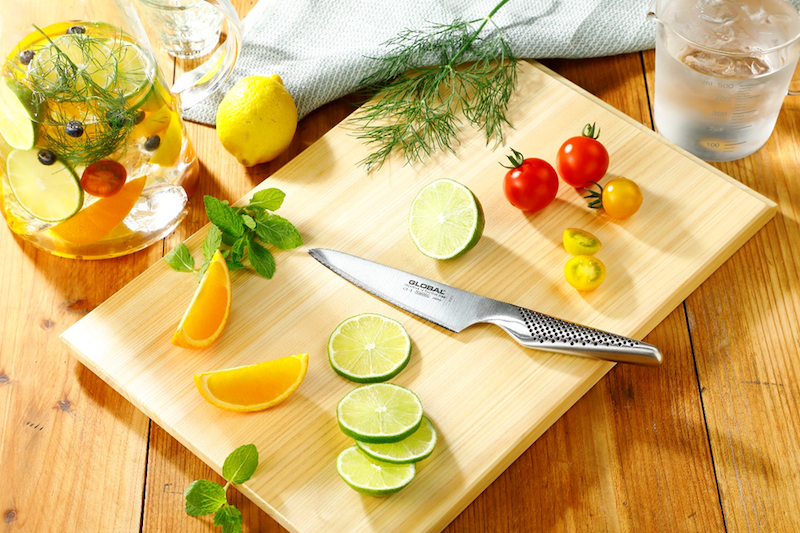
In 1983, industrial designer Yamada Komin entered the picture. Yoshikin hired him to create ‘the world’s best knife,’ one that was comfortable and easy to handle, but would appeal to professional and amateur cooks alike. This resulted in the design that would become Global’s trademark: an all-stainless kitchen knife seemingly forged from a single piece of steel, with no boundary between blade and handle.
Yamada later observed that the knife’s silhouette resembles a fish, reflecting his belief that the most rational, ergonomic forms already exist in nature — his philosophy is to seek shapes that feel intuitive and ‘right’ in the hand when in use.

Tsuchida Mino encountered Global knives and saw tremendous potential in them. Global knives were virtually unknown at the time even in Japan; Yoshikin was only producing 500 knives a month.
In 1985, he established Master Cutlery Corporation and collaborated with Yoshikin to bring Global knives to the world. He brought these knives to the Ambiente Trade Show in Frankfurt, displaying them in a tiny 3.3 m² booth alongside wares from six other companies. Their very first lineup had only 12 knives — modest compared to the hundreds of products they now offer worldwide.
Tsuchida’s promotional efforts were simple and practical — he would perform sharpening demonstrations, not only at trade shows but also at individual retail stores in many different countries. This continued every single year at trade shows and retail stores across the world.
Initial interest in distribution came from Sweden and Denmark. After a few years, Global knives expanded to Germany, the Netherlands, and the UK, and eventually, to North America and Australia. The 1990s and 2000s saw Global truly become a global brand, with production capacity booked months in advance. Today, Global knives are sold in 88 countries around the world — a beloved kitchen staple for millions around the world.

What’s so special about Global knives?
From a user’s perspective, Global knives are simply a joy to use. Full disclosure: I’ve owned a set of Global knives for a few years now and am not sponsored by them, more’s the pity.
They’re lightweight, beautifully balanced, and effortless to handle, perfect for someone like me with weak wrists and small hands. Part of their lightness is due to their hollow handle that’s filled with sand. Global knives are also relatively inexpensive for the quality and the return on investment, and are wonderfully durable. Their blades are gorgeously sharp and they’re easy to maintain. My knives have survived a bit of neglect, such as having left them in a wet sink overnight, which is impossible with knives that have wooden handles — they’re pretty forgiving for the average cook. Regardless of this carelessness, they remain easy to clean and wonderfully rust-resistant. Their handles have cute little dimples which aren’t just there for show — the texture helps you grip the knife more easily.
Out of all the knives I have (which isn’t very many to begin with) the Global chef’s knife gets the most use in my kitchen for almost every task that requires a blade — slicing, dicing, chopping, ripping open plastic packages (sorry), so on, so forth. It is designed to be versatile and capable of almost any kitchen task, so it works great with vegetables as well as most cuts of meat, fish, or other soft proteins. The only thing I’ve never used my Global chef’s knife to do is chop pork bones (you want a cleaver for that) or slice bread (use the serrated bread knife, for God’s sake).
Also, they do look really cool.
How Global knives are made
Global knives are crafted at Yoshikin’s factory in Tsubame, Niigata, from a proprietary stainless steel called CROMOVA 18 — an alloy of carbon, chromium, molybdenum, and vanadium developed specifically for the kitchen. It’s a lively, responsive steel that holds a razor‑thin edge for ages yet stays tough and forgiving, sharpening easily on ordinary water stones and standing up to everyday home and professional use.
A Global knife has a distinctive profile — the blade flows directly into the handle, making it seem like a single piece of steel. However, in reality, it consists of three main pieces of CROMOVA 18: the blade and two handle shells. These handle pieces are TIG‑welded to the blade tang and to each other, forming the familiar hollow stainless handle. This handle is then injected with just enough fine sand so that the knife balances at the intended point in a pinch grip.
After the pieces are welded and shaped, each Global knife is heat‑treated to reach their intended hardness, then carefully ground to a fairly sharp double‑sided edge. Finally, they’re finished and sharpened by hand, giving them their signature thin, razor-sharp edge.

Caring for your Global knives
Global knives are designed such that they require infrequent sharpening — particularly if you take care of them. I’d even argue that they stand up to a bit of neglect (although this is not to encourage carelessness).
After using them, wash by hand in warm water with a mild detergent, then rinse and dry thoroughly. Avoid dishwashers, soaking, or harsh chemicals like bleach that can stain or pit the steel and damage the handle.
Use wood or high-quality plastic cutting boards. Make sure you store the knife with its edge protected, such as by using a block, magnetic strip, or sheath. Never force it through bones, frozen foods, or other very hard ingredients or materials. If it sticks, ease it out with a slicing motion rather than twisting.
There’s no fixed schedule when it comes to sharpening. Instead, you should sharpen the knife whenever you feel it becoming, well, less than perfectly sharp. Light users might only need to do a proper whetstone sharpening every three to six months. Professionals may do do this far more frequently – as soon as a cut doesn’t feel crisp.
To sharpen a Global knife, hold roughly a 10–15° angle on a waterstone or ceramic stone and work both sides until the burr is gone, or use a MinoSharp‑style ceramic water sharpener (coarse, then fine) as an easier alternative. Whatever you do, avoid European-style steel sharpening tools.