Introduction
The santoku may be the favoured all-rounder knife among most Japanese households, and indeed, is a perfectly fine choice for most home cooks. However, the gyuto is an ideal all-rounder for slightly more ambitious home chefs — and anyone with larger hands or a preference for a slightly longer knife.
Not convinced? Here’s everything you need to know about the gyuto and then some.

Defining the gyuto knife
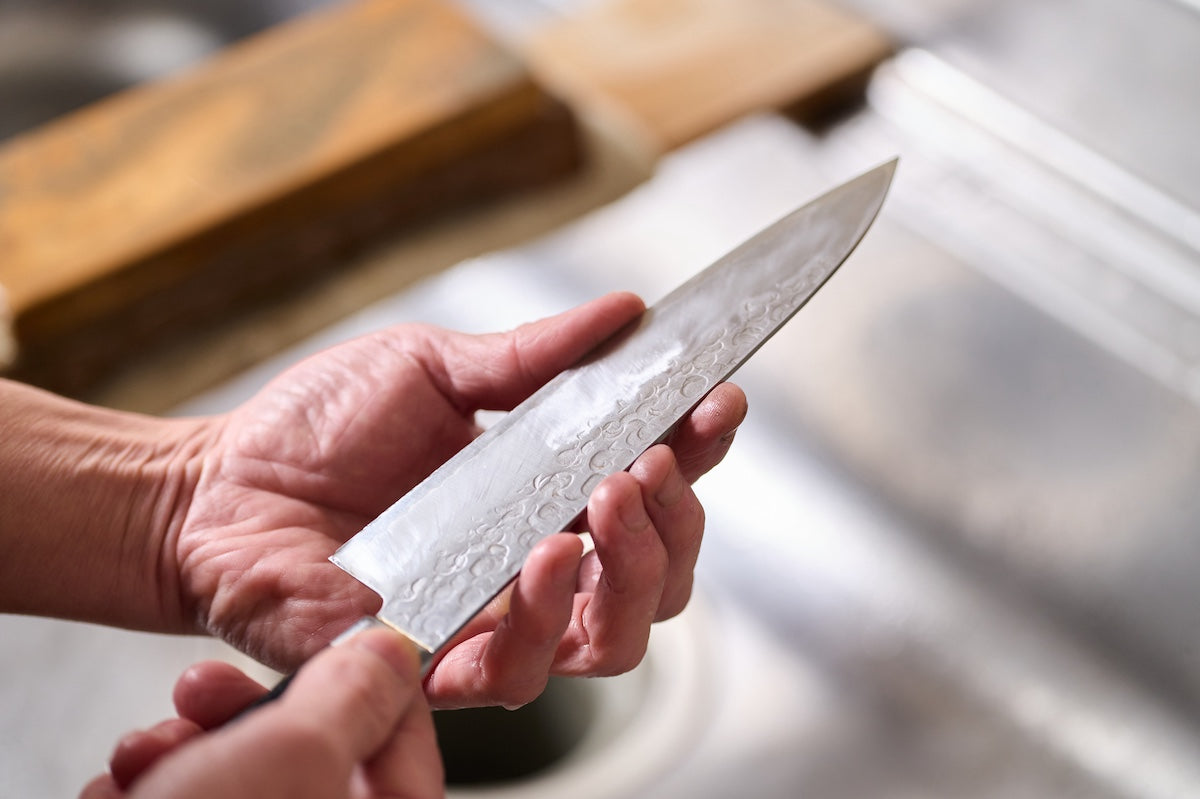
Literally translating to ‘cow blade,’ a gyuto is the Japanese answer to the Western chef’s knife. It’s a double-bevelled, all-purpose kitchen knife made from hard steel, and is suitable for working with most meats, fishes, vegetables, and fruits. It is typically thinner and lighter than a Western chef’s knife, and is often the main workhorse in many Japanese and Western-style kitchens.
Most gyuto blades fall between 180 mm and 270 mm, with 210–240 mm being the standard sweet spot for general use. The gyuto is an elegant creature: The edge profile is usually fairly flat near the heel for comfortable push‑cutting and chopping, then gently curves toward a pointed tip that works well for rocking cuts and precise tip work. The overall geometry is relatively thin along the spine and behind the edge, which favors clean slicing and fine control rather than heavy, bone‑smashing tasks.
There are noticeable regional and maker variations in profile. Some gyuto are more Western‑influenced, with a more pronounced belly and a feel closer to a German or French chef’s knife. These are often favoured by professional kitchens that rock‑cut a lot. Others have a flatter Japanese‑style edge, staying low to the board for longer before rising near the tip, which suits push‑cutting and straight chopping.
Other variations include the K-tip, or kiritsuke-gyuto with an angular ‘reverse tanto tip, which offers a very precise point and slightly flatter edge. Gyuto with Japanese-style handles tend to balance more towards the blade, with a nimble, tip-forward feel. Western-handled versions tend to balance nearer the hand.

History of the gyuto knife
The gyuto emerged in Japan during the Meiji period (1868–1912) as the country was forced to open up to Western trade. The floodgates were open, and Japan eagerly absorbed everything that came in: new technology, customs, fashions, and food.
Meat consumption had been restricted for more than two centuries, and Japanese knives had been designed around fish and vegetables. However, once the Emperor Meiji had been seen publicly eating beef in the 1870s, and the government began promoting a meat-inclusive diet, cooks needed a new kind of knife suited to breaking down larger cuts of beef and preparing ingredients for Western-style dishes.
Influenced in particular by French and other European chef’s knives, blacksmiths adapted the Western profile—a relatively long, double‑bevel blade with a pointed tip and gentle curve along the edge—into a lighter, thinner form made with hard Japanese steels. This hybrid knife became known as the gyuto.
This development came at a fortuitous time for traditional swordsmiths, who were forced to pivot during the Meiji period. With the Haitōrei (Sword Abolishment Edict) of 1876 and the decline of the samurai class, many makers in blade-making centers like Sakai shifted from forging weapons to producing kitchen knives. Some of the earliest gyuto were created by these former swordsmiths, who took their expertise in blademaking to craft high-performance culinary tools.
As more and more Western-style restaurants (yōshoku‑ya) opened, the gyuto gradually established itself alongside existing Japanese knives as the knife for handling beef and other meats. Over time, however, its role broadened from a mere meat knife to a true all-purpose chef’s knife.

How a gyuto differs from santoku knives
A gyuto and a santoku are both all-purpose Japanese kitchen knives, but they’re optimised for slightly different styles and tasks.
The gyuto usually has a longer blade with a pointed tip, and a noticeable continuous curve from heel to tip. This curve makes it well-suited to rocking and push-pull slicing motions, while the sharp tip is excellent for detailed work and trimming. In practice, gyuto excel at slicing and portioning meat and larger items, while still handling vegetables and fish very well, which is why professionals often treat it as their main, do‑everything blade.
The santoku is shorter, even a little squat — ideal for compact kitchens. It typically measures around 160–180 mm, with a taller blade and a flatter edge profile. The spine often drops toward a more rounded or sheepsfoot-style tip, so the tip is less sharp and protrudes less than on a gyuto. The flatter edge favors straight up‑and‑down or slight push cuts rather than big rocking motions, which many home cooks find comfortable for fast chopping, especially with vegetables.
In short: the gyuto is longer, meat-friendly, great for large-volume prep, and ideal for people with larger hands. The santoku is shorter, flatter, particularly good for prepping vegetables, and great for compact kitchens and people with smaller hands.

Choosing a gyuto
To choose a gyuto, first consider the length, then the handle, and then overall feel.
When it comes to length, most people are best served by a 210 mm or 240 mm blade. A 210 mm gyuto is a great all‑rounder for home kitchens — long enough to handle most tasks, but compact and easy to control even on small cutting boards. A 240 mm gyuto suits those with more space or experience, giving extra reach and efficiency for larger vegetables and big cuts of meat, at the cost of being slightly more demanding to manoeuvre.
Shorter blades (180 mm) feel very nimble and are comfortable if you’re used to santoku‑length knives or have a tight workspace. Longer ones (270+ mm) are usually for professionals or people who already know they prefer long blades.
Now for the handle. Your choices are between a Japanese-style ‘wa’ handle and a Western-style ‘yo’ handle.
Wa handles are lighter, often made from magnolia or similar woods, and they shift the balance point forward towards the blade. Many people like the precise, agile cutting that this enables.
Yo handles, with their visible scales and rivets, add weight to the back of the knife, moving the balance closer to the hand. This will feel familiar if you use European chef’s knives. They are usually a bit more robust and moisture-resistant, but heavier and harder to replace.
Whether an octagonal or D-shaped wa or a contoured yo handle, choose a shape and material that feels secure and comfortable in your hand. Importantly, look for something that won’t feel slippery when wet.
Beyond length and handle, pay attention to blade profile, steel, and weight. A more curved edge is better if you like rocking cuts; a flatter profile favors push‑cutting and chopping. Stainless or stainless-clad steels are lower‑maintenance and good for most home cooks, while carbon steels take a finer edge and sharpen easily but need more care to prevent rust.
Try to find a gyuto whose balance point lands roughly where you grip it, and whose weight doesn’t tire your hand with extended use. This is personal and varies by person, so it’s best to test them out in person before buying.
Ultimately, the ‘right’ gyuto is the one that fits you — your hand, your board size, cutting style, and tolerance for maintenance. Whatever you buy, it should feel like a knife you instinctively reach for every day.

Should you own a gyuto?
A gyuto is an excellent choice for the person who loves cooking, and does it often. It’s especially worth it for someone who regularly works with larger ingredients — think whole cabbages, large onions, roasts, fillets — where the extra blade length and pointed tip make prep faster, more precise, and more enjoyable.
Conversely, if you mainly cook small daily meals in a compact kitchen, or cut mostly vegetables and boneless meat, a santoku or small chef’s knife is likely a better first choice. A gyuto can come later as an upgrade as your needs evolve.
Consider also how much maintenance you are willing to do for your knives. Many gyuto are made with harder steels that take a superb edge, but need more sharpening and care. If you’re not ready for that, a simpler, softer steel or cheaper all-rounder may make more sense.
In short, choose a gyuto if you want pro-level versatility and are happy to invest a little attention in using and maintaining a longer, sharper blade. If you want something small, simple, and fuss‑free, you probably don’t need one yet.