- A Piece of Chicken History
- Yakitori: Classic Japanese Skewers
- Yakitori Recipe Tips: Grilling Over Binchotan
- Karaage: Japan's Crispy Fried Chicken
- Chicken Nanban: Miyazaki's Sweet and Savory Answer
- Chicken Katsu: The Crispy Chicken Everyone Loves
- Oyakodon and Simmered Chicken Dishes
- Jidori: Japanese Heritage Chicken and Regional Glories
- A Juicy Problem
For most of its history in Japan, a chicken's most important job was not to be eaten. It was to announce the dawn.
The first chickens on the Japanese archipelago - thought to have arrived around 300 BCE - functioned as living clocks. Sacred, useful and very much alive, they spent centuries mostly on the safer side of the kitchen knife.
But following a long negotiation between Buddhist prohibition, agricultural pragmatism and the endless need for protein, birds once treated as ceremonial creatures became Japan's most widely consumed meat and the subject of some of the country's most accomplished cooking.
A Piece of Chicken History
The earliest records of chicken consumption in Japan go back to the Kofun period, a 400-year span beginning around 250 AD, when hens past their egg-laying prime were...reassigned.
But widespread consumption remained off the table as Buddhist precepts against taking animal life held sway.
There did, however, seem to be some wiggle room when it came to pest control. From the Heian period (794-1185), records describe people grilling sparrows and other birds on skewers - both to protect crops and to pray for a good harvest.
The Edo period (1603-1868) cracked the door open. A 1785 cookbook titled Manpo Ryori Himitsubako includes a recipe for 'nagasaki tori dengaku', now considered a forerunner of modern yakitori.
At the time, people grilled chicken and other birds but the practice was not widespread. The shogunate later banned the consumption of wild birds to address overhunting, and feeding grain-eating chickens at a time when people themselves needed grain was an expensive proposition. But the appetite was clearly there.
The Meiji period (1868-1912) changed everything. The bunmei kaika modernization movement lifted the meat-eating prohibition, and restaurants specializing in Japanese chicken began to appear in cities. Even then, chicken outpriced beef.
The true democratization came in the 1950s, when broiler chickens, which are raised for their meat, arrived from the United States. With access to cheap, plentiful and tender chicken, yakitori shops multiplied across the country.
Today, Japanese chicken recipes span the full spectrum: from the smoky theater of charcoal grilling to the deep-fried crunch of karaage and the gentle simmer of oyakodon.
Yakitori: Classic Japanese Skewers
At its simplest, yakitori is grilled chicken on a stick. At its finest, it proves that every part of the chicken deserves its own skewer and its own seasoning.
Yakitori is especially popular as drinking food; it's the kind of meal that improves alongside cold beer and good company. Here's a quick guide to the different cuts at a yakitori-ya.
Momo, negima: Thigh meat is the classic choice and is also the foundation of negima yakitori, where cubes of tender chicken alternate with sections of green onion - negi - on a single skewer. The sweet char of the onion playing off the savory richness of the meat, negima is among the most-ordered items in any yakitori restaurant.
Sasami: A muscle inside the breast. Because it's little used, it's extremely tender and contains the least fat of any cut.
Seseri: Containing a relatively high amount of fat, the meat from the neck has a rich flavor.

Tsukune: Ground chicken shaped into balls or sausage shapes. Another popular item, tsukune is richly seasoned and often served with a raw egg yolk that serves as a dipping sauce.
Kawa: Skin from different parts of the chicken can have slightly different flavors but the skin from the neck is often used. Opinion remains divided between those who prefer the skin crispy and those who want it soft and chewy.
Hatsu: Although an organ meat, the heart has relatively little odor and is enjoyed for its rich flavor and distinctive texture.
Sunagimo: One of the chicken’s two stomachs. Because the gizzard grinds food, it's muscular, giving it a firm bite while still having a clean taste.
Chochin: Consisting of immature egg yolk and the connected ovary and oviduct, this is a prized cut because only one can be taken from each chicken.
Reba: Chicken liver has a sweetness and softness similar to the livers of other animals.
Nankotsu: Cartilage at the tip of the breastbone and from the knee joint is used for these crunchy skewers.
Bonjiri: Also called bonbochi, this is the meat around the tailbone. It may sound unappetizing but it's fatty, juicy and richly flavored.
If you're wondering where to start, momo, negima and tsukune form an ideal introduction.
Every skewer comes seasoned with either tare - a sweet and savory glaze built up through repeated basting over the fire - or just salt for the cuts that need no embellishment.
Yakitori Recipe Tips: Grilling Over Binchotan

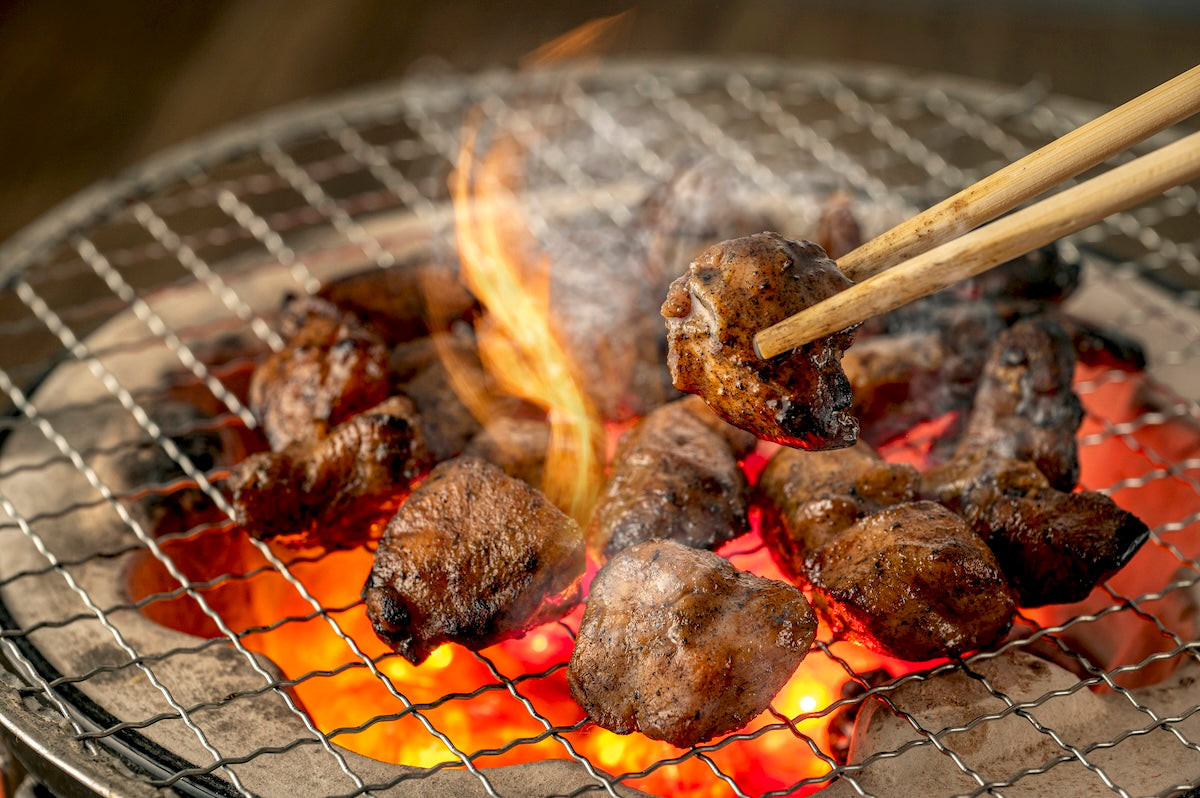
Anyone who has tried yakitori grilled over binchotan charcoal and then been served the gas-grilled version knows the difference immediately.
Binchotan, charcoal made from ubame oak, burns hotter, longer and more steadily than ordinary charcoal does. The result is chicken cooked from within, juicy and tender at the center, while the exterior crisps and takes on a refined smokiness.
But binchotan requires patience. The charcoal must be lit slowly over 15 to 20 minutes, the cook watching for cracking and popping as the charcoal heats unevenly.
The pieces should be arranged with a higher mound at the center for intense heat and lower banks on the sides, creating zones for cooking at different temperatures. A high smoke point and steady radiant heat make binchotan superior to other fuels for this purpose - and the difference on the plate is not subtle.
For skin-on chicken cuts, skewer the pieces with a small gap between them. Take the chicken out of the refrigerator 15 to 30 minutes before grilling so the meat returns to room temperature, which will help it to cook evenly.
Grill skin-side down first; once the surface develops color, turn over, then move the skewers toward the cooler edges of the grill to finish slowly.
For fatty cuts, try not to let dripping fat fall directly onto the charcoal, which will cause flare-ups. Alternating chicken skewers with vegetables such as shishito peppers helps to manage the smoke and also to reset the palate between rounds.
The finishing move: remove the skewers from heat just before the center loses all of its pinkness, wrap them in foil and let them rest for a few minutes. This makes the difference between a great yakitori and a dry one.
Karaage: Japan's Crispy Fried Chicken
If yakitori belongs to the specialist grill shop and the izakaya, karaage belongs to everyone. It fills bento boxes at every convenience store, anchors izakaya menus and appears at home dinner tables.
The recipe begins with the cut: chicken thigh, preferably skin-on, offers the dark meat flavor and fat content that chicken breast cannot match.
Cut the chicken into pieces of around 40 g to 50 g - large enough that the chicken doesn't dry out during frying.
The marinade is built on soy sauce, sake, ginger and garlic. Marinating the chicken pieces for around 30 minutes in the refrigerator is sufficient.
For extra tenderness, add mayonnaise to the marinade - the emulsified fats tenderize the meat and increase its juiciness.
Pat the marinated chicken dry before coating it - be sure to use potato starch as it produces a crispier crust. Coat the chicken immediately before frying; do it too far in advance and the starch will absorb moisture from the marinade, making the result gummy rather than light and crispy.

Then comes the technique that separates magnificent karaage from the merely fried: the double fry.
Use an oil with a high smoke point. Fry the chicken in batches at 170°C for three to four minutes - add the chicken pieces to the oil and resist touching them for the first minute while the coating firms up.
Once lightly golden, remove and drain on a wire rack rather than a baking sheet lined with paper towels; the rack allows steam to escape while paper towels trap it and soften the crust. Rest the chicken for five minutes while residual heat redistributes moisture through the meat.
Fry the chicken a second time at 180 to 190°C for one to two minutes until deep golden brown and perfectly crispy. Drain on the rack again.
Store any leftovers in an airtight container in the fridge. To reheat karaage without losing the crunch, an oven or air fryer set at around 180°C for five to eight minutes restores the crispy coating better than a microwave can.
Chicken Nanban: Miyazaki's Sweet and Savory Answer
Karaage's southern cousin has an entirely different temperament. Chicken nanban originated in the 1950s; a restaurant serving Western-style cuisine in Nobeoka city, Miyazaki prefecture is usually credited as its birthplace.
The name comes from nanban-zuke, a technique introduced by Portuguese traders - called Nanban-jin, or Southern Barbarians - in which fried food was steeped in vinegar and chili. Applied to fried chicken, it became one of Miyazaki's most beloved exports and spread to home kitchens, school cafeterias and bento boxes sold across the country.

Where karaage aims for the crunch, chicken nanban is characterized by a soft, moist texture created by the egg batter and sweet vinegar sauce.
The marinated chicken is coated in flour and beaten egg and fried in a skillet or deep pan in oil heated to 170-180°C.
While still hot, the fried chicken pieces go straight into a sweet-and-sour sauce of soy sauce, vinegar and sugar: the classic ratio runs two parts soy to three parts vinegar to two parts sugar.
A generous crown of tartar sauce finishes the dish, staging an ongoing conversation between richness and acidity.
Chicken Katsu: The Crispy Chicken Everyone Loves
No survey of Japanese chicken dishes would be complete without chicken katsu, the crispy cutlet that has become a staple of Japan’s set meals.
A Japanese recipe with a clear Western lineage, katsu involves coating a flattened chicken breast or thigh in seasoned flour, beaten egg and panko breadcrumbs before being fried until golden brown.
The result is a light and crispy shell encasing tender and juicy meat - different in character from karaage's crunchy coating but no less satisfying.
Oyakodon and Simmered Chicken Dishes
Oyakodon - literally 'parent and child bowl' - brings chicken and egg together in one bowl.
The dish is comfort food in its most accomplished form: quick yet deeply savory and precise. Chicken is simmered with sliced onion in a dashi-based broth until just cooked, then lightly beaten egg is streamed in and the lid closed for a brief moment, allowing the egg to set to silk-soft consistency - barely done, the edges opaque and the center still trembling.

The soft, custardy mass is poured over a bowl of rice, with a scattering of mitsuba or nori to add color without complicating things.
Simmered chicken dishes appear elsewhere in the Japanese repertoire. Mizutaki, a hot pot from Fukuoka, builds a rich, clean chicken broth through slow simmering of the bird. The broth is considered the centerpiece of the dish rather than a supporting player.
In keihan, a dish from the Amami region, rice is topped with various ingredients and hot chicken broth poured over the whole arrangement - a dish that's equal parts comfort and ceremony.
Jidori: Japanese Heritage Chicken and Regional Glories
Sitting above broiler chickens in price and flavor are jidori, Japanese heritage chickens that have been raised according to strict standards.
To qualify, a jidori must be at least 50 per cent derived from a native Japanese breed, raised for a minimum of 80 days and allowed to range freely after 28 days with no more than 10 birds per square meter. The result is firmer muscle, more developed fat and a depth of flavor that broiler chicken cannot replicate.
Three breeds hold national prestige. Hinai jidori from Akita is known for its firm texture and clean, pronounced flavor - excellent in yakitori and chicken broth preparations.
Nagoya Cochin from Aichi, often called Japan's gourmet chicken, is dense and complex, its breast meat staying moist and richly flavorful even by jidori standards. Satsuma jidori from Kagoshima offers pronounced chewiness and strong umami, a bird built for bold cooking.

These regional birds inspire regional obsessions. In Nagoya, sesame-scented or aggressively peppered chicken wings - tebasaki - are a point of civic pride.
In Miyazaki and Kagoshima prefectures, the Jitokko breed is given the sumibi-yaki treatment - charcoal grilling over intense heat - or served as sashimi or lightly seared.
A Juicy Problem
Japan has spent centuries finding the right way to cook a bird that once served as a clock.
Somewhere between the smoke of binchotan charcoal and the shatter of a perfectly fried piece of karaage - with a detour for the simmered comfort of oyakon - it has found its answer.
By Janice Tay