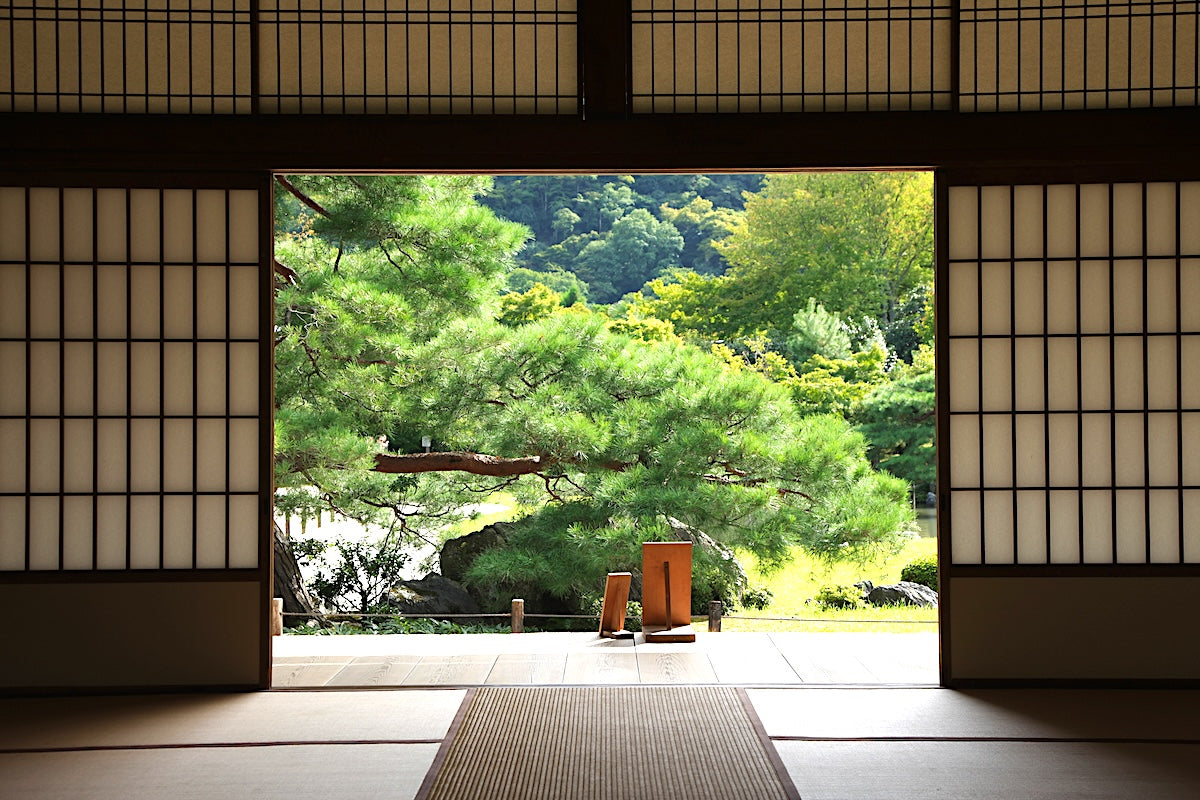
- Part of Japanese Homes from Ancient Times
- Tatami as Portable Furniture
- From Spot Mats to Full-Room Flooring
- Edo to Meiji: Widespread Use of Tatami
- Tatami Origins to Modern Adaptations
- How to Arrange Tatami Mats
- Watch Out for the Demon Gate
- A Serene Space for Tea - or a Very Bad Day for a Samurai
- Modern Tatami Layouts
- Staying Grounded...and Comfortable
When people picture a traditional Japanese room, they might imagine light passing through shoji screens to cast shadows on an expanse of rush mats: tatami.
But in the beginning, Japanese tatami was less 'entire floor' and more 'VIP mattress': the original mats were basically fancy beds for fancy people.
Part of Japanese Homes from Ancient Times
Archaeological evidence suggests that woven straw mats existed in ancient Japan - specifically, the Jomon and Yayoi periods - as floor coverings and bedding.
As far as written records go, the word 'tatami' first appeared in Kojiki, Japan’s oldest history book, compiled in 712. It mentions different kinds of mats - suga-tatami (reed), kawa-tatami (leather) and kinu-tatami (silk) - showing that tatami was already a thing in the Nara period.
The term comes from the verb 'tatamu', meaning 'to fold' or 'to pile', which suggests that these early versions were thin mats that could be folded up when not in use or piled in layers like dignified pancakes.
Only later did the mats evolve into the thick, non-folding slabs we now associate with traditional Japanese rooms and quietly judgmental tea masters.
But the tatami found in Japanese-style rooms today isn’t a modern reinvention. It’s the direct descendant of an 8th-century aristocratic bed mat that was so well-designed, the basic structure has barely needed updating.
This fragment of a mat, the oldest surviving tatami, is preserved at the Shosoin treasure house at Todaiji in Nara.
The mat once sat atop the imperial bed platform - mitoko - used by Emperor Shomu, who passed away in 756, making the mat over 1,260 years old.
Its structure would be familiar to any modern tatami craftsman. It comprises: a core made from rice straw layers, a surface of woven rushes, a covering along the sides and a hemp cloth underside, fulfilling the same role that modern backing materials do.
All the essential elements of today’s tatami mats were already present.
Tatami as Portable Furniture
During the Heian period (794-1185), the era following the Nara period, aristocrats lived in wooden-floored mansions. Tatami mats were placed on the floors as movable seats and bedding, with thickness and edge patterns regulated according to status.
At this stage, tatami remained a symbol of power. Commoners were still very much on the 'plain wooden floor' plan.
From Spot Mats to Full-Room Flooring
A big architectural shift occurred from the end of the Kamakura period (1185-1333) into the Muromachi period (1336-1573). As shoin-zukuri architecture evolved, tatami became something used to cover entire rooms, not just certain spots.
Early layouts included mawari tatami - mats arranged in a ring - which gradually evolved into full tatami floors.
By the Muromachi period, tea rooms and samurai residences featured tatami floors. This is where tatami transformed from furniture to flooring material.
Edo to Meiji: Widespread Use of Tatami
The full glow-up for tatami began in the Edo period (1603-1868), the era of relative peace that came after a protracted civil war.
Samurai, merchants and wealthy townspeople began incorporating rooms with tatami floors into their homes, especially as the Way of Tea spread beyond elite circles.
But it wasn’t until the Meiji period (1868-1912) that tatami mat floors became common in rural homes. Regulations on edge patterns relaxed, tatami production flourished - and the mats secured their place in Japanese interiors.
Tatami Origins to Modern Adaptations
Traditional tatami mats are made from natural materials: a base (doko) of compressed rice straw, a woven rush grass cover (omote) and cloth edges (heri).
In the post-war era, rapid housing construction and rice-straw shortages led to the use of alternative cores such as polystyrene foam and insulation boards, while keeping the characteristic rush-grass face.
Today, the range of tatami mats includes borderless tatami, washi-surface tatami and half-size modular mats that can sit on top of wooden floors.
They keep the charm of traditional tatami while adding softness to Western-style interiors and modern living, doubling up as yoga mat and minimalist sleeping set-up.
How to Arrange Tatami Mats
In Japanese culture, tatami isn't just thrown down like yoga mats before a YouTube workout. Tatami is laid so the room looks harmonious, the mats last longer and denizens of the other world are not unintentionally invited in.
Broadly, there are two layout categories:
祝儀敷き Shukugi-jiki: Auspicious Layouts
Shukugi-jiki refers to classic auspicious mat layouts, used today in nearly all tatami rooms in Japanese households. Historically, people would re-lay the tatami when hosting weddings, naming ceremonies or other happy events - much like a pre-modern version of tidying up for guests, except it required moving the entire floor.
A number of rules make up shukugi-jiki:
Four corners should never meet
The corners from four tatami mats should not touch at a single point to form a cross.

Align the weave with movement
When you enter a tatami room, the grain of the mats should run in the same direction you walk. It feels smoother underfoot and reduces wear along the rush grass.
Tatami were precious in the past, so preserving the mats was a financial priority.
Respect the tokonoma alcove
A tokonoma is the part of a Japanese room with the highest status. It's where the scroll hangs and the flowers are placed. The guest of honor is also seated in front of the tokonoma.
The tatami should be laid so that its long side and border run parallel to the alcove.
Laying the mat edge perpendicular to the tokonoma is known as tokosashi, a taboo in samurai residences that is still avoided today. The alignment makes the tatami edge appear to pierce the alcove, which would be interpreted as an insult to the guest of honor.
Tokosashi is also a no-no because the guest could end up sitting directly on the mat border - the interior design equivalent of making your VIP sit on the uneven part of a folding chair.
Avoid a long seam that divides the room
A line that slices from one wall to the other can feel visually jarring and is considered inauspicious. Breaking lines with alternating mat directions creates a calmer look and feel.
Use only 1 half-size mat in traditional layouts
Going half-mat crazy is a modern thing; you won't see more than one in a traditional layout.
Put together, these rules create a floor that is visually balanced, aligned with etiquette and practical for movement and maintenance.
Here are auspicious layouts for 6-, 8-, 10- and 12-mat rooms:

不祝儀敷き Fushukugi-jiki: Inauspicious Layouts
When all the mats face the same direction and the corners form crosses, the entire floor may look like a polite grid… of bad luck.
Traditionally, this is the layout used for funerals and other mourning rituals as well as for temple ceremonies.
Because Japanese funerals were once held in the home, families would re-lay the tatami in fushukugi-jiki for the event, then return to a more auspicious layout.
So why is fushukugi-jiki used in places such as halls and ryokan inns? While supposedly unlucky, it has a number of practical advantages:
Protection of tatami
When many people walk in the same direction - as they do in banquet halls or temples - having the grain unified reduces wear on the mats.
Ease of cleaning
The same grain direction makes for smoother sweeping and faster vacuuming.
Uniform appearance, faster service
Fushukugi-jiki creates a neat, cohesive look, appropriate for large spaces such as ryokan dining halls and public venues. It also streamlines service, as seating guests in the same orientation allows staff to move and serve more efficiently.

In short, fushukugi-jiki is the professional kitchen layout of the tatami world. Not warm and homey but undeniably practical.
Watch Out for the Demon Gate
According to an old Japanese belief, the northeast is the kimon, or demon gate. Malevolent forces are said to enter from the northeast; if they leave, it's through the ura-kimon - back demon gate - which lies in the southwest.
A half-size tatami mat implies a missing portion - in other words, a gap. Creating a gap in the northeast corner - the dreaded demon gate - was thought to draw in misfortune: sickness, financial hardship and visitors from the unseen world.
Even today, architects in Japan double-check the orientation so that half-tatami mats, entrances, water facilities and trash collection points are not located in the northeast corner.
In cases where this is unavoidable, people sometimes set out salt or plant holly to repel misfortune.
A Serene Space for Tea - or a Very Bad Day for a Samurai
Now we get to the dramatic part: tea ceremony vs ritual suicide… on the same number of mats.
A 4.5-tatami room (yojo-han) is one of the most iconic room sizes in Japanese culture, especially in tea ceremony architecture. A space of this size is compact and intimate but big enough for host and guests to move around without people knocking over the utensils.
It is also the room size most prone to accidental superstitious disaster.
 If the half-mat goes in the center and the four surrounding mats rotate clockwise around it, the flow aligns with where the sunken hearth (ro) is placed.
Tatami are arranged to be parallel to the host, avoiding a configuration that symbolically pierces the host, a layout thought to lead to self-harm.
But if the four surrounding mats are arranged counterclockwise around the central half-mat, the layout is known as seppuku no ma: the seppuku room.
Why the dramatic name?
This pattern is said to have been used when samurai performed ritual suicide. The logic was horrifically practical: the samurai would kneel on the central half-tatami. Afterward, only that single mat - and a half-mat at that - had to be replaced.
Clean-up became… simpler.
Naturally, this layout was avoided in homes because no one wants their living space to telegraph 'seppuku staging area'.
Modern Tatami Layouts
Ryukyu datami
These half-size, borderless mats are usually laid in alternating grain patterns (ichimatsu-jiki) to create a checkerboard effect.
Portable modern tatami
These lighter mats can be arranged however you like, though alternating the grain when using more than one mat still looks more refined.
Staying Grounded...and Comfortable
If you'd like to bring tatami mats into your home but have no plans to host Japanese tea gatherings, should you care about whether a layout is auspicious?
Even if you don’t subscribe to the underlying beliefs, even if demon gates sound more like anime than architecture, arranging tatami mats correctly will create a space aligned with aesthetics and ergonomics - and help the mats to last longer.
In other words: respecting the layout rules is less about superstition and more about tapping into a unique Japanese lore about how to live comfortably on the floor, whether you set your mats out in a Kyoto machiya or a New York apartment.
By Janice Tay