- Hatsumode: The First Shrine Visit of the Year
- Karuta Hajime: History and Tradition in a Game of Cards
- Heian Football: Kemari Hajime at Shimogamo Shrine
- Toka Ebisu: First Big Festival of the Year
- A Tree in Your Hand: Gafuten Shohin Bonsai Exhibition
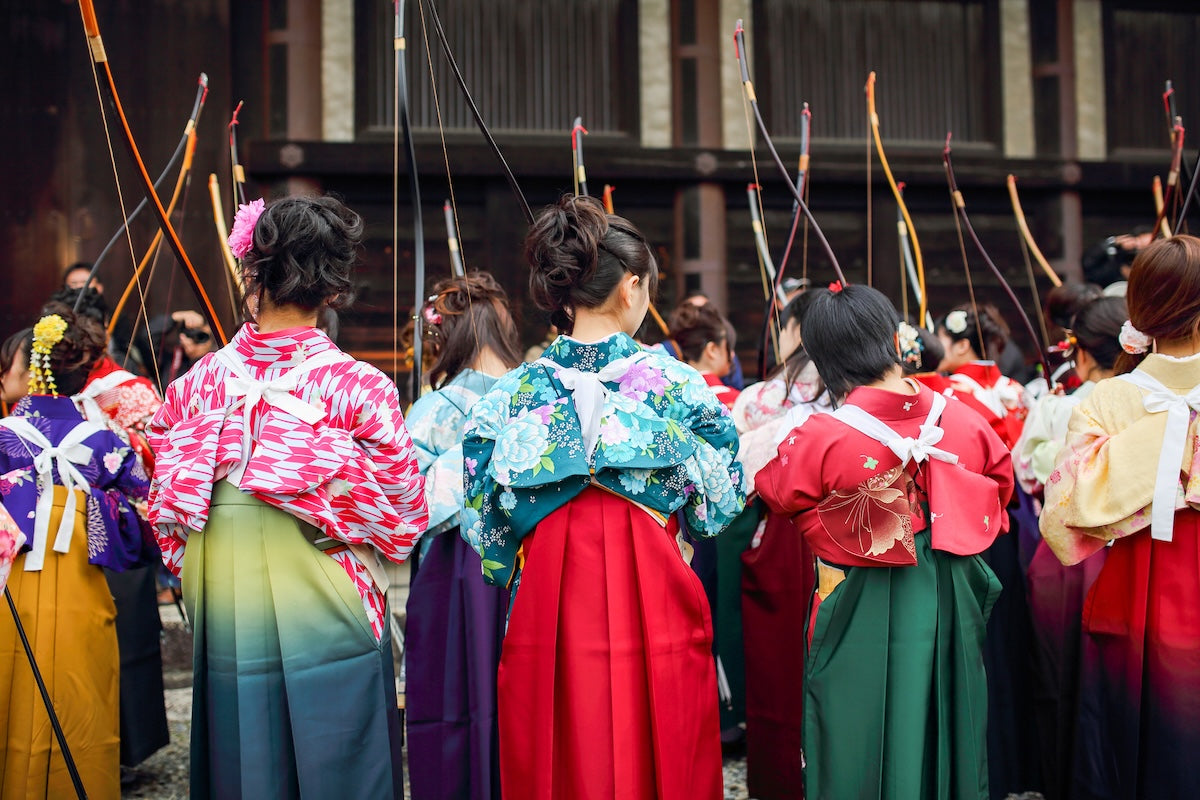
- Omato Archery Competition at Sanjusangen-do
- Celebrate With Porridge: Azuki-Gayu at Torin-in
- Flea Markets where the New Year Doubles Back
- January in Kyoto: Japan Travel at Two Speeds
Kyoto in January is like someone who went hard at the bonenkai year-end parties, queued for hours to strike a temple bell at midnight, queued again the next morning for a shrine visit, chewed through New Year rice cakes, squeezed through New Year sale crowds - then spent the rest of the month wrapped in a blanket, eating porridge with young greens and insisting that this was always the plan.
The first two weeks of January are dense with ritual and collective motion. Shrines and temples hum with energy as people welcome the new year and pray for good health and prosperity.
Then the volume drops.
From around mid-January, Kyoto becomes quieter and more spacious. The crowds thin. The air feels sharper. If you don’t mind the cold, this is one of the best times of the year to enjoy the city at a calmer pace.
The New Year atmosphere doesn’t disappear entirely, though. In the second half of the month, two of Kyoto’s most famous flea markets keep the seasonal mood alive, drawing locals and visitors alike.
Here's a guide to how this transition unfolds.
Hatsumode: The First Shrine Visit of the Year
When: January 1-3 (the first shrine visit of January, regardless of date, can also be treated as hatsumode).
Where: Shrines and temples across Kyoto (popular choices include Fushimi Inari Taisha, Yasaka Shrine and Heian Shrine).
Admission: Free (talismans such as hamaya arrows cost extra, as your future good health is not included in the base package).
Hatsumode (初詣) is the first visit of the new year to a Shinto shrine or Buddhist temple - a personal reset button with grander architecture.
What makes Kyoto a great place to experience hatsumode is that the city is packed with options. You can be swept up into the crowds at popular spots or discover Kyoto on the neighborhood level by choosing a smaller shrine such as Goou Jinja (below).

You can visit a shrine or temple, or do the very Japanese thing of not seeing a contradiction and go to both.
Many shrines have decorations and charms featuring the year’s animal according to the Chinese zodiac. In Japan, this cycle is aligned with the Gregorian calendar rather than the old lunar one, meaning that the new year - the Year of the Horse - begins on January 1, 2026, rather than February 17 as it does elsewhere in East Asia.
A quick history note: hatsumode has its roots in an older practice called toshigomori where the head of a household would stay overnight at the local ujigami shrine from New Year’s Eve into New Year’s morning.
Over time, this prayer vigil split into separate visits on New Year’s Eve and New Year’s Day, with the latter becoming a prototype of modern hatsumode.
Until the late 19th century, New Year shrine visits also meant going to a shrine or temple located in the lucky direction of the year but modernization and the advent of railways changed all this.
As train networks expanded and railway companies competed for passengers through advertising campaigns, hatsumode became more about visiting famous sites further away rather than just the local shrine - hatsumode thus evolved into both devotion and seasonal outing.
Karuta Hajime: History and Tradition in a Game of Cards
When: January 3; 13:00
Where: Yasaka Shrine (Noh stage)
If hatsumode is Kyoto’s New Year handshake, karuta hajime is its New Year flex.
On January 3, the first karuta ceremony of the year is held at Yasaka Shrine. Participants in gorgeous Heian-period court attire play the traditional card game known as Hyakunin Isshu karuta: a reader recites the opening of a poem and the players vie for the card with the rest of the verse.

The silk robes suggest languid elegance but the speed of the hands and the cards sent flying belongs to the world of competitive athletics.
Why Yasaka Jinja? The shrine’s enshrined deity, also the god of poetry, is honored as the composer of the country's oldest waka poem - the literary form that forms the basis of Hyakunin Isshu karuta.
Keep in mind that the event is popular and the viewing area is not infinite. If you want a good view, arrive early - some people wait from morning - and accept that the Kyoto winter is basically a test of character.
Heian Football: Kemari Hajime at Shimogamo Shrine
When: January 4; 13:30
Where: Shimogamo Shrine
Paid seating: JPY2,000 (registration starts at 12:00)
Of all the traditional events in Kyoto at the start of the year, the offering of kemari at Shimogamo Jinja is probably one of the most photo-worthy.
In kemari, a classical ball game associated with court culture, players form a circle and keep a deerskin ball aloft with controlled, deliberate kicks. The point isn’t scoring. The point is not letting the ball fall while maintaining the air of someone who has never broken into a sweat.

As the ball moves around the circle, the players shout, 'Ari', 'Yaa' and 'O' - calls said to originate in a dream experienced by kemari master Fujiwara no Narimichi (1097-1162).
According to his diary, he spent 2,000 days kicking the ball. When he completed the sennichigyo - one thousand consecutive days of kemari - he gathered his fellow players for a formal ritual. A celebratory banquet followed, as one does after a thousand days of not dropping something.
That night, while Narimichi ground ink to record the occasion, a ball rolled off a stand and stopped before him. He looked up - and saw three childlike figures with human faces and monkey limbs. They told him that they were spirits of the ball, appearing to celebrate the completion of the Thousand-Day Practice and to thank him for his offerings.
Each boy brushed aside his bangs to reveal a name written in golden characters on his forehead. The names read like a progression of the seasons: Shunyoka (Spring Willow Flower), Geanrin (Summer Peaceful Grove) and Shuen (Autumn Garden).
The human heart is easily agitated, said the spirits, but those who step onto the kemari court think only of the ball and, in doing so, their hearts grow lighter.
The spirits went on to say that, if their names were called during play, they would come at once to serve. Being mindful of unseen beings, they suggested, brings protection in return.
And with that, the spirits vanished.
Seen in this light, the calls of 'Ari' (from Geanrin), 'Yaa' (Shunyoka) and 'O' (Shuen) echoing across the kemari court are not merely coordination cues. They are an invocation, a reminder that even a game, when played with full attention, can quiet the heart, invite harmony in and briefly align the human with the unseen.
Toka Ebisu: First Big Festival of the Year
Where: Kyoto Ebisu Shrine
When: January 8-12. Event time varies by day.
Jan 8: 9:00-23:00
14:00: Yutate Kagura ritual
Jan 9: Gates stay open from 9:00.
Jan 10: Open 24 hours.
Jan 11:
14:00-16:00 Visitors who buy the lucky bamboo branches can receive them from Gion district maiko.
20:00-22:00 Maiko from Miyagawa-cho hand out lucky bamboo.
24:00 Gates close.
Jan 12: 9:00-22:00
This is the first major festival of the year for Kyoto - and for anyone whose New Year resolution is 'prosperity'. It's also ideal for people who enjoy crowds, street food and the very specific thrill of receiving a talisman from an apprentice geisha.
Toka Ebisu centers on Ebisu, a deity of good fortune and prosperity who is always shown smiling.
During the festival, many visitors buy branches of lucky bamboo known as fuku-zasa. These are blessed in kagura dances performed throughout the day by shrine maidens, after which worshippers attach lucky charms such as mini rice bales and koban coins.
Visitors can also observe another form of kagura - yudate kagura, a Shinto purification ritual in which a shrine maiden uses sacred bamboo leaves to scatter hot water through the air. Being splashed is believed to offer protection from illness, natural disasters and bad luck in general.
If you want your January visit to Kyoto to come with maximum volume, the Ebisu festival delivers: crowds in holiday mode, shrine maidens dancing on repeat and New Year optimism that has already updated its resume.
A Tree in Your Hand: Gafuten Shohin Bonsai Exhibition
When: January 9-11, 2026; 9:30-16:30 (final day: 9:30-15:30)
Where: Miyako Messe
Admission: JPY1,200 (free for those under 18)
Grow a tree on a miniature scale. Then make it even smaller, small enough to sit in the palm of your hand. If you succeed, you'll have shohin bonsai.

One of the largest bonsai exhibitions in Japan, Gafuten has more than 40 years of history as a gathering for shohin bonsai artisans, collectors and admirers from across the country.
The exhibition, held at the Miyako Messe convention center, is divided into two areas: one where meticulously composed bonsai arrangements are displayed and another devoted to sales. If you visit, the array of plants, pots and tools may just succeed in persuading you to take a very small tree home.
Omato Archery Competition at Sanjusangen-do
When: January 18, 2026 (held each year on the Sunday closest to January 15); 7:45 to late afternoon.
Where: Sanjusangen-do
If Kyoto had a yearly 'prove you are calm under pressure' ceremony, it would involve traditional Japanese archery - a bow, a faraway target and an audience waiting to see if you miss.
The Omato competition at Sanjusangen-do unfolds on the grounds of one of Kyoto’s great cultural treasures, the temple’s long main hall stretching out beside the shooting range. Rooted in the Toshiya contests of the Edo period, the event functions as both competition and archery ritual, blending skill, discipline and ceremony in a single winter day.
Each year, the arena fills with participants from across Japan, including many new adults marking their coming of age that year. For them, this is not only a test of aim but also a public measure of composure.
The targets are set at a distance that makes it clear that this is not a casual hobby. Accuracy here requires control, focus and the ability to rise above the pressure of several hundred people watching your every move.
Particularly striking is the women’s division, where young women take their turns in formal hare-gi: long-sleeved furisode kimono paired with hakama and elaborate hair ornaments.

The competition follows the schedule below, though start times can slip by thirty minutes to an hour depending on how many archers take part.
7:45 Opening ceremony
8:00 Ceremonial archery
8:30 Men’s division
10:50 Women’s division
13:50 Dan rank holders' division
15:00 Finals
The temple grounds are free to enter on the day and the priests also conduct a purification rite using willow branches, a brief blessing believed to ward off headaches.
Expect the area to be crowded. If you want a realistic chance at a good spot, arriving early is essential. From central Kyoto, Sanjusangen-do is easily reached from Gion-Shijo Station on the Keihan Line, making it one of the more accessible January events in the city.
Celebrate With Porridge: Azuki-Gayu at Torin-in
When: January 15-31, 2026; 11:00-15:00
Where: Torin-in, sub-temple of Myoshin-ji
Fee: JPY4,000 per person (reservation not required)
After the frenzy of shrines, crowds and lucky charms, Kyoto offers you a different New Year’s reset: porridge.
Eating azuki-gayu - red bean rice porridge - on the 15th day of the first month, once considered the last day of the festive period, was believed to ward off evil influences and prevent illness.
Though the belief belongs to an earlier age, it hasn’t faded entirely. At Torin-in, a sub-temple of the Myoshin-ji Zen complex, the custom lives on in a form shaped for modern visitors.
The meal includes Kyoto vegetables such as daikon harvested from the temple garden, auspicious New Year foods and sweets, all arranged on traditional vermilion lacquerware.
Participants offer a small portion of their meal - about seven grains of rice - which is given to the living creatures in the gardens.
The setting is part of the draw. Myoshin-ji is home to more than 40 sub-temples but Torin-in is known for the beauty of its gardens, which are rarely open to the public. Partaking of azuki-gayu there also offers a brief taste of temple life.
Flea Markets where the New Year Doubles Back
Kobo-san at Toji Temple
When: January 21, 7:00-16:00
Where: Toji (UNESCO World Heritage site)
Tenjin-san at Kitano Tenmangu Shrine
When: January 25, 6:00-16:00
Where: Kitano Tenmangu Shrine
These two markets are the best answer to the question: what are the things to do in Kyoto when the New Year week ends?
Alongside the usual street food, antiques and handicrafts, the stalls offer New Year items, plus the gentle dopamine hit of finding something you didn’t know you needed until you saw it going for 700 yen.
If you want to avoid the crush in the first week of January, build your schedule around these dates. You’ll get lively local atmosphere without having to take your chances in a shrine crowd of 4,000 people, all of whom seem to be holding protective arrows.
January in Kyoto: Japan Travel at Two Speeds
It's hard to pinpoint must-see Kyoto events to enjoy in January when you can choose from the atmosphere of hatsumode, the elegance of Heian-era games and the healing balance of temple porridge.
If you can, time your stay so you can experience a blend of lively rituals and quiet reflection because the start of the year reveals Kyoto at its most ceremonial and its most contemplative - sometimes on the very same street.
By Janice Tay