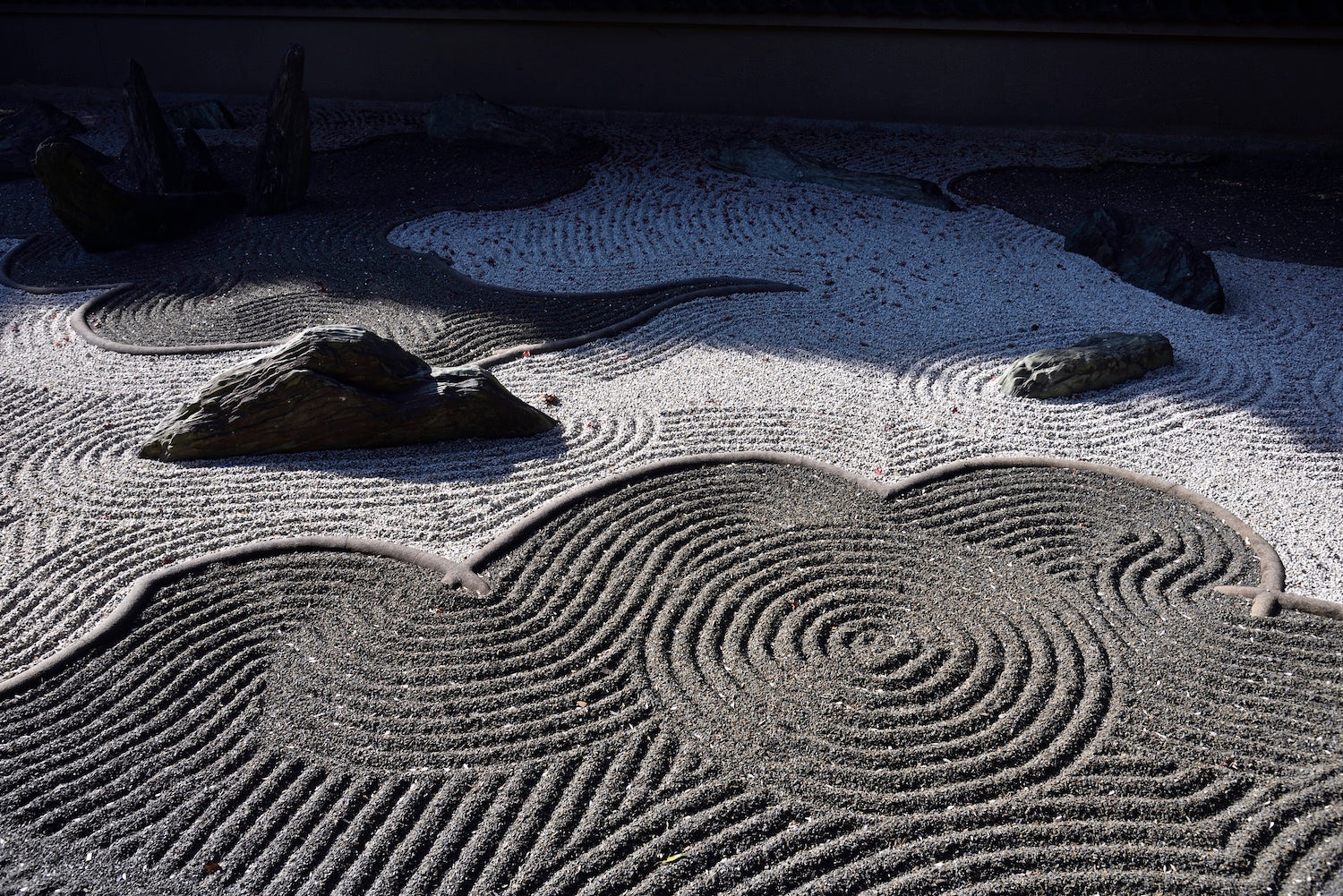
There’s something special about visiting traditional Japanese gardens. Whether it is a neatly raked sea of gravel in a Zen rock garden or a strolling garden with mossy undulating hills and maple trees, each one will have typically been designed to express a specific set of ideals on nature, life, and aesthetics. Such Japanese-style gardens are referred to as 日本庭園 nihon tei’en (or sometimes 和風庭園 wafu tei’en) to distinguish them from Western-style gardens.
Within the category of ‘Japanese-style gardens’ are Pure Land Buddhism-influenced paradise gardens, promenade gardens, dry gardens with rocks and gravel, tea gardens, moss gardens, and more. I will not delve too deeply into the minutiae of these styles in this essay. Rather, my aim is to introduce the common elements that make up Japanese gardens.
Even without knowing the history or construction behind a given garden, paying attention to these elements and how they vary between gardens will help deepen your appreciation as you walk through one.

Water
Water is central to all Japanese gardens, even the dry ones. It appears as ponds, small lakes, fountains, streams, channels, or miniature cascades in most gardens. In rock gardens, white sand is a symbolic stand-in for water; water and stone are yin and yang, considered complementary opposites. Flowing water imbues a still scene with life and movement; it can also express the flow of time and life. Equally pleasant is to pause and listen to the sound it makes — a burbling stream, a quiet trickle, the splash of water from a shishi-odoshi.
A pond in a paradise garden might be shaped like a cloud (雲形池 kumogata-ike) in reference to Buddha inviting his followers to join him in paradise, a gourd (瓢箪形池 hyotangata-ike) for warding off evils and illnesses, or even a metaphorical heart (心字池 shinji-ike) to emphasise that this body of water is the heart of the garden. Pay attention to the reflections, too: few scenes are more beautiful than a Japanese garden on a clear day mirrored in a rippling surface.

Stone water basins
Some gardens have tsukubai, or stone water basins, near the entrance. These are most common in tea gardens where visitors would clean their hands and mouth before a tea gathering. This ritual cleansing is not dissimilar to what one does before visiting the grounds of a Shinto shrine or Buddhist temple. However, the basins in gardens are now usually decorative, and few visitors are expected to use them for hand-washing.
The most well-known stone water basin is probably the one at Ryōan-ji Temple in Kyoto, renowned for its Zen rock garden. (Queen Elizabeth famously visited in 1975 and sat on a chair inside the temple.) The mouth of the basin is shaped like 口 kuchi, the character for mouth. When the four kanji written on the surface are read in combination with 口, the result is 吾唯足知, which translates as “I only know plenty.” In other words, what we have is already all we need.

Rocks, stones, gravel, and sand
These are another crucial element of Japanese gardens, whether in the form of stepping stones, raked sand, or islands in a body of water. Their innate characteristics determine their use in creating miniature landscapes or as part of the overall garden design. All sizes, types, and textures have their place in an aesthetically pleasing garden.
Philosopher Thomas Heyd describes stones in Japanese gardens as being “selected for their weathering… placed in such a way that they give viewers the sense that they ‘naturally’ belong where they are.” This is one of the underlying principles of Japanese garden design; all elements should look as though they had always existed here in a kind of harmony, though this painstaking approach does tend to veer into a kind of excessively artificial natural-ness at times.

Smooth stones may be used as stepping stones, while craggy volcanic rocks might represent mountains in a rock composition. Rocks are often arranged in odd-numbered compositions; a common variant is the three-rock arrangement where the tallest to the shortest represents heaven, humanity, and earth in that order. Sand and gravel usually represent water or clouds, and can be raked in various patterns to augment this impression. White sand in particular represents purity.
A large, vertical rock often represents Mount Penglai (known as Mount Hōrai), home of the legendary Eight Immortals of Chinese mythology. One example can be found in Zuihō-in, a subtemple at Daitokuji Temple in Kyoto, where Mount Hōrai is represented by a large rock in one corner of the symbolic sea of white sand. Kiyosumi Gardens in east Tokyo is another excellent garden which has a collection of fine stones and rocks quarried from all over Japan, including volcanic stone from the Izu Peninsula, Iyo Blue stone from Ehime, Ikoma stone from Nara, and Chichibu blue stone from Saitama.

Trees and flowers
Plants in a Japanese garden are chosen for their symbolism as much as their visual attractiveness. For example, pines represent longevity and perseverance, and they are often pruned to resemble a set of clouds. Bamboo is for strength, adaptability, and resilience. Lotuses and their buds represent purity, taken from Buddhist teachings. Cherry blossoms represent the evanescence of life; seasonal flowers, in general, remind us to appreciate short-lived moments of beauty. Deciduous red and gold-leaf trees like Japanese maples (typically acer palmatum) and ginkgo symbolise change and renewal. Even dry gardens have their plants in the form of mosses, which lend the garden a dignified, ancient countenance.
Japanese gardens tend to require constant maintenance. Weeds must be removed, and branches trimmed and shaped so as to create beautiful scenes. Tree branches must be trained to grow in the correct way, and supported with bamboo poles or wooden crutches if they are too heavy. Fallen leaves must be swept or picked up if they do not add to the overall aesthetics of the garden.

Garden bridges
Three types of bridges can be found in the Japanese garden: stone, wooden, and dirt (compacted soil and moss over logs). Stone bridges tend to be small rather than large, and rarely arched. Wooden bridges are the most varied as the material is versatile. Their design varies with their environment. Bridges cross streams or ponds with islands. They can be arched or flat; they can zigzag or wind; they can even be constructed from separate stepping stones.
Bridges were first used in Japanese gardens during the Heian period. One famous early example is the wooden bridge in Byōdō-in, Uji, that connects the Phoenix pavilion with an island of stones (Mount Hōrai, of course), representing the path to paradise and immortality. Another style is the zig-zagging yatsuhashi wooden bridge, typically built over iris marshes. It references a scene from Ise Monogatari in which the poet Ariwara no Narihira who is travelling out of Kyoto with his companions, is so moved by the beauty of the irises at a particular bridge that he composes a poem: I have a beloved wife / Familiar as the skirt / Of a well-worn robe / And so this distant journeying / Fills my heart with grief.

Stone lanterns
Japanese stone lanterns (台灯籠 daidorō) are a common feature at Buddhist temples and Shinto shrines, where they line the paths and approaches to the buildings. In the 16th century, tea masters began incorporating them into tea gardens as functional elements to light the darker parts of pathways or other elements to be emphasised. In later gardens they were used as decorative elements.
While some traditional lanterns are made of bronze or other metal, the most commonly used ones today are standing lanterns made from stone (granite). These are some of the common ones you may see. There is the Kasuga lantern, originating from Kasuga Taisha in Nara. Oribe-style lanterns are smaller ones for tea gardens, as indicated above. Yukimi-style lanterns (雪見灯篭, lit. snow-viewing) with their wide, umbrella-like roof are usually placed near water or in exposed places; a famous example is the elegant, frequently-photographed lantern at Kenrokuen in Kanazawa. Yamadōrō (山灯籠) are naturalistic and irregularly-shaped, typically used as a background element surrounded by vegetation.