The history of donburi is surprisingly recent. For a country with a culinary tradition stretching back millennia, the rice bowl dish as we know it emerged only about 200 to 300 years ago - which means donburi is younger than some of the buildings still standing in Kyoto.
The earliest ancestor of donburi is hohan (芳飯), a dish of rice with toppings that emerged in the Muromachi period (1336-1573).
But it was only centuries later that the conditions just right for donburi came together. Edo, the city that would become Tokyo was, by the early 18th century, one of the most densely populated places on earth. It was full of single men - samurai retainers, construction workers and itinerant laborers. They ate out. Regularly. Street stalls and eateries fed them and what they served had to be fast, hot and cheap.
The vessel that made this possible was the kendon-buri bachi: the bowl used by inexpensive eateries called kendon-ya (慳貪屋). Meaning something like 'curt and stingy', the term 'kendon' was either a description of the service or a piece of Edo black humor, or probably both. The bowl that came with the meal was eventually called donburi and the name stuck long after the surliness faded.
The Earliest Donburi Bowls
The first dish to truly define the donburi form was unadon - eel rice bowl. Known as unagi meshi in its early days, it emerged in the early 19th century, when eel restaurants began placing grilled kabayaki eel on rice to keep it warm.
Fukagawa-don - asari clams simmered in a miso broth and poured over rice - and tendon, the tempura bowl, followed.
The donburi form kept on expanding, absorbing changes to traditional Japanese cuisine like steamed rice soaking up sauce. Western influence brought beef to the Japanese table and, in the 1890s, the beef donburi - gyudon - was born. Oyakodon, the chicken-and-egg bowl called 'parent and child', appeared in the same decade, in 1891.

Katsudon, built around the breaded pork cutlet that arrived with Western cooking, developed through the Taisho and early Showa periods (1912-1940s). In the 1950s, kaisendon - the seafood bowl - was born, creating a major donburi category.
Types of Donburi: Delving into that Steaming Bowl
The most popular donburi dishes can be divided into two families: cooked-and-sauced and raw.
Gyudon is the speed demon of the first category: beef and onion simmered in a soy-based sauce, piled over rice and topped with red pickled ginger. It can be served in under 10 minutes and eaten in five.
Oyakodon is the one with the memorable name. Written with the characters for 'parent', 'child' and 'bowl', it pairs chicken and egg in a lightly sweet dashi sauce, the egg added in two stages so it sets around the chicken in soft, half-runny folds.

Unadon places fillets of eel, grilled in the Edo style - steamed first to remove excess fat, then lacquered with sweet soy glaze over charcoal - over rice in a bowl, often with a lid. The Nagoya variation, hitsumabushi, chops the eel up, serves it in a wooden vessel, and invites you to eat it in three ways: as it is, next with condiments such as green onions and wasabi, then with dashi poured over the top - and, finally, to circle back to the one you like best.
Katsudon, like many everyday Japanese dishes, does not remain fixed. Starting from the basic form of a bowl of rice topped with a deep-fried tonkatsu cutlet, it has branched into regional variations broadly divided into two styles: egg-bound and sauce-based.
In the Kanto-style classic, the cutlet is simmered in dashi and soy sauce, then bound with egg and often served with onion and mitsuba. The result is soft and unified, with flavors blending into a single, comforting whole.
Elsewhere, katsudon keeps its crispness. Sauce katsudon, found in prefectures such as Fukui, Gunma and Nagano, features a freshly fried cutlet dipped in sauce and placed over rice without egg. Niigata’s tare katsudon uses thinner cutlets coated in a sweet-savory sauce, while Nagoya’s version adds a rich miso sauce for depth.
There's a modern tradition of Japanese students eating katsudon before exams, since 'katsu' - breaded pork cutlet - sounds like the word for 'to win'. Whether the exam results support this is another matter.
Tendon is the aristocrat of the family, tempura of shrimp and seasonal vegetables dipped in a rich, sweet sauce and placed over rice. The traditional Edomae method submerges the hot tempura directly into the tare so the thicker batter absorbs the sauce before it meets the rice. The modern approach pours the tare over crispy tempura already on the bowl. Both schools believe the other is wrong.
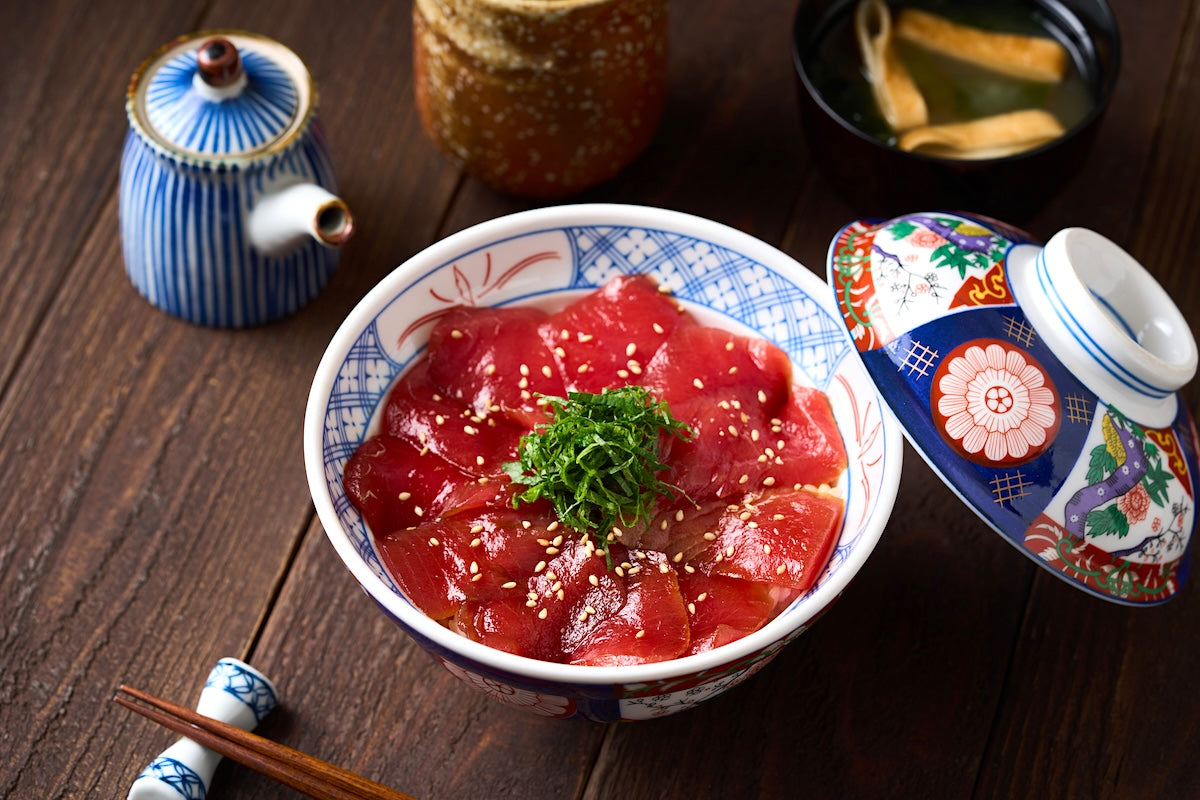
Tekkadon is the minimalist's choice: raw tuna, mainly lean akami, over vinegared rice with wasabi and soy sauce. The name tekka means 'red-hot iron' - a reference to the color of the fish. A zuke-don variation has the tuna pre-marinated in soy sauce, mirin and sake before it reaches the bowl.

Kaisendon is the freestyle version: assorted raw seafood over sushi rice, the toppings - salmon, scallop, squid and salmon roe - changing with the season, the market and wherever in Japan you happen to be eating it.
For those interested in exploring donburi variations further, the section below covers more ground.
Regional Variations: Donburi across Japan
Hokkaido is the home of kaisendon but the island's Tokachi region is also known for butadon - thick slices of pork grilled over charcoal with a kabayaki-style sauce, sharing a technique with unadon but substituting the smokier, meatier satisfaction of pork for eel's lacquered delicacy.
Miyagi prefecture's harako-meshi is a seasonal bowl worth timing a trip for: rice cooked in salmon broth, topped with fresh salmon and ikura, and available in autumn when the fish run upriver.
Kyoto's kinugasadon pairs sweet-braised abura-age fried tofu with Kujo negi - Kyoto's own green onion, slightly fatter and sweeter than the standard variety.
A specialty of Oita prefecture, ryukyudon features sliced fish marinated in a sweet-savory sauce - a technique that, according to one origin story, was adopted from fishermen of the nearby Ryukyu Kingdom.
More than culinary curiosities, these are donburi in its natural state: a format that absorbs whatever is local, in season and worth eating, then presents it as a complete meal in one bowl.
Making Donburi Dishes at Home
Bridging the topping and the rice is the sauce, which must reach the surface layer of the rice, soaking just far enough in to connect the two without drowning either. Too little and the bowl tastes like two separate meals. Too much and you have soup.
The golden ratios that define the most popular donburi sauces are not secret. For oyakodon and most egg-bound donburi, the standard is dashi 3 : mirin 2 : soy sauce 1.
Gyudon runs slightly richer: water 4 : soy sauce 2 : sake 2 : sugar 1.
For a pork bowl with a sweet-savory sauce, soy sauce, mirin and sake share equal weight at 3 : 3 : 3, with sugar at 1.
For raw seafood bowls - the tekkadon and kaisendon family - the sauce logic is inverted. Rather than cooked down, it is a light drizzle: soy sauce and mirin reduced together at 2 : 1, sometimes with a touch of sesame oil, applied sparingly so the fish stays in charge.

The condiments are not decorative. Mitsuba - Japanese parsley - goes on oyakodon in the final seconds, offering a refreshing contrast to the egg's richness. Beni shoga, the red pickled ginger, cuts through the fat of gyudon. Shichimi togarashi, the seven-spice blend, arrives at the table for anyone who wants heat. Shiso, green onion, myoga and sesame seeds cycle through the seafood bowls for aroma and texture. A donburi without its garnish is a sentence without punctuation - understandable but clearly missing something.
One garnish that's worth the extra effort: onsen tamago - a soft, slow-cooked egg - placed on top of various donburi types to add extra protein and a silky richness.
The Steamed Rice Beneath It All
More than a neutral base, the steamed white rice is what separates a good donburi from a mediocre one.
Japanese rice - short-grain, slightly sticky, subtly sweet - should be cooked slightly firm for donburi. This is not the softness you want for plain rice at dinner; this is rice that has to absorb sauce without turning into mush. The ratio is the same as always - roughly 1 cup (180 ml, or 1 go) of rice to about 200 ml of water - but pulled back slightly, by about a tablespoon or two.
Soak the rice for 30 to 60 minutes before cooking. The starch needs time to hydrate evenly; skip this step and the center of each grain cooks at a different rate from the outside. A small addition of sake - one tablespoon per go of rice - or half a tablespoon of mirin during cooking adds a gloss and subtle sweetness.
When the rice is done, fluff it immediately with a paddle to release the excess moisture.
The egg technique matters too. For oyakodon, katsudon or any egg-bound donburi, beat the eggs lightly - not until uniform, but enough to break the whites into rough, marbled streaks. Add roughly two-thirds of the beaten egg to the simmering sauce and let it begin to set for about 30 seconds, then add the remaining third and cover immediately.
Take it off the heat while the surface still looks slightly underdone. The residual warmth of the bowl and the hot cooked rice will finish the job. This is the technique that keeps the egg from becoming a scramble and the whole thing from turning into a breakfast casserole.
History Served Over Rice
There's a kind of honesty in donburi. Rice at the bottom, toppings at the top and sauce bridging the two - no illusions, no ceremony. And yet within that simplicity lives an entire history of adaptation: Edo stalls feeding a hungry, restless city, regional kitchens working with whatever the land and sea offered, and generations of cooks refining ratios that are seldom noticed but always tasted.
Perhaps this is why donburi endures. It's endlessly accommodating without ever losing its shape. It will take eel or beef, tempura or tuna, clams or tofu, and treat them all the same: put it on rice, serve it hot and don't keep the diner waiting.
Some meals ask you to slow down. Donburi simply asks that you show up hungry.