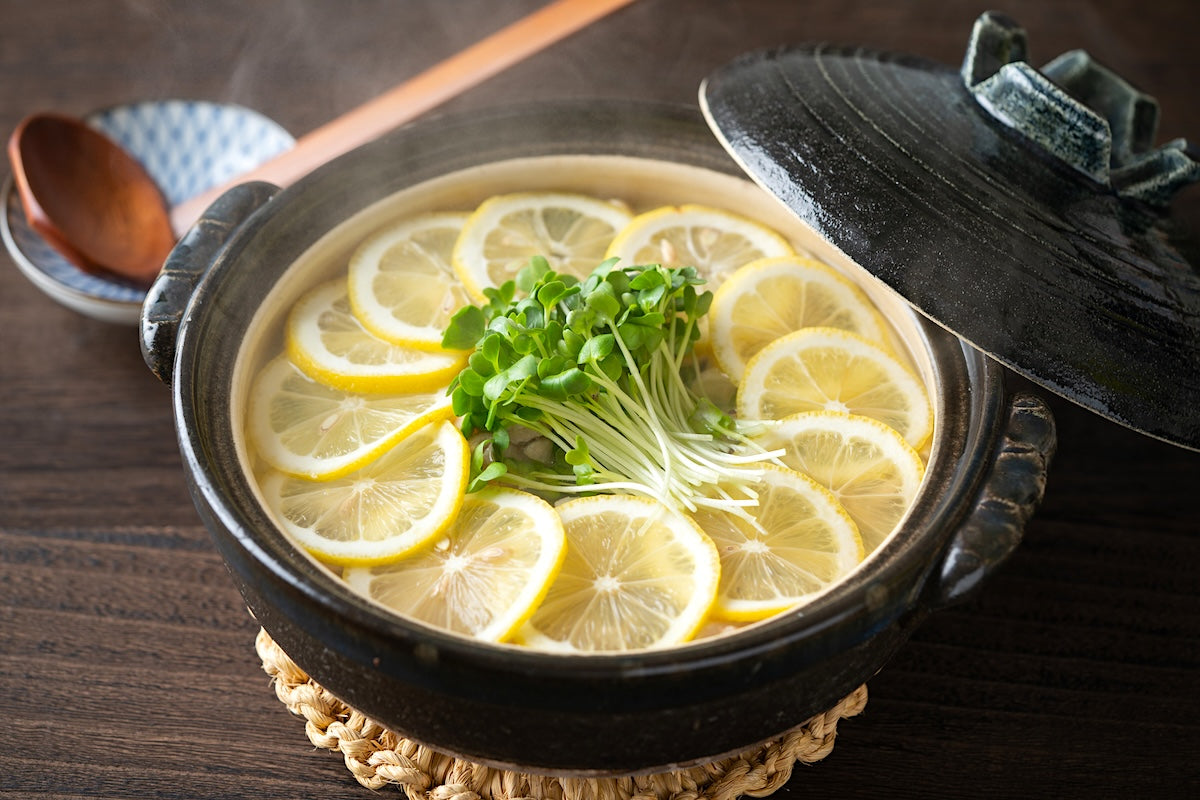
Most people encounter the donabe the same way: it's winter in Japan, there's a nabe hot pot bubbling on the table, everyone digs in and the pot keeps everything warm long after you turn off the heat.
That's a fine introduction to donabe and communal dining in Japan but treating this clay pot as something designed exclusively for winter is like keeping a cast-iron skillet only for steaks.
The donabe can also be used for cooking rice with a golden crust at the bottom, for steaming fish and vegetables and for slow-cooking broth until the ingredients seem to have given everything they had. In some households, it goes on the stovetop almost every day, regardless of season.
Pots Made Over 4 Million Years
The traditional donabe is made from aratsuchi - coarse, rough-textured clay - with the most prized coming from a single basin in Mie prefecture.
About 4 million years ago, the Iga basin sat at the bottom of the old Lake Biwa, a body of water smaller and positioned differently from the lake that bears that name today. Over millennia, the lake migrated northeast to its present location and the former lakebed rose to form the Iga plateau. The sediment left behind is dense with fossilized plant matter and microorganisms from those 4 million years of accumulation.
When clay from this area is fired at high temperatures, the organic material burns away, leaving behind a structure riddled with microscopic pores. The donabe is made from material that, in Japanese, is called kokyuu suru tsuchi - breathing earth.
The porous walls trap air, making the pot exceptionally effective at retaining heat - so effective that an Iga donabe stays hot for a long time after the flame is extinguished, continuing to cook the ingredients on residual warmth.
The porous clay also absorbs and releases moisture during cooking, regulating humidity inside the pot the way a wooden rice tub does: excess steam that would otherwise make rice sticky is drawn into the walls, then released back as needed.
And because the donabe stores heat rather than conducting it instantly, it emits strong far-infrared radiation, which penetrates ingredients from within rather than scorching the surface. The result is even cooking throughout: rice with distinct, fluffy grains; vegetables that develop sweetness; meat that stays tender.
Iga potters have been making direct-fire cookware since the Edo period (1603-1868), when the clay's properties were recognized as something the rest of the country couldn't replicate.
But the history of Iga ceramics goes back even further. Iga-yaki pottery production began in the Kamakura period (1185-1333) and peaked during the Momoyama era (1568-1603), when tea masters including warlord-aesthete Furuta Oribe oversaw the production of dramatic tea ceramics at Iga kilns - water jars and flower vases fired to warped, ash-glazed, deliberately imperfect results.
The pieces from this period, known collectively as ko-Iga (old Iga), are among the most significant objects in Japanese ceramic history, several of them designated Important Cultural Properties. The descendant of all that tradition is a round donabe, made from high-quality Iga aratsuchi clay, sitting on your stovetop.
The Home Cook's Case for Donabe Rice
Here's the argument for donabe rice in one line: it produces better rice than a rice cooker does, takes about the same amount of time and gifts you with a golden crust at the bottom.
The crust is called okoge and it's one of the defining pleasures of donabe cooking. It forms because the clay pot, unlike metal cookware, holds heat evenly at the base - and because the cook controls the finish. The method is straightforward once you understand what you're doing.
Soak the rice for at least 30 minutes in summer or 1 hour in winter; skipping this step will leave the center of the grains undercooked.
Use 200 ml of water per 1 go (150g) of rice. Bring to a boil over medium heat with the lid on, then reduce to low and cook for 10 to 15 minutes - resist the urge to open the lid.
As the rice nears the end of cooking, you will hear a faint crackling sound from inside the pot, which is the remaining moisture at the base beginning to evaporate. At that point, raise the heat to high for 10 to 20 seconds, then turn off the flame. Leave the lid closed and steam the rice for another 10 to 15 minutes. Then open the lid, fluff the rice up from the bottom with a rice paddle and serve.
The okoge, if you want it, forms during that brief blast of high heat. Keep it short: 10 seconds gives a light crust; 20 seconds makes it crunchier. The pot will tell you with sound and smell when it is done. What it will not do is let the rice sit sticky and wet, the way a rice cooker does when it has been left on warm for too long.
Steam, Seal and Let the Donabe Do the Work

Steaming is where the donabe's sealed environment and far-infrared heat work together most visibly. Place a ceramic slatted rack in the base, add water up to about 2 cm below the rack, bring the water to a full boil, then arrange the ingredients, cover with the lid and reduce the heat to medium-low.
The donabe brings out the natural sweetness of vegetables without waterlogging them; fish cooks gently in its own moisture rather than drying out.
Timing varies by ingredient. Leafy vegetables - cabbage, lettuce, napa cabbage - are done in about 2 to 3 minutes. Root vegetables such as carrot and sweet potato need 10 to 20 minutes, depending on thickness. Seafood, including cod and oysters, is ready in 5 to 10 minutes; the same range applies to pork and chicken.
One reliable spring recipe: arrange new onion wedges and carrot slices at the base of the donabe - you can also add a piece of kombu. Then lay cod fillets and leafy greens on top, pour in 3 tablespoons of sake and 1 tablespoon of water, scatter cherry tomatoes over everything and steam for 6 to 8 minutes over medium-low heat after the pot reaches a boil. The vegetables below absorb the fish juices as they fall; the cherry tomatoes soften and tint the liquid with acidity.
Season lightly with salt at the end. Remove the kombu if using it in the base, then pour the accumulated liquid over everything before serving - that broth contains most of the flavor.
One rule that applies to all donabe steaming: do not open the lid during cooking. The residual heat and sealed steam inside the pot are doing the work; every time the lid comes off, both escape.
Donabe Ideas for Every Season
The assumption that nabe season ends in March and the donabe goes back into storage until November is worth questioning. The pot's heat retention and even heat distribution are properties that serve every season.
Spring calls for bamboo shoot and chicken takikomi gohan - rice cooked with ingredients and seasoning, every grain infused with dashi and soy sauce and mirin as it steams. Summer brings corn and butter rice, or sake-steamed chicken over edamame rice.

In autumn, there is stuffed cabbage simmered in a light broth and rice cooked with chestnuts. In winter, the traditional nabe returns - but now it is one option among many rather than the only act.
Care and Maintenance of the Donabe
The donabe works its magic because of the tiny pores in its walls but before the pot's first use, those pores need to be filled with starch. Skip this step and the pores will remain open to detergent, strong flavors and moisture that causes cracking.
The process is simple. Wash the donabe with plain water - no dish soap - and allow it to dry completely, ideally with the base facing up.
Once fully dry, fill it to about 70 to 80 per cent of its capacity with water, then add either a bowl of leftover cooked rice or 1 to 2 tablespoons of flour or potato starch dissolved into the water. Simmer over low heat, without the lid, until the mixture thickens to a light porridge consistency.
Allow it to cool completely in the pot, then empty, rinse the pot with plain water and dry it thoroughly. The donabe is now ready for use.
For an Iga donabe, which has coarser pores, rice porridge is preferable to starch water; the pores are large enough that a thinner solution may not fill them adequately.
Day-to-day care follows three rules. First, always wipe the exterior dry before placing the pot on heat; a wet base put onto a flame is the primary cause of cracking because moisture in the clay expands rapidly as it heats.
Second, avoid sudden temperature changes in either direction - no cold water poured on a hot pot, no frozen-storage donabe placed directly onto a high flame.
Third, dry the pot completely before putting it away: a donabe stored damp will develop mold inside its pores.
Over time, the glaze develops a network of fine hairline cracks - called kani-nyu, or crab-entry lines - from the natural expansion and contraction of the clay. This is not damage. It is what a used, well-loved donabe looks like and is considered part of the pot's character. If the pot begins to leak, a fresh round of medome is usually enough to seal the lines.
What the Donabe Provides
Perhaps the real appeal of the donabe isn't that it's traditional. Nor is it the fact that it comes from clay formed under an ancient lakebed over millions of years though that is, admittedly, excellent material for dinner party conversation. The appeal is that the thing simply works.
The donabe survives not because it is old but because newer inventions have never entirely managed to replace what it does. Electric steamers can be programmed to start at a certain time. Microwaves can reheat. Rice cookers can keep rice warm for hours. But an earthenware pot made from breathing clay in Iga still produces food with a depth, texture and warmth that modern appliances try - and usually fail - to imitate.