- Kaomise Kabuki: Gion’s Winter Festival of Faces
- Shimai Kobo at Toji: Epic Year-End Temple Market
- Shimai Tenjin at Kitano Tenmangu: Shopping for the New Year
- Okera Mairi at Yasaka Shrine: Carrying Fire into the New Year
- Joya no Kane: New Year’s Eve Bell Ringing
- Composing Your Own Year-End Ritual in Kyoto
Early December in Kyoto is edged with autumn. A few scarlet leaves still cling to wintry branches but the fall foliage crowds are gone, making it a good time to tour the city.
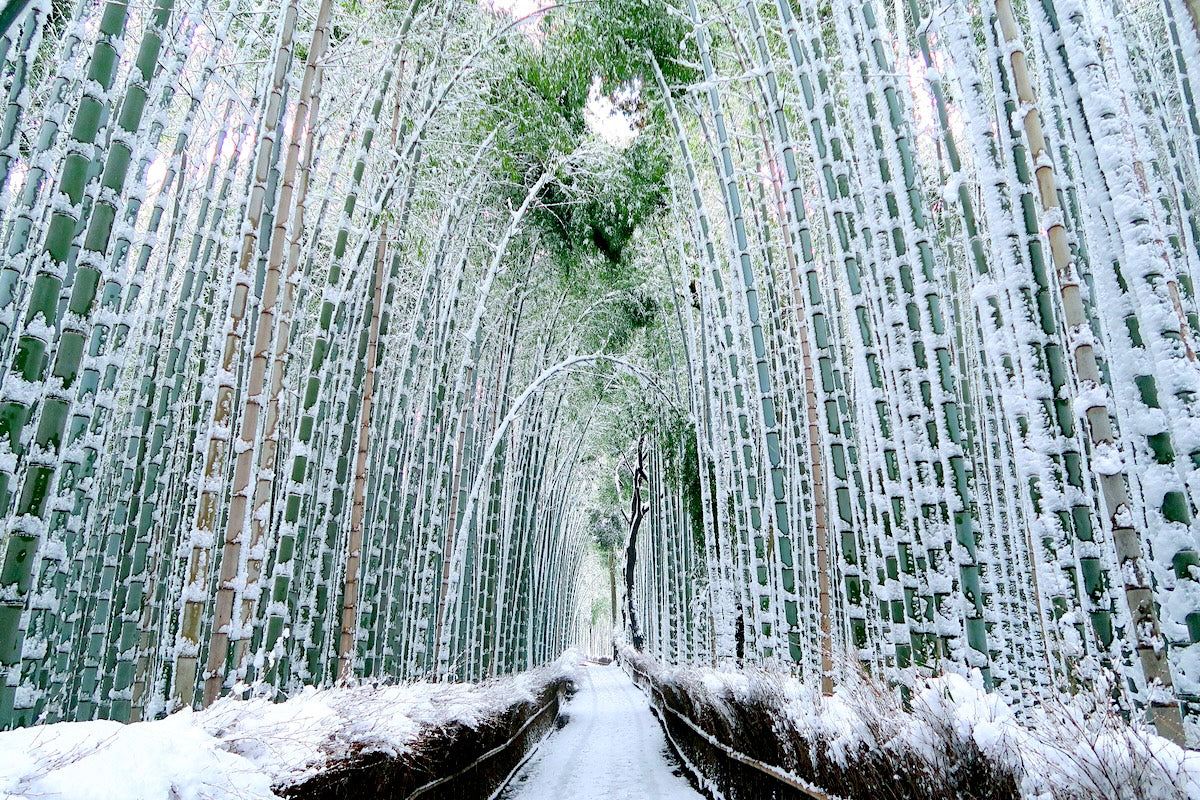
If you're lucky enough to wake up to snow flurries during your trip, grab your camera and head straight for scenic spots such as the Arashiyama bamboo forest or the stone and moss gardens of Daitokuji.
Even without filtering through snow, the winter light has a softness unique to this time of year.
Against this backdrop, traditional customs and celebrations shape the way that Kyoto moves from one year to the next. From the kabuki New Year at Minamiza Theater to the flea markets at Toji and Kitano Tenmangu, from the fiery Shinto ritual of okera mairi to the bell ringing of joya no kane, year-end events in Kyoto offer a front-row seat to more than a thousand years of Japanese culture.
Here's a selection of December highlights, in the order that they unfold in Kyoto.
Kaomise Kabuki: Gion’s Winter Festival of Faces

When: 1-25 December 2025, excluding 9 and 17 December. Two sessions a day; 10:30-15:40 and 16:20-20:25, with 3 intermissions per session ranging from 15-35 minutes.
Where: Minamiza Theater
The kabuki world has its own New Year: the kaomise, or face-showing, performances. In Kyoto, these are held at Minamiza, the grand kabuki theater on the edge of the Gion geisha district.
Kabuki contracts traditionally ended in the 10th month of the old calendar, with the 11th month - roughly corresponding to December - functioning as a New Year for the theater world.
The kaomise was where the new line-up of actors was presented to the public - an act that said, this is the troupe for the coming year.
Kyoto is one of the few places that preserves this tradition. At the Minamiza, long cypress boards called maneki are lined up over the entrance, each one painted with the name of a performer in bold kanteiryu script. The characters are crowded together, reducing the usual gaps - a visual wish that the theater seats will also be filled without empty spaces.
Look closely and you may see that the top of each maneki board is shaped like the character 入 ('to enter'), another charm for brisk ticket sales.
High above are sacred white staffs known as bonten, vessels to invite the gods in to watch over the performances. The bonten are renewed each year for kaomise.
You don't have to be a kabuki expert to enjoy the performances. Even watching one or two acts - the sweep of costumes, the painted faces held in stylized poses, the calls from the audience - connects you to a performing art born on the banks of the nearby Kamo river more than four centuries ago.
Shimai Kobo at Toji: Epic Year-End Temple Market

When: 21 December, 7:00-16:00; memorial service: 10:00
Where: Toji
On the 21st of every month, the grounds of Toji transform into the largest of Kyoto’s famous flea markets. More than 1,000 stalls line the paths around the pagoda, selling everything from antique ceramics to house plants, kimono and old tools.
But the market, known affectionately as Kobo-san, that's held on December 21 is different: Shimai Kobo – the final Kobo-san of the year – has the mood of an end-of-the-year festival.
Toji itself dates back to the 8th century. In the 9th century, it was entrusted to Kobo Daishi, the monk who brought esoteric Buddhist teachings from China and helped shape Japanese culture in ways still felt today.
At Shimai Kobo, the usual treasure hunt for antiques is joined by preparation for the holidays. Locals come to pick up ingredients essential to Japanese New Year cuisine as well as decorations such straw shimenawa ropes and zodiac ornaments for the coming year.
The market has its origin in stalls set up for the worshippers who gathered for the memorial service held on the 21st of every month in honor of Kobo Daishi. On the day of the service, visitors can enter the Miedo, a 14th-century building designated as a National Treasure.
Shimai Tenjin at Kitano Tenmangu: Shopping for the New Year
When: 25 December, 6:00-16:00
Where: Kitano Tenmangu
Four days later, on December 25, Kyoto’s market energy shifts from south to north.
At Kitano Tenmangu, a grand Shinto shrine dedicated to Sugawara no Michizane - scholar, poet and later deified patron of learning - the 25th of every month is Tenjin-san, a lively fair with hundreds of stalls.
In the early morning, vendors spread out antiques, second-hand kimono, calligraphy tools, toys and bric-a-brac. If you enjoy rummaging, this is one of the best events in Kyoto to hunt for vintage lacquerware, ceramics and clothes.
The final fair of the year is called Shimai Tenjin and, like Shimai Kobo, it has a distinctly end-of-the-year flavor. Because Shimai Tenjin falls so close to New Year’s Day, the market also doubles up as a place to gather ingredients and decorations for the holiday.
Even if you have no plans to whip up a Japanese New Year feast, look out for the stalls selling hoshigaki - the dried persimmons make a great snack on their own or stuffed with cream cheese. If you're hungry for more, follow your nose to the food stalls sizzling with takoyaki, yakisoba and other festival favorites.
Stay after sunset if you can. When dusk falls, the stone and hanging lanterns are lit to illuminate the grounds. As other places in the world twinkle with Christmas and New Year decorations, this Shinto shrine, too, lights up.
Okera Mairi at Yasaka Shrine: Carrying Fire into the New Year

When: 31 December, 19:00
Where: Yasaka Shrine
By December 31, Kyoto, like the rest of Japan, has shifted into full holiday mode. Offices close, houses have been cleaned, families gather for year-crossing - toshikoshi - noodles and prepare for hatsumode, the first shrine visit of the year.
At Yasaka Shrine in Gion, the night of New Year’s Eve is marked by a fire ritual called okera mairi. In the shrine courtyard, a sacred flame - kindled using traditional fire-drilling methods - burns steadily, fed by the wood and dried roots of the okera plant, long believed to ward off evil.
Worshippers buy ropes called kicho nawa - auspicious rope - and light them from the okera fire. To keep the ember alive, they swing the rope in slow circles as they walk away from the shrine, the tiny orange point tracing glowing arcs against the dark.
Those carrying the burning ropes walk home - taking the bus or train is, naturally, out of the question.
Traditionally, the sacred fire would be used to light a candle or lamp at the kamidana, the Shinto altar at home; and to start the fire to cook ozoni, the New Year mochi soup.
When the rope burns out, the remnant is hung in the kitchen as a charm against fire.
If you attend, dress warmly - nighttime temperatures in late December can plummet - and watch your surroundings. The sight of embers spinning through the crowds is unforgettable but it’s also a reminder that fire should be treated with respect.
Joya no Kane: New Year’s Eve Bell Ringing
When: 31 December; late night, culminating around midnight
Where: Temples across Kyoto
If okera mairi belongs to Kyoto’s Shinto side, joya no kane is its Buddhist counterpart.
Across Japan, temple bells are rung late at night every year on December 31, traditionally 108 times, a number said to correspond to the earthly desires that cloud the human heart.
Each slow, resonant strike is meant to shake loose a little of the past year’s burden so that people can step forward lighter, with cleaner intentions and better fortune in the new year.
In Kyoto, the most famous joya no kane is at Chion-in, a temple in the Higashiyama area. Here, 17 monks work together to ring one of Japan’s largest bells, a 70-ton giant that requires a massive wooden beam to set in motion.
Advance reservations are required and the public can only observe - not ring - the bell. Still, the sight of the monks shouting in unison and the thunder of the bell make this ritual one of the defining Kyoto events of New Year’s Eve.
If you would like to actually take part, temples such as Kodai-ji, Shinnyo-do and Seigan-ji allow visitors to ring the bell once per person or per group.
Composing Your Own Year-End Ritual in Kyoto
December may be a single page on the calendar but, in Kyoto, it is also a sequence of movements: market sellers handing over ingredients for New Year meals, a fiery rope twirled from shrine to home, monks pulling a bell rope one more time to cut through the dark.
If you let the traditions of the old capital guide you, you may find that December in Kyoto becomes less of a segment in your Japan travel tale and more like a chapter in a longer, personal story, a chapter in which you look back and look forward, with an ancient city offering you the space to reflect, recharge and recenter.
By Janice Tay