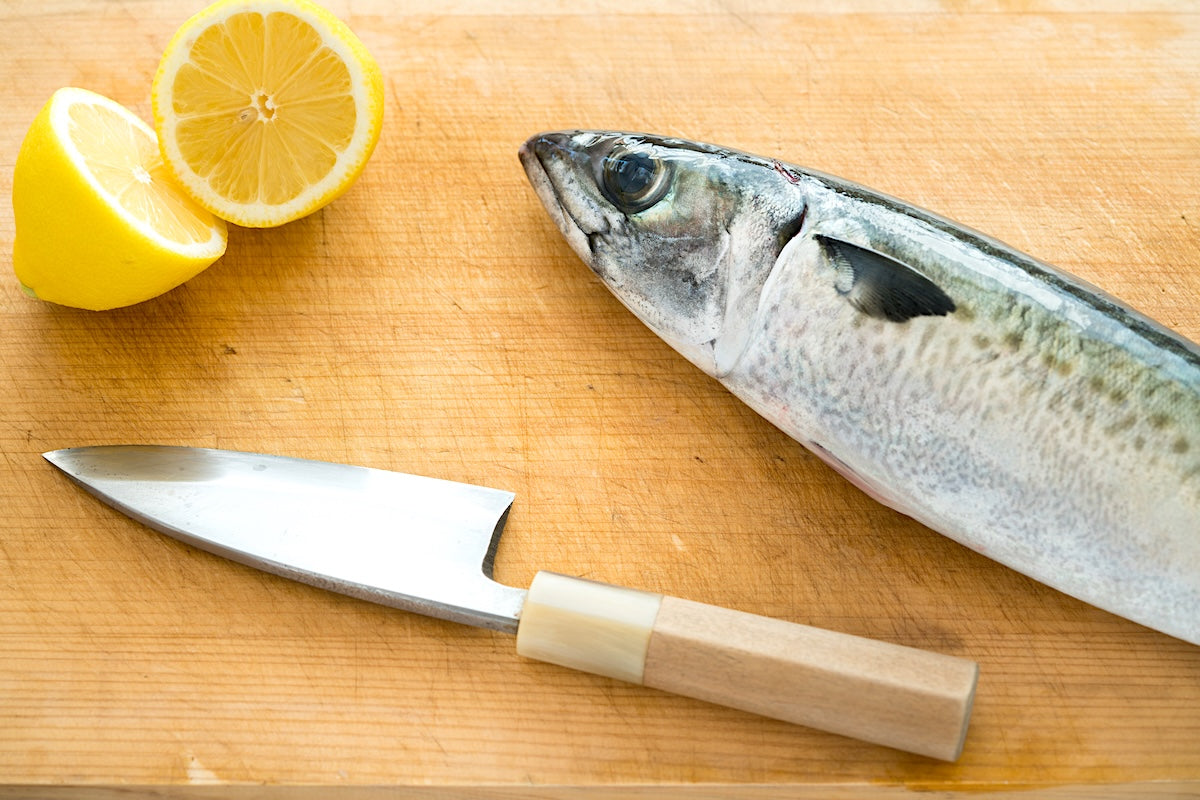
Most kitchen knives are designed to do several things adequately. The Japanese deba knife was designed to do one thing well: to break a whole fish down from head to tail, bones and all, with as little wasted flesh as possible.
Unlike all-purpose blades such as the santoku and gyuto - each built to handle vegetables, meat and fish with reasonable competence - the deba is a specialist. It does not slice meat. It does not chop vegetables. While it's a fish knife, it doesn't do sashimi.
Chefs in Japan's fish-forward kitchens keep a yanagiba for the sashimi but reach for the deba before it, when the fish still has a head and backbone.
According to the most popular origin story, the name goes back to the Edo period, to a blacksmith in Sakai, Osaka, whose reputation traveled without taking his name with it. What was recorded instead, in an 18th-century text, was his overbite: the knife he created was called deba-bocho, or 'buck-toothed knife', named for his prominent front teeth (出っ歯). In time, the character for 'tooth' was replaced with the character for 'blade' and the name, deba-bocho (出刃包丁), or more simply, deba, became what it is today.
Built for Bone: The Geometry of the Deba
Pick up a deba and the first thing you'll probably notice is the weight. The spine - the thick, unsharpened back of the blade - runs heavy from the heel, tapering to the tip.
When a knife needs to cut through fish heads and drive through vertebrae without deflecting or chipping, the spine of the knife has to absorb the force. A thinner blade would flex, skip or simply break. The deba's heft does the work that muscle would otherwise have to.
The cutting side of the blade is ground on one face only. This single-bevel profile is what separates it from the double-bevel construction of many Western knives, where both faces are angled symmetrically toward the edge in a V.
The back face of the deba is nearly flat, with a shallow concave hollow that reduces the surface contact between blade and flesh, so the cut material releases cleanly instead of clinging to the knife.
It also acts as a guide when filleting: pressed lightly against the backbone, the flat back face follows the contour of the bone almost automatically, pulling the flesh away in long, clean strokes.
The blade geometry is not uniform from one end to the other. The angle near the heel - the thick, handle-adjacent base - is more obtuse, built for bone. The angle toward the tip is more acute, suited to delicate flesh.
Push the knife through the muscle at the tip and you are using a finely ground edge; drive it down through the spine near the heel and you are using something closer to a wedge. It is, in effect, two tools in one.
Forge-welded construction - a hagane edge bonded to a softer jigane backing - gives the blade both toughness and a cutting surface hard enough to stay sharp through sustained use. Even when put under pressure, a well-made deba holds its geometry.
Using a Deba: Breaking Down A Whole Fish
Processing a fish with a deba follows a consistent sequence and, once you understand the logic, the steps become intuitive.
Start by removing scales - using a scaler or scrapping the back of the blade from tail to head - then move to the head. Insert the knife just behind the pectoral fin and cut diagonally toward the backbone.
When the blade meets bone, use the weight of the deba rather than force from the wrist. The head should come away cleanly.

Slice the belly open from the anus toward the collar opening, keeping the cut shallow enough not to puncture the organs.
Remove the entrails, rinse the bloodline along the backbone and wipe the cavity completely dry with kitchen paper. Any remaining moisture will lead to odor and affect the flavor of the flesh.
The filleting - sanmai-oroshi, or 'three-piece breaking down' - proceeds in an order that keeps the fish stable and the flesh intact. Start by making a shallow cut along the backbone from tail to head along the back, then along the belly. The blade travels at a shallow angle, tip leading, running just above the backbone.
When it makes bone contact, level the knife horizontally and let it slide along the bones - not cutting through them but gliding over them, peeling the fillet upward with each pass. The flat back face of the blade, held against the spine, does the guiding.
Repeat on the other side. The result is two fillets and the central bone - the sanmai, or the three pieces.
The heel of the blade handles the hard work: fish heads, vertebrae, any place where bone resistance is high. The tip handles the delicate work: separating flesh from fine rib bones, trimming the belly, running along small bones without tearing the flesh.
Beginners may find that practicing with Japanese horse mackerel - aji - helps them pick up the technique because the fish is small and firm.
After filleting, the yanagiba takes over. The deba's job is done. It has converted a whole fish into fillets ready for the sashimi knife, and everything it has done was made possible by a blade geometry that a double bevel cannot replicate.
How to Choose the Right Blade Length
The choice of deba is determined by the fish, not the cook. Match the knife to the size of the fish you are breaking down and the blade will span the body in a single stroke; go too short and you will need multiple passes that risk tearing the flesh; go too long and you lose control over smaller fish entirely.

As a general guide: a small deba - around 10.5-12 cm - is good for sardines, small horse mackerel or fish of a similar size. A 15 cm version - the deba most recommended for home cooks - covers the common range, accommodating fish such as mackerel and sea bream comfortably.
For larger fish such as amberjack or sea bass over 60 cm, a 16.5-18 cm deba would give you the reach and weight you need.
Beyond 21 cm, you're in professional territory and the realm of blades used by chefs to break down large yellowtail and bluefin tuna, which typically measure 1.5-3 m in length.
For most home cooks starting out, a 15 cm deba is the sensible answer. It's the most versatile size and handles the fish that appear most commonly on the cutting board.
Carbon Steel: Edge Retention Comes at a Price
The traditional deba is made from hagane - high-carbon steel - for the same reason it was used for samurai swords: it takes an edge that stainless steel cannot match, holds that edge through sustained cutting and sharpens cleanly on a whetstone.
The two most common carbon steels used in high-quality Japanese knives are shirogami, also known as white steel, and aogami, or blue steel. White steel is a purer carbon steel, known for its extreme sharpness. Blue steel adds tungsten and chromium to the mix, which improves edge retention and toughness at a slight cost to ease of sharpening.
But both are vulnerable to moisture. Carbon steel knives will rust. This is not a warning; it's a description of the material's nature. Steel is processed iron and iron wants to return to iron oxide. Rust is primarily iron oxide - leave a carbon steel deba wet for even a few minutes and the surface will begin to oxidize. Leave it wet on a cutting board with fish blood and salt - both of which accelerate corrosion - and the damage compounds.
Stainless steel debas are available and have improved considerably in quality, with high-grade alloys now producing edge retention and sharpness that professional chefs find adequate.
But the traditional deba, the one used in serious fish butchery for centuries, is carbon steel.
Essential Knife Care
The care instructions for a carbon steel deba are not complicated; they just require you to follow them without delay.
Wash the knife immediately after use - not at the end of the meal, not after the dishes are done. Use mild detergent and a soft sponge; abrasive pads scratch the surface and create microscopic pits where rust begins.
Pour hot water over the blade after washing to help evaporate the moisture quickly. Then dry the blade completely with a clean cloth. Not mostly dry. Completely dry.
Air it somewhere well-ventilated before putting it away because even a carefully wiped blade has residual surface moisture that needs to escape.
For storage between uses, stand the knife vertically in a dry location. Do not lay it flat - moisture trapped beneath the blade will find the edge.
If the knife will sit unused for more than a few days, apply a thin coat of knife oil or camellia oil to the blade. Camellia oil is food-safe, non-oxidizing and the traditional choice. Don't use salad oil - it'll turn sticky and become a problem rather than a solution.
For longer storage, wrap the oiled blade in newspaper. The paper absorbs residual humidity and provides mild additional protection.
A wooden saya - the blade cover traditionally made from Japanese magnolia - protects the edge during transport. For long-term storage, however, a saya is not ideal: wood holds moisture, and moisture in an enclosed sheath will rust a carbon steel deba. Unwrap and store it separately.

Sharpen your deba about once a month with a whetstone to maintain the sharpness but do not over-sharpen the back, which will affect its food release capacity.
If rust does appear, use a rust eraser or scrub with cleanser applied to a cork stopper. For stubborn rust, try sandpaper (around #1000 grit).
But there's no shame in seeking professional help if sharpening is difficult or the rust is severe. Do whatever it takes to keep your deba sharp.
A Knife Designed for One Thing
The deba does not pretend to be versatile. It does not flirt with the idea of slicing tomatoes or dicing onions just to make itself more likable. It shows up, looks at your whole fish - and gets to work.
But if you neglect it, the knife will rust with the same thoroughness that it slices - a reminder that precision cuts both ways.
Either way, the message is clear: this is not a knife that meets you halfway. It expects you to come to it.
And once you do, you may find that breaking down a whole fish - once a messy negotiation - becomes closer to a conversation.