- Fire, Flame and the Cooking Pot That Became Art
- The Goddess Mystery of the Jomon Period
- Guardians of the Mound: Haniwa and the Kofun Period
- The Smile That Crossed the Sea: The Introduction of Buddhism
- The Nara Period: A Golden Age of Buddhist Art
- Where to See It All
- The Art from Archaeological Evidence
Many accounts of Japanese art focus on the refinement - the spare ink painting, the tea bowl chosen for the quality of its imperfection, the garden raked into philosophical silence. But all these appear only somewhere in the middle of the story.
The real beginning is older, messier and more dramatic. It starts with a cooking pot in the Jomon period.
Spanning more than 10,000 years - from roughly 13,000 BCE to around 1,000 BCE - the era takes its name from the patterns found on its pottery. The term ‘Jomon’, meaning ‘cord pattern’ or ‘cord-marked,’ was coined by American zoologist and archaeologist Edward S. Morse, who excavated the Omori shell mound in 1877 and uncovered prehistoric pottery and tools there.
The pottery - thick-walled, dark brown to black, and fired at relatively low temperatures of around 600°C to 800°C - was made by stacking coils of clay by hand and smoothening them together, since the pottery wheel had yet to arrive on the Japanese archipelago.
The defining surface came from rolling twisted plant-fiber cords across the wet clay, creating a pattern of raised ridges. Other marks were made with fingernails, bamboo, shells and animal bones, producing a range of textures that varied by region and era. Western Japan tended toward plain or incised surfaces; eastern Japan went for complexity.
The initial purpose was practical. These were vessels for cooking acorns, meat and fish: a technology that fundamentally changed the Jomon people's diet and made settled - as opposed to nomadic - living viable. But later in the era, the purpose of the pottery changed.
Fire, Flame and the Cooking Pot That Became Art

The Middle Jomon period, roughly 5,000 years ago, is when ancient Japanese pottery stopped being merely something to hold other things.
The most extreme expression of this is the kaen-gata doki - flame-style pottery - produced along the Shinano River basin in what is now Niigata prefecture. Where most ceramics from this era were functional deep bowls with cord-marked surfaces, the vessels erupt upward from the rim in flame-like projections surrounded by serrated edges.
The most famous surviving example - excavated from the Sasayama site in Tokamachi city in 1982 - stands 46.5 cm high, measures 43.8 cm across at its widest point and weighs 7.4 kg. Designated a National Treasure in Japan, its nickname is Jomon Yukihomura: Jomon Snow Flame.
What it was used for has been settled by the evidence of scorching and boil-over residue on the exterior: it was a cooking pot. A cooking pot that someone invested extraordinary skill and attention in decorating, for reasons that remain unclear.
The Goddess Mystery of the Jomon Period
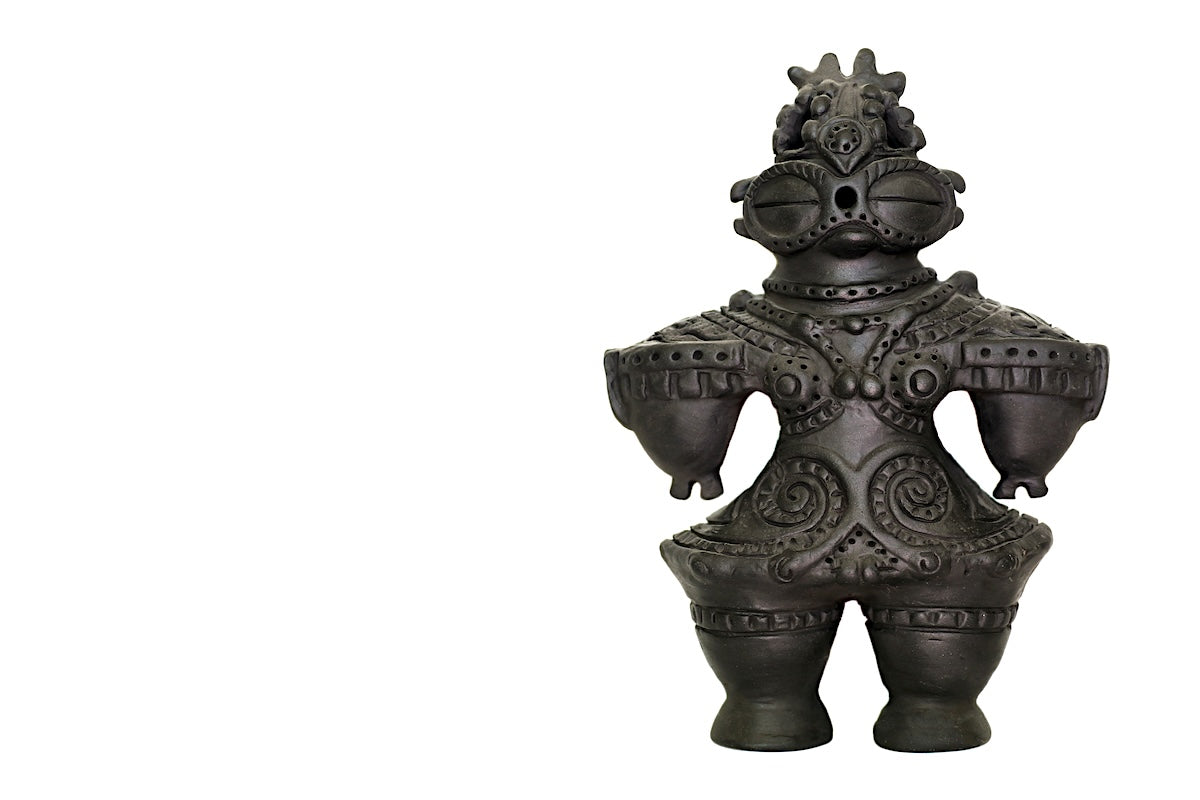
Alongside the pots, Jomon culture produced another object that has puzzled researchers for generations: dogu - clay figurines most commonly depicting female forms with emphasized breasts, hips and abdomens. The figures usually have no facial features.
More than 20,000 have been found across Japan, concentrated in the east of the country. Almost all were found deliberately broken - suggesting use in ritual, possibly in healing practices where the figure was meant to absorb illness or injury. Whole examples are exceptionally rare, which makes the ones that survived intact something close to miraculous.
The most celebrated is the Jomon no Megami - the Goddess of Jomon - which was excavated in 1992 from the Nishinomae site in Funagata town, Yamagata prefecture. At 45 cm, it is the largest dogu ever found. Composed of a smooth, abstracted face, wide shoulders breaking into a W-shaped chest and legs that widen at the base like a flared skirt, it was unearthed in five pieces, restored to near-completeness and designated a National Treasure in 2012. It is now held at the Yamagata Prefectural Museum.
What these figurines meant to the people who made and broke them is one of the most intriguing mysteries in Japanese archaeology. Theories abound but the most honest answer is: we don't know.
Guardians of the Mound: Haniwa and the Kofun Period
The Kofun period - named for the massive burial mounds built for rulers and clan leaders over some 350 years from the late 3rd century - produced a completely different kind of clay object. Where dogu were ritual, intimate and deliberately destroyed, haniwa were public, declarative and built to last.
The name combines hani - red clay - and wa, meaning to encircle. These unglazed clay figures were placed on and around the burial mounds, many of which were enormous. The Daisen Kofun in Osaka, thought to be the resting place of the 16th emperor of Japan, stretches 486 m in length; at its peak it was ringed by an estimated 30,000 or more haniwa.
The earliest forms were simple cylinders - hollow, bottomless tubes with circular cutouts in the sides, arranged in rows along the terraces of the mound. Their job was to define the boundary between the sacred burial space and the world outside.

Later, from around the 5th century, haniwa became representational: warriors in armor, shrine maidens, horses with decorated harnesses, dancers with their arms flung wide. These forms recreated the funeral ceremony and the world of the deceased for eternity, or at least until the 7th century, when production stopped.
Most surviving figurative haniwa are painted with red ochre - bengara - and have a hollow structure that kept them from cracking in the kiln. Their expressions are simplified to the point of abstraction, which makes them oddly affecting - the wide-set eyes, the slightly open mouths, the arms that appear to be in the middle of something important that was never finished.
Found in 1930 in Saitama prefecture, the 'Dancing People' - two figures, arms raised and mouths open - are probably the most well-known example. Are they figures of celebration? Visit the Tokyo National Museum and decide for yourself.
The Smile That Crossed the Sea: The Introduction of Buddhism
In the 6th cenutry, King Seong of the Korean kingdom of Baekje presented the Yamato court with a gilt bronze statue of Shakyamuni Buddha, along with sutras and ritual implements.
This introduction of Buddhism to Japan set off a transformation in Japanese art that would last centuries. Craftsmen including sculptors who specialized in Buddhist imagery arrived from Baekje and they brought with them a visual language shaped by Chinese aesthetics as filtered through Korean interpretation.

The result was a style characterized by elongated faces, almond-shaped eyes, clothing that fell in neat folds and a particular expression: calm, slightly smiling - and enigmatic. That smile, sometimes compared to the Mona Lisa's, is the trademark.
The leading sculptor of the early Asuka period was Kuratsukuri no Tori, also known as Tori Busshi, a craftsman of immigrant origin whose most important surviving work is the Shaka Triad at Horyu-ji. Cast in bronze in 623, the three figures - Shakyamuni Buddha and two bodhisattvas - share the same composed stillness, the same drapery and the same unhurried expression.
The Nara Period: A Golden Age of Buddhist Art
When the capital moved to Nara in 710, the ideology of protecting the state through Buddhism was already established but Emperor Shomu took it even further. In 741, he issued a decree ordering the construction of temples and convents throughout the country. Then, with the resources of the entire nation, he commissioned the Vairocana Buddha - the Great Buddha of Nara - which was cast in bronze and consecrated in 752. It remains one of the largest bronze Buddhist statues in the world.
But the Nara period's most lasting contribution to Japanese art is not scale. It is technique.
Sculptors in the Tenpyo period (729-749), working in what is now considered the golden age of Japanese sculpture, mastered two methods that produced results unlike anything that came before. The first was clay modeling over a wooden armature, which allowed for precise naturalistic detail. The second was a process in which layers of hemp cloth soaked in lacquer were built up over a clay or wooden core, which was then hollowed out or removed once the lacquer hardened, leaving a shell that was both light and capable of taking extraordinary surface refinement.
The Asura statue at Kofukuji has three faces, six arms and expressions of such interior complexity that it continues to fascinate millions. The statue is also so light that it has been carried out of the temple to safety during fires and was evacuated by train to Yoshino in 1945 when air raids threatened Nara. It travels well for a 1,300-year-old.
The Fukukenjaku Kannon at Todaiji's Hokke-do - a standing figure with three eyes and eight arms - is another Tenpyo masterwork, housed in what may be the oldest surviving building from that era in Japan. Both the statue and hall are designated as National Treasures.
Then there is the Shosoin, the treasure repository of Todaiji. Founded in 756 when Empress Komyo donated more than 600 of Emperor Shomu's personal objects following his death, It holds about 9,000 objects from the 8th century: lacquerware, textiles, glass, documents and instruments. These include the only five-stringed lute of its type surviving anywhere in the world. Its rosewood body is inlaid with mother-of-pearl showing a musician playing on camel-back, justifying the description of the Shosoin as the last stop on the Silk Road.
Where to See It All
The art made between the Jomon period and the close of the Nara period covers more than 14,000 years. Here's a guide to where you can see some of it in person.
The Tokyo National Museum in Ueno probably holds the most comprehensive collection of Jomon dogu and other pottery.
To see more Jomon ceramics, head to Niigata and the Tokamachi City Museum, the permanent home of the National Treasure flame vessels from the Sasayama site. Just north of Niigata is Yamagata - the Prefectural Museum displays the 'Goddess of Jomon'. In the center of Japan, in the mountainous prefecture of Nagano, the Chino City Togariishi Museum of Jomon Archaeology holds two other National Treasure dogu: the 'Jomon Venus' and the 'Masked Goddess'.
For the Kofun period, the Tokyo National Museum holds the most important haniwa collections including the 'Dancing People' tomb sculptures. The Imashirozuka Burial Mound Park in Osaka offers something rarer: a restored arrangement of haniwa displayed around a keyhole burial mound.
For the Buddhist sculpture of the Asuka and Nara periods, there is only one city. The Kofukuji National Treasure Hall in Nara displays the Asura statue. Todaiji's Hokke-do houses the Fukukenjaku Kannon in its original 8th century hall.

The Nara National Museum holds the annual Shosoin Exhibition every autumn, when roughly 60 objects from the repository are shown to the public.
Outside Japan, institutions such as the Metropolitan Museum of Art and the British Museum hold significant examples of ancient Japanese ceramics and sculpture in their permanent collections.
The Art from Archaeological Evidence
In the end, ancient Japanese art begins the same way much of human civilization does: with somebody trying to cook dinner. A clay pot appears beside a fire in the Jomon period, its surface pressed with rope patterns by hands whose names are long forgotten. Thousands of years later on the same island, colossal Buddha statues are raised and Silk Road treasures preserved. Between those points lies one of the most fascinating artistic evolutions anywhere in the world.
What survives from ancient Japan isn't merely a collection of artifacts but a record of people trying to make meaning visible through clay, bronze, lacquer and ritual. Sometimes that meaning took the form of a serene Buddha. Sometimes it took the form of cookware as dramatic as a volcanic eruption.
Perhaps this is what speaks most clearly across the millennia: even 5,000 years ago, humans aspired towards cookware upgrades.